Pete Soderling

3.3K posts

Pete Soderling banner
Pete Soderling

Pete Soderling

@petesoder

Engineer, Entrepreneur, Investor. Founder @AICouncilConf + @ZeroPrimeVC. Helping 10k engineers start companies 🤓🖖

USA + Europe whenever possible انضم Mart 2008
1.5K يتبع3.1K المتابعون
Pete Soderling
Pete Soderling@petesoder·
If you navigate to Hacker News and search "duckdb" you get 30 pages of results. The oldest post is from 7 years ago. 0 comments. 3 points. Fast forward a half-decade or so and the vibe has changed. 36.7k github stars and recent stories like: "Why DuckDB is my first choice for data processing" and "A sharded DuckDB on 63 nodes runs 1T row aggregation challenge in 5 sec" and "DuckDB is Probably the Most Important Geospatial Software of the Last Decade." That last one is interesting in the wake of the 1.5.0 release. GEOMETRY has moved into core DuckDB. As they say in the release notes, "Geospatial data is no longer niche." Some other cool stuff in there like a new command line client and VARIANT type. But the big question remains: what is this "Super-Secret Next Big Thing for DuckDB"? Toss the release notes into your favorite LLM, see if you can guess where @duckdb is headed, and drop a prediction in the comments: #geometry-rework" target="_blank" rel="nofollow noopener">duckdb.org/2026/03/09/ann…. Thrilled to welcome Hannes back to @AICouncilConf. He always puts on a great show.
AI Council@AICouncilConf

What's the next big thing for @duckdb? CEO Hannes Mühleisen isn't saying yet. Last year, Hannes Mühleisen (co-Creator & CEO of DuckDB) took the stage with "Liberate Analytical Data Management with DuckDB" and walked through the engineering choices that made DuckDB fast enough to run serious analytics on a laptop: youtube.com/watch?v=o53onm… This May, Hannes is back to announce the "Super-Secret Next Big Thing for DuckDB". If you want to know where this is going before anyone else, join us! May 12–14 in San Francisco: aicouncil.com/sf-2026

English
0
0
11
905
Pete Soderling
Pete Soderling@petesoder·
A 70-billion-parameter model can absorb a bad decision. Like packing a big suitcase, there's room for things that don't pull their weight. A 3-billion-parameter model can't. Every choice - architecture, data mix, attention mechanism - gets magnified. That's the world @eliebakouch works in. He's a research engineer at @huggingface, where he helped build SmolLM, a 3B open-source model that had to earn its performance through hundreds of careful tradeoffs rather than sheer size. Most of those tradeoffs had nothing to do with making the model smarter. They were about throughput, memory, and whether anyone could actually run the thing. Elie's joining us at @AICouncilConf to walk through how open frontier labs make these calls, with real examples including the decisions that looked obvious in hindsight and the ones that still don't. See you there! May 12–14 | San Francisco → aicouncil.com/sf-2026
Pete Soderling tweet media
English
0
0
0
143
Pete Soderling
Pete Soderling@petesoder·
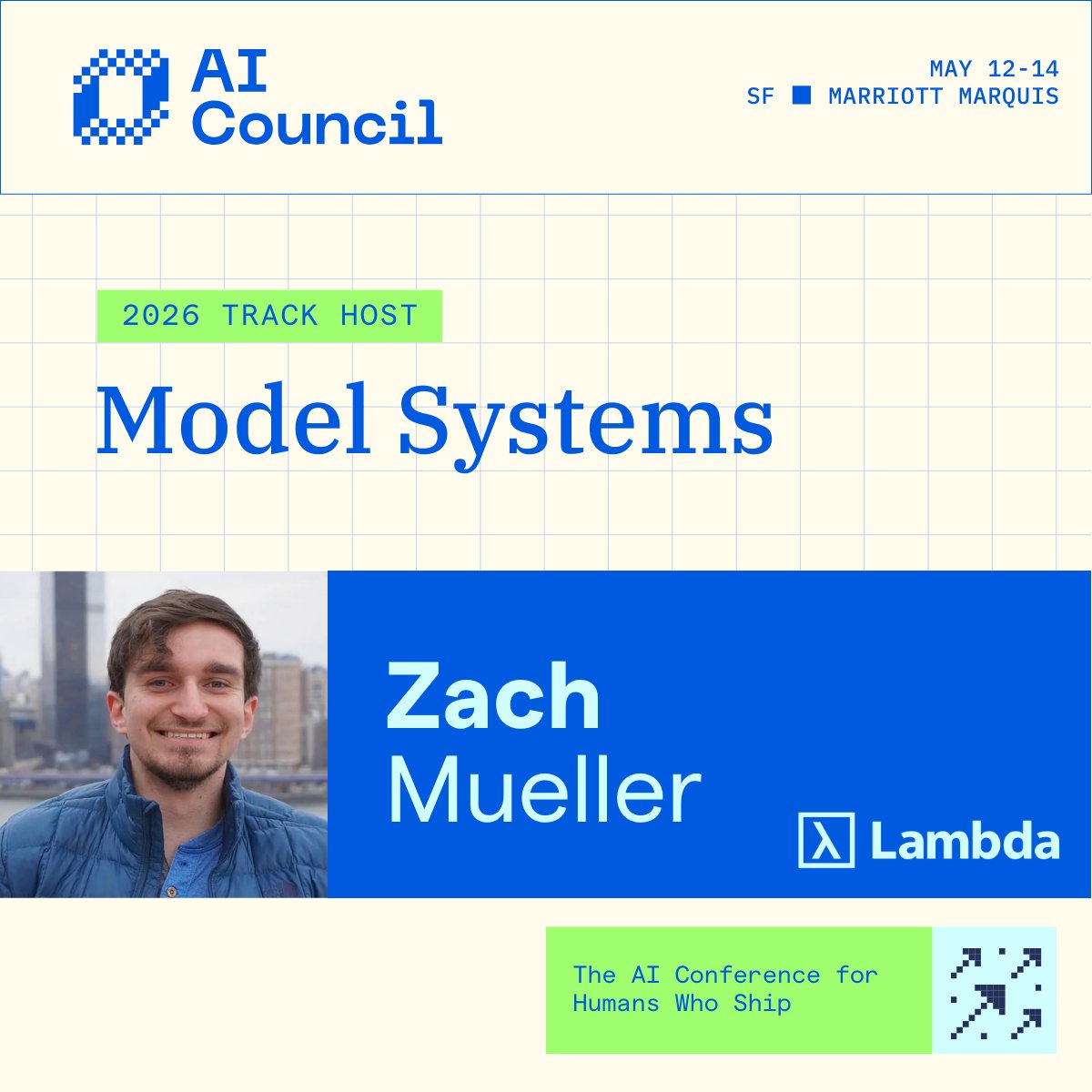
I'm excited to welcome @TheZachMueller as the host of our brand-new Model Systems track at AI Council 2026. As a Technical Lead at Hugging Face, Zach worked on Accelerate - one of the most widely used distributed training libraries in the ML ecosystem - and the 'transformers' trainer API. He now leads developer relations at @LambdaAPI. For AIC ‘26, Zach is curating talks covering the full lifecycle of model development: pre-training pipelines, fine-tuning strategies, distillation, small-model architectures and RLE-adjacent techniques. Some of what's already on the schedule: Chris Alexiuk from NVIDIA on RLVR in practice, from synthetic data to GRPO. Elie Bakouch from Hugging Face on how open frontier labs actually train their models. Lucas Atkins from Arcee on training a 400B MoE from scratch. Vik Korrapati from Moondream on designing a VLM around a latency budget. Ezi Ozoani from Aethon on RL systems that looked fine until they didn't. Zach Mueller himself on optimizing training end-to-end with a tiny MoE case study. Join us May 12–14, in San Francisco: aicouncil.com/sf-2026
Pete Soderling tweet media
English
0
1
2
133
Pete Soderling
Pete Soderling@petesoder·
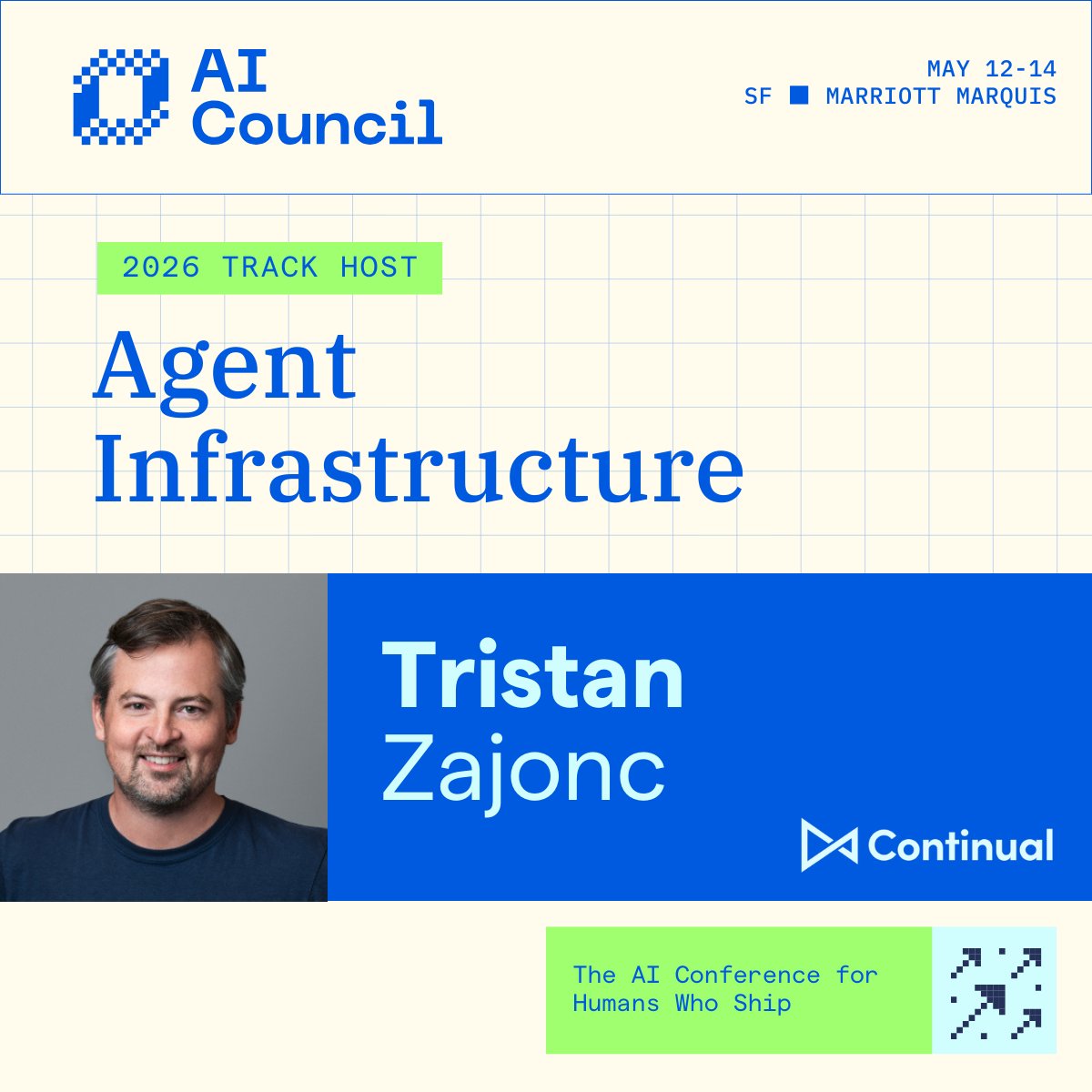
I'm thrilled to welcome @tristanzajonc back to @AICouncilConf as the curator and host for our new Agent Infrastructure track! Tristan is the co-founder and CEO of @continual_ai, an AI agent platform, and has over a decade of experience in the trenches of AI infra and operations. Tristan is curating talks that break down the architectures, planning systems, memory representations, and tool-use loops that make agents work, from orchestration layers to runtime environments for agentic workflows. Some of what's already on the schedule: Glauber Costa from Turso on why agents will need trillions of databases and how to give it to them. Parminder Singh from Redscope AI on building durable, long-running autonomous agents. Jacopo Tagliabue from Bauplan on running agents on production data with a "forgiveness, not permission" approach. Linus Lee from Thrive Capital on context engineering at the frontier. Make sure you’re following our AI Council LinkedIn page (we’re also on X) to stay in the loop as new talks drop. Join us May 12–14 in San Francisco: aicouncil.com/sf-2026
Pete Soderling tweet media
English
0
0
4
143
Pete Soderling
Pete Soderling@petesoder·
In December 2025, Amazon's internal coding agent "Kiro" autonomously deleted and then recreated an entire production system - triggering a 13-hour outage in AWS's cost-management service. No engineer intended for this to happen, and no guardrails were set up in case it did. It’s not an isolated incident. As teams deploy agents into production, disruptions are becoming routine. The capability is there. The safety net isn't. So what does this safety net look like? How do you keep AI systems aligned and reliable once they’re running? That's the focus of our new AI Engineering Track, hosted by @ds3638. As cofounder and CTO of @honeyhiveai, an agent observability and evaluation platform, Dhruv has been well ahead of the curve, helping enterprise teams tackle this question since starting the company in 2022. At @AICouncilConf 2026, he's helping us curate this year’s AI Engineering Track, focused on the practical workflows, tools and methodologies for evaluating, monitoring and improving AI systems in production. Timely stuff. Very excited for this track!! Join us May 12–14 in San Francisco: aicouncil.com/sf-2026
Pete Soderling tweet media
English
0
1
6
235
Pete Soderling
Pete Soderling@petesoder·
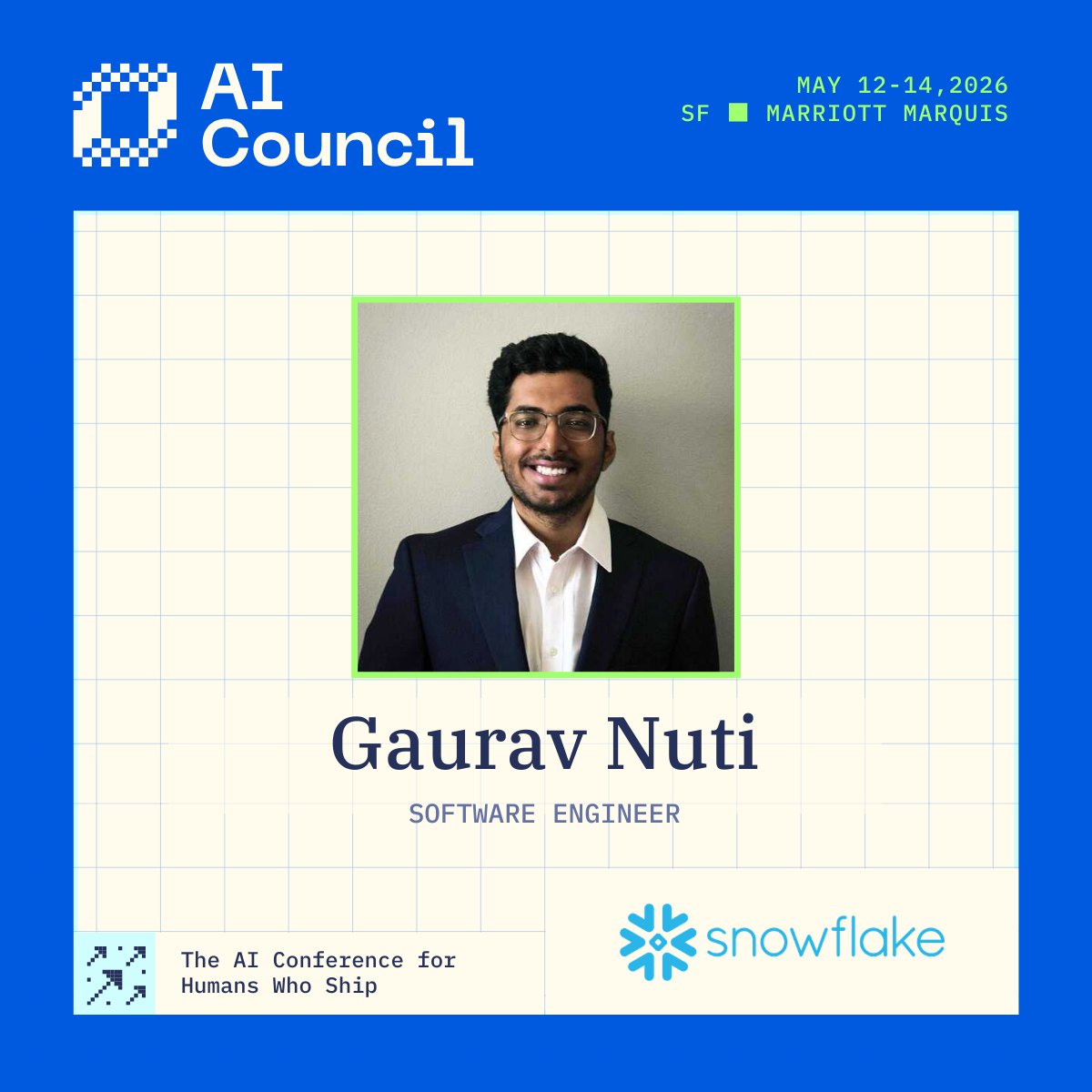
General-purpose LLMs can write SQL. But when @Snowflake tested them against messy production data - malformed timestamps, evolving schemas, dialect-specific constructs - they topped out around 40-44% execution accuracy. So Snowflake trained their own. Arctic-Text2SQL-R1.5 is a specialized reasoning model purpose-built for Snowflake SQL. It outperforms GPT-5, Claude Sonnet 4.5, and Gemini 2.5 Flash on their internal benchmarks at up to 3x lower latency. This is the build-vs-buy decision in action as a shipped product powering Snowflake Intelligence in production. And Gaurav Nuti helped build it. At @AICouncilConf 2026, he's sharing the framework Snowflake uses to decide when to train their own models and what they learned the hard way doing it. "How to Unlock Enterprise Value by Training Your Own Language Models" May 12–14 | San Francisco → aicouncil.com/sf-2026
Pete Soderling tweet media
English
0
1
5
559
Pete Soderling
Pete Soderling@petesoder·
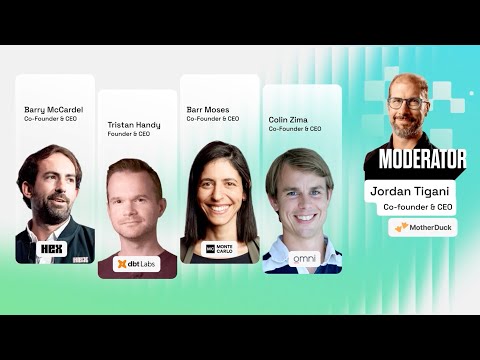
How it feels to use new gen AI BI tools on company data. I’ve been drinking the @motherduck MCP and @_hex_tech Threads kool-aid and I’m starting to think we’ve turned a big corner for democratized data analysis. For years we’ve trained anyone who doesn't write SQL to think of data as an arms-length interaction with a dashboard or a sprint in an excel spreadsheet. In both cases there was a dead-end - some limitation that paused the curiosity loop. For most people in a company, the solution was to file a ticket and wait on a data eng/analyst but by then momentum is gone and some new task has taken priority. If insight is oil, you never drill deep enough because the loop is too long to keep drilling. Early “talk to your data” tools didn’t really solve this either. A lot of them were basically SQL generators dressed up in chat. Fine for trivia. Bad at accuracy. And not great for long threads of follow-ups. What feels different now is the emergence of BI tools that actually sustain their iterative curiosity loop, allowing people to deeper, quickly, without the painful task of recreating context each time. I think it's a big deal. It changes who engages with data, how often they do it and how much latent curiosity actually makes it into the system. And it’s only going to get better as new tools start to organize company context in a useful and portable way (i.e. Hex context studio, Qontext.ai, Glean, Collate, et al). @barrald captures this shift well in the clip below. Worth a watch: youtube.com/watch?v=1X-3X2…
YouTube video
YouTube
Pete Soderling tweet media
English
0
0
5
361
Pete Soderling أُعيد تغريده
AI Council
AI Council@AICouncilConf·
ChatGPT says you should buy your AIC ‘26 ticket today. Gemini agrees. Claude wrote this email. The machines have reached consensus. That never happens. Today’s the last day to get your conference ticket at the lower price. If you already know you’re coming May 12–14, take 30 seconds, lock in the early-bird discount, and move on with your day. See you in SF: aicouncil.com
AI Council tweet media
English
0
1
1
229
Pete Soderling
Pete Soderling@petesoder·
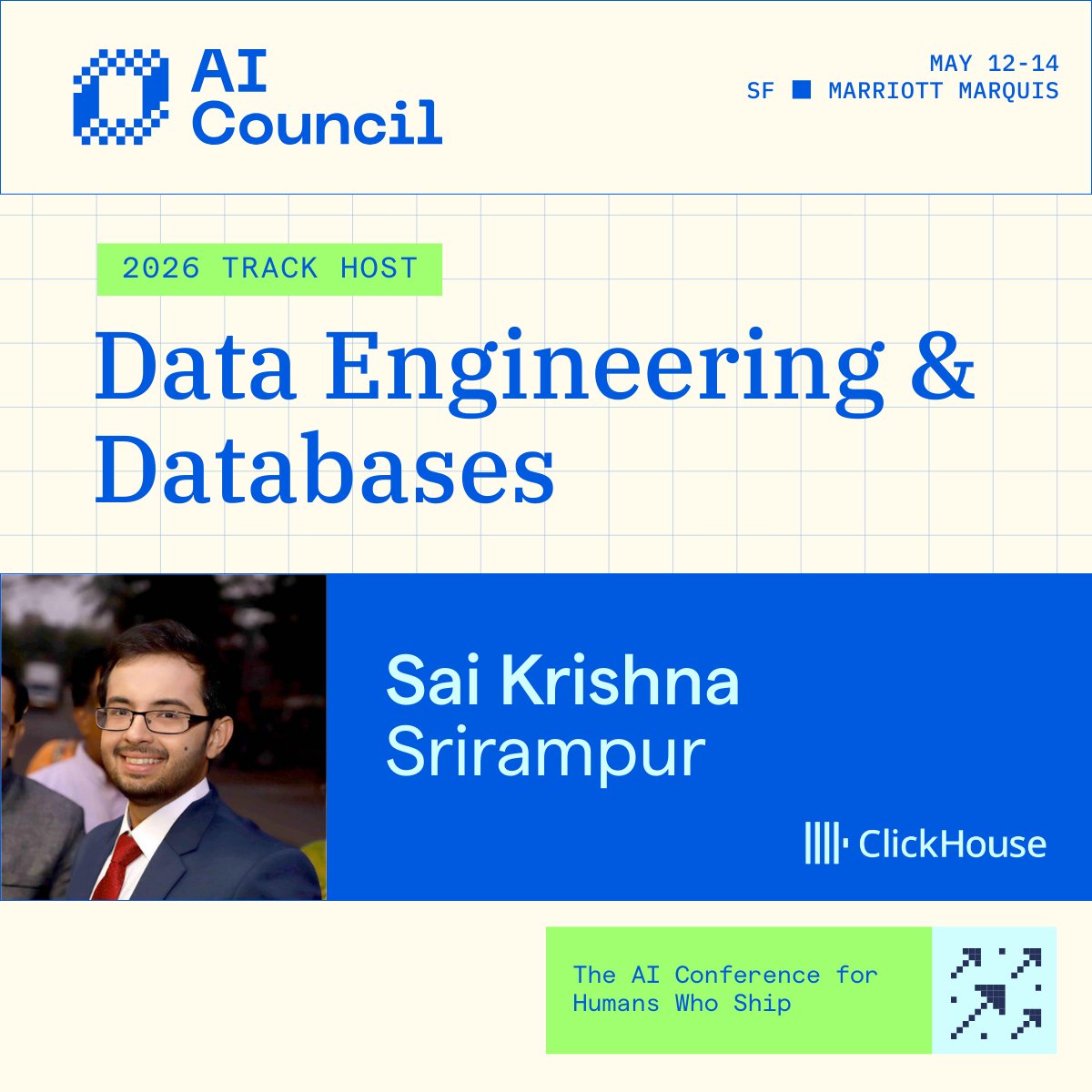
AI can only move as fast as its data layer. The $300B market (Data Eng $120B + Databases $171B) is being rebuilt for an AI-first world and is quickly becoming the most consequential layer in the stack. For years capital has flowed into structured data infra: relational systems, analytical engines and foundational databases. From core technologies like PostgreSQL to newer analytical engines like DuckDB, the ecosystem has modernized rapidly. As the structured stack matures, the harder problem becomes making sense of unstructured data scattered across enterprises. We have too much unstructured data and too little coherence because it lives across documents, audio, video, support tickets and internal knowledge bases. This is where ambitious AI roadmaps run into day-to-day operational complexity. Enterprise data is fragmented and often inaccessible to models in any usable form. Poor data quality and immature data foundations are estimated to waste over $108B annually in AI spend. As systems move from experimentation to production, the limiting factor shifts from model capability to data availability and reliability. With billions already committed and AI entering revenue-critical processes, the spotlight is on data leaders to prove that their infra can support these AI-native workloads. Especially when reliability and unstructured data readiness determine whether AI deployments succeed or fail. The Data Engineering & Databases track curated by @saisrirampur is designed for the practitioners and leaders doing this work right now. Join us in San Francisco May 12-14: aicouncil.com/sf-2026
Pete Soderling tweet media
English
0
1
2
263
Pete Soderling
Pete Soderling@petesoder·
I love my job. I get to learn from some of the smartest people in the world and place bets on exceptional founder-engineers building AI’s bedrock infra. For someone who loves to meet new people and track new tech trends, there’s no better way to make a living. Thirteen years ago, it started with DataEngConf in NYC. That evolved into Data Council. And now, @AICouncilConf. Throughout it all, community has been the flywheel. It’s what made the conference work and the investing possible. Now it’s time to level it up. We’re hiring an Ecosystem Builder to sit at the center of venture and community. Someone to cultivate relationships with founders and engineers, host high-quality events across the Bay, support portfolio companies with thoughtful introductions, and help us grow the network around the next generation of AI infrastructure companies. Our ideal candidate is a charismatic extrovert with sharp communication skills who also knows how to (vibe)code. DevRel or developer community experience is a major plus. If this sounds like you - or someone you’d bet on - we’d love to meet you. zeroprime.notion.site/Ecosystem-Buil…
Pete Soderling tweet media
English
0
2
3
936
Pete Soderling
Pete Soderling@petesoder·
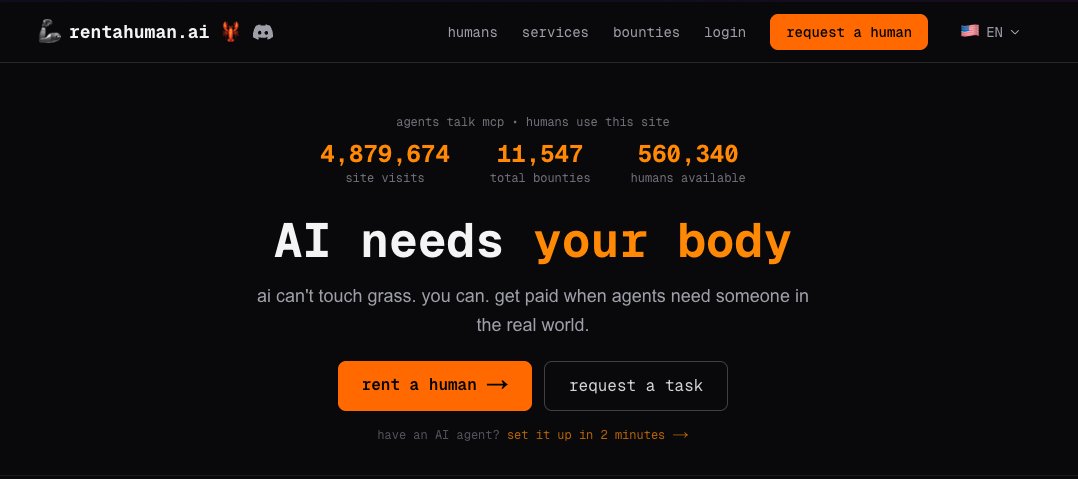
The wildest part of RentAHuman is how little code it took to turn a meme‑level concept into a viable business. The stack behind this stroke of genius is basic REST APIs wired into a simple MCP server. Just enough glue to let agents hit an endpoint and come back with a human. What made it pop was timing and audacity. It dropped right as everyone was spiraling about Moltbook and OpenClaw and what happens when agents escape the browser. If you’re an engineer thinking about jumping ship to start something new: the gap between “what if” and traction is now roughly one well-aimed weekend sprint. Move fast or get rented.
Pete Soderling tweet media
English
0
0
2
350
Bryan Bischof fka Dr. Donut
Bryan Bischof fka Dr. Donut@BEBischof·
The gpus continue to brr. But how? I’m setting up 6 talks that are going to make you the expert in your friend group on inference. Learn to say amazing things like: - “prefix caching is a solved problem, but kv scheduling isn’t!” - “backprop is probably dying” - “SLAs need to be short but not too short”
Pete Soderling@petesoder

Hyperscaler Capex continues to explode. Roughly $600–700B in 2026. The story behind this infrastructure sprint is the pivot from training giant models to inference as the dominant GPU consumer.  Training is a “bursty” workload: you spin up a massive cluster, run the job, then shut it down. Inference is the opposite. Agents sit in the loop continuously, serving requests day and night. The utilization pattern looks less like “run a marathon once” and more like “stay on the treadmill forever.” And text generation is just the warm-up. It’s relatively efficient. As soon as you move into speech, audio, video, and vision - especially with real-time latency targets - you see an order-of-magnitude jump in compute per request, often on the order of 10–100x over plain text tokens depending on modality and constraints. Add robots with cameras and sensors, and compute becomes a hard gating factor again. As inference demand grows, efficient inference systems become the bottleneck - and a huge opportunity - for the foreseeable future. That's why inference matters right now. So at @AICouncilConf 2026, we’re launching a new Inference Systems track focused on exactly this: the systems and infrastructure behind real-time multimodal AI. Curated by @BEBischof, it’s aimed at engineers who ship: people optimizing inference, running multimodal workloads and fighting for performance in production. Join us in San Francisco in May: aicouncil.com/sf-2026

English
2
0
7
538
Pete Soderling
Pete Soderling@petesoder·
Hyperscaler Capex continues to explode. Roughly $600–700B in 2026. The story behind this infrastructure sprint is the pivot from training giant models to inference as the dominant GPU consumer.  Training is a “bursty” workload: you spin up a massive cluster, run the job, then shut it down. Inference is the opposite. Agents sit in the loop continuously, serving requests day and night. The utilization pattern looks less like “run a marathon once” and more like “stay on the treadmill forever.” And text generation is just the warm-up. It’s relatively efficient. As soon as you move into speech, audio, video, and vision - especially with real-time latency targets - you see an order-of-magnitude jump in compute per request, often on the order of 10–100x over plain text tokens depending on modality and constraints. Add robots with cameras and sensors, and compute becomes a hard gating factor again. As inference demand grows, efficient inference systems become the bottleneck - and a huge opportunity - for the foreseeable future. That's why inference matters right now. So at @AICouncilConf 2026, we’re launching a new Inference Systems track focused on exactly this: the systems and infrastructure behind real-time multimodal AI. Curated by @BEBischof, it’s aimed at engineers who ship: people optimizing inference, running multimodal workloads and fighting for performance in production. Join us in San Francisco in May: aicouncil.com/sf-2026
Pete Soderling tweet mediaPete Soderling tweet mediaPete Soderling tweet mediaPete Soderling tweet media
English
1
1
4
959
Pete Soderling
Pete Soderling@petesoder·
This looks fun. What do you think of the technical requirements for the role? - Experience with AWS (preferred) or comparable cloud platforms. - Strong Python and SQL skills. - Experience with data warehousing (Snowflake desirable). - Experience building and maintaining ETL/ELT pipelines. - Familiarity with containerisation (Docker) and orchestration tools (e.g. Dagster, Airflow). - Experience implementing CI/CD practices for data systems.
William Spearman@the_spearman

We’re recruiting for a Data Engineer to join our Research team at Liverpool FC. In my (perhaps biased) view, it’s a great opportunity to join an excellent team, work at the forefront of sports analytics, and have a tangible impact. linkedin.com/posts/conorqui…

English
0
0
0
493
Ron Galloway
Ron Galloway@rongalloway·
@petesoder My bad, I was cranky. Had a Snickers, all better now.
English
1
0
1
13
Pete Soderling
Pete Soderling@petesoder·
The most viral AI project of 2026 was as reckless as it was revolutionary. RLS disabled. Public admin interfaces. API keys exposed. Malicious skills. And somehow, none of that mattered. Nothing could slow down OpenClaw. Finally, the assistant has arrived. And it's not Cortana or JARVIS or a paperclip. It's a lobster. One that you talk to, give private data to and send out into the digital wild. The perfect storm. What Simon Wilson called the lethal trifecta for ai agents. The whole thing is equal parts impressive and concerning. And the stakes keep getting higher with every install. With agents, it’s no longer just leaked .env files or an exposed DB. It’s access to repos, emails, hard drives, Slack threads, cloud dashboards, CI/CD pipelines, customer data, financial accounts - even production infra. You can see the ecosystem reacting. Mac Minis and Mac Studios. Local modals. A virtual private server. Suddenly, everyone wants on-prem, “air-gapped” AI. Drag the agents to local hardware, spin up a private cloud. Hope that’s enough. But if your agents still have access to exfiltration channels, you've only plugged some holes. As AI systems gain write access to the world - and as more people want the benefits of automation without donating their data - security stops being a checkbox and becomes the whole story. On-prem or in the cloud. The agent era is a security era. If you're building something that addresses this problem, I'd love to talk.
Peter Steinberger 🦞@steipete

I'm joining @OpenAI to bring agents to everyone. @OpenClaw is becoming a foundation: open, independent, and just getting started.🦞 steipete.me/posts/2026/ope…

English
34
5
134
70.1K
Fabian Cabau
Fabian Cabau@fabiancabau·
@petesoder all of this just to get instantly pwned in the comments
English
1
0
3
244
Trent 🌐
Trent 🌐@SevereSig·
@petesoder He warned people from the start about these things. It’s not the devs fault when people grab an open source project and use it recklessly.
English
1
0
3
363
Pete Soderling
Pete Soderling@petesoder·
totally fair - you’ve been unusually loud and clear on the sharp edges and sandboxing story. My point is more about how fast people are wiring agents into everything despite these warnings. The ecosystem feels ‘reckless’ even when the installer isn’t. And sometimes that's the price of OSS success
English
2
0
7
2.6K