Ramez Naam

63.7K posts

Ramez Naam banner
Ramez Naam

Ramez Naam

@ramez

Climate and clean energy investor. Author of 5 books. Energy & Environment co-chair @SingularityU. Trying to build a better world.

Seattle انضم Mayıs 2007
9K يتبع56.7K المتابعون
تغريدة مثبتة
Ramez Naam
Ramez Naam@ramez·
Despite this election, I remain an optimist about America and the world. Humanity will continue to produce new ideas and new innovations to improve our lives. Good people will continue to come together to improve the world. And the political tide will turn. We'll make it so.
English
35
17
266
112.2K
Ramez Naam أُعيد تغريده
Gabriel
Gabriel@gbrl_dick·
it makes sense but i'm still regularly surprised that people who actually use frontier models all day for their jobs can point to like 10 critical things they can't quite do yet vs people who are 'very into AI' and think everything is already solved
English
12
2
205
10.2K
Ramez Naam أُعيد تغريده
Theo
Theo@theojaffee·
Negative sentiment toward AI is a luxury belief
Theo tweet media
English
75
52
560
54.2K
Ramez Naam أُعيد تغريده
Joshua Achiam
Joshua Achiam@jachiam0·
I think these are important and sober considerations. One more I want to add: it may be a serious risk to US national security interests to become sufficiently inhospitable to foreign technical talent that we drive them to go back home. That would significantly decrease the US capacity for making technical progress at the same time as it hands an extraordinary bounty of talent and know-how to our adversaries and other strategic competitors. The success of the United States in technology is partly safeguarded by being such a powerful talent magnet: every great researcher or engineer who comes to work here is not working for another country. To the extent that we are in a competitive global race, we should be genuinely cautious about the possibility of diminishing our advantage at the critical moment.
Samuel Hammond 🦉@hamandcheese

I'm quoted in this piece so let me provide my full comment to the reporter: The most striking thing about the government's filing are the things it *doesn't* mention. It doesn't mention anything about Anthropic hesitating to allow Claude to be used to defend an incoming hypersonic missile, for instance -- one of the many bizarre things alleged by @USWREMichael. The focus on foreign national employees is an indicator of how thin the DoW's case is. It is also an extremely fraught line of argument to go down. Every leading US AI company employs a substantial number of foreign nationals. In FY 2025, Amazon, Microsoft, Meta, Google, Apple, Oracle, Cisco, Intel, and IBM all appeared in the top 50 employers by number of granted H-1B visas, ranging from a few hundred to over 6,000. Meta alone had 5,123 approved H-1B petitions in 2025. (See: newsweek.com/h-1b-visas-imm… ) This is an undercount, of course, as there are many other visa pathways as well as greencard holders and dual nationals. The share is also higher in AI. A large plurality of the core research and engineering talent at every frontier AI lab is foreign, reflecting the global nature of the race for top AI talent. One talent tracker shows Chinese-origin researchers constitute roughly 40% of top AI talent at US institutions. Total foreign nationals likely constituting 50-65% of research teams specifically. This is certaintly true to my experience on the ground. (See: digitalprojectsarchive.org/interactive/di… ) So the first point is that employing foreign nationals, including Chinese nationals, is not unique to Anthropic. The more important question is what measures are taken to protect against insider threats. Ironically, within the industry Anthropic is widely considered to be the most serious and proactive about policing insider threats from foreign nationals and otherwise. They were early adopters of operational security techniques like compartmentalization and audit trails, in part because they were early to partner with the IC and DoW, but also as a reflection of their leadership's strong convictions about the future power of the technology. They were audited last year on these points: the compliance review found Anthropic employs role-based access control, just-in-time access with approval workflows, multi-factor authentication for all production systems, and quarterly access reviews. (See: tdcommons.org/cgi/viewconten… ) Anthropic is known for its security mindset more generally. Last year they famously disrupted a Chinese espionage effort occuring on their platform, banned the PRC from their services, and worked with the NSA and others to share intel. I can't speak to every other company, but the contrast is perhaps most stark with xAI. X employees famously slept in tents to work around the clock, are disproportionately Chinese, and have at least one case of an employee walking out with tons of sensitive data. See: sfstandard.com/2025/08/29/xai… Anthropic is also famous for its remarkable employee retention, which is another important vector for IP theft and security leakages. It's important to underscore just how precarious the DoW's case is, both on the legal merits, and as a potential precedent for the US AI industry. If employing foreign nationals is treated as a prima facie supply chain risk, *no* major US AI company would be eligible to contract with the DoW, along with most of the tech sector. Insider threats are a genuine and tricky concern. Many defense companies are ITAR restricted, meaning they can *only* hire US citizens. If that were the standard in AI, we would destroy all our frontier companies in an instant, and then scatter that talent around the world for our adversaries to scoop up. So in short, the DoW's argument is both ridiculous and playing with fire.

English
8
8
75
8.9K
Ramez Naam
Ramez Naam@ramez·
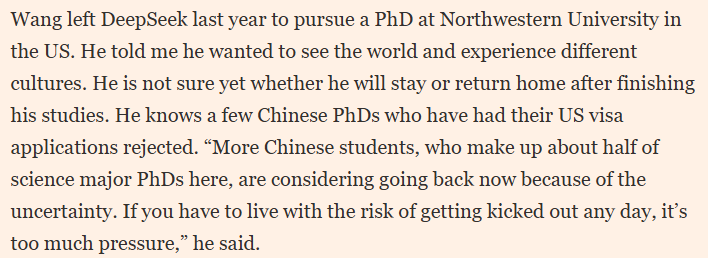
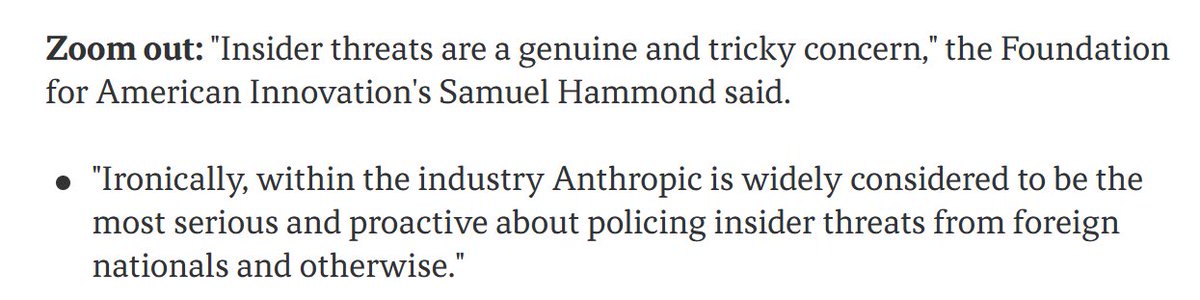
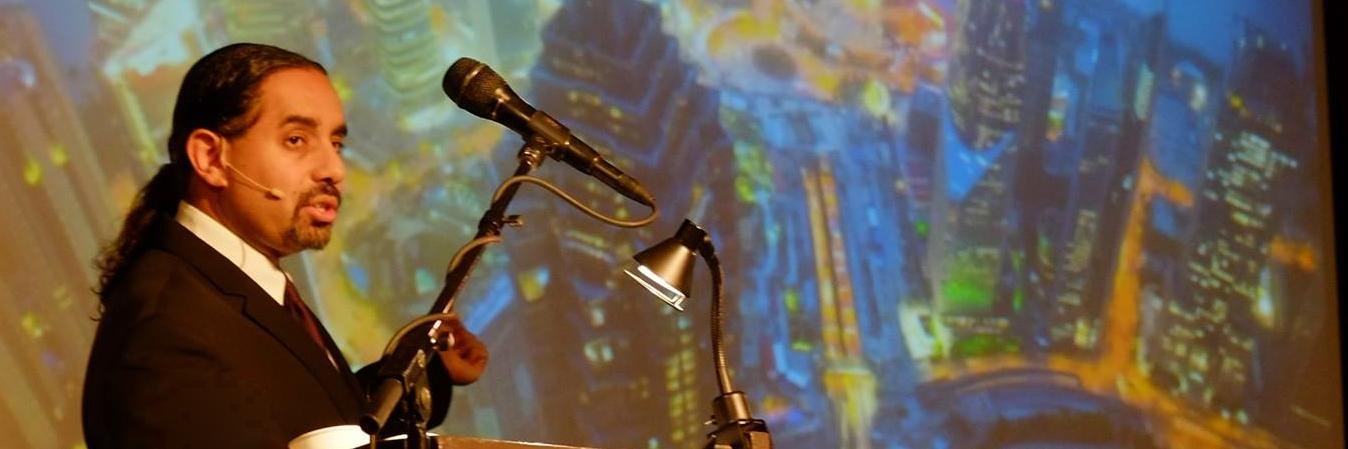
Read @hamandcheese's full comments to the @axios reporter below, and then see if you think this screenshot accurately or fairly reflects what he said.
Ramez Naam tweet media
Samuel Hammond 🦉@hamandcheese

I'm quoted in this piece so let me provide my full comment to the reporter: The most striking thing about the government's filing are the things it *doesn't* mention. It doesn't mention anything about Anthropic hesitating to allow Claude to be used to defend an incoming hypersonic missile, for instance -- one of the many bizarre things alleged by @USWREMichael. The focus on foreign national employees is an indicator of how thin the DoW's case is. It is also an extremely fraught line of argument to go down. Every leading US AI company employs a substantial number of foreign nationals. In FY 2025, Amazon, Microsoft, Meta, Google, Apple, Oracle, Cisco, Intel, and IBM all appeared in the top 50 employers by number of granted H-1B visas, ranging from a few hundred to over 6,000. Meta alone had 5,123 approved H-1B petitions in 2025. (See: newsweek.com/h-1b-visas-imm… ) This is an undercount, of course, as there are many other visa pathways as well as greencard holders and dual nationals. The share is also higher in AI. A large plurality of the core research and engineering talent at every frontier AI lab is foreign, reflecting the global nature of the race for top AI talent. One talent tracker shows Chinese-origin researchers constitute roughly 40% of top AI talent at US institutions. Total foreign nationals likely constituting 50-65% of research teams specifically. This is certaintly true to my experience on the ground. (See: digitalprojectsarchive.org/interactive/di… ) So the first point is that employing foreign nationals, including Chinese nationals, is not unique to Anthropic. The more important question is what measures are taken to protect against insider threats. Ironically, within the industry Anthropic is widely considered to be the most serious and proactive about policing insider threats from foreign nationals and otherwise. They were early adopters of operational security techniques like compartmentalization and audit trails, in part because they were early to partner with the IC and DoW, but also as a reflection of their leadership's strong convictions about the future power of the technology. They were audited last year on these points: the compliance review found Anthropic employs role-based access control, just-in-time access with approval workflows, multi-factor authentication for all production systems, and quarterly access reviews. (See: tdcommons.org/cgi/viewconten… ) Anthropic is known for its security mindset more generally. Last year they famously disrupted a Chinese espionage effort occuring on their platform, banned the PRC from their services, and worked with the NSA and others to share intel. I can't speak to every other company, but the contrast is perhaps most stark with xAI. X employees famously slept in tents to work around the clock, are disproportionately Chinese, and have at least one case of an employee walking out with tons of sensitive data. See: sfstandard.com/2025/08/29/xai… Anthropic is also famous for its remarkable employee retention, which is another important vector for IP theft and security leakages. It's important to underscore just how precarious the DoW's case is, both on the legal merits, and as a potential precedent for the US AI industry. If employing foreign nationals is treated as a prima facie supply chain risk, *no* major US AI company would be eligible to contract with the DoW, along with most of the tech sector. Insider threats are a genuine and tricky concern. Many defense companies are ITAR restricted, meaning they can *only* hire US citizens. If that were the standard in AI, we would destroy all our frontier companies in an instant, and then scatter that talent around the world for our adversaries to scoop up. So in short, the DoW's argument is both ridiculous and playing with fire.
English
0
0
4
855
Ramez Naam
Ramez Naam@ramez·
@hamandcheese Christ, that reporter really had a narrative they shoehorned you into. Deceptive.
English
0
0
2
150
Samuel Hammond 🦉
Samuel Hammond 🦉@hamandcheese·
I'm quoted in this piece so let me provide my full comment to the reporter: The most striking thing about the government's filing are the things it *doesn't* mention. It doesn't mention anything about Anthropic hesitating to allow Claude to be used to defend an incoming hypersonic missile, for instance -- one of the many bizarre things alleged by @USWREMichael. The focus on foreign national employees is an indicator of how thin the DoW's case is. It is also an extremely fraught line of argument to go down. Every leading US AI company employs a substantial number of foreign nationals. In FY 2025, Amazon, Microsoft, Meta, Google, Apple, Oracle, Cisco, Intel, and IBM all appeared in the top 50 employers by number of granted H-1B visas, ranging from a few hundred to over 6,000. Meta alone had 5,123 approved H-1B petitions in 2025. (See: newsweek.com/h-1b-visas-imm… ) This is an undercount, of course, as there are many other visa pathways as well as greencard holders and dual nationals. The share is also higher in AI. A large plurality of the core research and engineering talent at every frontier AI lab is foreign, reflecting the global nature of the race for top AI talent. One talent tracker shows Chinese-origin researchers constitute roughly 40% of top AI talent at US institutions. Total foreign nationals likely constituting 50-65% of research teams specifically. This is certaintly true to my experience on the ground. (See: digitalprojectsarchive.org/interactive/di… ) So the first point is that employing foreign nationals, including Chinese nationals, is not unique to Anthropic. The more important question is what measures are taken to protect against insider threats. Ironically, within the industry Anthropic is widely considered to be the most serious and proactive about policing insider threats from foreign nationals and otherwise. They were early adopters of operational security techniques like compartmentalization and audit trails, in part because they were early to partner with the IC and DoW, but also as a reflection of their leadership's strong convictions about the future power of the technology. They were audited last year on these points: the compliance review found Anthropic employs role-based access control, just-in-time access with approval workflows, multi-factor authentication for all production systems, and quarterly access reviews. (See: tdcommons.org/cgi/viewconten… ) Anthropic is known for its security mindset more generally. Last year they famously disrupted a Chinese espionage effort occuring on their platform, banned the PRC from their services, and worked with the NSA and others to share intel. I can't speak to every other company, but the contrast is perhaps most stark with xAI. X employees famously slept in tents to work around the clock, are disproportionately Chinese, and have at least one case of an employee walking out with tons of sensitive data. See: sfstandard.com/2025/08/29/xai… Anthropic is also famous for its remarkable employee retention, which is another important vector for IP theft and security leakages. It's important to underscore just how precarious the DoW's case is, both on the legal merits, and as a potential precedent for the US AI industry. If employing foreign nationals is treated as a prima facie supply chain risk, *no* major US AI company would be eligible to contract with the DoW, along with most of the tech sector. Insider threats are a genuine and tricky concern. Many defense companies are ITAR restricted, meaning they can *only* hire US citizens. If that were the standard in AI, we would destroy all our frontier companies in an instant, and then scatter that talent around the world for our adversaries to scoop up. So in short, the DoW's argument is both ridiculous and playing with fire.
Axios@axios

Pentagon: Anthropic's foreign workforce poses security risks trib.al/mxJqnc8

English
11
34
265
44.1K
Ramez Naam
Ramez Naam@ramez·
@Keller You are so on! We were in the same room at A360 last week. I should have come up and said hi. Will ping you and would love to come by!
English
0
0
1
36
Keller Cliffton
Keller Cliffton@Keller·
@ramez Ramez!! I read Nexus a few years ago and totally loved it. Come visit us sometime, would love to show you around. And exactly right in your assessment btw
English
1
0
3
196
Ramez Naam
Ramez Naam@ramez·
This is one reason I'm suspicious of most humanoid robotics companies today. I've seen lots of canned demos in perfect or near perfect conditions. Very very few in uncontrolled settings that were even the slightest bit impressive.
Keller Cliffton@Keller

The Bitter Lesson of Robotics: It's extremely easy to make a video of a robot doing something once under perfect conditions then post it to X. But it often takes a decade to harden systems and design for all the insane edge cases of the real world. Many companies raising $$$$ on cool demos, but all the hard work comes after

English
1
4
49
4.2K
Ramez Naam
Ramez Naam@ramez·
@allTshirtsGot April 2025. Not even up to date with all the horrible stuff since then.
English
0
0
18
530
Ramez Naam أُعيد تغريده
Jesse Peltan
Jesse Peltan@JessePeltan·
2.9 TW of solar globally, half in China. 1.3 TW of wind globally, half in China. The majority of all new capacity is built China.
Jesse Peltan tweet media
English
16
44
310
23.5K
Ramez Naam
Ramez Naam@ramez·
@RurbanHermit @Ed_of_O What I mean is that Trump's policies prior to the war with Iran actually inhibited drilling in the US, despite the campaign pledge of drill baby drill.
English
1
0
1
32
Rurban Hermit
Rurban Hermit@RurbanHermit·
@Ed_of_O @ramez Well, I would answer that by saying that on many leases they have to drill in a certain time frame or lose the lease. Otherwise, they drill if the price is above break-even...ie, Oil Company CEOs are not stupid (at least most of them). But the ethos remains.
English
1
0
1
31
Ramez Naam
Ramez Naam@ramez·
Washington is blessed with abundant hydro that's the bulk of our electricity, wind power that's much of the rest, and some coal in Eastern Washington State that will ultimately get phased out. While we are a regulated state things are going just fine both in terms of clean energy ( because of our blessing of hydro ) and in terms of electricity costs.
English
0
0
0
48
Sam Kaplan
Sam Kaplan@Munsrat·
@ramez How does this compare to Washington state? What does WA need to do to deregulate its energy market? Any papers you can point me to on these questions? Many thanks!
English
1
0
0
56
Ramez Naam
Ramez Naam@ramez·
@Ragcha I'm not in Texas :). I like telling the story in part because it's so surprising, and it demonstrates that even a red states can see surges in clean energy where permitting and market competition allow it.
English
1
0
3
40
Chris McKee
Chris McKee@Ragcha·
@ramez It’s like people in Texas blindfold themselves and stick their fingers in their ears. I’m all for Texas tripling down on renewables and batteries. But California exceeds 100% of its grid demand most days. Y’all are still playing catch up.
Mark Z. Jacobson@mzjacobson

70% (53 of 76) of all days and 26 straight in 2026 on the California ISO have experienced >100% WWS for part of the day, averaging 3.2 h/day among all 76 days. Gas down 61% in '26 v '23 Batteries up 329%, solar up 67%.

English
1
0
1
84
Ramez Naam
Ramez Naam@ramez·
@mattyglesias Yep. Also: 1. Easy permitting (Texas reserves most powers for the state, limiting how much localities can block projects.) 2. Deregulated power market with direct price competition for generation assets and a nearly permissionless structure. Rather than monopoly utilities.
English
1
1
14
579