segmenta

861 posts

segmenta

segmenta

@segmenta

Rowing Rowboat (YC S24). Prev: Co-founder/ CTO Agara AI (acq. Coinbase), Coinbase AI, Twitter AI

انضم Nisan 2009
1.4K يتبع798 المتابعون
segmenta أُعيد تغريده
Avi Chawla
Avi Chawla@_avichawla·
The next step after Karpathy's wiki idea: Karpathy's LLM Wiki compiles raw sources into a persistent md wiki with backlinks and cross-references. The LLM reads papers, extracts concepts, writes encyclopedia-style articles, and maintains an index. The knowledge is compiled once and kept current, so the LLM never re-derives context from scratch at query time. This works because research is mostly about concepts and their relationships, which are relatively stable. But this pattern breaks when you apply it to actual work, where context evolves across conversations constantly, like deadlines, plans, meetings, etc. A compiled wiki would have a page about the project but it wouldn't track ground truth effectively. Tracking this requires a different data structure altogether, which is not a wiki of summaries, but a knowledge graph of typed entities where people, decisions, commitments, and deadlines are separate nodes linked across conversations. Rowboat is an open-source implementation of exactly this, built on top of the same Markdown-and-Obsidian foundation that Karpathy uses, but extended into work context. The way it works is that it ingests conversations from Gmail, Granola, and Fireflies, and instead of writing a summary page per topic, it extracts each decision, commitment, and deadline as its own md file with backlinks to the people and projects involved. That's structurally different from a wiki, because a wiki page about "Project X" gives you a summary of what was discussed. A knowledge graph gives you every decision made, who made it, what was promised, when it was promised, and whether anything has shifted since. It also runs background agents on a schedule, so something like a daily briefing gets assembled automatically from whatever shifted in your graph overnight. You control what runs and what gets written back into the vault. You bring your own model through Ollama, LM Studio, or any hosted API, and everything is stored as plain Markdown you can open in Obsidian, edit, or delete. Repo: github.com/rowboatlabs/ro… TL;DR: Karpathy's LLM Wiki compiles research into a persistent Markdown wiki. It works well for concepts and their relationships but breaks down for real work where the context evolves over time. Rowboat builds a knowledge graph instead of a wiki, extracts typed entities with backlinks, and runs background agents that act on that accumulated context. Open-source, local-first, bring your own model.Karpathy nailed the foundation. The next layer is here.
Avi Chawla tweet media
Andrej Karpathy@karpathy

LLM Knowledge Bases Something I'm finding very useful recently: using LLMs to build personal knowledge bases for various topics of research interest. In this way, a large fraction of my recent token throughput is going less into manipulating code, and more into manipulating knowledge (stored as markdown and images). The latest LLMs are quite good at it. So: Data ingest: I index source documents (articles, papers, repos, datasets, images, etc.) into a raw/ directory, then I use an LLM to incrementally "compile" a wiki, which is just a collection of .md files in a directory structure. The wiki includes summaries of all the data in raw/, backlinks, and then it categorizes data into concepts, writes articles for them, and links them all. To convert web articles into .md files I like to use the Obsidian Web Clipper extension, and then I also use a hotkey to download all the related images to local so that my LLM can easily reference them. IDE: I use Obsidian as the IDE "frontend" where I can view the raw data, the the compiled wiki, and the derived visualizations. Important to note that the LLM writes and maintains all of the data of the wiki, I rarely touch it directly. I've played with a few Obsidian plugins to render and view data in other ways (e.g. Marp for slides). Q&A: Where things get interesting is that once your wiki is big enough (e.g. mine on some recent research is ~100 articles and ~400K words), you can ask your LLM agent all kinds of complex questions against the wiki, and it will go off, research the answers, etc. I thought I had to reach for fancy RAG, but the LLM has been pretty good about auto-maintaining index files and brief summaries of all the documents and it reads all the important related data fairly easily at this ~small scale. Output: Instead of getting answers in text/terminal, I like to have it render markdown files for me, or slide shows (Marp format), or matplotlib images, all of which I then view again in Obsidian. You can imagine many other visual output formats depending on the query. Often, I end up "filing" the outputs back into the wiki to enhance it for further queries. So my own explorations and queries always "add up" in the knowledge base. Linting: I've run some LLM "health checks" over the wiki to e.g. find inconsistent data, impute missing data (with web searchers), find interesting connections for new article candidates, etc., to incrementally clean up the wiki and enhance its overall data integrity. The LLMs are quite good at suggesting further questions to ask and look into. Extra tools: I find myself developing additional tools to process the data, e.g. I vibe coded a small and naive search engine over the wiki, which I both use directly (in a web ui), but more often I want to hand it off to an LLM via CLI as a tool for larger queries. Further explorations: As the repo grows, the natural desire is to also think about synthetic data generation + finetuning to have your LLM "know" the data in its weights instead of just context windows. TLDR: raw data from a given number of sources is collected, then compiled by an LLM into a .md wiki, then operated on by various CLIs by the LLM to do Q&A and to incrementally enhance the wiki, and all of it viewable in Obsidian. You rarely ever write or edit the wiki manually, it's the domain of the LLM. I think there is room here for an incredible new product instead of a hacky collection of scripts.

English
1
7
13
1.5K
segmenta
segmenta@segmenta·
@alvarovillalbap We automatically filter these. You can also granularly control what should be filtered in settings in the app.
English
2
0
2
49
Alvaro Villalba
Alvaro Villalba@alvarovillalbap·
@segmenta Awesome value prop How can I make sure it doesn’t index/graph bs emails like newsletter subscriptions?
English
1
0
1
60
segmenta
segmenta@segmenta·
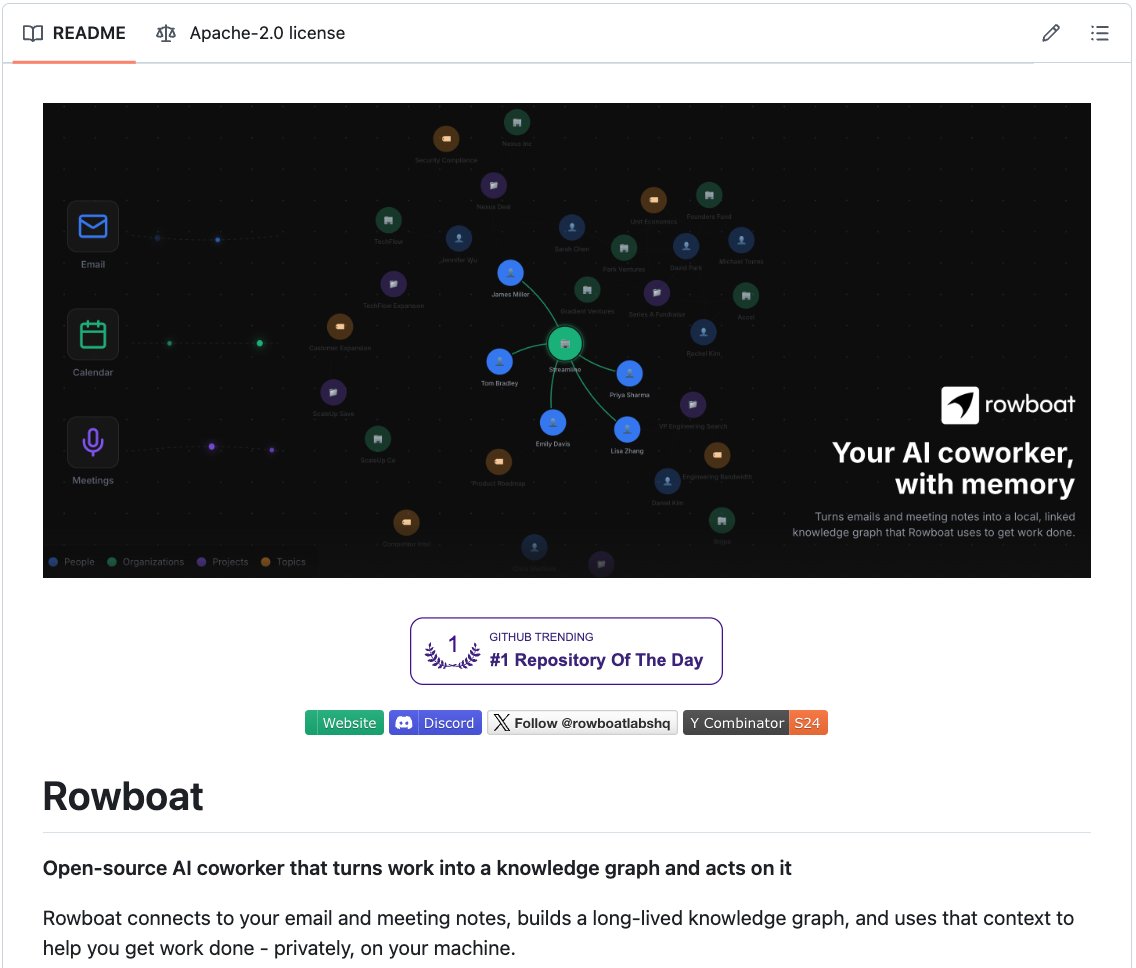
Introducing Rowboat. An AI coworker that compiles your emails, meetings, and work into a living knowledge graph, then uses it to actually get things done. Open source. Local-first. Voice-powered. Karpathy described the idea last week. We've been building it for a while.
English
24
31
391
53.8K
segmenta
segmenta@segmenta·
This captures a lot of the problem space we’re building Rowboat for: a personal living knowledge base for your work. We think the “incredible new product” here is very real.
Andrej Karpathy@karpathy

LLM Knowledge Bases Something I'm finding very useful recently: using LLMs to build personal knowledge bases for various topics of research interest. In this way, a large fraction of my recent token throughput is going less into manipulating code, and more into manipulating knowledge (stored as markdown and images). The latest LLMs are quite good at it. So: Data ingest: I index source documents (articles, papers, repos, datasets, images, etc.) into a raw/ directory, then I use an LLM to incrementally "compile" a wiki, which is just a collection of .md files in a directory structure. The wiki includes summaries of all the data in raw/, backlinks, and then it categorizes data into concepts, writes articles for them, and links them all. To convert web articles into .md files I like to use the Obsidian Web Clipper extension, and then I also use a hotkey to download all the related images to local so that my LLM can easily reference them. IDE: I use Obsidian as the IDE "frontend" where I can view the raw data, the the compiled wiki, and the derived visualizations. Important to note that the LLM writes and maintains all of the data of the wiki, I rarely touch it directly. I've played with a few Obsidian plugins to render and view data in other ways (e.g. Marp for slides). Q&A: Where things get interesting is that once your wiki is big enough (e.g. mine on some recent research is ~100 articles and ~400K words), you can ask your LLM agent all kinds of complex questions against the wiki, and it will go off, research the answers, etc. I thought I had to reach for fancy RAG, but the LLM has been pretty good about auto-maintaining index files and brief summaries of all the documents and it reads all the important related data fairly easily at this ~small scale. Output: Instead of getting answers in text/terminal, I like to have it render markdown files for me, or slide shows (Marp format), or matplotlib images, all of which I then view again in Obsidian. You can imagine many other visual output formats depending on the query. Often, I end up "filing" the outputs back into the wiki to enhance it for further queries. So my own explorations and queries always "add up" in the knowledge base. Linting: I've run some LLM "health checks" over the wiki to e.g. find inconsistent data, impute missing data (with web searchers), find interesting connections for new article candidates, etc., to incrementally clean up the wiki and enhance its overall data integrity. The LLMs are quite good at suggesting further questions to ask and look into. Extra tools: I find myself developing additional tools to process the data, e.g. I vibe coded a small and naive search engine over the wiki, which I both use directly (in a web ui), but more often I want to hand it off to an LLM via CLI as a tool for larger queries. Further explorations: As the repo grows, the natural desire is to also think about synthetic data generation + finetuning to have your LLM "know" the data in its weights instead of just context windows. TLDR: raw data from a given number of sources is collected, then compiled by an LLM into a .md wiki, then operated on by various CLIs by the LLM to do Q&A and to incrementally enhance the wiki, and all of it viewable in Obsidian. You rarely ever write or edit the wiki manually, it's the domain of the LLM. I think there is room here for an incredible new product instead of a hacky collection of scripts.

English
7
0
9
2.8K
Steven Grin
Steven Grin@sgrin77·
@segmenta @CAMP_Realty @ycombinator Multiple accounts is key. This is one of biggest impediments for me on Claude mcp integration. Need mult oauth account access to build a true knowledge graph.
English
1
0
1
164
segmenta
segmenta@segmenta·
@reachmeviz Hermes is great but it mainly focuses on the general purpose agent itself. Rowboat is a desktop app for knowledge work assistance. It’s built around cooperative work - hence the user readable knowledge graph, voice out, meeting notes etc.
English
0
0
0
294
Viz
Viz@reachmeviz·
@segmenta How is this different from things like Hermes agent which also constantly evolves its memory ?
English
1
0
1
335
segmenta
segmenta@segmenta·
@CAMP_Realty @ycombinator You can connect only one Gmail account right now. Outlook support is coming soon. Would love to learn what your use case is for multiple accounts.
English
2
0
1
338
segmenta
segmenta@segmenta·
We built ours. Memory is markdown files on specific topics: things about the user and their preferences on tasks like email drafting, presentations, etc. The assistant can save things to memory when needed and there is also a background agent that looks at chats and creates memory notes if the assistant missed anything. Happy to explore on DM.
English
0
0
0
456
Saïd Aitmbarek
Saïd Aitmbarek@SaidAitmbarek·
@segmenta That's so cool, do you rely on external memory providers? Or did you build yours? Asking, but i'll explore the codebase (thx for oss) Let's launch you on microlaunch.net anytime btw mate.
English
1
0
2
540
segmenta
segmenta@segmenta·
@bittybitbit86 You are going to be pleasantly surprised :) Our default spam detection is better than Gmail's. And you can configure it in the app to how strict you want it to be.
English
0
0
2
237
LiτBro
LiτBro@bittybitbit86·
@segmenta This shit gonna fill my knowledge graph with 24k spam emails isn’t it?
English
1
0
0
265
segmenta
segmenta@segmenta·
@levie Couldn't agree more! This is exactly why we built Rowboat: an AI coworker that compiles your work into a knowledge graph and uses it to actually do things - with the same tools you use. Just launched: x.com/segmenta/statu…
segmenta@segmenta

Introducing Rowboat. An AI coworker that compiles your emails, meetings, and work into a living knowledge graph, then uses it to actually get things done. Open source. Local-first. Voice-powered. Karpathy described the idea last week. We've been building it for a while.

English
0
0
1
59
Aaron Levie
Aaron Levie@levie·
The same kinds of productivity gains we've seen in coding with AI agents are heading to the rest of knowledge work. This is the jump when you go from having a chatbot to being able to actually have an agent go off and do work for minutes or even hours and come back with a complete work output that you then review. Here's an example of the new Box Agent filling out an RFP response from an existing knowledge base. This process would normally take hours to fill out, and requires the full attention of the user doing the work. Now, you provide the Box Agent with the RFP questions, and it will go off, make a plan, extract all the relevant questions, read through existing source material to come up with an answer, and then generate a new word document as the final output. All while you're doing something else. The key to this architecture is that the agent is able to use all of the same tools in the background that a user uses to get work done. The agent can search for documents, read entire files, run scripts and tools in the background, and even be able to write code on the fly to automate tasks it hasn't seen before. And best of all, the Box Agent will (soon) work from the Box MCP and CLI so you can invoke it in any agentic system as a step in a process. This kind of agent complexity would have been impossible even 6 months ago. Models consistently failed at tracking long running tasks or using the right tools at the right moment for the task. But this is all now possible because of models like GPT-5.4, Opus 4.6, and Gemini 3, and is only getting better by the month. Just as we moved from engineers writing code and using AI as an assistant to answer questions, in many areas of knowledge work -like legal, finance, consulting, sales, marketing, and more- when we have a problem we'll just kick off the AI agent to just go work on it for us in the background.
English
31
11
124
20.5K
segmenta
segmenta@segmenta·
Fair point. Local-first is a side benefit. The real bottleneck is context quality, like you said. That's why we built Rowboat around a living knowledge graph instead of RAG. Consciously building context over time is better than doing one off data pulls when needed - is our thesis.
English
1
0
0
772
Gregor
Gregor@bygregorr·
@segmenta The "local-first" framing is doing a lot of heavy lifting here. Isn't the bottleneck not where data lives but whether the AI actually understands context well enough to act without making things worse?
English
1
0
2
911
segmenta
segmenta@segmenta·
@yabsssai Thanks! We have integrations to Jira, Linear and Asana and few others. What does your team use - would love any feedback.
English
5
0
0
321
YabsssAI
YabsssAI@yabsssai·
your idea of a "living knowledge graph" really resonates, as someone who's worked on similar data integration projects, i've found that the key to successful implementation is in the data quality inputs – have you talked to any teams about integrating rowboat with existing task management systems?
English
1
0
1
353
Akshay 🚀
Akshay 🚀@akshay_pachaar·
@segmenta Ok, I was looking for something that is local first for my AI brain. Giving it a spin right away. And congrats on shipping.
English
1
1
1
1.1K
segmenta
segmenta@segmenta·
@JaykhatriDev Its processed mostly chronologically - the newer source typically supersede the older one. Having said that, this is done by background agents - there is some amount of LLM discretion involved.
English
0
0
1
754
Jay Khatri
Jay Khatri@JaykhatriDev·
@segmenta how does it handle conflicting information from different sources?
English
1
0
1
823
segmenta
segmenta@segmenta·
@saadnvd1 Its stored as plain markdown files with Obsidian-style backlinks.
English
0
0
1
827
Saad
Saad@saadnvd1·
@segmenta Local-first is the part I care about most. How are you handling the knowledge graph storage: SQLite + embeddings locally, or something custom?
English
1
0
2
984
segmenta
segmenta@segmenta·
Since our previous launch, we’ve added: → Voice, so you can talk to Rowboat and it talks back → A native meeting note taker → Live note to track anything with agents → Bases view → Granular web search → Works out-of-the-box, no API keys needed All on top of the local-first, Markdown-based knowledge graph.
English
0
0
5
2.8K