@Masta_Rebel @MoodyWriter13 You are an investor. You know that nothing is free. You know where that 4200% ytd comes from.
English
Luke
288 posts


Decentralized power supply for AI data centers is currently one of the hottest themes in the market, and the relevant stocks have been moving rapidly higher. In fuel cells, $BE is the clear market leader, while $FCEL and Ceres Power are trying to position themselves as alternatives. On the combustion side, the situation is different: the major gas turbine manufacturers such as GE Vernova, Siemens Energy, and Mitsubishi Power are effectively sold out, with multi year backlogs extending well into the second half of the 2020s. The obvious alternative is gas engines, where several established players are active, including $CAT, Wärtsilä, INNIO and its Jenbacher platform, Cummins, and 2G Energy. One advantage of gas engine solutions over fuel cells receives far too little attention in the current debate: they are dispatchable and therefore combine naturally with solar power. The engine ramps up when solar generation falls away. Fuel cells cannot do this. They are fundamentally baseload assets and do not tolerate rapid load changes or frequent start stop cycles. This matters more for AI workloads than many investors realize. Pure baseload power is primarily needed during full scale training runs, and even there, workloads create second by second load transients. Inference is even more dynamic because it follows user demand and therefore exhibits a clear daily utilization profile. This is exactly where dispatchable gas engines excel, especially when paired with a modest battery energy storage system. Some of these engines can already operate on hydrogen, further strengthening their long term relevance. The downside relative to fuel cells is clear: lower efficiency and higher emissions because fuel is combusted. There is one particularly interesting German company in this space that already has a strong position in decentralized energy infrastructure for the energy transition through combined heat and power systems, biogas solutions, and large scale heat pumps: 2G Energy $2GB.DE According to management, the company is currently close to signing several US data center contracts in the high double digit to low triple digit megawatt range, with each individual order potentially worth up to €100 million. That is highly meaningful for a company currently guiding for €440-490 million in annual revenue. For larger competitors, deals of this size would barely move the needle. The stock is already up roughly 50% ytd. That is not insignificant, and on absolute numbers it is not cheap. But relative to peers it still looks highly attractive: P/S 2026e of approximately 2.1x EV/EBIT 2026e of roughly 22x EV/EBIT 2027e of roughly 18x Compare that to $BE at roughly 11 to 13x forward sales, or GE Vernova with a market cap near $293 billion and a forward earnings multiple around 32x. Based on its current business alone, 2G is not cheap. But the data center optionality is still not reflected in the valuation. The concrete advantages of 2G’s solutions include: Standardized modular units manufactured in house and deliverable within roughly 9 to 18 months. This is the critical advantage while turbine supply remains constrained. The Gas2Power platform covers backup power, prime power, and grid services, with full load step capability within 10 seconds. This makes it ideal for pairing with solar generation. The waste heat can be used for absorption cooling, directly supporting data center thermal management. Approximately 55 dB(A) at 10 meters, which materially improves permitting prospects for sensitive sites. What makes the business model especially compelling is its focus on high margin recurring service revenue. A triple digit megawatt installed base generates maintenance and service revenue over more than a decade. That recurring stream is the real compounding engine behind what initially appears to be a one time equipment sale. For investors looking at decentralized AI infrastructure power, this company is worth a look.

I have very entertaining stories I hope to share publicly someday. For now... LOL Drinking with old college buddies.


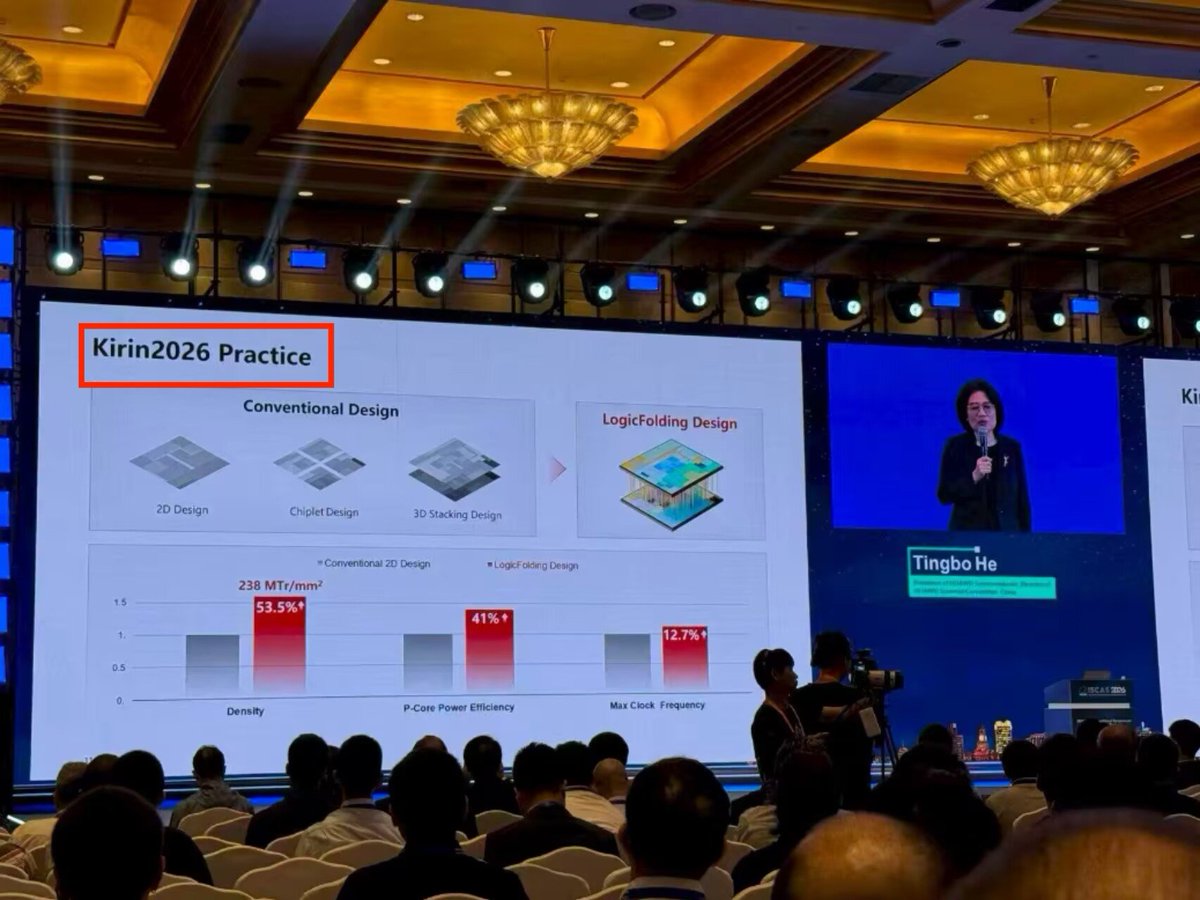
Any expert opinions on this news??? @jukan05 @rwang07 @lithos_graphein

Necessity is the mother of all inventions. China keeps pushing the boundaries and punching above the waist. Huawei aims to design high-end chips by 2031 with transistor density equivalent to 1.4 nm processes—close to the expected global frontier by the end of the decade. This is notable given China’s limited access to advanced EUV lithography and other tools due to U.S. export controls How they plan to achieve this? Tau Scaling Law: This principle shifts focus from traditional transistor shrinking (Moore’s Law-style) to improving signal/data movement speed within chips and systems. It emphasizes scaling, wiring optimization, and overall density/performance gains. reuters.com/world/asia-pac…


$SIVE is on a speculative, unsustainable rally that is not backed by any fundamentals. Healthy parabolic stocks like $LITE, $BE, $AXTI, $SNDK either pop and grind up following each earnings event as new information is introduced to the market and improves the fundamental outlook OR they sell a raw material or commodity whose supply/demand dynamics and price can be tracked publicly. $SIVE is neither. The last earnings call was on February 26th, to which the market had zero reaction; however starting mid-March, $SIVE proceeded to run 2000%. No fundamental news was released to warrant such a re-rating. The O-Net and Jabil R&D partnerships are not new. The news that is actually needed to move the fundamental value: commercial volume orders with real dollar values attached, did not occur. In fact, they restated their FY25 EBIT net loss, which got worse. My bearish campaign against $SIVE is only beginning. The higher this speculative stock runs, the more people will lose money; we must keep the damage contained. Those purposely spreading unreliable information to increase the market capitalization of an illiquid microcap to inflate their own wealth at the expense of everyday investors must be held accountable. My short report is coming soon.


To be honest I do believe $SIVE can reach 80b market cap. It's in an exploding market and its peers have done it.... So what prevents them?


$SIVE has gone up more than 1,700% since I first pitched it on X. Is there anyone who bought it back then and is still holding it? That person probably owes me a coffee.
"given the CPU TAM CAGR update to 50%, plus DRAM per server CPU core is rising from 4GB to ~16GB or even 32GB in the future, DRAM CAGR is definitely going to be re-evaluated." Yup, people are underestimating CPU DRAM demand The DRAM in Nvidia's systems went from 500 GB per Grace CPU (72 cores) to 1.5 TB per Vera CPU (88 cores) in one generation RAM per core went from 6.7 GB (Grace) to 17 GB (Vera)

Why No Price Hike Despite a Severe Shortage? Why doesn't Nittobo raise prices to reap windfall profits? The AI server boom has triggered an explosion in global demand for high-end glass fiber materials. Yet even as the market tightens into deepening shortage, Nittobo (Nitto Boseki, 日東紡) has opted for a counterintuitive strategy. Management made clear that the company currently has no plans for further price increases on its low-CTE (low coefficient of thermal expansion) glass fabric (T-glass), emphasizing that at this stage it will focus on expanding capacity to "defend market share." According to Japanese media reports, Nittobo is a leading major supplier that commands the critical global supply of high-end low-thermal-expansion glass fiber. The company said it had initially planned to prioritize expanding low-Dk (low dielectric) glass fiber capacity, but as demand from AI servers and edge devices such as smartphones outpaced expectations, the supply-demand gap for low-thermal-expansion T-glass widened sharply. In response, it has decided to accelerate the pace of expansion, adding glass fabric production lines at its Fukushima site in Japan while also installing new glass melting furnace equipment in Taiwan. Nittobo noted that T-glass demand is currently expanding rapidly. Not only is demand for the "thick fabric" used in semiconductor packaging substrates for AI servers continuing to climb, but the growth rate of the "thin fabric" used in edge devices such as smartphones is exceeding initial expectations by an even wider margin. The company emphasized that it has reached an internal consensus to further scale up the relevant capital investment in order to meet the strong demand from both thick-fabric and thin-fabric customers simultaneously. Defending Market Share Over Short-Term Price Hikes On the future price trajectory that the market is watching closely, Nittobo management responded that it currently has no plans to make further price adjustments to either T-glass or low-dielectric glass, and will continue selling at the prices set at the start of this fiscal year. The company reiterated that its top priority at present is expanding capacity to meet customer demand, thereby cementing its leadership position in the high-end materials market. It added that, so long as its products remain competitive and market demand holds firm, it will not hesitate to commit to capacity expansion. Nittobo had previously announced that it would raise the capital expenditure (CapEx) budget in its FY2024–2027 medium-term management plan by a substantial 50%, from the originally planned ¥80 billion to ¥120 billion—a move intended to respond to product demand and shifts in the market environment. Glass fabric is a critical component of IC substrates and printed circuit boards (PCBs), serving as the most fundamental chip-reinforcement layer material in electronic devices. As advanced chip packaging imposes extremely stringent requirements on micro-scale deformation, T-glass—with its low-thermal-expansion properties—can effectively prevent package warpage, establishing itself as a core element in ensuring the stability of high-end computing.
Bought $QURE last week. The FDA must be crazy not to approve their candidate for Huntington's disease. Together with $CAPR, $CMPS and $CMP.AX, these are four companies with very promising data that are very likely to receive approval within the next 1-2 years.