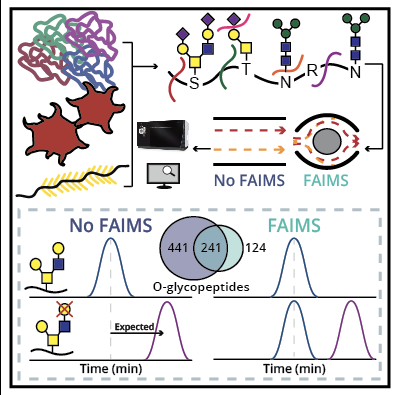
🚨Newest #glycotime#TeamMassSpec preprint from the Malaker lab! 🚨Here, @VRAdoesMS spearheaded a project where we evaluated the use of FAIMS for O-glycoproteomic analysis. What we found was quite interesting... 🧵👇doi.org/10.1101/2023.0…
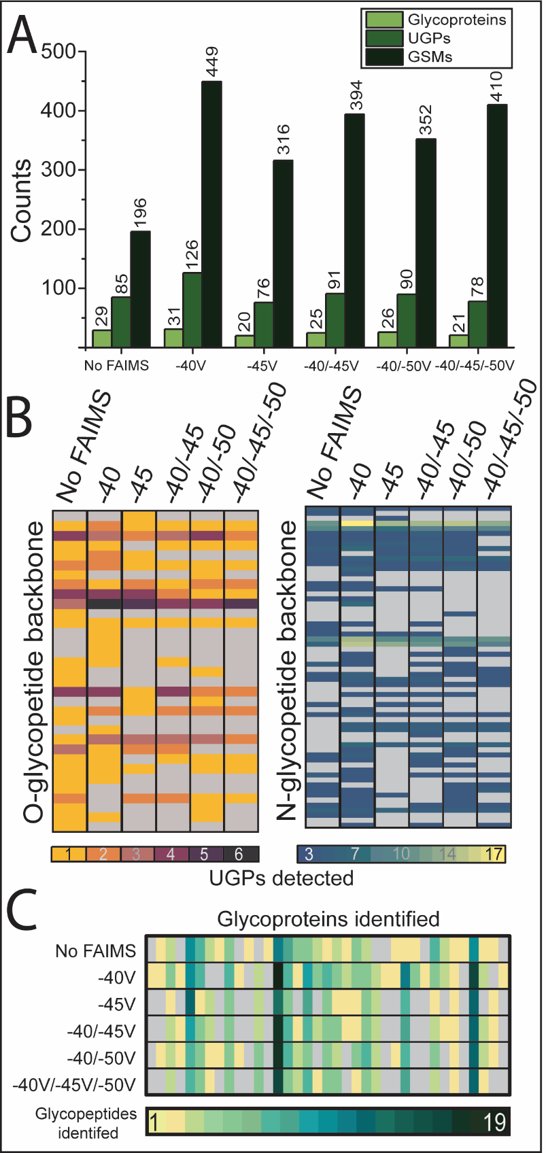
@VRAdoesMS First, given our obsession with the #mucinome, we digested mucin-domain glycoprotein podocalyxin and subjected it to FAIMS separation. In every CV studied, FAIMS resulted in *LESS* glycopeptide PSMs (GSMs), unique glycopeptides (UGPs), and localized O-glycosites
We then used more complex samples containing both N- and O-glycoproteins and discovered that FAIMS became much more useful as sample complexity increased; a trend that was also observed in other studies.
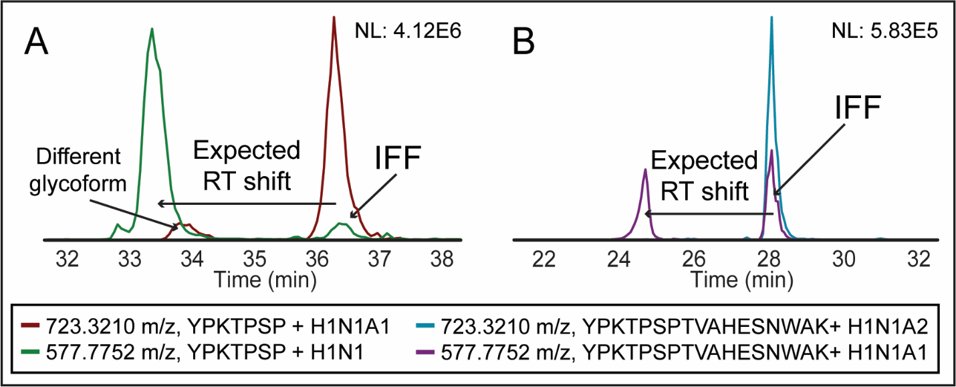
This is where it gets really interesting... we discovered a phenomenon we termed "in FAIMS fragmentation" (IFF) was leading to glycan losses akin to in source fragmentation but occurring in the FAIMS source.
@StacyMalaker "In FAIMS fragmentation" isn't a new phenomenon - ion heating and subsequent fragmentation is almost inevitable at such high field strengths, but what is interesting is that you observe it for such large analytes! The fragmentation barrier for loss of glycosyl units must be low
@cieritano Yes, others have observed glycan fragmentation/ion heating before but I don't know if anyone studied it using FAIMS. And yes, glycans are extremely labile in nature, so it's not super surprising... just worrisome at how prevalent it is, as you said!
@StacyMalaker I'm quite interested in your results, as this is a topic I've explored fairly extensively during my PhD! Do you happen to know what the largest glycosylated system is that underwent IFF (in terms of molecular weight)?
@cieritano Thanks for the citations, we'll definitely check them out! And this is a better question for @VRAdoesMS -- Val, see above.
Also, note that we focused on O-glycopeptides which are smaller than N-glycopeptides (in length and glycan size), though I bet it's occurring there too