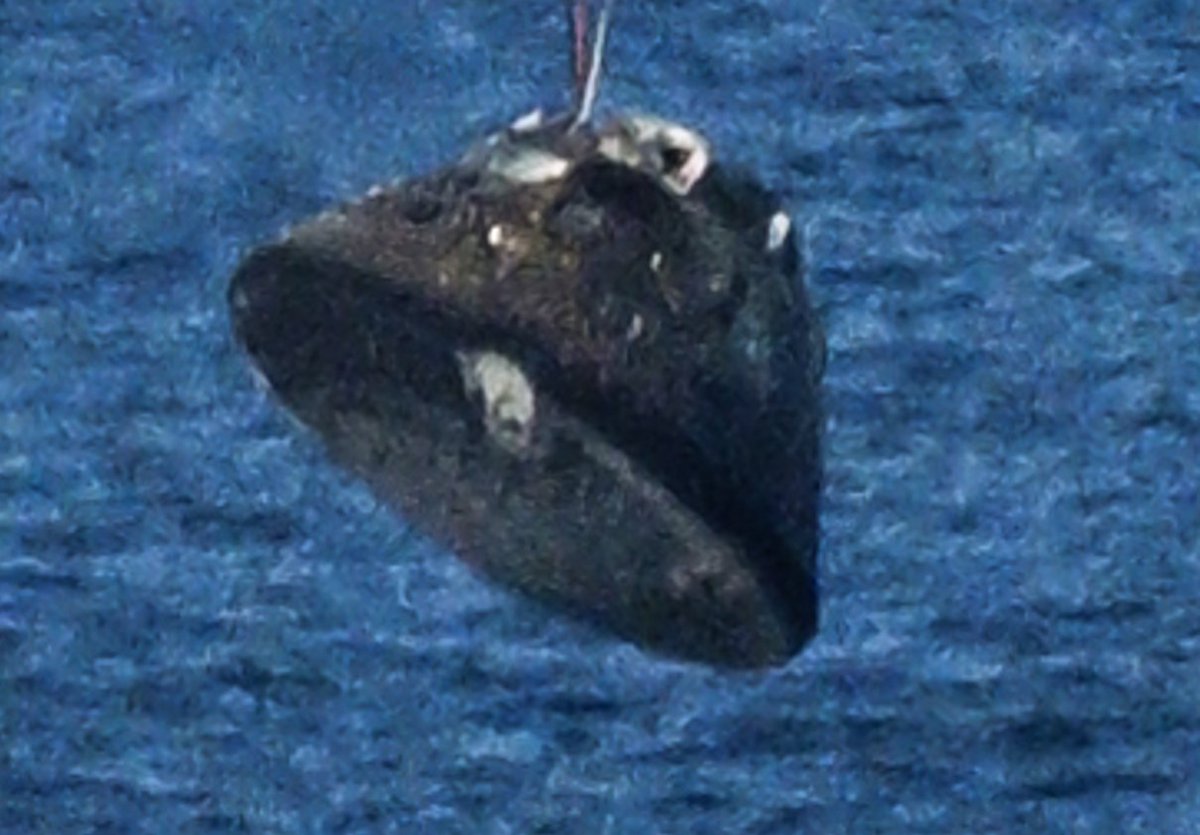
I am hesitant to get ahead of a proper data review, but I understand the space community’s curiosity, especially when imagery can give the impression of a problem.
As you would expect, engineers were eager to inspect the heat shield, starting with diver imagery shortly after splashdown and continuing with the review aboard the ship. No unexpected conditions were observed. I suspect when the images are released, it will be pretty obvious the stark difference between Artemis I and Artemis II head shield performance.
As to the question specifically, the discoloration was not liberated material. The white color observed corresponds to the compression pad area and is consistent with the local geometry, AVCOAT byproducts, and transitional heating environments. We observed this behavior in arc jet testing and expected it in this compression pad area.
We will complete a full data review across all systems, including the thermal protection system, and make the results publicly available.
@rookisaacman genuine question. What is the reasoning behind simply not slowing velocity prior to re-entry?
I get that the atmosphere is a great (and no mass) braking system, however it is inherently dangerous and causes a reusability issue.
Always wondered why!
Btw congrats on the mission. It was amazing to watch.
@ocd_offroad@NASAAdmin@rookisaacman@SciGuySpace Energy involved is too great to do this via thrusters (would require too much propellant). A heatshield is the most mass efficient solution to dissipating the energy given known physics.
Im thinking more of a low density solution. Imagine skipping a stone across a pond rather than just dropping it.
If you were to skim the upper atmosphere you can take advantage of drag while generating less heat, and allowing the lower temps to help keep you cool.
That would certainly cut down on the thrust requirements.
There's risk in this. A trajectory aiming for a shallow dip into the atmosphere to gently slow velocity would inherently create low margin control risk of a skip and slingshot into void of space. A more aggressive angle drastically increases peak heating but guarantees low variable free return trajectory, perhaps even under no/little power.
@mwc82@JayAranha@NASAAdmin@rookisaacman@SciGuySpace Fair point, I think we easily have the ability to control that reaction. But a valid concern.
Of course I would assume that once moonbase is established a simple orbital refuel and propulsion based decel will be the order of the day.
Growing pains.
@ocd_offroad@mwc82@JayAranha@NASAAdmin@rookisaacman@SciGuySpace Propulsion based deceleration is not possible. Heatshields are a magnitude more mass efficient. They are also proven and reliable. The only crew lost during reentry was due the shield already being damaged.