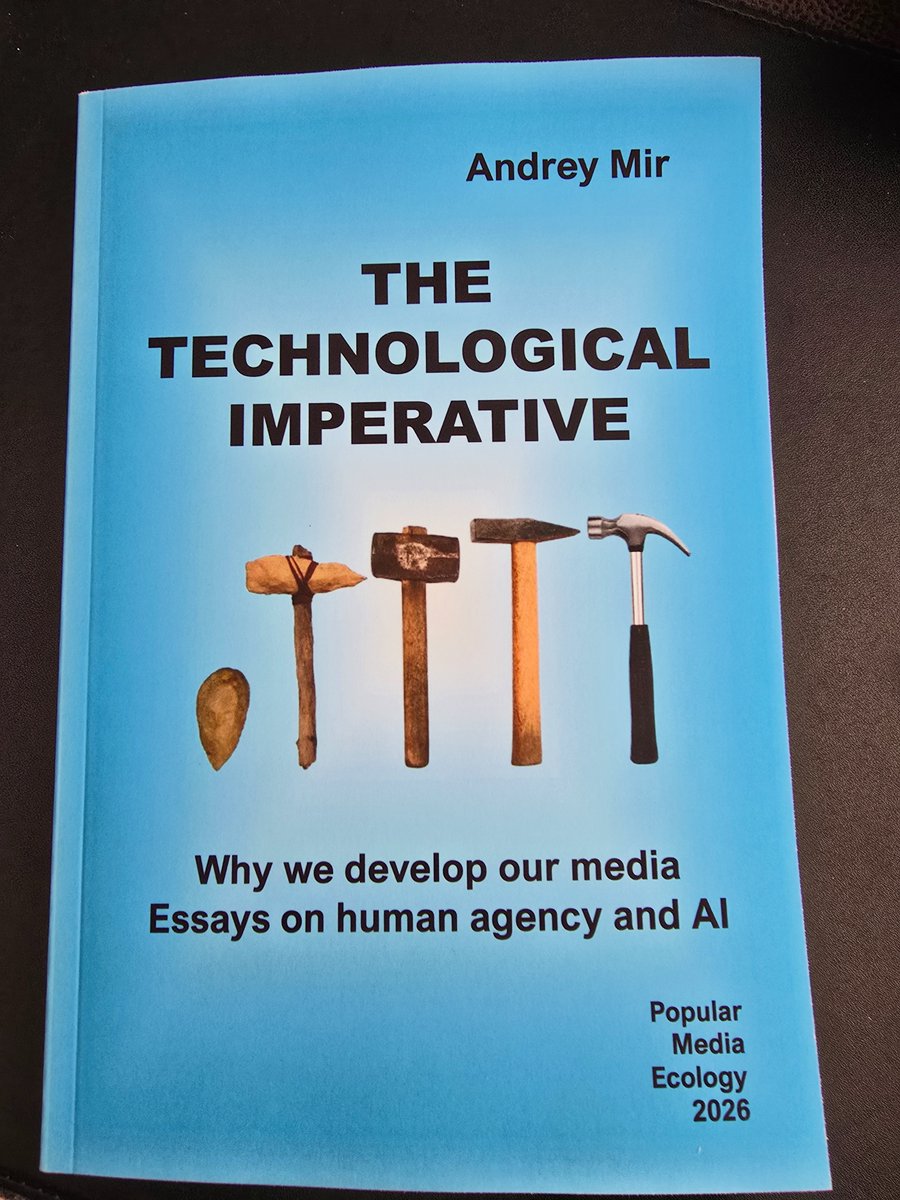
Look what arrived 👀
Looking forward to reading this
If you're not familiar with @Andrey4Mir then check out his blog at andreymir.com or just pick up one of his books. Highly recommended.
You don't know what you want until you've tried to say it badly several times.
Silicon Valley's entire roadmap assumes the opposite.
That assumption will hollow out knowledge work from the inside. Here's the argument.
🧵 (1/19)
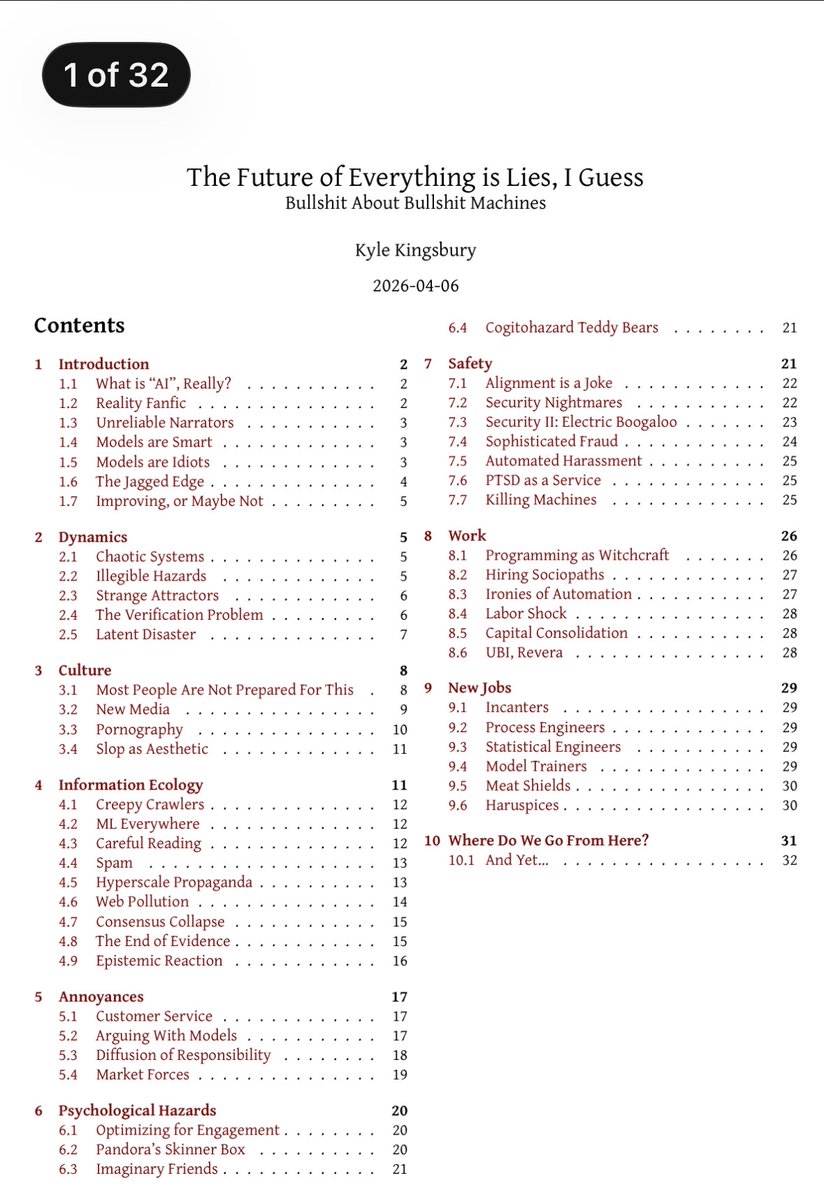
Read Kyle Kingsbury’s 32 page critique of AI: “The Future of Everything is Lies.”
It is a polemic, cynical and disagreeable piece to many in tech, but felt by most outside of it. It highlights the many problems we will need to solve as AI percolates through society.
Must read.
I did not present any solutions. Nor did I argue against experimentation.
You miss the point about media ecology theory, it's an entirely different lens than the one you are looking through. I am not arguing that the Block's approach is wrong in the way that a bad management style is wrong. I'm saying Block is building inside a media-ecological transformation it hasn't recognised, and that the reversal (the invisible hierarchy, the de-skilling of edge workers, the hub-and-spoke topology) is a structural inevitability of the technology when pushed to its extreme. Therefore a comparison to Cathedrals and Bazaars is inapplicable.
The media-ecological transformation is expanded upon with examples across the essay. If we compare it to the comparison then then you can think about it this way:
Raymond framed that as a management choice between centralized, controlled, scheduled, polished releases (i.e. the Cathedral model) and a decentralized, many authors, rapid iteration (i.e. the Bazaar). He was right about the Bazaar, but what he couldn't see writing in 1997, and nobody else writing about open source at that time did, was that the Bazaar was a media effect. The Bazaar became possible because the internet changed the media through which software developers interacted and coordinated. The Bazaar couldn't of run across six continents on postal mail, the media wouldn't be able to carry it. The internet didn't just make the Bazaar faster, it made it possible.
Raymond also couldn't identify it's reversal, which is what happens when a media is pushed to its extreme. At its extreme the fully decentralized Bazaar produced GitHub, which produced Microsoft acquiring GitHub, which produced Copilot, which is now is now training on all the Bazaar's code to produce an AI that threatens to make open-sourcr contributors redundant (at least as code writers). The Bazaar, pushed to its limit is reversing into a new type of Cathedral - owned by the type of corporation it was meant to displace.
Agree, what the Block are doing is interesting. It wouldn't be worth the effort to write an essay otherwise, or this response.
And your solution seems very doomer.
Experimentation is crucial. The risks are real, but evolution will continue despite the warnings posted.
The Industrial Revolution has had a cost on the environment, but I would argue that humanity is still better off.
The cathedral and bazar was not just about organizing people. It’s the tools, the practice, the approach… the ideals.
Sooo… what Jack is doing is interesting and worth following along. It’s not for everyone and most will “wait and see.”
Someone asked my thoughts this post..
Admittedly, I only read maybe 2/3rds of this… haven’t sent it to an LLM to give me the tl;dr. BUT… a couple things came to mind.
1. The cathedral and bazar talk about two ways to organize companies/software development approaches. In that era, neither are “wrong” or “catastrophic.” They produce similar results in very different ways.
2. Humanity is unequivocally better off today than it was 150yrs ago. Extreme poverty is down, famine is down, and education is up because of the past technological advances we have experienced.
This article tries to pick apart the shortcomings of Jack’s thesis, but references an argument like - smart phones have made humanity dumber because we can’t remember people’s phone number” It’s an old adage that misses the forest through the trees. We no longer NEED to remember these things. Instead we now fill that mental space with the incredible breadth of “news” we consume.
There is validity to the concerns, but the focus is in the wrong areas. The proposal from Jack is where (software development / technology) companies are going to head. Reduced headcount, living operating systems with strong LLM guidance/suggestions. The organizations that build out knowledge graphs + RAG + real-time streaming will be more agile and competitive than those that dont. They may not be “better”, where better is subjective (ie, “What’s the *best* blockchain?”)
So, I do believe there will be failures, I hope they are not catastrophic… (this article didn’t talk about what happens when governments adopt this approach for policing, trade negotiations, etc.) and I also do believe humanity will be better as a result of this technology. The same way any major technology has shifted humanity, AI will too (and the author notes this as well).
Thanks for writing this Micky :) tell your LLM to be more concise next time though 🙏
The Rockefeller Institute (1901) is the weirdest test of your metis argument. He put scientists, not trustees, in charge of spending. "Gather great minds, liberate them from petty cares, let them chase intellectual chimeras without meddling." That's Block's architecture inverted. Same insight (managers are the bottleneck), opposite conclusion (protect the humans from the system instead of replacing them with it). The edge workers ran the budget.
Great example, thank you for the comment.
Rockefeller and Block made the same diagnosis: managers are the bottleneck. They arrived at opposite architectures. Rockefeller removed the managers and replaced them with nothing. He gave the scientists the budget and got out of the way. Block removes the managers and replaces them with a world model. The intelligence moves into the system. The humans become edge workers receiving composed answers from a layer they didn't build and can't interrogate.
Rockefeller understood the difference between the tollbooth and the mountain. The administrative friction – grant cycles, trustee approval, bureaucratic reporting – was the tollbooth. The scientific struggle – the dead-end hypotheses, the arguments between researchers that forced better thinking, the lateral leap that only happens when two people argue in a corridor for an hour – that was the mountain. He automated the tollbooth. He protected the mountain. Block automates everything and assumes the mountain will survive at the edge.
The scaling objection is real. Rockefeller's model worked for a few hundred exceptional scientists with an endowment and no quarterly earnings call. It did not need to coordinate six thousand employees processing millions of financial transactions at machine speed. The commenter would need to explain how that architecture transfers, and that's where it gets harder.
But the structural question survives the scaling objection. The Rockefeller example shows that the right instinct – managers are the problem – has historically produced at least one architecture that solved it by empowering humans rather than replacing them. That possibility exists. Block didn't choose it.
The essay argues that replacing human judgment with a world model is a different thing from protecting the conditions under which human judgment develops. Rockefeller knew that. The Rockefeller example is historical proof.
Block chose Brasília. Rockefeller chose something else. Every company following this template is building Brasília.
This is the most dangerous kind of fair comment - the kind that sounds complete but isn't.
"This reduces to a context problem" makes it sound temporary. Fix the context window, solve the problem. But some of what the model lacks was never data in the first place. Political dynamics, knowing when to break the process, the thing that makes a room still when the right person speaks – that exists only in practice. You cannot digitize it. You can only do it, repeatedly, until you know it.
That's the Bainbridge point. The edge workers who carry what the model can't are being de-skilled by the same system that depends on them. The gap doesn't close as the technology improves; it widens as the humans stop practising.
Air France 447. 228 people dead. The autopilot was not suffering from a lack of context. The co-pilot had lost the ability to fly.
There is a window for building something that uses both – human judgment and machine capacity together. That window is not permanent. The longer you wait, the fewer people remain who know how to hold the human side of it. Then the question of context becomes moot. There is nobody left to ask.
@mgurri For me, this reduces to a context problem: humans carry immense amounts of context, available at hand in whatever decision they make. This allows for literally an infinite scale of nuances. A LLM is ages away from the same amount of context in any inference it makes.
Don’t know this poster, but he delivers a brilliant analysis of vast questions re AI, hierarchy, corporate structure - and the drift of our civilization…
"Companies with RAG and real-time streaming will win" is the type of short-term competitive logic I am warning about. The Gaussian copula outperformed every alternative too. Every bank that adopted it beat the ones that didn't. Right up until they didn't. And then they took down (nearly) everything.
The Cathedral and the Bazaar comparison is not relevant. Raymond described two ways to organize within the same environment. I'm arguing that the media environment itself is changing. They're very different things.
Nowhere is it said that smartphones make people dumber because they are forgetting numbers. That's a disingenuous take. The argument actually made is that Air France 447's co-pilot lost the ability to fly a plane, because the automated system removed the need to practise flying. Then 2228 died. That's what extension-amputation looks like. The stakes are much higher than simply forgetting a phone number.
Yes, humanity is better off than 150 years ago. This is also not an argument I made. You can acknowledge enhancements and still ask what frictions are load-bearing. You are only doing the first (acknowledging the enhancements) - that's the easier and less mentally challenging exercise.
You raise the government case, then didn't follow up on it. Stay there a moment. This is where it actually gets worse, not better. Companies can go bankrupt and will be replaced. Governments do not. When a state puts absolute faith in a centralized intelligence layer, there's no market correction mechanism. There is just damage. Who will get fired? Who will build the competing model? The thing will just run.
The scary thing is not that the Block fails. It's that lots of companies will copy their template before it fails. Capitalism survives shock through diversity of form. When there is no diversity, then the correction and the catastrophe become the same event. This is my warning.
This is not technology scepticism, it's just the arguments of the WHOLE essay.
@jack@DanielMiessler@mgurri@sequoia (30/30)
If you want the full argument – media ecology, information authority, the Bainbridge paradox, the Borges map – it's here:
x.com/AI_MickyJ/stat…
The engineers building the next form might want to understand why the last one died before they pour the foundation.
@jack@DanielMiessler@mgurri@sequoia (29/30)
I don't know what the right form is. Nobody does yet.
The most important thing the architects haven't admitted isn't that they might be wrong about the design.
It's that they might be wrong about who is doing the designing.
I had to read @jack's essay twice. The first time I thought it was just about management. The second time I understood it was about something else entirely.
🧵 (1/30)