
Angehefteter Tweet
螺螄粉安撫查訪使
2.4K posts


螺螄粉安撫查訪使
@CarelessLord
Mailing Member of the Communist League of the People's Republic of Rome, Head of the Latte Division of the Atheist Society in the Great Song Empire
Beigetreten Aralık 2020
22 Folgt48 Follower

@0J3ZwWw6jG76584 你为ROC“收回”了那么多领土,为什么还特意给你的日本留那几个小茶杯蛋糕?还有琉球群岛中间的那个岛屿是怎么回事?我不记得中共和KMT有主张过那个小岛,这是替二战后中国驻军留的么?

中文


@LarsPorsena1 @TedRall 1.1949年后中共大规模普及枪支,因为KMT土匪仍大量在山区活动。
2.1962年后中苏交恶,中国启动“第三战线”计划,大规模组织民兵,分发枪支,进行全民动员。
x.com/CarelessLord/s…
螺螄粉安撫查訪使@CarelessLord
@cjobp @luo_yuehan 中国正式禁枪是1996年10月1日。 在1980年市场经济社会主义建立以前,中国的枪支泛滥问题比美国更严重。1980年以后,中国进入大规模枪支暴力频发的时代,直到2000年。 在此之前,枪支普遍存放在每个工厂、企业的保安室和猎人家里。很多农民被强制要求参加民兵培训,从16岁开始学习射击。
中文

@TedRall No. The actual question is whether the Chinese people were disarmed and if so, whether that facilitated the CCP's murderous repression. What do you think the answer is?
English

No, China did not establish gun control in 1935. The myth that China banned firearms in 1935 is a popular internet talking point that has no basis in actual historical events. Throughout the Republican era (1911–1949), China was fractured by civil war and warlord conflicts. There was no centralized, unified gun control law during this time.
Anti Kommunistic@antikommunistic
Communism sounds amazing… Until someone actually has to live under it. Then suddenly everyone wants out. Why do you think that is?
English
@AK_CN_Shitpost 如果你对Hypergryph的党组织的活动内容有兴趣,这里是他们的自我介绍:
bilibili.com/video/BV1Qi421…
中文

The Communist Party Committee of Shanghai Hypergryph Network Technology Co., Ltd. was officially established


English

@CarelessLord @AK_CN_Shitpost My irony comes from Hypergryph being able to profit at all under a “communist” government, where the entire point is to seize the means of production and redistribute it among the people
Though China isn’t really communist, it’s like 50/50 between communism and capitalism
English

YouTube
中文

@RnaudBertrand Pushing it down to the regional level that is still controlled by the local CCP means that the party still sets policy and incentives
English

This is a really fascinating paper that everyone interested in China's industrial policy should read.
It destroys so many myths (see below), and is written by deeply credible people who conducted over three years of fieldwork in China and interviewed 60+ Chinese officials, entrepreneurs, and engineers. When it comes to China studies, it literally doesn't get more rigorous than this.
First myth it destroys: contrary to popular belief, Beijing's industrial policy didn't build the companies that became China's EV champions. They rose largely **despite** it, through its cracks.
For sure, Beijing did favor EVs as an industry and pushed hard for it but their big bet was SOEs (State Owned Enterprises): research grants, pilot programs, licenses, cheap credit - virtually all of it flowed to state firms.
The result? China's actual EV champions - BYD, Geely, NIO, XPeng, Li Auto, etc. - are overwhelmingly private firms that succeeded despite Beijing favoring their SOE competitors.
How so? Because, when favoring SOEs, the central government didn't just pick winning companies, it picked winning cities, each SOE being anchored in a specific city: Shanghai (SAIC), Changchun (FAW), Wuhan-Shiyan (Dongfeng), etc.
Which means that every city not on the list, that wanted a piece of the auto boom, had only one option left: team up with private entrepreneurs who were equally excluded from central government favor.
That's what truly fueled China's EV miracle: an alliance of the excluded, between local private entrepreneurs and local mayors.
This is the biggest misconception this paper destroys: the reality is that the "Chinese state capitalism" that many in the West think powered the EV boom actually tried to block many of these companies from existing. In effect, it was closer to an obstacle course that local actors (mayors and provinces) learned to game.
Geely - now the third largest automaker in China - is a fantastic example of this.
First of all, it started off illegal since, to build passenger cars, you had to have a central government license and they couldn't get one. Zhejiang Province told them to go ahead regardless because the province had hundreds of auto parts suppliers but no carmaker of its own.
It's only a couple of years later, recognizing the fait-accompli that Geely was producing cars and was competitive, that the central government admitted them to the National Sedan Catalog - effectively legalizing them retroactively because there were facts on the ground.
Then there was the Volvo acquisition in 2010, which is fair to say - looking back - proved to be the most strategically valuable acquisition in Chinese automotive history. Despite it being presented at the time (and still described this way today) as "China buying Volvo", all 3 major state-backed banks in China (Export-Import Bank, China Development Bank, Bank of China) refused to finance the deal. The only state-bank money Geely managed to get was a $200 million loan from a provincial branch of China Construction Bank - a tiny fraction of what the deal required.
Geely actually did the deal with Goldman Sachs money via Hong Kong plus loans and equity from four local governments (Chengdu, Zhangjiakou, Daqing, Shanghai's Jiading district), each of which bought in by securing a Volvo plant or headquarters for itself.
In effect, the doors that Beijing controlled were largely closed to Geely, but it made it because the doors subnational actors controlled were opened.
Which all means this paper destroys another very common myth: the big merit of the central government in all this was to be relatively chill about it, to NOT be dictatorial.
I just imagine if that had happened in France and you had - say - the mayor of Lyon or Marseilles open, fund and promote an unlicensed carmaker against Renault: the préfet would shut it down within weeks, and the mayor would be lucky to escape prosecution.
That's the irony: on industrial policy, the supposedly "totalitarian" Chinese state proved more tolerant of local defiance than most Western liberal democracies would be. Beijing's greatest contribution to the EV miracle wasn't the plan - it was looking the other way while the plan was being violated.
To be sure, the paper doesn't hide the costs of this system: ferocious local competition also produced what's known today in China as "involution" (内卷-Neijuan, basically a hypercompetitive price war), as well as some spectacular failures. For instance one county lost 6.6 billion yuan on a carmaker that never really made cars.
But that's precisely the point: this is a high-risk, high-reward model of decentralized experimentation, the very opposite of the careful central planning Westerners imagine.
I've repeated this countless times but it bears repeating again: the single greatest misconception people have about China is - probably because we wrongly associate communism with centralized control - that it is a monolith run from Beijing. Some even say it's run by "one man."
The reality is the exact opposite: China is, in practice, one of the most decentralized countries on earth. Roughly 85% of government spending in China happens at the subnational level - against about 30% in the average OECD country (and even less in France, which is actually one of the most centrally controlled countries on earth). A Chinese mayor commands fiscal resources, land, investment funds and policy latitude that virtually no Western mayor could dream of.
Last but not least, I'd be remiss not to mention what the paper has to say on the positive legacy of Mao and its role in the rise of EVs (given I myself wrote an article titled "Mao's economic record wasn't bad, actually": arnaudbertrand.substack.com/p/maos-economi…).
When it comes to China myths, none is more entrenched than the idea that Mao left behind nothing but ruins.
This paper confirms a key argument of my article: Mao's deliberate dispersal of industry across China (during the Great Leap Forward and Cultural Revolution decentralizations) left dozens of cities with their own small auto works. Inefficient, yes - but these scattered factories survived into the 1990s and became the seed stock of everything that followed: the industrial base, the engineers, and the production licenses that EV startups would use to enter the market.
The paper even says it outright: the fragmentation that industrial policy "sought to eradicate" is "precisely" what "ironically enabled" the EV sector's rapid rise.
This is exactly the mechanism I described in my Mao article: structures built in the Mao era - communes becoming township governments, commune enterprises becoming TVEs, Third Front factories seeding interior industrialization - became load-bearing foundations of the reform miracle.
Fittingly, the spark for China's first municipal carmaker adventure was literally a TVE (Township and Village Enterprise), the institutional descendants of Mao's commune enterprises: Tongbao, a kit-car maker in Wuhu whose success stunned local officials into building what became Chery (one of China's biggest carmakers today). You can't tell the story of China's EV miracle without crediting the legacy of Mao.
What's the biggest lesson in all this for Western policymakers?
The obvious one is that the part of industrial policy that most people assume China does and that they sometimes want to copy - i.e. the state picking winners - is actually the part that failed.
The part that did succeed is the China nobody in the West believes exists: a radically decentralized system with a high degree of tolerance for disobedience and experimentation.
We imagine China as a country where nothing happens without Beijing's approval when the reality is closer to the opposite: China's EV miracle happened precisely because localities asked for forgiveness rather than permission.
All in all, and this is the lesson I often come back to, this is yet another illustration of the importance of understanding China for what it is as opposed to the caricature we've built of it. This matters whichever "camp" you're in. If you see China as a rival, you can't compete with someone you don't understand. If you see them as a source of lessons, you can't emulate what you've misunderstood. Whatever you want from China - to compete with it or learn from it - the entry fee is the same: genuinely understanding it.
Fengming Lu@FengmingLuPE
Why did private firms, not state-owned enterprises (SOEs), come to dominate China’s EV sector? My new @ChinaJournal article (co-authored with Xiao Ma @maxiaoalex) challenge the "top-down industrial policy" narrative. The real engine? Strategic alliances between local governments and private capital. 🧵 Based on 3+ years of fieldwork, 60+ interviews (with officials, entrepreneurs, and engineers), and rich first-hand accounts, we show how strict central regulations inadvertently drove local states to bet big on private EV players. Here is the story: (1/15)
English
@sarahcollins0 @NuryVittachi 其次,事实核查:联合国并未“记录”新疆的大规模拘留和强迫劳动。联合国人权高专巴切莱特只是将西方提出的相关指控,向中国提出,并未进行实际深入的独立调查。这份报告是对ASPI的重复和重组,在对新闻的以讹传讹中,将这份报告视为联合国对中国新疆人权状况的“诊断”,是严重错误。
中文

@NuryVittachi So when the UN documents mass detention and forced labour in Xinjiang, that's 'Western propaganda'. But China's version, vocational training and tourism, gets accepted without question. Convenient how that works.
English
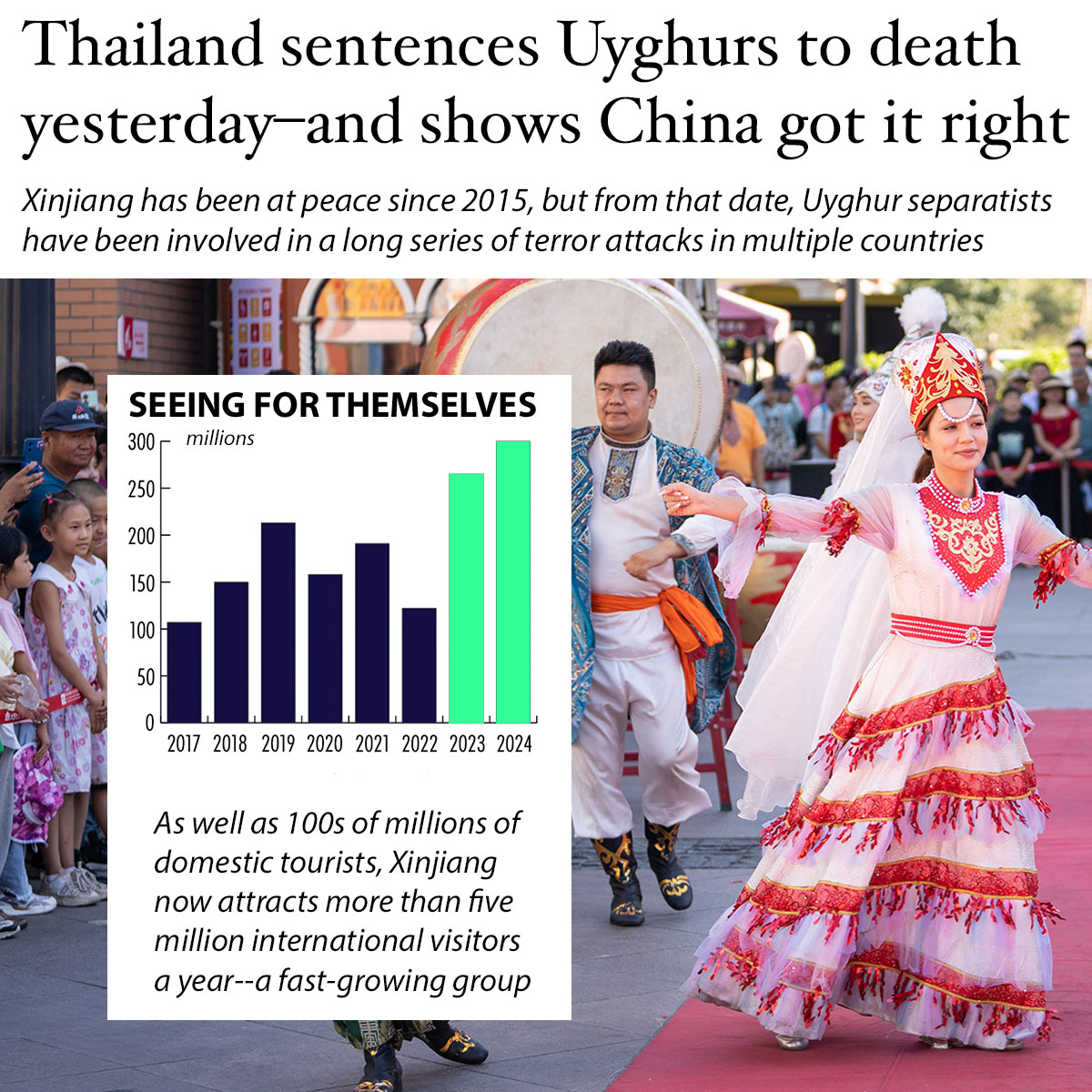
THAILAND IMPOSED DEATH SENTENCES on two Uyghur bombers yesterday – and showed that China got it right on dealing with terror attackers.
Turkic separatist terrorism is now feared in multiple countries—but NOT in China, where a program of vocational and language training for Uyghur radicals has dropped mass terror attacks to zero for eleven years.
Peaceful, ethnically mixed Xinjiang is now one of the world’s top tourism centers, with 300 million visitors a year.
This is a huge achievement, given that Uyghur separatists had been committing random acts of terror in China since at least 1990, with hundreds of innocents killed over multiple attacks across two and a half decades.
But this has flipped 180 degrees. Xinjiang is at peace. The last mass casualty terrorism incident was in October 2015, when Uyghur knifemen killed at least 16 people.
.
STIFF POLICING
How did China solve its problem? By stiff policing and compulsory vocational training for people associated with radicalism.
The NED (a CIA regime-change spin-off) worked with BBC and other western news organizations to rebrand the program as “atrocities”, implying, without evidence, that “millions” had been locked into “concentration camps” and even murdered.
But that has been well debunked, and it’s now impossible to avoid the hard fact that the Chinese system deradicalization system has worked.
One can just look and see, as millions of visitors do every year. While in the past, visitors were almost all Chinese domestic tourists, these days more than five million international tourists tour Xinjiang every year. Today the Chinese Uyghur community is peaceful, with rising rates of health and wealth. The population is growing in size and in proportion to other ethnic groups.
Uyghur longevity in China, at 77 years and rising, has significantly overtaken that of native Americans in the US, at just 70.1 years. Uyghur longevity is now close to that of white Americans, which is 78.4 years.
.
COMPARE CHINA AND OUTSIDE
That’s inside China’s borders.
But Uyghur separatists elsewhere?
As we mentioned, China solved its problem in 2015, but outside China the problems simply continued unabated:
- In 2015, Uyghur separatists bombed the Erawan Shrine in the centre of Bangkok, Thailand, killing 20 people and injuring 120.
- In 2016, Indonesian authorities arrested Uyghur terrorists working with the Eastern Indonesia Mujahidin, a terrorist group affiliated with Islamic State.
- After a pair of extremist suicide bombings in Brussels, Belgium, in March of 2016, China expressed willingness to work with European countries to combat terrorism. The offer was ignored.
- In 2017, a Syrian ambassador warned that 5,000 Uyghurs were fighting in Syria for jihadist groups. Other analysts had different estimates—but all agreed the fighters existed.
- In 2019, Four Uyghurs convicted of terror-related offenses in Indonesia were deported to China.
- In 2020, risk analysts warned that ISIS-Khorasan had started working with the East Turkestan Islamic Movement. This group was known as TIP, for Turkistan Islamic Party.
- In 2021, an ISIS-K fighter using the kunya “al-Uyghuri” attacked Shia Muslims in Kunduz, Afghanistan.
- In 2022, ISIS-K members made a shooting attack on a hotel in Kabul used by Chinese travelers.
- In 2025, the Economist reported that the rebels storming Syria in 2024 to topple Bashar al-Assad included fighters who “had roots in the Chinese region of Xinjiang and were members of the Turkistan Islamic Party (TIP), a group which aims to establish an Islamic state spanning Xinjiang and other parts of Central Asia”.
.
STORY CANNOT BE TOLD
There are plenty of other examples, but the basic conclusion should be clear from those examples.
China’s program to eradicate terrorism among its ethnic minority population and create a positive, low-crime community, has been remarkably successful.
Unfortunately, this story simply cannot be told to the world.
Look up the topic on Google, and you get link after link to the debunked NED/ BBC narrative of “millions” in “concentration camps” in China instead.
Ask AI programs for information, and all of them regurgitate the debunked NED/BBC fiction too.
Getting the truth out there is as challenging as ever.
English
@sarahcollins0 @NuryVittachi 联合国也是由人组成,其中也包含西方有特定立场的人,以及对于反恐措施的强度和广度,不同人有不同的标准。
中文
@LeviathanGunha 只有“短发”那个因为“中性化”的嫌疑而遭受“恋童癖 bait”的指责,而更女性化的却没有,我有些猜到那些右派反对Eive的动机了。
中文


@DungkenV @MourningScholar @OkboiN 事实上,私营企业中的党的委员会,不会参与企业内部的反腐调查,企业及其内部人员的任何违法犯罪行为,只会由外部的政府执法部门及其中的党纪委负责。
在执法部门以外,公司内部党组织从来不单独开展反腐检查,党的纪委部门一般都是在法律处罚之后启动惩罚程序。
公司内部的党组织更像党员工会。
中文

@MourningScholar @OkboiN A bit complicated but CCP policy Order will have more impact on company policy IF it come to social media/national security and propaganda warfare.
Any they proper get yearly anti corruption check from CCP too. Lol
English

told y'all. gacha games are diamat
AK_CN_InfoDump@AK_CN_Shitpost
The Communist Party Committee of Shanghai Hypergryph Network Technology Co., Ltd. was officially established
English
@KeanuNazari @xue948738946967 “支持”,绝大多数地区得到的只是口头和情感上的“支持”,不是一些左派想象的“善良的干涉主义帝国”。
中文


I got this high-res scan from an archive here in China.
Rare 1967 world map titled "The Boundless Radiance of Mao Zedong Thought Illuminates the Entire World Red."
It's mapping "countries where revolutionary struggle has been launched" that the PRC was backing.

English

@Rover8847 @SuperSisi 韩国有相当规模的这种年轻长相,就足够了,游戏反映的种族偏好不需要全国所有人都如此。
这是虚构作品,它只是在反映这个民族的审美偏好之一,不需要完全对应现实。
中文


Shift Up definitely made Evie look young for Stellar Blade 2, but it is still based in reality for some Asian girls in their early twenties
For reference this is Blackpink’s Jennie Kim at 21
Of course the girl needs to be lucky, pretty and cute! But it is not too far from Evie

SuperSisi@SuperSisi
While many people think Evie looks much younger, it is totally possible for Asian girls to have this kind of appearance at 23 (the age inferred in a recent interview with Shift Up) especially with short hair. In fact it is not uncommon. For westerners she may appear in her teens, but for us it isn’t strange to see her as a young adult.
English

@AK_CN_Shitpost Sad to say, since Lin's event it's been pretty obvious that the CCP was getting a say in the story.
And this has resulted in things like The Masses Travels where they rewrote chunks of the lore to fit what they wanted, and probably some of the other terrible ideas.
English

I always find it fascinating that the first instinct of many failed European monarchs was exile abroad, whereas Chinese rulers usually abdicated or died where they stood.
The last Song emperor died with his ministers rather than surrender. The last Ming emperor hanged himself in Beijing when the Ming fell. And the last Qing regent, after surviving multiple assassination attempts and the collapse of the dynasty, simply retired to his Beijing mansion. He then spent the rest of his life in Beijing and Tianjin through the warlord era, the Republican period, the Japanese invasion, and the founding of the PRC. When Japan established the puppet state of Manchukuo, he publicly denounced it rather than treating it as a refuge. Bro never seemed to think there was another state he could flee to or call home.
Angelica 🌐⚛️🇹🇼🇨🇳🇺🇸@AngelicaOung
Not just forgot I straight up did not know this. I thought it was kinda strange that European royalty were such a transcultural layer and often had such weak ties to the people they ruled. I just figured it wasn’t a problem. But it was a problem. Created a crisis of legitimacy. “Everyone forgets that the French Revolution villainized the monarchy for being alien to the French nation. King Louis XVI was 80% ethnically German/Austrian and his wife was 100% Austrian. In his trial, charges 9, 19, 20, 28, 31, and 33 were all concerning his foreignness to France which led to his treasonous collaboration with the Germans/Austrians fighting France at the time.”
English

@Pirat_Nation 我问了Grok,Grok说OpenAI的报告靠AI推测那些反AI账号使用VPN登录,账号“据说”属于一个中国公司(但不公开证据),并且这些账号“反对中国海外异见人士”。🤣🤣🤣
中文

OpenAI uncovered a China-linked campaign that tried to turn Americans against AI data centers by posing as regular people online.
The posts focused on rising electricity demand, water use, and the impact of large data centers on local communities.
OpenAI investigator Ben Nimmo said the campaign was “jumping onto the bandwagon of a genuine pre-existing domestic debate” rather than creating a new issue.
According to OpenAI, the operation tried to “exploit and amplify existing public concerns” but showed little sign of impact. Nimmo said, “We didn’t see any signs that they succeeded.”


English
@XrystalPhoenix @AK_CN_Shitpost 首先,一家公司成立一个共产党委员会,这“一点点讽刺”你已经忽略了。
其次,抽卡游戏与赌博有本质区别。
中文
@AK_CN_Shitpost A gacha game company… making a communist party committee…
The irony is not lost on me
English
恭喜!中共鹰角网络委员会正式成立!2022年党员人群超过50人,开始筹备成立党总支部,2026年党员人数正式达到100人。海猫络合物任党委副书记。mp.weixin.qq.com/s/cjRmJBMz-aTA…
#明日方舟ㅤ #Arknights #アークナイツ


中文

@CalMEurofan 无耻。7.3万人是2023年10月7日至今所有所有经医院、司法委员会核验登记的遇难者。
原子核爆的是即时遇难人数,而加沙是长期被封锁的狭小平民聚居区,持续轰炸伴随饥荒、缺水、医疗崩溃,大量间接死亡(疫病、营养不良)未计入 7.3 万统计,实际人道损失远高于纸面数字。
这仍然是恐怖的大屠杀。
中文

This is my favorite argument.
In Hiroshima, roughly 140k people died due to the nuclear bomb out of 350k. That’s 40% of the city.
In Nagasaki, 80k people died out of 263k. That’s 30% of the city.
In Gaza, 73k people have died (according to GHM) out of 2.3 million. That’s about 3% of the population. A substantial percentage of that are terrorists.
So Israel has dropped an amount of bombs on Gaza that exceeds the power of the nuclear bombs we dropped on Japan and yet the death toll is far lower both proportionally and on a raw numbers basis.
How is that possible if Israel is committing genocide? Maybe it’s because they’re not.
Muhammad Mazen@mhmd_s09
One of the most brutal scenes in human history has been leaked. The amount of explosives that Israel dropped on the Gaza Strip exceeded the power of the two atomic bombs that the United States dropped on Japan at the end of World War II. A video that the world must never forget.
English