Cashflow Farming 👨‍🌾

805 posts

Cashflow Farming 👨‍🌾 banner
Cashflow Farming 👨‍🌾

Cashflow Farming 👨‍🌾

@Cashflowfarming

Concentrated portfolio targetting 15% CAGR. Tech Sales by day, Investing by night.

Beigetreten Ekim 2023
261 Folgt261 Follower
Angehefteter Tweet
Cashflow Farming 👨‍🌾
Cashflow Farming 👨‍🌾@Cashflowfarming·
Probably the most comprehensive yet digestible investment thesis on $OKTA you will find online. I included qualitative/quantitative info and a case study to deliver a well-rounded, insightful thesis. Curious to hear your thoughts in the comments!👇👇 (full PDF in the comments.)

Cashflow Farming 👨‍🌾 tweet mediaCashflow Farming 👨‍🌾 tweet mediaCashflow Farming 👨‍🌾 tweet media
English
10
3
31
5.8K
Cashflow Farming 👨‍🌾
Cashflow Farming 👨‍🌾@Cashflowfarming·
🇻🇳 🇻🇳 ”I am the master of my fate, I am the captain of my soul" 🇻🇳🇻🇳 Vietnam: Economic success through sovereignty and pragmatic planning (🇪🇺 Europe should take inspiration from Vietnam's pragmatism and planing). Vietnam stands out in Southeast Asia for pursuing independence and development with discipline, consistency, and realism. Achieving the highest GDP growth in the region. 🚀 📊 While countries such as Thailand 🇹🇭, Philippines 🇵🇭, Indonesia 🇮🇩, Cambodia 🇰🇭struggle economically or just straight up act as Vassal states for foreign powers (such as the USA 🇺🇸). Vietnam has worked to preserve autonomy across politics, economic strategy, energy security, and digital infrastructure. The result has been major economic success, with stronger growth, rising industry, tangible improvements in living standards for its population, and building the most anti-fragile economy in the region. 1) Sovereignty in a Dependent World 🌍🛡️ Many countries in Southeast Asia function, in practice, as junior partners or de facto vassals of larger powers, especially the United States, often at the expense of their own long-term interests. Vietnam, by contrast, has pursued a sovereign path. Vietnam built a fast-growing economy while also trying to limit excessive foreign influence and interference. Rather than becoming fully dependent on any one external power, Vietnam has sought to maintain room for independent decision-making. That ability to preserve strategic autonomy is one of the main reasons it stands apart in the region. Let’s explore how: 2) A balanced relationship with China 🇨🇳 Vietnam’s strength lies in its pragmatic relationship with China. Rather than aligning with the United States and openly provoking Beijing, like the Philippines does, Vietnam is much smarter and cooperates with China where it serves Vietnamese interests while preserving its own autonomy. Vietnam has a “Three No’s” policy, meaning it doesn’t join military alliances, doesn’t allow foreign bases in its country, and doesn’t side with one country against another 🪖 ⚔️. Vietnam keeps military channels open and even conducts joint patrols and exercises with China. This shows a willingness to manage tensions through cooperation where possible, instead of turning itself into a permanent frontline state for another power. Another strategic autonomy comparison is that Thailand relies heavily on the United States for weapons (which can block fighter jets ✈️ from working at any moment if they want), while Vietnam diversifies its suppliers to maintain strategic autonomy. Moreover hanks to friendly relations with China, Vietnam is accessing China’s leading edge industrial technology in areas like manufacturing, batteries, energy and electrification. To contrast this, the Philippines has taken the opposite path. By expanding U.S. military access, it has tied itself more closely to Washington’s regional strategy while gaining little in terms of technology or industrial development. The country’s infrastructure remains heavily oil-dependent, with some of the weakest infrastructure in the world. 3) Electrification, Energy & infrastructure ⚡🔋🏗️ By working with China, Vietnam is gaining the tools to build a more energy-independent and anti-fragile economy. Asian countries are energy vulnerable because they depend heavily on imported oil and gas. Vietnam has recognised that real energy security and anti fragility for net importers lies in aggressive electrification. 🛢️⛽💧 Electric scooters are widespread, and now mandated in Hanoi, domestic EV production is emerging with domestic companies such as Vinfast, and the broader infrastructure is being built out. Crucially, this progress is tied to cooperation with China, which holds the key technologies, industrial capacity, and IP in batteries, electrification, and energy storage. Vietnam recently announced nuclear electricity projects in joint development with Chinese expertise. Its push into nuclear and large-scale power generation further reinforces this long-term strategy. Vietnam is building resilience through electrification, while others remain exposed to a fragile fossil-fuel system. 4) Digital sovereignty 📱 🌐 Where many countries rely on foreign technology for communications, payments, and digital services, Vietnam has ensured that its digital destiny is in its own hands. Vietnam communicates and pays primarily through Zalo. 🅉💬📱 By not relying on apps such as WhatsApp or services like Mastercard, Vietnam is making it harder for foreign countries to interfere and destabilize through surveillance, backdoors, or arbitrary sanctions. Zalo (developed by VNG Corporation) is Vietnam’s super app for: - Messaging - Payments - Cloud & business services - Digital services & mini programs - Government services 5) War & Independence ⚔️🪖🛡️🇻🇳 In many cases, a country’s sovereignty is decided on the battlefield: those who win wars of independence can set their own political systems, draft their own constitutions, and rules. By contrast, countries that are militarily defeated face imposed limits. For example, after World War II, Germany 🇩🇪 and Japan’s 🇯🇵 constitutions was shaped and had to be approved by the USA 🇺🇸. Their military size was also restricted. While the Philippines 🇵🇭 also developed within a U.S influenced constitution (which was poorly adapted for local conditions). Vietnam stands in contrast, having secured victory in its conflicts and therefore retaining full control over its political and military development. It’s Doi Moi reforms, education program and modern planning has been hugely successful. 6) Human Capital 🎓 📚 🧠 👩‍🏫 👨‍🎓 ✏️ Vietnamese youth place a high emphasis on education and self-improvement, reflected in high literacy, STEM, and solid academic performance. Its population is young, disciplined, and highly motivated, with a clear drive to improve living standards. Economically, Vietnam is also well-balanced. It’s not overly reliant on tourism but has a diversified base spanning manufacturing, electronics, agriculture, and a growing tech sector. This mix of human capital and economic diversity gives it a strong foundation for sustained growth. #Vietnam #Việtnam #KinhTếViệtNam #ChuyểnĐổiSố #CôngNghệ #PhátTriển #ĐổiMới #ĐầuTư #HạTầng #DoanhNghiệp #KhởiNghiệp #SảnXuất #TươngLai #ASEAN #KinhTe #KinhTeVietNam #TangTruong #CongNghe #ChuyenDoiSo #SoHoa #HaTang #CongNghiep #SanXuat #DauTu #KhoiNghiep #DigitalVietnam #Zalo
Cashflow Farming 👨‍🌾 tweet media
English
0
0
0
25
Aria Radnia 🇮🇷
Aria Radnia 🇮🇷@QualityInvest5·
You could've nailed the bottom of $MNDY stock in the 2022 selloff ––> Rallied 400% And would now be down -3% on those same shares Crazy
English
5
0
38
5.5K
Cashflow Farming 👨‍🌾 retweetet
Paul, not a CFA
Paul, not a CFA@Investmentideen·
$WIX is officially dead. Just redesigned an entire website, hosted it on Cloudflare, and integrated a form that announces submissions via Telegram–all done by Agentic AI in under 24 hours. Cancelling my WIX subscription next week.
English
19
2
55
13.6K
Cashflow Farming 👨‍🌾 retweetet
Therationalmind
Therationalmind@Rationalmind__·
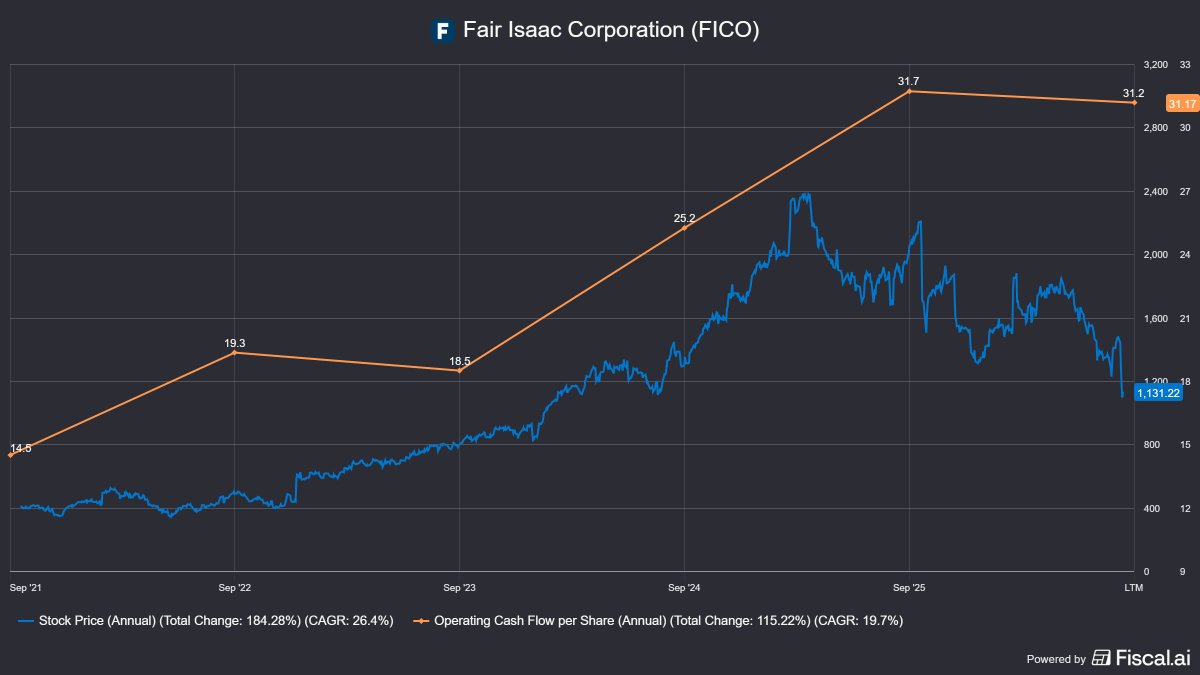
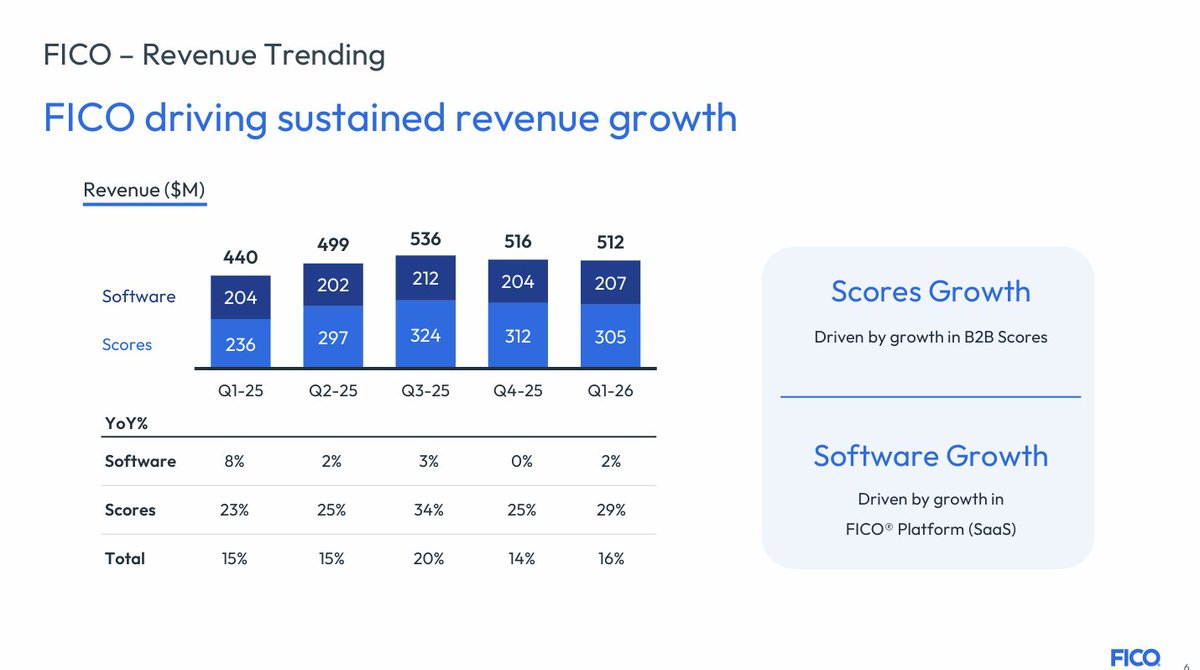
A quality valuation analysis on $FICO Current price: ~$1,150. FY26 non GAAP EPS guide: $38.17.​ NTM P/E: ~29.6x.​​ TTM FCF: $718M.​​ TTM FCF yield: ~2.7%.​​ As you can see, $FICO is no longer priced like the untouchable monopoly it was in early January when the stock was around $1,666, or even above $2,000 A lot of the multiple compression has already happened, while the business itself is still growing at a very healthy rate.​​ Before we get into valuation, let’s look at why $FICO is such a good business BUSINESS QUALITY $FICO is really two businesses: Scores and Software. Scores is the crown jewel, and it is one of the best business models in the market.​ FICO says its score is the industry standard measure of consumer credit risk for over 35 years and is used by 90% of top U.S. lenders.​ That is not a normal software moat That is infrastructure.​ Q1 FY26 was strong: Revenue: $512M, up 16% YoY.​​ Scores revenue: $305M, up 29% YoY.​​ Software revenue: $207M, up 2% YoY.​ GAAP EPS: $6.61, up 8% YoY.​​ Non-GAAP EPS: $7.33, up 27% YoY.​​ The key point here...the Scores segment is still an absolute machine​ Q1 Scores operating margin was 88%.​ That is monopoly profitability...point And the mortgage business is still doing heavy lifting.​ FICO said mortgage originations were more than half of B2B revenue in recent quarters, and Q1 Scores growth was driven mainly by higher mortgage score unit price plus higher mortgage origination volume.​ The market tends to ignore the Software side, but there is something real there too.​ Platform ARR reached $303M in Q1, up 33% YoY, and platform DBNRR hit 122%.​ That matters because it gives $FICO a second compounding engine beyond the core score monopoly BALANCE SHEET This is where you should be honest: FICO does not have a pristine balance sheet.​ Cash and investments were $217.9M at Q1, while total liabilities were $3.66B, stockholders’ deficit was $(1.81)B, and leverage was 2.64x versus a covenant max of 3.5x.​ So this is not a cash rich fortress like some other compounders It is a highly cash generative business that uses leverage and buybacks aggressively That works beautifully when the moat is intact...It becomes much less comfortable when the market starts questioning pricing power CAPITAL ALLOCATION $FICO continues to lean hard into buybacks.​ In Q1 alone, it repurchased 95K shares for $163M at an average price of $1,707 per share.​​ Management explicitly shows a 20+ year history of continuous repurchases and states that share repurchases remain a key part of capital allocation.​ This has helped turbocharge EPS growth over time.​ But it also means you need to underwrite both the business and the leverage together.​ GUIDANCE FY26 guidance is still strong: Revenue: $2.35B, up 18% YoY.​ GAAP EPS: $33.47, up 22% YoY.​ Non-GAAP EPS: $38.17, up 24% YoY.​ Non-GAAP net income: $907M, up 28% YoY.​ That is the part the market is wrestling with The stock has sold off hard, but management is still guiding for a very strong year THE BEAR CASE The bear case is obvious: mortgage score competition. VantageScore and the bureaus are pushing hard, arguing that competition can lower lender costs, broaden access, and save hundreds of millions annually Equifax said more than 250 mortgage lenders were already taking advantage of its VantageScore offer, and more than 40 non GSE lenders were in production with only VantageScore scores for some portfolios That is why the market suddenly stopped treating FICO like a sacred cow If pricing gets structurally competed away, the multiple should stay lower than it was before. THE BULL CASE The bull case is that the market is overreacting to headline risk and underestimating how embedded FICO still is FICO is not sitting still: it launched its Mortgage Direct Licensing Program, says it is engaged with resellers representing about 90% of U.S. mortgage volume, and introduced pricing options designed to reduce reseller markup and lender breakage fees $FICO is also pushing innovation rather than just defending legacy pricing.​ It partnered with Plaid for the next generation of UltraFICO, expanded strategic reseller participation, and keeps pushing FICO 10T as the most predictive and inclusive score.​ So the key question is not if competition exist It is whether competition permanently breaks FICO’s economics, or just trims the excess while leaving the franchise dominant NOW TO VALUATION At today’s price of about $1,150, $FICO trades at roughly 29.7x FY26 non GAAP EPS guidance of $38.17. ​​ Rather than use Graham’s formula, I think the better way to value $FICO is to ask a simpler question: What does the stock look like if EPS compounds from here, and what multiple does the market pay at the end?​​ Let’s use FY26 non GAAP EPS guidance of $38.17 as the base.​ If FICO compounds EPS at 10% for 3 years: FY29 EPS would be about $50.8.​ At 25x P/E = $1,270 price target, or about 4% CAGR At 30x P/E = $1,524, or about 10% CAGR.​​ At 35x P/E = $1,778, or about 16% CAGR.​​ If FICO compounds EPS at 15% for 3 years: FY29 EPS would be about $58.1.​ At 25x P/E = $1,453, or about 8.6% CAGR.​​ At 30x P/E = $1,743, or about 15.4% CAGR.​​ At 35x P/E = $2,033, or about 21.5% CAGR.​​ If FICO compounds EPS at 20% for 3 years: FY29 EPS would be about $65.9.​ At 25x P/E = $1,648, or about 13.2% CAGR.​​ At 30x P/E = $1,978, or about 20.4% CAGR.​​ At 35x P/E = $2,308, or about 26.7% CAGR.​​ If FICO compounds EPS at 25% for 3 years: FY29 EPS would be about $74.6.​ At 25x P/E = $1,864, or about 18.0% CAGR.​​ At 30x P/E = $2,237, or about 25.5% CAGR.​​ At 35x P/E = $2,609, or about 32.1% CAGR.​​ What this tells me is simple: If $FICO becomes just a 10% grower and the market only pays 25x, upside is limited.​​ If $FICO can still grow EPS 15%–20% and hold a 30x multiple, returns are very attractive from here.​​ If the mortgage fears fade and the market re rates the stock closer to 35x, the upside becomes very meaningful So this is no longer a buy anything, it’s a monopoly stock It is now a quality business with controversy, which is usually where the interesting setups start. FINAL TAKE $FICO still has one of the best underlying businesses in the market: mission critical product,​ 88% Scores margins,​ recurring buybacks,​ strong FY26 guide,​ and a real second engine in Platform software.​ But the stock is no longer priced for perfection, because the market is finally questioning whether the moat is as wide as everyone assumed. That is exactly what makes the setup interesting. Today at around $1,150, $FICO looks less like a forever expensive compounder and more like a high quality franchise that may finally offer a real entry point.
Therationalmind tweet mediaTherationalmind tweet media
English
3
4
70
5K
Cashflow Farming 👨‍🌾 retweetet
Simba
Simba@anonymouskeepit·
$AER is getting interesting at ~130 which is ~1.2x 12/31 book value. Management probably repurchasing aggressively given capital allocation policy. Obviously some counterparty and releasing risk but an attractive entry imo if you think crisis will resolve soon.
English
2
2
30
15.7K
Cashflow Farming 👨‍🌾 retweetet
Cashflow Farming 👨‍🌾
Cashflow Farming 👨‍🌾@Cashflowfarming·
The days where technology will be operated purely by our brain's electromagnetic signals will eventually come ( $META neural band is an early preview). In the mean time, and thanks to LLM's voice will be the interim medium to operate tech hands and voice free.
yenkel@yenkel

English
0
1
2
187
Aria Radnia 🇮🇷
Aria Radnia 🇮🇷@QualityInvest5·
@MarketProphit please remoev me from this AI slop list you guys have made, i dont wanna be a prophet of anything
English
2
0
9
1.9K
Aria Radnia 🇮🇷
Aria Radnia 🇮🇷@QualityInvest5·
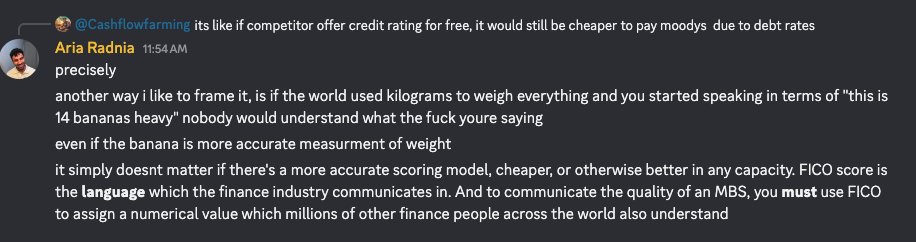
What would be harder to compete with: Make a viable competitor to $ASML lithography De-throne $FICO as the industry standard? 🤔
English
25
0
38
22.4K
Aria Radnia 🇮🇷
Aria Radnia 🇮🇷@QualityInvest5·
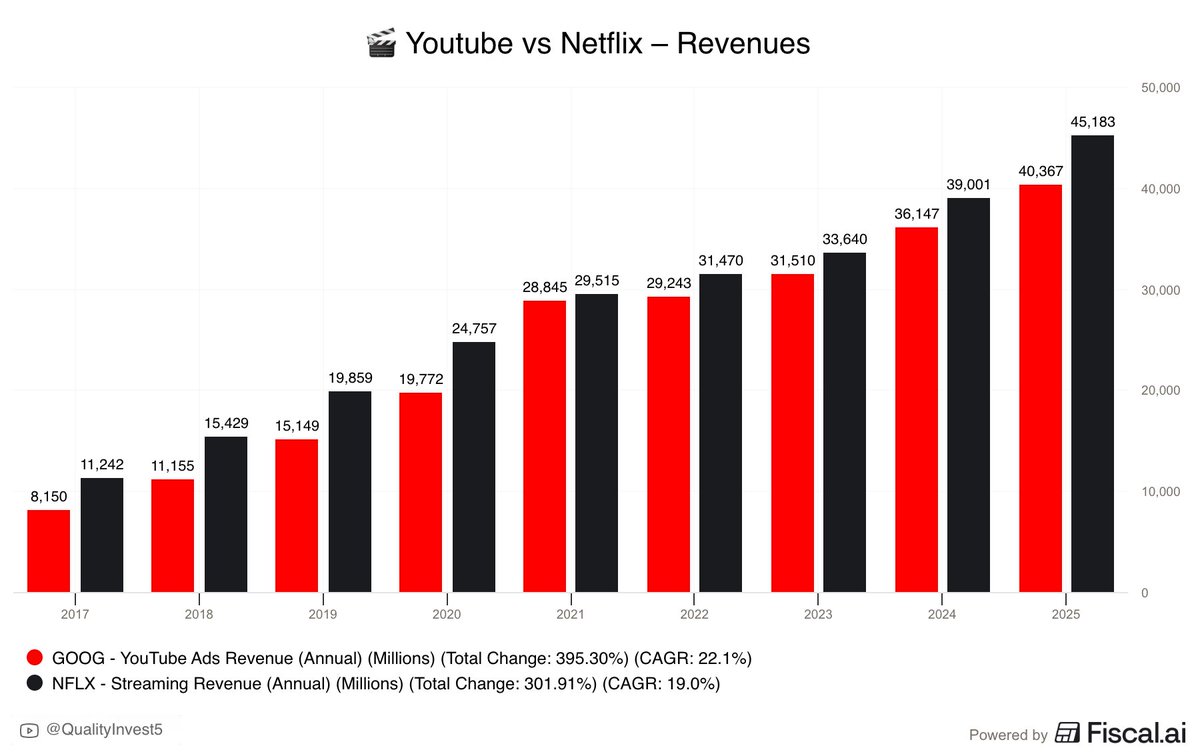
If YouTube was public on its own Would it have a higher or lower market cap than Netflix?
Aria Radnia 🇮🇷 tweet media
English
16
2
36
6K
Cashflow Farming 👨‍🌾
Cashflow Farming 👨‍🌾@Cashflowfarming·
Vinci ($DG.PA) is a collection of hard asset monopolies. It doesn't get talked about a lot, but Vinci's assets are cash machines and critical assets that are impossible to replace, bypass, or disrupt. They operate the following businesses: - 72 airports. - 4,400km of toll roads. - Energy construction Order book at a record €69B. Concessions: Airports and toll roads generate less than 20% of revenue but the majority of operating profit. Long contracts, captive traffic, inflation-linked pricing. Energy (under-rated thesis IMO): VINCI Energies is capitalising on one of Europe’s most urgent structural needs: electrification. The continent has learned the hard way how costly dependence on imported gas and oil can be. With Russia no longer a trusted partner, Gulf energy supplies exposed to geopolitical risk, and the US becoming a less reliable ally, the EU is committing MASSIVE investment to electrification and energy sovereignty, the spending is a matter of political life or death for leaders. Vinci is capturing this immense demand, as evidenced by its record order book backlog. Non-USD Diversification: In a world shaped by de-dollarisation, Vinci generates its cash flows in non-USD currencies such as euros, sterling, and reais. Its non-USD exposure by design is a great way to diversify your portfolio without compromising on quality. 👇🏻 Any interest in this one?
Cashflow Farming 👨‍🌾 tweet media
English
1
0
1
72
Fiscora
Fiscora@fiscorainvest·
@QualityInvest5 @Cashflowfarming Language protocol moat is probably one of the highest tiers of moat in my opinion. You already know how I feel about $FICO.
English
2
0
7
750
Cashflow Farming 👨‍🌾
Cashflow Farming 👨‍🌾@Cashflowfarming·
@JulienTechInvst Comment miser sur un pureplay sur la demande de CPU? ARM? HPE? QCOM? ou autre? ou meme aws avec graviton. Quelle serait le meilleur comme stock cpu a ton avis?
Français
2
0
2
609
Julien | Tech & Invests
Julien | Tech & Invests@JulienTechInvst·
Ça fait un moment que je le répète, mais la pénurie de GPUs s’est aggravée sur 2026. Il y a un gros gap entre la demande en puces et celles qui seront mises en ligne sur l’année. Les chiffres le montrent encore d’ailleurs et la situation n’est pas prête de s’améliorer… Ce qui est fou c’est que ces infos sont publiques mais il y a toujours des personnes pour douter de la demande et penser qu’Nvidia ne continuera pas de croître. Le marché répète sans arrêt les mêmes erreurs en sous-estimant la durée de la croissance qu’une méga cap peut faire. Pour rappel, le cloud ça a plus de 20 ans, avec les premiers datacenters modernes tels qu’on les connaît qui datent de 2007-2008 (avec AWS). Une grosse partie des workloads ont déjà migré sur le cloud public et pourtant, on a jamais eu autant de demande pour de nouvelles capacités de calcul (et donc de CPUs), même en excluant la demande IA. Très clairement, on atteindra pas de break even avant au moins 2029-2030 sur la capacité de calcul IA. Et même passé cette date, la probabilité que la croissance continue est de quasi 100%
Ben Pouladian@benitoz

GPU availability just hit multi-year lows. B200: <5% H100: collapsing A100: same Oil gets the headlines, but the dominant secular story for markets is surging compute demand. At NVIDIA GTC next week seeing what’s next. Stay tuned. $nvda

Français
3
3
79
16.4K