
Cashflow Farming 👨‍🌾

800 posts

Cashflow Farming 👨‍🌾 banner
Cashflow Farming 👨‍🌾

Cashflow Farming 👨‍🌾

@Cashflowfarming

Concentrated portfolio targetting 15% CAGR. Tech Sales by day, Investing by night.

Katılım Ekim 2023
261 Takip Edilen263 Takipçiler
Sabitlenmiş Tweet
Cashflow Farming 👨‍🌾
Cashflow Farming 👨‍🌾@Cashflowfarming·
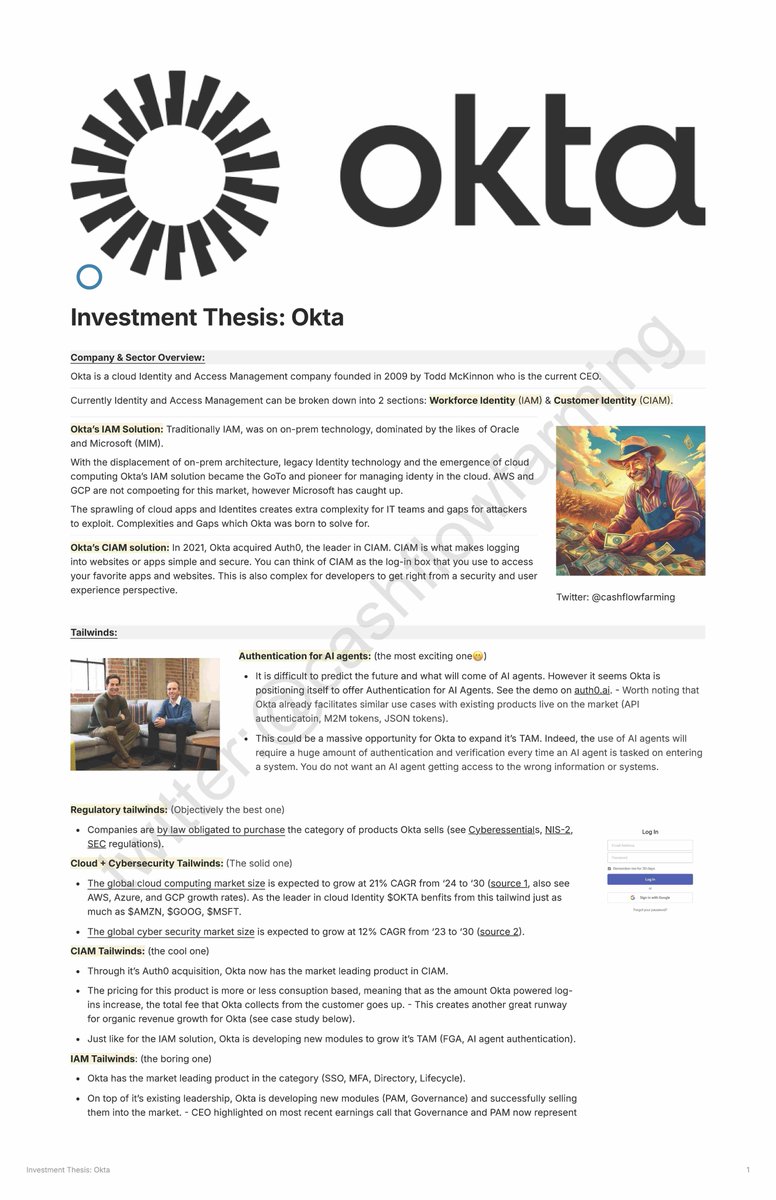
Probably the most comprehensive yet digestible investment thesis on $OKTA you will find online. I included qualitative/quantitative info and a case study to deliver a well-rounded, insightful thesis. Curious to hear your thoughts in the comments!👇👇 (full PDF in the comments.)
Cashflow Farming 👨‍🌾 tweet mediaCashflow Farming 👨‍🌾 tweet mediaCashflow Farming 👨‍🌾 tweet media
English
10
3
31
5.8K
Cashflow Farming 👨‍🌾 retweetledi
Therationalmind
Therationalmind@Rationalmind__·
A quality valuation analysis on $FICO Current price: ~$1,150. FY26 non GAAP EPS guide: $38.17.​ NTM P/E: ~29.6x.​​ TTM FCF: $718M.​​ TTM FCF yield: ~2.7%.​​ As you can see, $FICO is no longer priced like the untouchable monopoly it was in early January when the stock was around $1,666, or even above $2,000 A lot of the multiple compression has already happened, while the business itself is still growing at a very healthy rate.​​ Before we get into valuation, let’s look at why $FICO is such a good business BUSINESS QUALITY $FICO is really two businesses: Scores and Software. Scores is the crown jewel, and it is one of the best business models in the market.​ FICO says its score is the industry standard measure of consumer credit risk for over 35 years and is used by 90% of top U.S. lenders.​ That is not a normal software moat That is infrastructure.​ Q1 FY26 was strong: Revenue: $512M, up 16% YoY.​​ Scores revenue: $305M, up 29% YoY.​​ Software revenue: $207M, up 2% YoY.​ GAAP EPS: $6.61, up 8% YoY.​​ Non-GAAP EPS: $7.33, up 27% YoY.​​ The key point here...the Scores segment is still an absolute machine​ Q1 Scores operating margin was 88%.​ That is monopoly profitability...point And the mortgage business is still doing heavy lifting.​ FICO said mortgage originations were more than half of B2B revenue in recent quarters, and Q1 Scores growth was driven mainly by higher mortgage score unit price plus higher mortgage origination volume.​ The market tends to ignore the Software side, but there is something real there too.​ Platform ARR reached $303M in Q1, up 33% YoY, and platform DBNRR hit 122%.​ That matters because it gives $FICO a second compounding engine beyond the core score monopoly BALANCE SHEET This is where you should be honest: FICO does not have a pristine balance sheet.​ Cash and investments were $217.9M at Q1, while total liabilities were $3.66B, stockholders’ deficit was $(1.81)B, and leverage was 2.64x versus a covenant max of 3.5x.​ So this is not a cash rich fortress like some other compounders It is a highly cash generative business that uses leverage and buybacks aggressively That works beautifully when the moat is intact...It becomes much less comfortable when the market starts questioning pricing power CAPITAL ALLOCATION $FICO continues to lean hard into buybacks.​ In Q1 alone, it repurchased 95K shares for $163M at an average price of $1,707 per share.​​ Management explicitly shows a 20+ year history of continuous repurchases and states that share repurchases remain a key part of capital allocation.​ This has helped turbocharge EPS growth over time.​ But it also means you need to underwrite both the business and the leverage together.​ GUIDANCE FY26 guidance is still strong: Revenue: $2.35B, up 18% YoY.​ GAAP EPS: $33.47, up 22% YoY.​ Non-GAAP EPS: $38.17, up 24% YoY.​ Non-GAAP net income: $907M, up 28% YoY.​ That is the part the market is wrestling with The stock has sold off hard, but management is still guiding for a very strong year THE BEAR CASE The bear case is obvious: mortgage score competition. VantageScore and the bureaus are pushing hard, arguing that competition can lower lender costs, broaden access, and save hundreds of millions annually Equifax said more than 250 mortgage lenders were already taking advantage of its VantageScore offer, and more than 40 non GSE lenders were in production with only VantageScore scores for some portfolios That is why the market suddenly stopped treating FICO like a sacred cow If pricing gets structurally competed away, the multiple should stay lower than it was before. THE BULL CASE The bull case is that the market is overreacting to headline risk and underestimating how embedded FICO still is FICO is not sitting still: it launched its Mortgage Direct Licensing Program, says it is engaged with resellers representing about 90% of U.S. mortgage volume, and introduced pricing options designed to reduce reseller markup and lender breakage fees $FICO is also pushing innovation rather than just defending legacy pricing.​ It partnered with Plaid for the next generation of UltraFICO, expanded strategic reseller participation, and keeps pushing FICO 10T as the most predictive and inclusive score.​ So the key question is not if competition exist It is whether competition permanently breaks FICO’s economics, or just trims the excess while leaving the franchise dominant NOW TO VALUATION At today’s price of about $1,150, $FICO trades at roughly 29.7x FY26 non GAAP EPS guidance of $38.17. ​​ Rather than use Graham’s formula, I think the better way to value $FICO is to ask a simpler question: What does the stock look like if EPS compounds from here, and what multiple does the market pay at the end?​​ Let’s use FY26 non GAAP EPS guidance of $38.17 as the base.​ If FICO compounds EPS at 10% for 3 years: FY29 EPS would be about $50.8.​ At 25x P/E = $1,270 price target, or about 4% CAGR At 30x P/E = $1,524, or about 10% CAGR.​​ At 35x P/E = $1,778, or about 16% CAGR.​​ If FICO compounds EPS at 15% for 3 years: FY29 EPS would be about $58.1.​ At 25x P/E = $1,453, or about 8.6% CAGR.​​ At 30x P/E = $1,743, or about 15.4% CAGR.​​ At 35x P/E = $2,033, or about 21.5% CAGR.​​ If FICO compounds EPS at 20% for 3 years: FY29 EPS would be about $65.9.​ At 25x P/E = $1,648, or about 13.2% CAGR.​​ At 30x P/E = $1,978, or about 20.4% CAGR.​​ At 35x P/E = $2,308, or about 26.7% CAGR.​​ If FICO compounds EPS at 25% for 3 years: FY29 EPS would be about $74.6.​ At 25x P/E = $1,864, or about 18.0% CAGR.​​ At 30x P/E = $2,237, or about 25.5% CAGR.​​ At 35x P/E = $2,609, or about 32.1% CAGR.​​ What this tells me is simple: If $FICO becomes just a 10% grower and the market only pays 25x, upside is limited.​​ If $FICO can still grow EPS 15%–20% and hold a 30x multiple, returns are very attractive from here.​​ If the mortgage fears fade and the market re rates the stock closer to 35x, the upside becomes very meaningful So this is no longer a buy anything, it’s a monopoly stock It is now a quality business with controversy, which is usually where the interesting setups start. FINAL TAKE $FICO still has one of the best underlying businesses in the market: mission critical product,​ 88% Scores margins,​ recurring buybacks,​ strong FY26 guide,​ and a real second engine in Platform software.​ But the stock is no longer priced for perfection, because the market is finally questioning whether the moat is as wide as everyone assumed. That is exactly what makes the setup interesting. Today at around $1,150, $FICO looks less like a forever expensive compounder and more like a high quality franchise that may finally offer a real entry point.
Therationalmind tweet mediaTherationalmind tweet media
English
3
4
70
5K
Cashflow Farming 👨‍🌾 retweetledi
Simba
Simba@anonymouskeepit·
$AER is getting interesting at ~130 which is ~1.2x 12/31 book value. Management probably repurchasing aggressively given capital allocation policy. Obviously some counterparty and releasing risk but an attractive entry imo if you think crisis will resolve soon.
English
2
2
30
15.7K
Cashflow Farming 👨‍🌾 retweetledi
Cashflow Farming 👨‍🌾
Cashflow Farming 👨‍🌾@Cashflowfarming·
The days where technology will be operated purely by our brain's electromagnetic signals will eventually come ( $META neural band is an early preview). In the mean time, and thanks to LLM's voice will be the interim medium to operate tech hands and voice free.
yenkel@yenkel

English
0
1
2
185
Aria Radnia 🇮🇷
Aria Radnia 🇮🇷@QualityInvest5·
@MarketProphit please remoev me from this AI slop list you guys have made, i dont wanna be a prophet of anything
English
2
0
9
1.9K
Aria Radnia 🇮🇷
Aria Radnia 🇮🇷@QualityInvest5·
What would be harder to compete with: Make a viable competitor to $ASML lithography De-throne $FICO as the industry standard? 🤔
English
25
0
38
22.4K
Aria Radnia 🇮🇷
Aria Radnia 🇮🇷@QualityInvest5·
If YouTube was public on its own Would it have a higher or lower market cap than Netflix?
Aria Radnia 🇮🇷 tweet media
English
16
2
36
6K
Cashflow Farming 👨‍🌾
Cashflow Farming 👨‍🌾@Cashflowfarming·
Vinci ($DG.PA) is a collection of hard asset monopolies. It doesn't get talked about a lot, but Vinci's assets are cash machines and critical assets that are impossible to replace, bypass, or disrupt. They operate the following businesses: - 72 airports. - 4,400km of toll roads. - Energy construction Order book at a record €69B. Concessions: Airports and toll roads generate less than 20% of revenue but the majority of operating profit. Long contracts, captive traffic, inflation-linked pricing. Energy (under-rated thesis IMO): VINCI Energies is capitalising on one of Europe’s most urgent structural needs: electrification. The continent has learned the hard way how costly dependence on imported gas and oil can be. With Russia no longer a trusted partner, Gulf energy supplies exposed to geopolitical risk, and the US becoming a less reliable ally, the EU is committing MASSIVE investment to electrification and energy sovereignty, the spending is a matter of political life or death for leaders. Vinci is capturing this immense demand, as evidenced by its record order book backlog. Non-USD Diversification: In a world shaped by de-dollarisation, Vinci generates its cash flows in non-USD currencies such as euros, sterling, and reais. Its non-USD exposure by design is a great way to diversify your portfolio without compromising on quality. 👇🏻 Any interest in this one?
Cashflow Farming 👨‍🌾 tweet media
English
1
0
1
72
Fiscora
Fiscora@fiscorainvest·
@QualityInvest5 @Cashflowfarming Language protocol moat is probably one of the highest tiers of moat in my opinion. You already know how I feel about $FICO.
English
2
0
7
750
Cashflow Farming 👨‍🌾
Cashflow Farming 👨‍🌾@Cashflowfarming·
@JulienTechInvst Comment miser sur un pureplay sur la demande de CPU? ARM? HPE? QCOM? ou autre? ou meme aws avec graviton. Quelle serait le meilleur comme stock cpu a ton avis?
Français
2
0
2
609
Julien | Tech & Invests
Julien | Tech & Invests@JulienTechInvst·
Ça fait un moment que je le répète, mais la pénurie de GPUs s’est aggravée sur 2026. Il y a un gros gap entre la demande en puces et celles qui seront mises en ligne sur l’année. Les chiffres le montrent encore d’ailleurs et la situation n’est pas prête de s’améliorer… Ce qui est fou c’est que ces infos sont publiques mais il y a toujours des personnes pour douter de la demande et penser qu’Nvidia ne continuera pas de croître. Le marché répète sans arrêt les mêmes erreurs en sous-estimant la durée de la croissance qu’une méga cap peut faire. Pour rappel, le cloud ça a plus de 20 ans, avec les premiers datacenters modernes tels qu’on les connaît qui datent de 2007-2008 (avec AWS). Une grosse partie des workloads ont déjà migré sur le cloud public et pourtant, on a jamais eu autant de demande pour de nouvelles capacités de calcul (et donc de CPUs), même en excluant la demande IA. Très clairement, on atteindra pas de break even avant au moins 2029-2030 sur la capacité de calcul IA. Et même passé cette date, la probabilité que la croissance continue est de quasi 100%
Ben Pouladian@benitoz

GPU availability just hit multi-year lows. B200: <5% H100: collapsing A100: same Oil gets the headlines, but the dominant secular story for markets is surging compute demand. At NVIDIA GTC next week seeing what’s next. Stay tuned. $nvda

Français
3
3
79
16.4K
Jamal Dinkoui
Jamal Dinkoui@BerbarianWizard·
What the CIA did with crack to Black people in USA, the DGSI is now doing with seed oils to Arabs in France.
English
85
946
5.4K
2.2M
CapexAndChill
CapexAndChill@CapexAndChill·
"There is always something to worry about. Avoid weekend thinking and ignore the latest dire predictions of newscasters. Sell a stock because the company's fundamentals deteriorate, not because the sky is falling." - Peter Lynch, Beating the Street
CapexAndChill@CapexAndChill

I remember Peter Lynch dedicated a whole section in one his books to the weekend worriers. This happened a few times already where the futures open on Sunday disastrously, yet when the market finally opens its not that down nearly as much.

English
2
0
9
1.7K
BuccoCapital Bloke
BuccoCapital Bloke@buccocapital·
The case for software. Not rooted in vibes, but in earnings power. 1. If AI truly can replace labor, it’s not crazy to argue that the incumbent software companies are best positioned to capture the economic value of the opportunity. If you charge $50/seat for a support rep, but suddenly flip to charging .50c per closed support ticket, you are suddenly sitting on a much more lucrative business model 2. Gross margins for software are unbelievably good. Revenue is recurring and predicable. It’s sticky revenue. If these businesses get religion on profitability there is incredible untapped earnings power There’s more here, but I think you only need those two pillars. And I don’t think either of them are insane assumptions. Today, these businesses are priced at material terminal value risk. The multiple compression risk is mostly gone. They’re pretty derisked
Dave “3 and 30” Tepper@institLPGP

@PythiaR sold too hard based on what? make a case not rooted in vibes. base it on earnings power. I’ll wait.

English
18
14
366
90.7K
Cashflow Farming 👨‍🌾
Cashflow Farming 👨‍🌾@Cashflowfarming·
Just re-opened $MNDY for the first time in a year. Lot's of debates, fear, contrarian takes out there. But sometimes it's just so simple and obvious: $MNDY is getting one-shot Claude coded by every enterprise customer out there. Simple.
English
1
0
4
161
Cashflow Farming 👨‍🌾 retweetledi
Mitch Presnick 柏力
Mitch Presnick 柏力@mitchpresnick·
The United States tends to view China as its principal competitor because it interprets global power through a largely zero-sum lens. China, by contrast, does not primarily frame the United States as the central opponent. Its real competition is with its own historical constraints — its analog legacy, the risk of the middle-income trap, demographic headwinds, and the demands of the technological frontier in the digital age. In that sense, China competes less against a nation than against underdevelopment, inefficiency, and time itself. Its posture toward AI illustrates this clearly: it treats AI simultaneously as a destabilizing force that must be controlled and as an accelerant for industrial upgrading. That dual framing reflects a positive-sum orientation — the belief that technological transformation is the arena to be mastered, not merely a weapon in geopolitical rivalry.
Balaji@balajis

I disagree. Yes, Congressional Democrats do want to stop AI, because it disrupts blue jobs. And Republicans do want a military-friendly AI. But China wants to open source AI, because the Chinese make money from AI-enabled hardware instead. The rest of the world wants open source models as well. That’s likely where things land up, once model capabilities top out. America is essentially serving as the bootloader for AI, spending billions to give the world one last incredible gift before turning the lights out on Silicon Valley. Because with wealth taxes and visa restrictions, one can no longer easily concentrate talent and capital in Silicon Valley. That’s why Zuck, Page, Brin, Thiel, and Elon got out. We have one last round of IPOs, and then the seed corn is gone. Moreover, once spread to the four winds, the Silicon Valley network effect is up for grabs. And the anti-tech sentiment isn’t localized to California. There is building bipartisan animus in America towards technologists as a class. So: neither Blue America, nor Red America, nor Tech America is going to control AI in the long run. It’s just going to decentralize. Indeed, the first wave of AI decentralization is already here.

English
15
52
312
34.4K