
Angehefteter Tweet
DÆD
324 posts

Minor update: 0xio Extension v2.3.1 is now available
Portfolio & Pricing
• Live OCT price on token cards
• Portfolio value chart with historical tracking
• Toggle between OCT and USD balance
NFT Management
• Remove NFT collections directly from the gallery
• Improved NFT support and UI consistency
UX Improvements
• Clearer balance display and loading states
• Devnet tag + improved token labeling (OCT / pOCT)
Performance
• General polish and stability improvements
chromewebstore.google.com/detail/0xio-wa…
English




DÆD retweetet

the first octra program with fully public inference for SmolLM2-135M (training, weight loading, and state are fully public)
currently, it's only for informational purposes, because the full cycle is expensive (4k OCT) since it performs about 1 billion FP64 arithmetic ops
so, wait for an update of the webcli with an interface for interaction via a wrapper (will be available tomorrow)
now you can look at the process of loading weights:
octrascan.io/epoch.html?id=… (using this epoch as an example)
example exec with resp: octrascan.io/tx.html?hash=a…
* the program is verified and completely open

London, England 🇬🇧 English

Transparent blockchains are a liability for real world adoption. The market knows this but keeps compromising on solutions.
I just took a position in $OCT because Octra finally delivers Fully Homomorphic Encryption that actually scales in production today.
Here is why the tech fundamentals matter. 👇
@octralabs’ @octra operates as a standalone Layer 1 and a private coprocessor for other networks. Built by developers with serious systems experience, including ties to VK, they scrapped off the shelf FHE libraries. Instead, they built Hypergraph Fully Homomorphic Encryption from scratch.
HFHE translates encrypted data into a hypergraph structure where operations map to hyperedges. This allows the network to evaluate logical gates in parallel rather than sequentially. Bootstrapping occurs concurrently. Data is encrypted once, and the network computes the data without ever decrypting the payload.
Execution happens inside "Circles" which act as isolated, encrypted environments. Developers can write backend logic in Rust, C++, OCaml, or WASM. The Octra VM even natively supports machine learning workloads alongside standard smart contracts.
The architecture relies on an actor model peer to peer design mixed with asynchronous BFT consensus. Storage and compute are sharded across validator groups. Because work distributes naturally, the system actually gains speed as more nodes join.
The $OCT coin drives the entire ecosystem. It pays for compute and rewards honest node operators. The economics are incredibly clean: the absolute maximum supply is 1 billion coins, and the protocol plans to burn roughly 37 percent of the total supply, transitioning entirely to a pure mining model driven by validator rewards.
The applications are live today. We are talking about confidential DeFi, dark pools, and stealth transfers. More importantly, automated trading and AI execution require hard proof and absolute data integrity. Octra provides the secure, encrypted sandbox to actually ship on chain AI without leaking proprietary models or inputs.
If you understand that verifiable computation is the backbone of the next cycle, $OCT sits perfectly at the base layer.
• Where to Buy: $wOCT on $ETH
• Website: octra.org
• GitHub: github.com/octra-labs

English



DÆD retweetet

Payment rails for agents may exist, but agents themselves will not live on a distributed ledger. An encrypted substrate is needed to bring personal data onchain.
@VitalikButerin explicitly names FHE as a candidate for true convergence of AI and crypto:
vitalik.eth.limo/general/2024/0…
English

Quantum computers will break alot of wallet on chain. There's one strategy that requires no address change, no asset migration, no hard fork and scores YES on every security property the Coinbase Advisory Board tested.
4 strategies evaluated.
1 scored YES on everything.
1 team shipped it.
That's us. @SoundnessLabs
👇👇👇👇
Soundness@SoundnessLabs
The Coinbase Independent Advisory Board on Quantum Computing and Blockchain dropped a 50-page report on April 21. Section 4.3 walks through four strategies for migrating execution-layer signatures to PQ. Only one strategy gets a deployed example, by @SoundnessLabs
English
DÆD retweetet

The Coinbase Independent Advisory Board on Quantum Computing and Blockchain dropped a 50-page report on April 21.
Section 4.3 walks through four strategies for migrating execution-layer signatures to PQ.
Only one strategy gets a deployed example, by @SoundnessLabs
Soundness@SoundnessLabs
English
DÆD retweetet
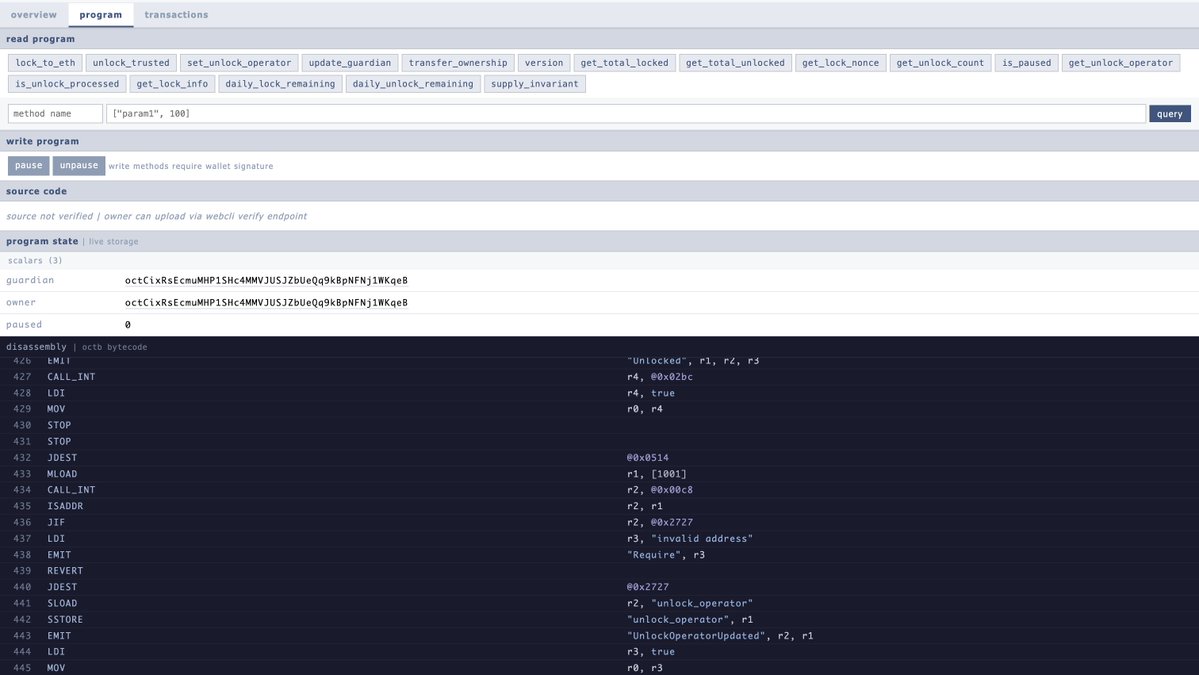
mini-update to the @octrascan website that will be useful for devs: you can now see the entire bytecode and exec history, as well as the full storage and memory


London, England 🇬🇧 English
Big ups @projecteleven for the work they’ve been putting to protect our digital assets 🫶
English
DÆD retweetet

Project Eleven Awards 1 BTC Q-Day Prize for Largest Quantum Attack on Elliptic Curve Cryptography to Date
Researcher breaks 15-bit ECC key on publicly accessible quantum hardware in a 512x jump from the previous public demonstration.
Project Eleven today awarded the Q-Day Prize, a one Bitcoin bounty, to Giancarlo Lelli for breaking a 15-bit elliptic curve key on a publicly accessible quantum computer. The result is the largest public demonstration to date of the attack class that threatens Bitcoin, Ethereum, and over $2.5 trillion in ECC-secured digital assets.
"The resource requirements for this type of attack keep dropping, and the barrier to running it in practice is dropping with them," said @apruden08, CEO of Project Eleven. "The winning submission came from an independent researcher working on cloud-accessible hardware. No national lab, no private chip. It shows that tangible progress is possible and highlights the urgency to migrate to post-quantum cryptography sooner rather than later. Google just committed to being quantum-secure by 2029. The window to get ahead of this is closing.”
Lelli derived a private key from its public key across a search space of 32,767 using a variant of Shor’s algorithm. Shor's targets the Elliptic Curve Discrete Logarithm Problem (ECDLP), the math underlying the digital signature schemes securing Bitcoin, Ethereum, and most blockchains.
Quantum attacks on ECC have moved from theory to practice over the last seven months. Steve Tippeconnic's 6-bit demonstration in September 2025 was the first public break on quantum hardware. Lelli's 15-bit result extends it by a factor of 512.
Theoretical resource estimates for a full 256-bit attack, the scale Bitcoin operates at, have fallen sharply over the same period. Google's April 2026 whitepaper put the requirement at under 500,000 physical qubits. A subsequent paper from Caltech and Oratomic brought that figure as low as 10,000 qubits in a neutral-atom architecture.
Lelli's result is the practical counterpart to those optimizations. The distance from 15 bits to 256 bits is large, but the gap is increasingly viewed as an engineering problem and not a fundamental physics problem.
Roughly 6.9 million Bitcoin sit in wallets whose public keys are visible on-chain, exposing them to quantum attack. All blockchains using ECC share similar risks with vulnerable assets.
Project Eleven is developing its next challenge, focused on the intersection of frontier AI models and quantum cryptanalysis.
English