
Rock Doc Dom retweetet

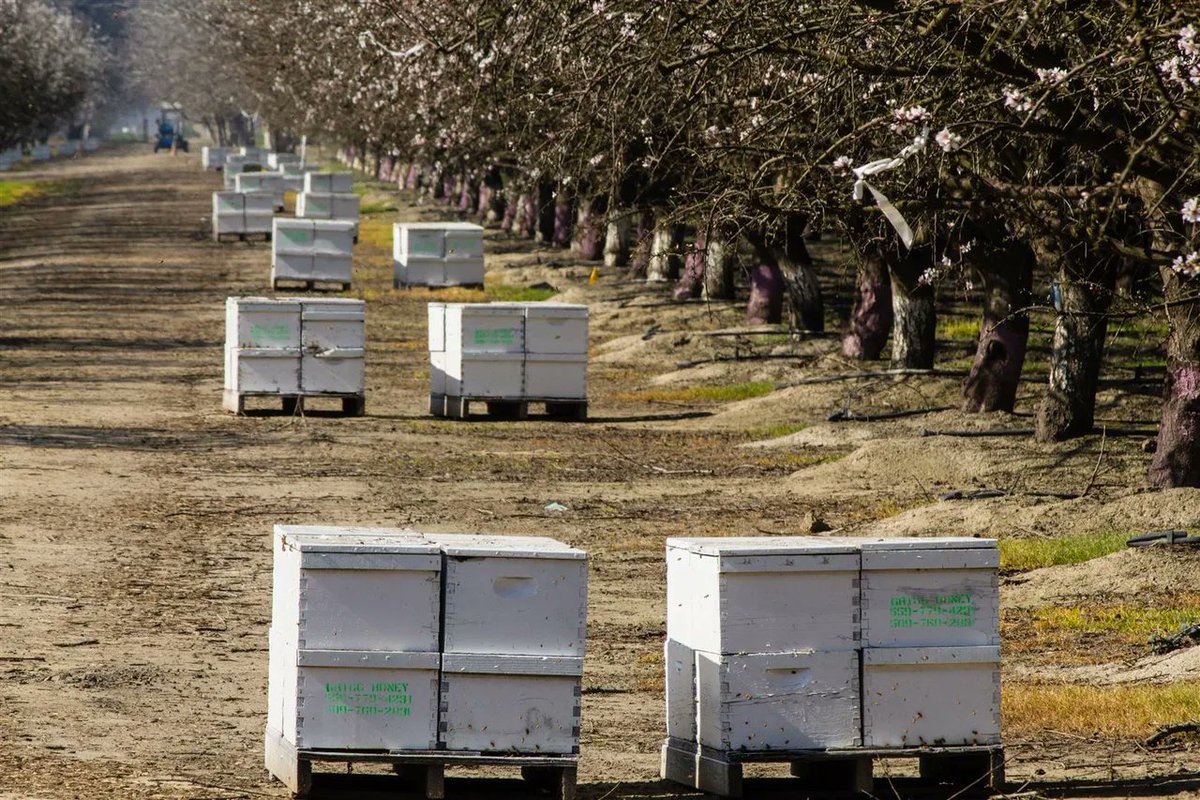
Every February, 70% of the commercial honey bees in the United States, roughly two million colonies, are loaded onto lorries and driven to California. They are going to pollinate the almonds.
80% of the world's almonds come from one valley in California. Over 1.3 million acres of nothing but almond trees, blooming for three weeks in monoculture, requiring more pollinators than the state can produce on its own. So the bees are trucked in from every corner of the country. Florida. New York. Montana.
The bees are fed sugar water for the journey because their own honey has been removed to lighten the load.
They arrive in the Central Valley to a landscape that is, for three weeks, pink and white blossom, and for the other forty-nine weeks of the year, dead. Nothing to eat. No forage. No diversity. Just almond trees and bare dirt, sprayed regularly with fungicides and insecticides that were deemed bee-safe in adult bees but turn out to be lethal to larvae when combined.
In February 2025, commercial beekeepers reported the worst die-off on record. Around 60% of commercial honey bee colonies in the United States dead in a single pollination season. Financial losses estimated well over $139 million. Some beekeepers lost 90 to 100% of their colonies.
The almonds are marketed as plant-based. Clean. Ethical. The preferred alternative.
The preferred alternative requires the single largest managed pollination event in human history and it is quietly killing the pollinators faster than they can be replaced.
Every glass of almond milk is, statistically, a small contribution to the largest pollinator die-off on record.
This is not in the advertising.
English