PaperImperium

11.1K posts

PaperImperium

PaperImperium

@ImperiumPaper

Economics Lead at @megaeth. Views and opinions my own.

Beigetreten Temmuz 2021
741 Folgt9.9K Follower
Angehefteter Tweet
PaperImperium
PaperImperium@ImperiumPaper·
I’ve been doing a lot of accounting-related posts lately, as investors finally wake up to there needing to be a fundamental business case for investment. Here is a list of items crypto needs to do better to become investable: 1) Your own tokens are $0 in assets if uncirculated. They are a contra asset or contra equity if repurchased. 2) DATs that are related to the issuers of their tokens are hobbled with cost-minus-impairment valuation under GAAP. So valuation can only ratchet down and never up. Unrelated DATs can use fair value, where GAAP value can go in both directions. 3) If you send money to an entity that’s not a subsidiary (even if under common control, like the founder controlling it) this is likely an expense. 4) Your controlled subsidiaries/DAOs can be consolidated into your own accounting, but then you must back out the minority interest you do not own. 5) Due to years of structuring projects to have multiple actors (e.g. Labs, Foundation, DAO), a project can be insolvent even if a specific entity is not. Likewise, the project can be solvent even if a specific entity is insolvent. 6) Stablecoin issuers can simultaneously be insolvent and their stablecoin fully backed. 7) Noncash expenses are still expenses. Some projects are at negative billions in profit due to emissions. This often is structured as a Labs entity getting paid in cash while the project pays out tokens. See number 5 for the result. I’ll add more as I see projects struggling with them.
English
1
0
33
8.2K
PaperImperium
PaperImperium@ImperiumPaper·
@beepidibop I don’t think it’s quite like that. I’d say there’s a distinction between entertainment (enjoyable) and attention giving (not always enjoyable - think of ads or doom scrolling)
English
1
0
1
31
beepidibop
beepidibop@beepidibop·
@ImperiumPaper Sounds a bit like what the "attention economy" og CT posters talked about in 2021 The summary of it is money flows to w/e grabs people's attention regardless of foundamentals. So in the end what matters most is social capital, the ability to direct people's attention.
English
1
0
0
36
PaperImperium
PaperImperium@ImperiumPaper·
I think there’s an interesting space between “gambling” and “finance” that has finally begun to mature. It probably goes back earlier, but really seems to have exploded with meme stocks and memecoins. In recent months, I’ve begun to refer to this territory as “finance entertainment” since it has a good analogue in “sports entertainment” - those semi-competitive exhibitions like pro wrestling, Ninja Warrior, or even the Harlem Globetrotters that prioritize entertainment but nonetheless do require serious athletic abilities and skills. Coming onto MegaETH and getting to dig into the app ecosystem, I find apps like Hit One and Euphoria to be more refined, highbrow options in this space that I personally can see the appeal of. It’s made me also appreciate that memecoins were not, in fact, just a casino, at least for some users. I think I and others were slow to recognize this because, as I explained in the QT below, gamblers, investors, and traders all swim in the same waters, and the high visibility of gamblers masked the dopamine-seeking-but-still-serious traders that participate in memecoins. The key distinction from gambling is that there has to be a credible thesis to get a positive return, usually through speculation as a mechanism to move assets through time from periods of relatively low demand to periods of relatively high demand. And this middle territory is naturally separated from regular finance by a soaring mountain range of boring UX and no attempt at providing actual entertainment (that’s not pure gambling). I’m still developing my thoughts on who the natural consumer-investors of finance entertainment are. My priors are that it’s a kind of trader that would try to make money in other ways if the experience wasn’t fun or gamified. I’m also not aware of much serious investigation, whether inside crypto or outside, into this blend of consumption and investment activity, although clearly Robinhood has leaned into this and may have some internal research. If anyone has credible data or research on finance entertainment, please drop it in the comments or my DMs. And while I try to only rarely make predictions, I suspect this new generation of finance entertainment apps will end up partly being spectator sports. It’s easy to imagine a kind of Twitch-style streaming of Hit One trades.
PaperImperium@ImperiumPaper

I used to agree with this, but updated my priors. You, as an individual trading or investing your own money, do actually have some edges that you can exploit. First, let’s differentiate between gamblers, traders (aka speculators), and investors. They all swim in the same pool, but are doing very different things. An investor is someone who “buys a dollar for 50¢” in common parlance. That is to say, they identify the intrinsic value of an asset, and try to buy it at a discount to that value. Note that intrinsic value means you think *in the absence of markets* there is value in the asset. Traditionally this takes the form of cash flows over the life of the asset. But it could also be cost reductions to your business or strategic value or any other metric that provides value without ever selling the asset. It’s very important to realize that most people who think they are investing do not meet this definition. If you are relying on selling your asset at an appreciated price in the future, then you are in part trading! This means most people’s retirement accounts have a strong trading element, because they need to liquidate assets (far in the future) and not just live off the income. Traders/speculators are different. They fundamentally are moving assets through time from a time of relatively weak demand (relative to supply) to a time of strong demand. This is not unlike a wholesaler who moves goods through space from an area of low demand (e.g. a carrot farm with bajillions of carrots) to an area with high demand (a supermarket where people want carrots). Traders who are long are performing a valuable service to relieve future shortages of an asset by removing it from the market today and securing it for sale into the market of tomorrow. Trading short works in the reverse (but is obviously more complex because no one has a Time Machine). However! Just as many “investors” are in fact traders, many self-described “traders” are actually in our third group. Enter the gambler. The gambler has a similar goal to the trader. They want to speculate on future prices. However, traders usually have some credible, coherent reason for their actions. They believe token supply will unlock or the carrot harvest will be bad this year or that rising cash flows at Apple will increase the price investors are willing to pay for the stock. The gambler doesn’t have this. They are in fact defined by their lack of edge and reliance on luck. And they usually are amateurs without discipline. The Gambler’s Ruin is a thing in game theory for a reason. Now, back to edge. You as an individual have some significant edges over most professionals. Your mandate is flexible - you can, in theory, invest or trade in anything. You are not subject to unexpected redemptions by LPs. You are not of size so can still get excess returns in smaller assets and markets (this is maybe one of the most powerful ones). Your time horizon can be far longer than most professional managers (the average holding period for a US stock is considerably less than a year) So the key to success here is that you lean into the areas where you have an edge, and to avoid areas where you have a structural disadvantage (e.g. day trading an asset in a deep market that a professional can deploy billions into) But mostly, a lot of underperformance is not being honest about whether you are a gambler, a trader, or an investor. Anecdotally, I think in crypto it’s mostly gamblers (including many professionals), with a lot of traders (VCs are at their core traders bc they need exit), and a tiny-but-growing cadre of investors now that some tokens have some (highly uncertain) intrinsic value.


English
3
0
17
2.9K
PaperImperium
PaperImperium@ImperiumPaper·
Hmmm. No, I don’t think I’d say that. Just that it’s a group of apps I’ve typically not engaged closely with before. I think there’s RWA/perps/financial plumbing on Mega that ends up doing most of the volume and TVL a year from now. But there’s certainly some retail facing apps that will be quicker to hit their stride.
English
0
0
2
556
Eldar
Eldar@eldarcap·
If @megaeth purpose or main driver is gonna be finance entertainment then am even less confident in its future than before.
PaperImperium@ImperiumPaper

I think there’s an interesting space between “gambling” and “finance” that has finally begun to mature. It probably goes back earlier, but really seems to have exploded with meme stocks and memecoins. In recent months, I’ve begun to refer to this territory as “finance entertainment” since it has a good analogue in “sports entertainment” - those semi-competitive exhibitions like pro wrestling, Ninja Warrior, or even the Harlem Globetrotters that prioritize entertainment but nonetheless do require serious athletic abilities and skills. Coming onto MegaETH and getting to dig into the app ecosystem, I find apps like Hit One and Euphoria to be more refined, highbrow options in this space that I personally can see the appeal of. It’s made me also appreciate that memecoins were not, in fact, just a casino, at least for some users. I think I and others were slow to recognize this because, as I explained in the QT below, gamblers, investors, and traders all swim in the same waters, and the high visibility of gamblers masked the dopamine-seeking-but-still-serious traders that participate in memecoins. The key distinction from gambling is that there has to be a credible thesis to get a positive return, usually through speculation as a mechanism to move assets through time from periods of relatively low demand to periods of relatively high demand. And this middle territory is naturally separated from regular finance by a soaring mountain range of boring UX and no attempt at providing actual entertainment (that’s not pure gambling). I’m still developing my thoughts on who the natural consumer-investors of finance entertainment are. My priors are that it’s a kind of trader that would try to make money in other ways if the experience wasn’t fun or gamified. I’m also not aware of much serious investigation, whether inside crypto or outside, into this blend of consumption and investment activity, although clearly Robinhood has leaned into this and may have some internal research. If anyone has credible data or research on finance entertainment, please drop it in the comments or my DMs. And while I try to only rarely make predictions, I suspect this new generation of finance entertainment apps will end up partly being spectator sports. It’s easy to imagine a kind of Twitch-style streaming of Hit One trades.

English
1
0
6
1K
PaperImperium
PaperImperium@ImperiumPaper·
@patio11 Can’t speak to how many are affiliated, but many unaffiliated are eager to get out from under using them and find other sources of financing for a variety of reasons. Big opening in the market here that’s mysteriously vacant.
English
0
0
0
100
Patrick McKenzie
Patrick McKenzie@patio11·
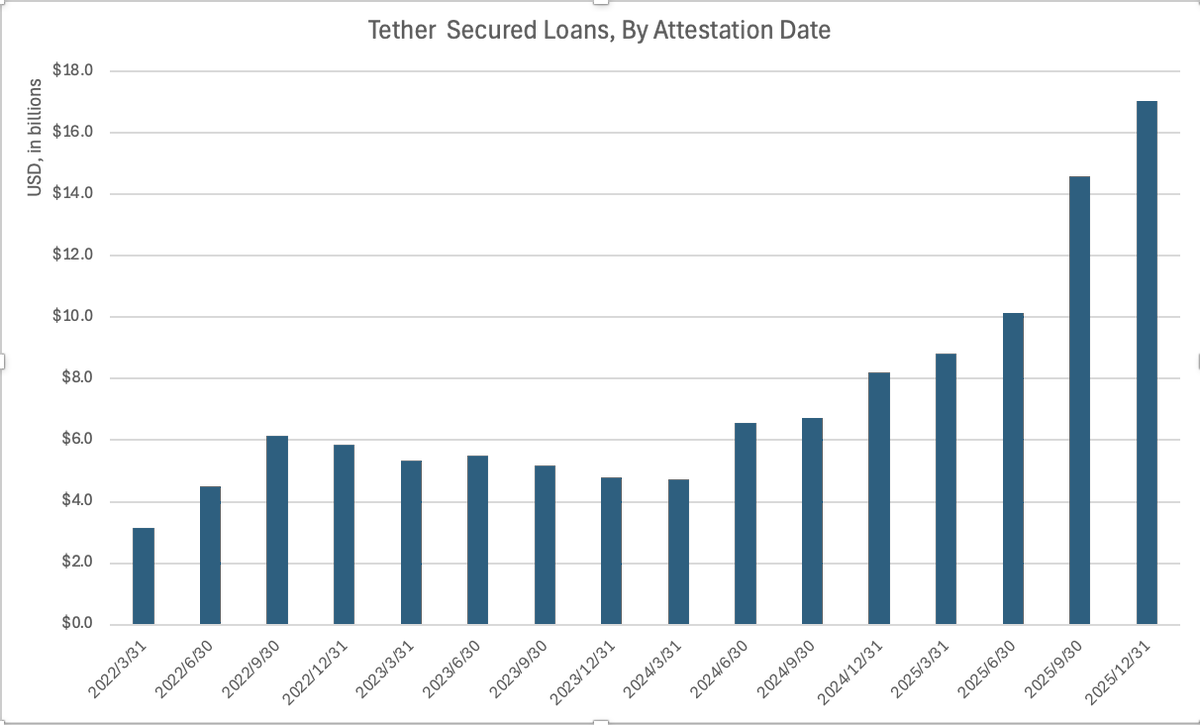
Once upon a time, Tether caveated their quarterly attestations with language to the effect that their secured loans were not to affiliated entities. They ceased this caveat in early 2022.
English
3
0
30
6.1K
Patrick McKenzie
Patrick McKenzie@patio11·
I’ve been curious about the shape of this graph for a while, particularly because Tether has long said it intended to reduce secured loans.
Patrick McKenzie tweet media
English
9
15
115
15.6K
Nicholas Cannon
Nicholas Cannon@inkymaze·
Risk Curator Obituaries 10-10-2025: Reaching for yield 06-06-2026: Integration parachuting
English
1
0
7
1.3K
PaperImperium
PaperImperium@ImperiumPaper·
@josefabregab @vizidotcom The large partners listed + me not having heard of them is a bit of a head scratcher, too. Hence asking here if anyone knows them. It’s not an uninteresting idea in theory
English
0
0
1
19
PaperImperium
PaperImperium@ImperiumPaper·
New to me: @vizidotcom (credit scoring onchain addresses) Has anyone used this? I see Aave, Compound, and Uniswap listed as integration partners but have not heard of Vizi before
English
2
0
3
1.1K
Ryan Lanman
Ryan Lanman@ryanlanman1·
I actually tried to jump on this and found it vexingly dofficult to bridge wstETH or BTC collateral from Eth L1. The only path i found via MegaEth’s native bridge for wstETH had a haircut of a few 10’s of bps on the collateral. If i save 2% on borrowing costs, i need to believe that delta will last for 4+ months to make beidging worth it. Similarly, the UX of going from wBTC —> BTC.b seemed horrible. No native way to bridge wBTC to Mega, even for swaps?
English
1
0
1
25
PaperImperium
PaperImperium@ImperiumPaper·
What accounts for there being close to 0% borrow rates? Not enough size? Not the preferred collateral assets? Borrowers aren’t aware?
PaperImperium tweet media
English
23
4
57
14K
PaperImperium
PaperImperium@ImperiumPaper·
@TheTakenUser I don’t think Arbitrum releases financial statements. Just kind of update reports from various DAO-funded entities.
English
1
0
1
22
Capitulation.eth 🦇🔊 🦞
@ImperiumPaper Beefy is a proper looking P&L simple but informative and then I looked at Arbitrum’s that went out today 60 pages with cool graphics and one page of what barely can pass for financial disclosure. Quite disappointing tbh
English
1
0
0
45
Capitulation.eth 🦇🔊 🦞
Is there a single onchain business that publishes actual financial statements, asking for a friend?
English
3
1
8
1.2K
PaperImperium
PaperImperium@ImperiumPaper·
@bjnpck Today? You’d probably need to bridge out. But seems a small price to save 200bps on your $2 million loan if you’re an individual. But maybe I’m wrong
English
1
0
1
257
Bojan
Bojan@bjnpck·
@ImperiumPaper What can you do with the borrowed money? Are there farms or you need to bridge?
English
1
0
1
267
MRKWH
MRKWH@MRKWH·
@ImperiumPaper No opportunity to deploy without too great risk, friction of bridging
English
1
0
1
365
Theofanis Sipsis
Theofanis Sipsis@TSIPS1267·
@ImperiumPaper There's no market for borrowing it, I mean there's less than a million dollars of ETH and BTC there compated to 20 million of stables. Pool-based lending platforms revolve around borrowing against collateral, so it'll only have reasonable rates when there is more collateral.
English
1
0
2
789
PaperImperium
PaperImperium@ImperiumPaper·
@Pr0cessus0 What specifically would get you to head over? It’s not as if you can’t borrow the stables and bridge back
English
3
0
2
510
Lolu
Lolu@Pr0cessus0·
@ImperiumPaper No other yield opportunities on the chain I guess, need more apps
English
1
0
3
560
PaperImperium
PaperImperium@ImperiumPaper·
> Issuers can hold enough reserves to cover every dollar in circulation and still depeg if those reserves can't be accessed when they're needed. Then they’re probably collateral, not reserves. Reserves are liquid by definition. Hence the phrase “fractional reserve” which does NOT mean undercollateralized. Wells Fargo USD (aka a balance at Wells Fargo) does not hold $1 liquid for every $1 of deposits. But it DOES hold >$1 collateral for every $1 of deposits. Of course, there can be edge cases where you think you have reserves like tbills that can be sold almost at par quickly or even deposits, and then some AML flag trips up your transfers. I’ve seen $100 million or more get stuck so I’m a little sympathetic but that’s why you do a fire drill at least once.
Delphi Digital@Delphi_Digital

A stablecoin can be fully collateralized and still fail. Issuers can hold enough reserves to cover every dollar in circulation and still depeg if those reserves can't be accessed when they're needed. The BIS made this point in their paper "On par: A Money View of Stablecoins." They draw the analogy that stablecoins are the modern equivalent of Eurodollars, with onchain private dollar deposits replacing offshore ones. Traditional banking maintains par through central bank settlement, primary dealer networks, standing repo facilities, and a lender of last resort. Stablecoins don't have any of these mechanisms. If there's a run there's no forward market, no credit facility, and no mechanism to absorb the pressure before it hits the reserves directly. The analogy extends beyond Eurodollars. In their current form stablecoins resemble the wildcat banks of 19th century America. They operate across fragmented jurisdictions without any of the institutional infrastructure that keeps the traditional banking system stable. But this is the same trajectory the banking system itself went through. Wildcat banking was fragmented but it eventually led to federal oversight and consolidation that made the system functional at scale. The regulation coming for stablecoins is what made the banking system functional at scale too.

English
4
5
42
7K