Bill Tai

20.4K posts

Bill Tai banner
Bill Tai

Bill Tai

@KiteVC

🏄VC: 23 IPOs🤠 @Zoom 's 1st seed; Formative catalyst @BitfuryGroup @Canva; seed @Color @Tweetdeck;🌱 Founding Chair @Hut8corp @IPInfusion @TreasureData

United States Beigetreten Mart 2007
2.8K Folgt37.8K Follower
bone
bone@boneGPT·
DEVELOPING: Chinese entrepreneur boasts receipt of 200 NVIDIA H200 GPUs in Beijing despite US export ban, explains how he circumvents export ban 🧵
English
135
511
2.2K
872.2K
Bill Tai
Bill Tai@KiteVC·
AND if marginal productivity comes from software and electrons generated from non oil sources.. then we live in a world where the NEXT currency is 'stored electrons.. ' I had this thought around 2009 , and expressed some of that thinking in this old medium piece from 2018 : @billtai/currency-in-the-4th-industrial-revolution-19a73d47b6c5" target="_blank" rel="nofollow noopener">medium.com/@billtai/curre…
English
0
0
3
243
Bill Tai
Bill Tai@KiteVC·
We have already started that transtion. If savings and currency are 'stored productivity to use for something else' (meaning if you lived a subsistence living, no savings, no need for currency; your 'excess' is saved for use later)
English
1
0
1
148
Bill Tai
Bill Tai@KiteVC·
This piece on the 'petro dollar' is a GREAT primer on why the world is, what it is today (in terms of economies, currencies, geopolitical tensions, wars..) as it's about 'control of productivity'. What is currency? What are savings? Stored productivity. But what comes next?
Felix Prehn 🐶@felixprehn

x.com/i/article/2034…

English
1
1
4
1.3K
Bill Tai retweetet
Rohan Paul
Rohan Paul@rohanpaul_ai·
Ali Ghodsi, the cofounder and CEO of Databricks, says Zoom has a massive chance to build an AI-first product, that could seriously disrupt the traditional enterprise SAAS. Because it sits on the largest datasets of meeting videos and transcripts. The big pain in enterprise software is data entry and coordination. Zoom already sits on the raw input: every customer call and internal meeting, plus the video, audio, and transcript. If Zoom can reliably pull out decisions, context, and action items, then write them back into the right system of record automatically, as an AI-first workflow layer, it becomes the front door for work. That would replace lots of separate SAAS tools that exist mainly to collect notes and updates. --- Video from 'Bg2 Pod' YT channel (link in comment)
English
49
24
281
82.1K
Bill Tai retweetet
Anish Moonka
Anish Moonka@AnishA_Moonka·
September 2009. Jensen Huang walks onto a small stage at the Fairmont hotel in San Jose. About 1,500 people are in the room. He runs a company that makes chips for video games. He spends the next 8 minutes doing math on a whiteboard, explaining why the future of computing won't come from making CPUs faster. He calls it "CEO math" and apologizes in advance to every computer science professor in the audience. Then he lays out an argument that almost nobody took seriously at the time: the way to make computers dramatically faster is to pair a regular CPU with hundreds of tiny parallel processors, the kind that already exist inside graphics cards. One CPU for the sequential stuff. Hundreds of GPU cores for everything else. He calls it "heterogeneous computing." He shows the math. A workload that can be split into many pieces at once gets up to 200x faster on this combined system. A workload that has to run one step at a time loses nothing. "The most important thing in creating a new architecture," he says, "is to make sure it does no harm." This was the first GPU Technology Conference. NVIDIA had launched a software platform called CUDA three years earlier, in 2006, to let developers write programs that run on graphics cards instead of just regular processors. Almost nobody cared. GPUs were for rendering Call of Duty, not for scientific computing. The academic world was polite but skeptical. The enterprise world ignored it entirely. By this point, Huang had been making this argument for years. NVIDIA was a $7 billion company. It competed with AMD and Intel for market share in the graphics market. That was the whole business. Jensen kept saying the GPU wasn't just a gaming chip; it was a computing platform. He kept saying parallel processing would reshape every industry from medicine to finance to physics simulations. People kept nodding, then doing nothing. Then deep learning happened. Around 2012, AI researchers discovered that training a neural network, which means teaching a computer to recognize patterns by running the same calculation millions of times across huge datasets, was exactly the kind of workload Jensen had been describing. GPUs can train AI models 10 to 50 times faster than CPUs. The architecture he outlined in this 2009 talk, with one CPU handling step-by-step tasks while hundreds of GPU cores crunch through massive amounts of parallel data, is now the literal blueprint for every AI data center on earth. ChatGPT runs on NVIDIA GPUs. Claude runs on NVIDIA GPUs. Gemini, Llama, Midjourney, nearly every major AI model you've heard of was trained on NVIDIA hardware using CUDA, the software platform Jensen built for a market that didn't exist yet. NVIDIA was worth about $7 billion when Jensen gave this talk. It is worth over $4.4 trillion today. That's a 600x increase. Jensen Huang, who founded the company at a Denny's in 1993 with two friends, now has a net worth of over $160 billion. He made Forbes' list of the 10 richest people for the first time this year. GTC 2026 is currently ongoing. 17,000 people are packing a hockey arena to watch the same guy explain what comes next. In 2009, 1,500 people showed up at a hotel ballroom, most of them for gaming graphics.
English
43
349
2.1K
408K
Bill Tai retweetet
Kaito | 海斗
Kaito | 海斗@_kaitodev·
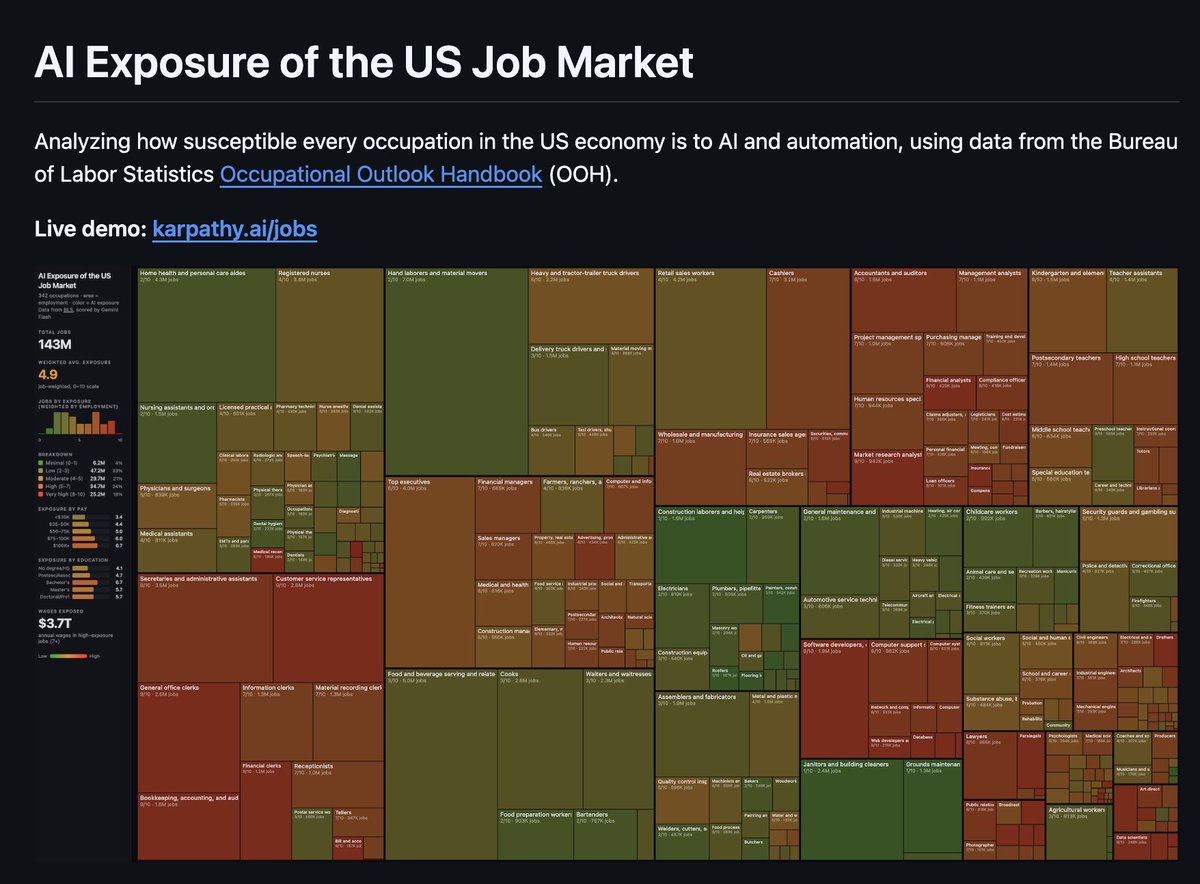
5 minutes ago, @karpathy just dropped karpathy/jobs! he scraped every job in the US economy (342 occupations from BLS), scored each one's AI exposure 0-10 using an LLM, and visualized it as a treemap. if your whole job happens on a screen you're cooked. average score across all jobs is 5.3/10. software devs: 8-9. roofers: 0-1. medical transcriptionists: 10/10 💀 karpathy.ai/jobs
Kaito | 海斗 tweet media
English
968
1.8K
12.1K
3.5M
Bill Tai
Bill Tai@KiteVC·
An incredibly interesting read - for this date of 3.14 (pi day)
The Curious Tales@thecurioustales

🚨In 1700s, French mathematician Georges-Louis Leclerc took a needle, a wooden floor, and a question that sounds almost childishly simple. If you drop a needle randomly onto a surface ruled with parallel lines, and the needle's length equals the distance between those lines, what are the odds it crosses one of them? The answer is 2 divided by pi. No circles anywhere in that experiment. No curves, no arcs, no radii. Just a straight needle falling onto straight lines through pure chance. And pi crawls out of the probability like it was hiding there the entire time, waiting for someone to ask the right question. Mathematicians call this Buffon's Needle, and it remains one of the most conceptually violent results in the history of probability. You can physically recreate it on your kitchen floor. Drop a needle 500 times, count the crossings, divide, and you will approximate pi to several decimal places through nothing but randomness and straight lines. The circle was never in the room. Pi showed up anyway. This is what separates pi from every other mathematical constant. It doesn't stay inside its original context. It migrates. Euler discovered it hiding inside the sum of the reciprocals of all squared integers, a problem involving no geometry whatsoever. The Gaussian bell curve that governs how errors distribute in measurements, how heights vary in a population, how quantum particles spread across space, carries pi in its foundation even though the curve itself was never constructed from a circle. Physicist Eugene Wigner wrote a paper in 1960 that never got the mainstream attention it deserved. He called it "The Unreasonable Effectiveness of Mathematics in the Natural Sciences." His central bewilderment was precisely this pattern: mathematical structures developed in complete abstraction, with zero intention of describing physical reality, keep turning out to be the exact language the universe was already using before anyone looked. Pi is his strongest case. It wasn't engineered to fit physics. It was found already fitted, in places nobody thought to look for it, in systems that share nothing geometrically with a circle. The needle doesn't know about circles. The universe apparently does.

English
0
0
2
2K
Bill Tai retweetet
The Figen
The Figen@TheFigen_·
I think that is the best advertisement I’ve ever seen.
English
594
10.5K
60.1K
1.5M
Bill Tai
Bill Tai@KiteVC·
it's about time... just hope it's not too late to start the process of catching up. We need something like the Telecom Deregulation Act of 1996 to incentivize the private sector to take on the challenge of remaking our grid; that will speed things up considerably!
U.S. Department of Energy@ENERGY

x.com/i/article/2032…

English
7
10
29
8.4K
Bill Tai
Bill Tai@KiteVC·
Decades ago, there were a dozen credible and well funded players that could compete at the then 'state of the art' megabit densities.. wild swings in part pricing was the result. Now it's down to three players, and the barrier to entry is enormous. The architecture of memory subsystems has also changed quite a bit as has the margin structure of the end markets. Sure - I get why the P/E multiples have been low at past cyclical peaks as a result. I do think that the changes in industry structure and end use markets are significant enough though, for a 're-rating'. Even if $mu's P/E does not rise to the same level as leaders like $nvda (although their net income margin structure may get pretty close in a quarter) , if it gets half way there, it'll drive a significant gain in $mu's market cap and share price.
Dean Marantis🇺🇸🇬🇷@Deenobrown123

I’m tired of the cyclical story for Micron. People act like that money is not real money or something. Micron will make $40 billion dollars in 2026. Micron will make more money in 2026 than Tesla, Palantir, Wal Mart, and Costco combined. Not just more than each of them, but more than each of them combined. Think about that. Those 4 companies have a total market cap of over $3.1 trillion dollars. Micron’s market cap is $450 billion. Plus micron may nearly make double of what they make in 2027. Micron is growing faster and making more money than them. Plus Micron is sold out for all of 2026 and 2027 will be sold out as well. Yet, Micron is worth 1/6th of what they are worth combined. Even if you only know 3rd grade math, you must realize that Micron is a great buy right now. Not a single stock in the American stock market comes close.

English
1
6
13
4K
Bill Tai retweetet
Manana Samuseva📍NYC 🔜 DAS NYC, Cannes ETH.CC
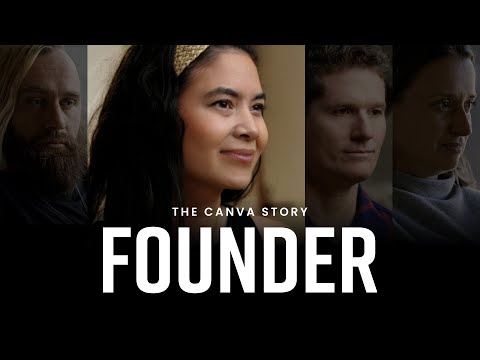
She was told “no” more than 100 times. Now hundreds of millions of people use what she built. Melanie Perkins @MelanieCanva, co-founder @canva and Bill Tai @KiteVC – born 1987, Perth – mum a teacher – dad a Malaysian engineer with Filipino and Sri Lankan roots – no family money — just discipline age 14 – selling handmade scarves at local markets – training figure skating at 4:30 a.m. – learning to show up when no one’s watching at university – tutors graphic design to pay the bills – watches students struggle with Adobe Photoshop for an entire semester thinks: – design software should be stupidly simple – online – collaborative first attempt – 2007 — launches Fusion Books from her mum’s living room – drag-and-drop yearbooks for schools – grows into one of Australia’s biggest yearbook companies the crazy idea – if teenagers can design yearbooks – anyone can design anything so she decides to rebuild the entire design industry the wall of “no” – flies to Silicon Valley at 24 – no network – no big-name backers – no CS degree investors don’t take her seriously – hears “no” more than 100 times rock bottom – writes a letter to herself just to keep going – promises she’ll find the team – the money – the product she sees in her head hacking access – learns kitesurfing to enter a VC’s invite-only circle – meets @KiteVC then – gets introduced to Lars Rasmussen – spends a year seeing every CTO candidate reject the idea – finally lands ex-Google engineer Cameron Adams 2013 — Canva is born – launches at 26 – early press includes negative reviews – no big ad spend just a product people quietly start telling friends about then the curve – millions of users within a few years – 2018 — unicorn – soon after — tens of billions in valuation today – hundreds of millions of users – tens of millions paying – used in 190+ countries and she stays in Sydney – no Silicon Valley move – no flashy billionaire lifestyle she marries co-founder Cliff Obrecht with a $30 street-market ring the plot twist – signs the Giving Pledge – commits to giving away most of their wealth – pledges the majority of their Canva shares to philanthropy – already sending tens of millions directly to families in need what she didn’t have – no technical degree – no rich parents – no insider network what she did have – a classroom insight – an obsession with simplicity – the stomach for 100+ rejections because the difference between a crazy idea and a global company isn’t the pitch deck it’s who keeps building after everyone else stops. youtu.be/GUjt0iRJ3eo
YouTube video
YouTube
English
0
5
13
1.3K