
Michael R. Bernstein

10.9K posts

Michael R. Bernstein banner
Michael R. Bernstein

Michael R. Bernstein

@NerdWorldOrder

Dissonant Cogitant, Autodidact, Dilettante, Effer of the Ineffable, Epistemic Rupturer. Adding Value since 1970.

Albuquerque, NM Beigetreten Nisan 2011
4.8K Folgt1K Follower
Angehefteter Tweet
Michael R. Bernstein
Michael R. Bernstein@NerdWorldOrder·
🚀 Excited to announce the first public release of lodum (v0.2.0)! Its basically Rust's serde for #Python. Fast, universal serialization for JSON, YAML, MsgPack, & more-powered by dynamic AST bytecode generation.🐍⚡️ Try it: `pip install lodum` Docs: webmaven.github.io/lodum/
English

1
1
1
55
Eli Afriat 🇮🇱
Eli Afriat 🇮🇱@EliAfriatISR·
I will follow back anyone who recognizes her. 💙
Eli Afriat 🇮🇱 tweet media
English
3K
473
4.2K
100K
Michael R. Bernstein retweetet
tubbypaws
tubbypaws@tubbypaws·
tubbypaws is returning to the world and may do some new things soon. i may even take on commissions with a twist…
English
2
3
9
285
Michael R. Bernstein retweetet
ליאור שליין
ליאור שליין@LiorSchleien·
America and Israel - The End?
English
630
170
1.8K
65.6K
Michael R. Bernstein retweetet
Sarah Ettedgui
Sarah Ettedgui@SarahEttedgui·
Stop trying to define Antizionism by first defining Zionism For a long time, I approached it that way myself. I would begin with: What is Zionism? Jewish self-determination? A political movement? A national liberation movement? Then I would assume “anti-Zionism” simply meant opposition to whichever definition I landed on. That is the wrong framework. When we study other forms of prejudice, we do not start by defining the target group and work backwards. We do not define Blackness to understand anti-Black racism. We do not begin by defining LGBT identity to understand anti-LGBT prejudice. We examine the recurring mechanisms that animate the hostility itself: the narratives, the stereotypes, the irrational assumptions, the moral coding, the patterns of exclusion. The same analytical exercise should apply here. Antizionism is the contemporary manifestation of hate and hostility toward Jews. The question therefore becomes: what are its recurring features? What are its libels? What are its assumptions? What are the patterns that repeat themselves across institutions, social spaces, and public discourse? Why are “Zionists” treated as a stigmatized category, as people who are uniquely untouchable, morally contaminated, or beyond legitimate engagement? The discussion stopped being an internal debate about Jewish political thought a long time ago. It has become an examination of a global hate movement and the mechanisms that animate it. Therefore, we should analyze antizionism through the mechanisms by which it operates: stigmatization, exclusion, collective attribution, and recurring libels. Antizionists rarely explain antizionism itself. The conversation always returns to Zionists and their supposed conduct. It is time to stop studying the object and reverse the lens. Turn the mirror around.
English
40
40
159
18.8K
Michael R. Bernstein retweetet
Massimo
Massimo@Rainmaker1973·
A wholesome moment. Mom giving her daughter one of the best experiences. Memories that last forever, not just a day.
English
231
855
8.3K
335.2K
Michael R. Bernstein retweetet
Tom London
Tom London@TomLondon6·
I'm Jewish, British & 64 All my life, I wondered how the Holocaust could have happened. I understood that Hitler & other leaders were EVIL, but how did millions of ordinary people go along with it? NOW, seeing how so many in the West rationalise & defend the Gaza Genocide, I think I have my answer and it is profoundly disturbing
English
2.3K
11.3K
39.7K
1.6M
Michael R. Bernstein retweetet
Tali Goldsheft
Tali Goldsheft@TaliGoldsheft·
Because I care about treating people humanely—and because I’m a proud Zionist—this is the final straw. Fire Ben-Gvir. If you agree, share this please.
English
736
364
1.7K
61.8K
Michael R. Bernstein
Michael R. Bernstein@NerdWorldOrder·
@ghumare64 Rohit, can you post on how the three repos `agentmemory`, `agentbrain`, and `akbp` relate to each other?
English
0
0
0
44
Rohit Ghumare
Rohit Ghumare@ghumare64·
claude: /𝚌𝚘𝚖𝚙𝚊𝚌𝚝 or /𝚌𝚕𝚎𝚊𝚛 to compress memory, from next sessions you will use 570K tokens per chat. me: 𝚗𝚙𝚡 @𝚊𝚐𝚎𝚗𝚝𝚖𝚎𝚖𝚘𝚛𝚢/𝚊𝚐𝚎𝚗𝚝𝚖𝚎𝚖𝚘𝚛𝚢
Rohit Ghumare tweet media
English
2
0
9
1.8K
Michael R. Bernstein retweetet
Michael Dickson
Michael Dickson@michaeldickson·
Let’s see if all who are observing “Nakba Day” can wrap their heads around this cognitive dissonance. The fact is: there has never been an Arab State called Palestine, and historically when people referred to Palestine they were talking about the Jewish homeland.
Michael Dickson tweet media
English
92
810
1.7K
27.3K
Michael R. Bernstein retweetet
HonestReporting
HonestReporting@HonestReporting·
Bad enough that @NYCMayor put out a “Nakba Day” propaganda video. So it’s no surprise that @nytimes simply repeats the false narrative without scrutiny. Because Inea Bushnaq is not a “Nakba survivor.” She is the descendant of Bosnian Muslims and was not forcibly displaced from her home. But facts don't matter to the NYTimes.
HonestReporting tweet media
Josh@_j0sh_a_

😂 This “Nakba Survivor” is literally a “European settler” In the late 19th century, Muslim Bosnians (including Inea’s grandparents), fled Bosnia to Ottoman Syria, after Austria-Hungary took control of Bosnia. They feared that now, the Christians will seek revenge after years of mistreatment. Inea’s father’s family lived in Tulkaram, but he himself lived in Jerusalem where Inea was born. In the 1930’s, Inea’s father had a Job in England, he returned to Mandatory Palestine after a few years, but in 1948 they decided to move back to England. They were not expelled, and no one forced them to move to England. As a matter of fact, Tulkaram, and the old city of Jerusalem remained under Jordanian Arab control. Not a single Zionist to bee seen there. So in summary, this is a European with no strong roots in the land of Israel, whose family made the decision to immigrate back to the continent of their grandparents instead of remaining under Arab control. (And the “visit Palestine” poster on her wall is a Zionist poster by Franz Kraus to encourage Zionist tourism to the holy land. It’s not even the original poster, but a replica of the poster, with an additional Hebrew description mentioning his name 🤦‍♂️)

English
46
532
1.7K
63.8K
Michael R. Bernstein retweetet
M Khalid
M Khalid@khalidJMSW·
I am a Druze American, and today I feel deeply ashamed to call myself Syrian. All this horror—and much more—has unfolded in my city, Sweida, solely because we are Druze. We are a small minority in the Middle East—a secular, peace-loving people who have rejected takfirism and jihadism for over a thousand years, since the birth of our faith. Yet we are not cowards. We have survived in one of the harshest corners of the world for more than a millennium, holding steadfast to our humanity, dignity, and moral integrity. We do not preach our religion, nor do we seek converts. We cherish science, art, and music. We value life and family. We honor women, never veil them, and practice monogamy as our faith commands. If these savage, bloodthirsty extremists are allowed to destroy us, they will do so without hesitation. They possess no moral compass, only the delusions of a psychotic ideology. The West must not look away and must not tie Israel’s hands, for it is the only nation that has tried to help us and halt the massacre. If the world remains silent, they will wipe us out and then turn their fury toward the Christians and every other minority in the Middle East. Their ultimate aim is to create another Afghanistan at Europe’s doorstep, then Europe itself or “Rome” as they like to say. We can hold the line—but we need the West’s support, not its complicity with the Jihadists.
English
30
276
916
10.4K
Michael R. Bernstein
Michael R. Bernstein@NerdWorldOrder·
@ArrayManta @skdh That's actually something I get AI to check for me. It isn't uncommon to get around a 10-15% rate of "Author is misrepresenting the cited paper to some degree." I bet that if the citation edges between papers were typed based on this, we'd get much more useful ranking data.
English
0
0
0
18
Manta Array
Manta Array@ArrayManta·
@skdh Imagine if the standard for hallucination was "does that reference actually support the statement it was cited with?" Almost even worse because it cites something real slightly misleadingly and it happens a lot in academic papers
English
1
0
1
399
Sabine Hossenfelder
Sabine Hossenfelder@skdh·
I'll tell you why so many people upset about the "no hallucinated citations" ban on the arxiv: because they've all been copying citation lists from each other without checking them since the beginning of time. And why did they do this? Because half of the citations in scientific papers are politics and not to the benefit of the reader. If you don't list the right papers, your paper doesn't look 'right' and reviewers will complain that you didn't cite this-and-that other unrelated work. For what I am concerned, these are all bullshit citations that shouldn't be in the papers in the first place. They can easily be automated by "related papers" links, that are (wait for it) provided by... AI...
English
211
392
4.8K
443.7K
Michael R. Bernstein retweetet
Captain Allen
Captain Allen@CptAllenHistory·
On This Day — May 17, 1939: Britain Appeased the Arabs & Condemned Europe’s Jews to the Holocaust As Jews across Europe were being beaten, robbed & deported after Kristallnacht, Britain joined the side of their persecutors by issuing the infamous White Paper of 1939 — one of the most disgraceful acts of appeasement and betrayal in modern history. First they appeased Hitler at Munich. Then they appeased the Mufti of Jerusalem and Arab violence. At the worst possible moment, Britain illegally slammed the last escape door shut on Europe’s Jews. The White Paper drastically restricted Jewish immigration to a trickle and made any further entry subject to Arab consent — which the Arabs had already made clear would be zero. Jewish land purchases were brutally restricted. This was not policy. This was betrayal. Britain had been granted the Mandate for Palestine by the League of Nations via unanimous international treaty specifically to establish a Jewish national home and encourage close Jewish settlement. The League’s own Mandates Commission reviewed the White Paper and declared it illegal — a clear violation of the Mandate. Britain simply ignored the League and enforced it anyway. The Jews begged for their lives. Britain gave them a death sentence. Hundreds of refugee ships were turned away. British forces fired on many. The Struma — carrying 769 Jews, including 70 children — was refused entry and later sunk. One of many such tragedies. Britain’s policy trapped Jews in Europe with nowhere to run as the Holocaust began. By closing the gates while the Nazis prepared the gas chambers, Britain became complicit in the scale of the systematic, industrialized genocide. At least hundreds of thousands of Jews who could have reached safety in the Land of Israel were instead exterminated. The British didn’t just fail the Jews. They actively helped ensure that when the Nazis came for them, there was no place left in the world to which they could escape. That is why a strong, sovereign Israel is not optional — it is an existential necessity. Never again will Jews depend on the mercy of empires that appease our enemies and abandon us to slaughter. Never again will we trust “guarantees” from powers that fold, betray, or look away when it matters most.
English
75
870
1.9K
47.7K
Rohan Paul
Rohan Paul@rohanpaul_ai·
Is Grep All You Need? The surprising result is not that grep is powerful, but that agent design makes it powerful. The paper says not that grep beats vectors, but that agents fail or win through their harness. That sounds like a small distinction until you look at what was actually tested. The authors compare grep-style search and vector retrieval across LongMemEval tasks, where agents must recover facts from long conversation histories full of distractors. Inline grep beats inline vector across every harness-model pair in their main experiment, sometimes by wide margins. The tempting headline is that vector databases are overbuilt for coding agents. The better reading is sharper: when the answer is anchored in literal evidence, names, dates, file paths, function names, error strings, user preferences, grep gives the model a clean mechanical advantage. Embeddings are built to tolerate paraphrase, but tolerance has a cost. They can pull in semantically nearby clutter, especially when a short agent query is vague. Grep has the opposite failure mode. It is dumb, cheap, and narrow, but when the agent knows the right string to hunt for, dumb becomes a feature. The deeper finding is that retrieval is not a component you can benchmark in isolation. The same search method behaves differently depending on whether results are injected inline, written to files, routed through a CLI, or wrapped in a custom agent loop. So the question is not “Do we still need vector databases?” The question is whether your agent is solving a semantic discovery problem or an evidence-location problem. For coding agents, a surprising amount of work is evidence-location: find the symbol, trace the call, inspect the diff, read the failing test, recover the exact line. Vectors still matter at scale and for fuzzy conceptual search, but this paper weakens the lazy default that every serious agent stack begins with embeddings. Sometimes the upgrade is not a smarter index. Sometimes it is giving the model primitive tools, clean files, disciplined context, and a harness that lets exact search do exact work. ---- Paper Link – arxiv. org/abs/2605.15184 Paper Title: "Is Grep All You Need? How Agent Harnesses Reshape Agentic Search"
Rohan Paul tweet media
English
18
38
242
49.2K
Michael R. Bernstein
Michael R. Bernstein@NerdWorldOrder·
@_Suresh2 @rohanpaul_ai You also need to band-pass the signal. You obviously don't want to use the data from random stuff that happened to turn out well, but there is also no need to reinforce things that the model already does really well (and this is always going to be the strongest positive signal).
English
0
0
0
4
Suresh
Suresh@_Suresh2·
@rohanpaul_ai the hard part is getting conversations clean enough that signal beats noise
English
1
0
0
45
Rohan Paul
Rohan Paul@rohanpaul_ai·
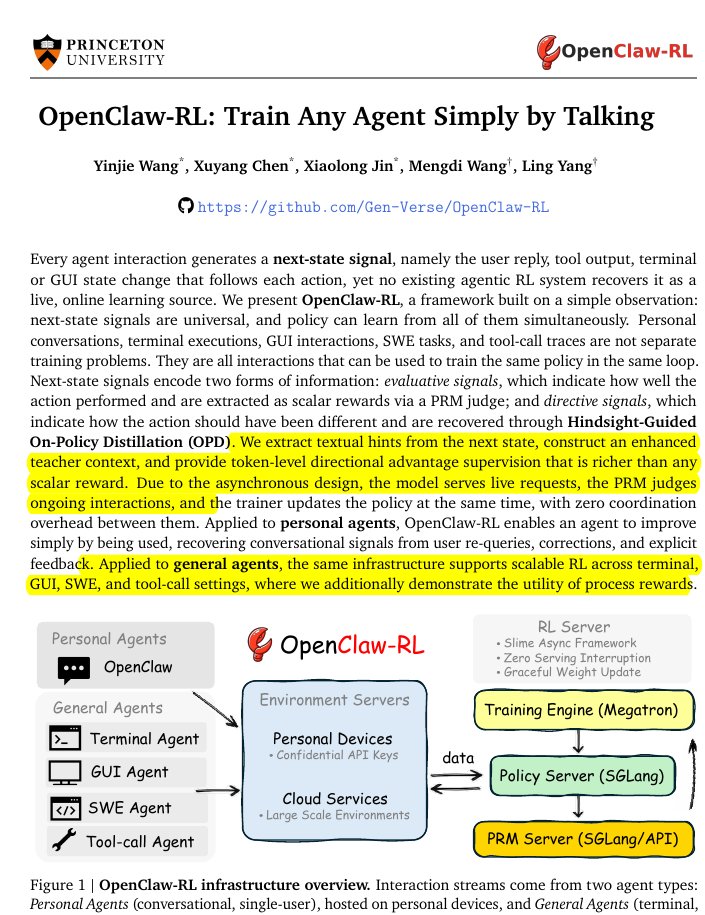
This research builds a system that trains language models continuously using everyday conversations instead of manual labeling. The huge deal here is that this method completely removes the traditional need for human workers to manually gather, review, and score massive datasets. AI Agents can now use their everyday mistakes to get smarter automatically. Whenever a person replies to the digital assistant or corrects a mistake, the software treats that response as a direct learning signal. A background program reads these natural follow-up messages and extracts specific text hints about what the model should have done differently. The software agent simply updates itself in real time during normal use by analyzing how people naturally interact with it. Every time a person corrects an agent or a software test fails, the system receives a valuable clue about how to improve. ---- Think about a student looking at their final grade and throwing the paper away without reading the teacher's helpful notes. Current Reinforcement Learning systems do the exact same thing. Current models throw this natural feedback away because they only care about whether the final outcome was a success or a failure. OpenClaw-RL fixes this by grabbing 2 specific signals from every single interaction. - First, it looks at evaluative signals to see if the action worked. If a user asks the same question again, they are probably unhappy. If a test passes, it is a success. These become simple numerical rewards using a Process Reward Model judge. - Second, it gathers directive signals to figure out how the action needs to change. User corrections and error logs offer direct guidance. These become word-level supervision using a technique called Hindsight-Guided On-Policy Distillation. Personal chats, terminal commands, Graphical User Interface clicks, and software tasks all create these reaction signals. A single policy can learn from all of them at the same time. It runs the training process in the background so the model never has to pause its normal tasks to learn. By treating standard deployment as a continuous learning environment, the model constantly adapts to individual user preferences without any manual data labeling. ---- Paper Link – arxiv. org/abs/2603.10165 Paper Title: "OpenClaw-RL: Train Any Agent Simply by Talking"
Rohan Paul tweet media
English
15
48
274
16.4K
Michael R. Bernstein
Michael R. Bernstein@NerdWorldOrder·
@RestrainedDepth @rohanpaul_ai Backpropagation is the kind of low-level corrective signal you're claiming ML has neglected. Figuring out corrective rather than outcome based signals at progressively higher levels of abstraction/indirection/delay is no small thing. For a while outcome-based RL was enough.
English
0
0
0
9
Restrained Depth AI
Restrained Depth AI@RestrainedDepth·
The clinical version of this principle: people don’t grow from successful outcomes, they grow from corrections that get integrated into the model of self. What’s interesting is how long ML stayed on the outcome-only signal when behavioral science figured out 70 years ago that the corrective feedback is where the learning actually lives. The “did it work” signal trains performance. The “what should have been different” signal trains capability. Most current AI training treats the feedback like noise. The capability gap closes when you treat it like the lesson.
English
1
0
4
210
Michael R. Bernstein
Michael R. Bernstein@NerdWorldOrder·
@alex_whedon 3rd, which implementation details of Agentic coding harnesses can now be discarded as unnecessary, and which still have value? 4th, how well does this model extrapolate from limited data? Does it still need to reason? How well does it do that?
English
0
0
1
943
Alexander Whedon
Alexander Whedon@alex_whedon·
We were a little slow on this, but we just got a technical blog post up with more details. Please take a look! subq.ai/how-ssa-makes-… We have a model card coming next week, and we are happy to take requests for any specific details there. I am happy to answer any questions here!
English
67
57
676
267.4K
Alexander Whedon
Alexander Whedon@alex_whedon·
Introducing SubQ - a major breakthrough in LLM intelligence. It is the first model built on a fully sub-quadratic sparse-attention architecture (SSA), And the first frontier model with a 12 million token context window which is: - 52x faster than FlashAttention at 1MM tokens - Less than 5% the cost of Opus Transformer-based LLMs waste compute by processing every possible relationship between words (standard attention). Only a small fraction actually matter. @subquadratic finds and focuses only on the ones that do. That's nearly 1,000x less compute and a new way for LLMs to scale.
English
1.5K
2.9K
23K
12.8M