Sabitlenmiş Tweet

@tim_lees_burner @rachdele How dare you, we have activation functions
English
Manta Array
3.1K posts
@ArrayManta
research engineer, computational neuroscience, neuromechanics follows not equal to endorse. Peace to all. master Jack ass of some trades, PhD of none

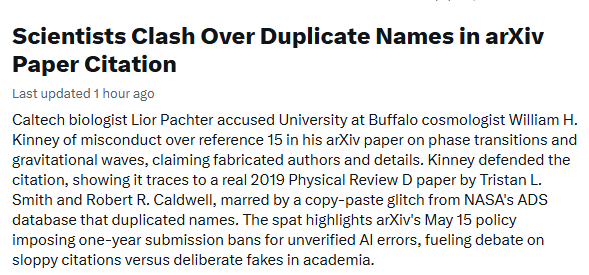
I've gotten a lot of comments like this, so forgive me if this isn't very kind, but I'm at my limit. If you're a serious academic, you've spent a lot of time looking at citations, and you know they often contain errors. You know that it's very common for professors just to copy citations they found in other papers and put them into their own papers because they need a lot of citations to look credible. Given that this is going on, it's kind of silly to think that we should have a kind of death penalty for having an LLM, hallucination mistake What you're doing is virtue signaling and pretending that citations are somehow sacred to what academics do, when in fact they're mostly just poorly put up window dressing. You're being dishonest. Perhaps with yourself, perhaps with me.



So this means you expect every author to check every citation and make sure that every citation is real and accurate? What if it's beyond the ability of one of the authors to verify one of the citations because that citation is in a language he doesn't know or concerns technical material he doesn't understand but another author on the paper does?

I've gotten a lot of comments like this, so forgive me if this isn't very kind, but I'm at my limit. If you're a serious academic, you've spent a lot of time looking at citations, and you know they often contain errors. You know that it's very common for professors just to copy citations they found in other papers and put them into their own papers because they need a lot of citations to look credible. Given that this is going on, it's kind of silly to think that we should have a kind of death penalty for having an LLM, hallucination mistake What you're doing is virtue signaling and pretending that citations are somehow sacred to what academics do, when in fact they're mostly just poorly put up window dressing. You're being dishonest. Perhaps with yourself, perhaps with me.
#JNeurosci: Beniaguev et al. developed a simplified spiking neuron model: the filter-and-fire (F&F), which showed two key functional consequences of multiple synaptic contacts: increased memorization capacity and spatiotemporal pattern recognition. doi.org/10.1523/JNEURO…
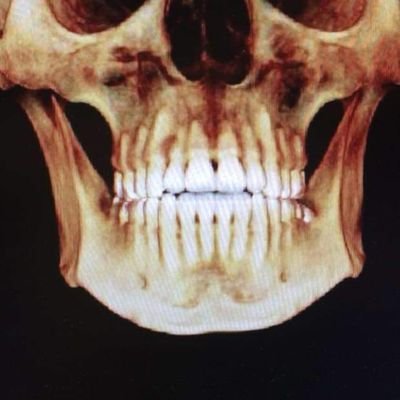
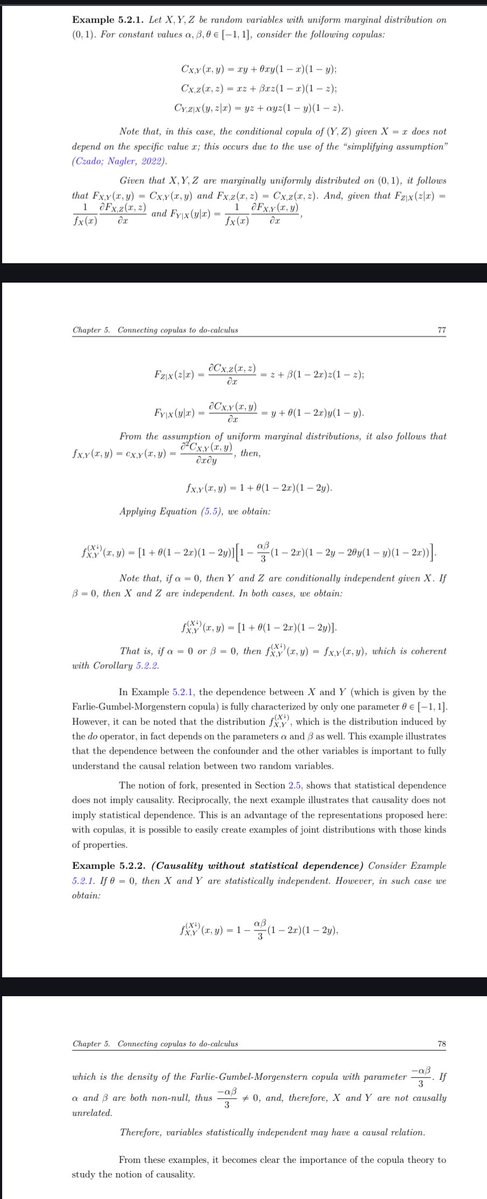
We usually repeat that correlation doesn’t imply causation, which is true. But the reverse, causation doesn’t imply correlation, is ALSO true. Let X~N(0,1) and Y=X^2. In this example, X causes Y. But the correlation between X and Y is Corr(X,Y)=Corr(X,X^2)=Cov(X,X^2)/(σ_X*σ_(X^2))=(E[X*X^2]-E[X]*E[X^2])/(σ_X*σ_(X^2))=0. Why?👇 The function h(x)=x^3 is odd: (-x)^3=-x^3 and the distribution is symmetric around 0, f is even: f(x)=f(-x) Thus (x^3)*f(x) is odd (odd*even=odd function) and the integral of an odd function over a symmetric interval is 0. Thus E[X^3]=∫X^3*f(x)dx=0 (the integral is from -♾️ to ♾️) The same occurs with the function g(x)=x because g(-x)=-x=-g(x) (it’s odd). So E[X]=∫X*f(x)dx=0 (the integral is again from -♾️ to ♾️) Thus Corr(X,Y)=0 because Cov(X,X^2)=0. Thus we have proven that causation DOES NOT IMPLY correlation. Q. E. D. ▪️









@devahaz @LocasaleLab @loobah_l The really hot take if you want one is that medicine isn’t generally a field of power laws so the return from focusing on right tail talent is exponentially lower than in engineering, finance, or athletics