NickeNumbers

3.4K posts

NickeNumbers banner
NickeNumbers

NickeNumbers

@NickeNumbers

Investor, Former CFO, Math Fan. Not trying to be smart, working to not be too stupid🗞️👉https://t.co/HmooOp3MS1 Not investment advice. Do your own DD.

Virginia, USA Beigetreten Kasım 2019
170 Folgt362 Follower
NickeNumbers retweetet
Helene Meisler
Helene Meisler@Chartfest1·
Saturday Poll. The next 100 points for the S&P?
English
17
17
55
29K
NickeNumbers
NickeNumbers@NickeNumbers·
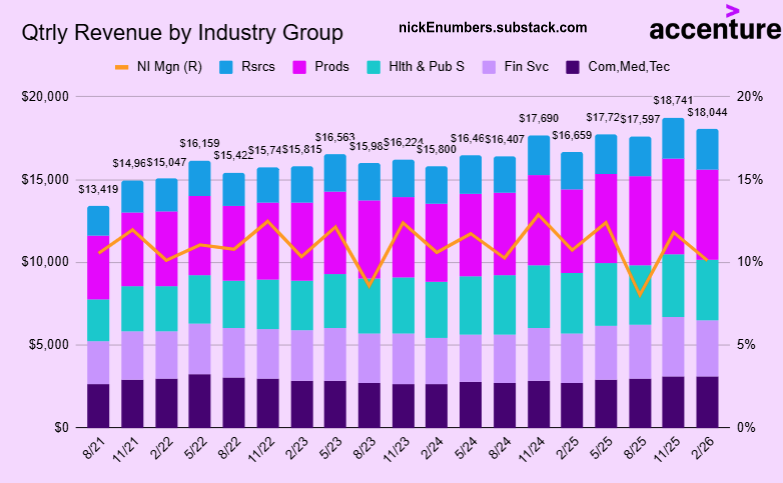
Quarter Revenue by Industry Group for @Accenture with Net Income Margin. Rev growth, and stable net margins for $ACN 🤔- $SNOW, $NET, $CRWD, $NVDA, $AMZN If you enjoy pls❤️and Repost♻️.
NickeNumbers tweet media
English
0
0
0
156
NickeNumbers
NickeNumbers@NickeNumbers·
Outstanding!
Dwarkesh Patel@dwarkesh_sp

Renaissance history is so much wilder and weirder than you would have expected. Very fun chatting w @Ada_Palmer about it. Some especially fascinating things I learned from the conversation and her excellent book, Inventing the Renaissance: Not only did Gutenberg go bankrupt in the 1450s (after inventing the printing press), but so did the bank that foreclosed on him, and so did his apprentices. This is because paper was still very expensive, and so you had to make this big upfront CAPEX decision to print a batch of 300 copies of a book - say the Bible. But he's in a small landlocked German town where only priests are allowed to read the Bible - so he sells maybe 7 copies. It’s only when this technology ends up in Venice, where you can hand 10 copies to each of 30 ship captains going to 30 different cities, that it starts taking off. Speaking of which, the printing revolution wasn’t just one single discrete event, just as the computer revolution has been this whole century of going from mainframes -> personal computers -> phones -> social media, each with different and accelerating social impact. Books came first, but they’re slow to print, and made in small batches. The real revolution is pamphlets - much faster, much harder to censor. Pamphlet runners are how you can have Luther's 95 Theses go from Wittenberg to London in 17 days. So much other wild stuff from this episode. For example, did you know that the largest and best-funded experimental laboratory in 17th century Europe was very likely the Roman one run by inquisitors? Ada jokes that the Inquisition accidentally invented peer review. The focus of the Inquisition is really misunderstood - it was obsessed with catching dangerous new heretics like Lutherans and Calvinists - it only executed one person for doing science. And this leads Ada to make an observation that I think is really wise: the authorities and censors are always worried about the exact wrong things given 20/20 hindsight. When Inquisition raids an underground bookshop during the French Enlightenment, they don’t mind the Rousseau, Voltaire, and Encyclopédie, but they lose their minds about some Jansenist treatises about the technical nature of the Trinity. More broadly, a lesson for me from this episode is that it’s just really hard to shape history in the specific way that you want to impact things. One of the most famous medieval scholars is this guy Petrarch. He survives the Black Death in the 1340s, watches his friends die to plague and bandits, and says: our leaders are selfish and terrible, we need to raise them on the Roman classics so they'll act like Cicero. So Europe pours money into finding ancient manuscripts, building libraries, and educating princes on classical virtues. Those princes grow up and fight bigger, nastier wars than ever before with new deadlier technology. And this, combined with greater urbanization and endemic plague, results in European life expectancy decreasing from 35 in the medieval period to 18 during the Renaissance (the period which we in retrospect think of as a golden age but which many people living through it thought of as the continuation of the dark ages that had persisted since the fall of Rome). Anyways, the libraries Petrarch inspires stick around, the printing press makes them accessible to everyone, and 200 years later a generation of medical students is reading Lucretius and asking "what if there are atoms and that's how diseases work?" which eventually leads to germ theory, vaccines, and a cure for the Black Death (Ada has longer more involved explanation of how cosplaying the Romans results through a series of many steps to the scientific revolution). Petrarch wanted to produce philosopher-kings that shared his values. Instead he created a world that doesn't share his values at all but can cure the disease that destroyed his. So much other interesting stuff in the full episode - hope you enjoy! Timestamps: 0:00:00 - How cosplaying Ancient Rome led to the Renaissance 0:28:49 - How Florence's weird republic worked 0:38:13 - How the Medicis took over Florence 0:58:12 - Why it was so hard for Gutenberg to make any money off the printing press 1:17:34 - Why the industrial revolution didn't happen in Italy 1:23:02 - The slow diffusion of paper through Europe 1:41:21 - The Inquisition accidentally invented peer review Look up Dwarkesh Podcast on Apple Podcasts, Spotify, YouTube, etc.

English
0
0
0
16
Chamath Palihapitiya
@andrewdfeldman @cerebras I’m a fan of both of you guys. But in order to do a real apples to apples comparison we’d want to know: 1) system to system (if the table above is wafer vs chip) 2) yield 3) rack scale eng 4) GPU integration for decode disaggregation What does this complete picture say?
English
13
2
145
47.6K
Andrew Feldman
Andrew Feldman@andrewdfeldman·
NVIDIA's biggest GTC announcement was a $20 billion bet on the same problem we solved 6 years ago. Their next-gen inference chip - not available yet - has 140x less memory bandwidth than @cerebras. To run a single 2 trillion parameter model, you need 2,000+ Groq chips. On Cerebras, that's just over 20 wafers. Even paired with GPUs, Groq maxes out at ~1,000 tokens per second. We run at thousands of tokens per second today. And every day. In production now. Why? When you connect 2,000 chips together, every interconnect has latency. Every cable has overhead. It doesn't matter what your memory bandwidth is on paper if you're bottlenecked by the wiring between thousands of tiny chips. We solved this with wafer scale. One integrated system. Little interconnect tax. Jensen told the world that fast inference is where the value is. He’s right - it’s why the world’s leading AI companies and hyperscalers are choosing Cerebras.
Andrew Feldman tweet media
English
69
72
744
150.4K
NickeNumbers
NickeNumbers@NickeNumbers·
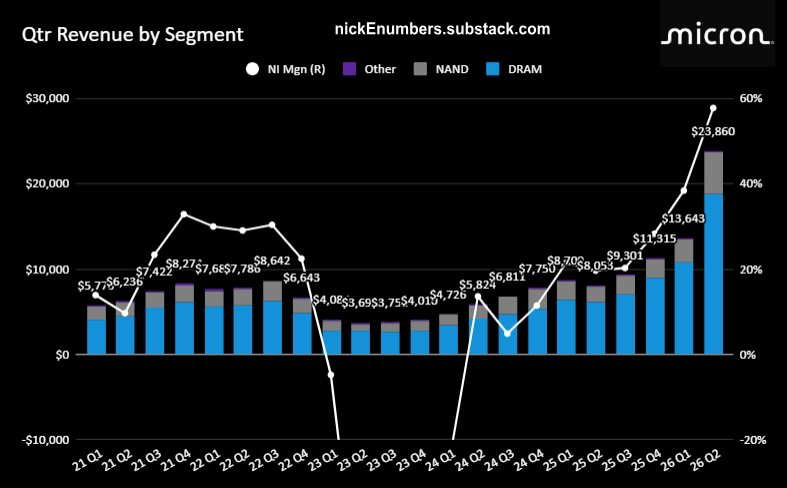
Quarterly Revenue by Segment for @MicronTech with Net Income margin [Awww Snap💥] Record Revenue for $MU, and great forward guide. 🤔- $LRCX, $NVDA, $AMAT, $TSM, $AMD, $TXN If you enjoy pls❤️and Repost♻️.
NickeNumbers tweet media
English
0
0
0
536
Daniel S. Loeb
Daniel S. Loeb@DanielSLoeb1·
The sanctimony of the acceptance speeches and the condescending way they implied the lowly audience both shared their values and was temporarily allowed in on their inside jokes was especially noxious. Its a wonder my flat screen survived the full impact of the Loro Piana sneaker which I used as a projectile.
Elon Musk@elonmusk

Oscars have become unwatchable
English
34
17
325
45.9K
NickeNumbers
NickeNumbers@NickeNumbers·
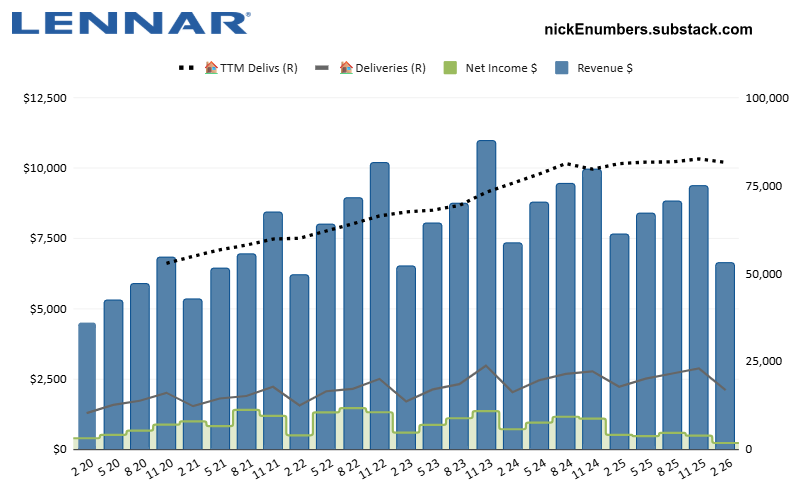
Metrics for @Lennar updated with today's earnings print 📰 $LEN revenue stable but profitability remains down. 🤔👷🏾‍♀️- $DHI, $LEN, $PHM, $GRBK, $TOL If you enjoy pls❤️and Repost♻️.
NickeNumbers tweet media
English
0
0
0
89
Gavin Baker
Gavin Baker@GavinSBaker·
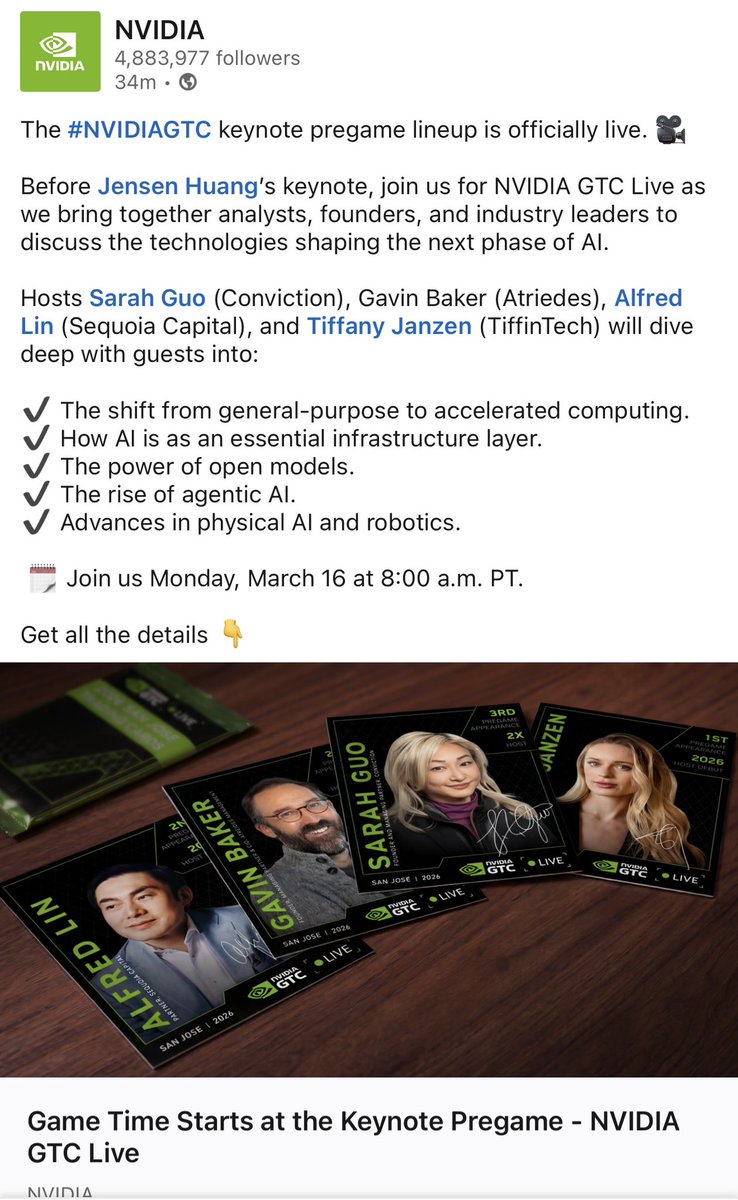
Really looking forward to being one of the hosts of @nvidia “GTC Live” next week.
Gavin Baker tweet media
English
21
9
318
27.6K
NickeNumbers
NickeNumbers@NickeNumbers·
Quarter Revenue by Segment for @Oracle with Net Income Margin. 22% YoY revenue growth $ORCL 🤔- $GOOG, $NVDA, $MSFT, $NVDA If you enjoy pls❤️and Repost♻️.
NickeNumbers tweet media
English
0
0
0
167
NickeNumbers
NickeNumbers@NickeNumbers·
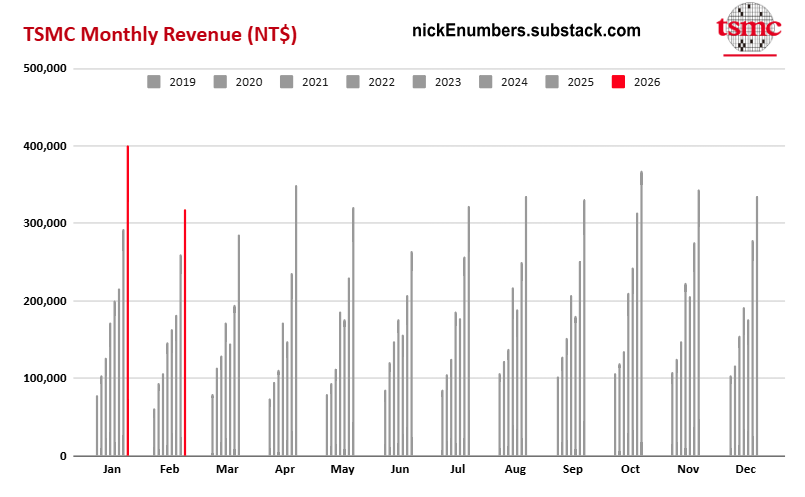
Revenue for 2/26 #TSMC 🤩 $TSM Revenue for 2/26 down 21% vs 1/26 and UP🔼🔼 22% vs 2/25. 🤔Positive for- $NVDA, $AMAT, $LRCX, $ASML If you enjoy pls❤️and Repost♻️.
NickeNumbers tweet media
English
0
0
0
96
Andrej Karpathy
Andrej Karpathy@karpathy·
Three days ago I left autoresearch tuning nanochat for ~2 days on depth=12 model. It found ~20 changes that improved the validation loss. I tested these changes yesterday and all of them were additive and transferred to larger (depth=24) models. Stacking up all of these changes, today I measured that the leaderboard's "Time to GPT-2" drops from 2.02 hours to 1.80 hours (~11% improvement), this will be the new leaderboard entry. So yes, these are real improvements and they make an actual difference. I am mildly surprised that my very first naive attempt already worked this well on top of what I thought was already a fairly manually well-tuned project. This is a first for me because I am very used to doing the iterative optimization of neural network training manually. You come up with ideas, you implement them, you check if they work (better validation loss), you come up with new ideas based on that, you read some papers for inspiration, etc etc. This is the bread and butter of what I do daily for 2 decades. Seeing the agent do this entire workflow end-to-end and all by itself as it worked through approx. 700 changes autonomously is wild. It really looked at the sequence of results of experiments and used that to plan the next ones. It's not novel, ground-breaking "research" (yet), but all the adjustments are "real", I didn't find them manually previously, and they stack up and actually improved nanochat. Among the bigger things e.g.: - It noticed an oversight that my parameterless QKnorm didn't have a scaler multiplier attached, so my attention was too diffuse. The agent found multipliers to sharpen it, pointing to future work. - It found that the Value Embeddings really like regularization and I wasn't applying any (oops). - It found that my banded attention was too conservative (i forgot to tune it). - It found that AdamW betas were all messed up. - It tuned the weight decay schedule. - It tuned the network initialization. This is on top of all the tuning I've already done over a good amount of time. The exact commit is here, from this "round 1" of autoresearch. I am going to kick off "round 2", and in parallel I am looking at how multiple agents can collaborate to unlock parallelism. github.com/karpathy/nanoc… All LLM frontier labs will do this. It's the final boss battle. It's a lot more complex at scale of course - you don't just have a single train. py file to tune. But doing it is "just engineering" and it's going to work. You spin up a swarm of agents, you have them collaborate to tune smaller models, you promote the most promising ideas to increasingly larger scales, and humans (optionally) contribute on the edges. And more generally, *any* metric you care about that is reasonably efficient to evaluate (or that has more efficient proxy metrics such as training a smaller network) can be autoresearched by an agent swarm. It's worth thinking about whether your problem falls into this bucket too.
Andrej Karpathy tweet media
English
965
2.1K
19.3K
3.5M
NickeNumbers retweetet
Puru Saxena
Puru Saxena@saxena_puru·
📢🎙️ AlphaTarget PULSE - new pod is out Topics discussed: - Geopolitical conflict - AI + software selloff - Macro risk - Selloff in the KOSPI - AI, agents + software youtube.com/watch?v=hF7EVo…
YouTube video
YouTube
English
8
12
67
61.3K
NickeNumbers
NickeNumbers@NickeNumbers·
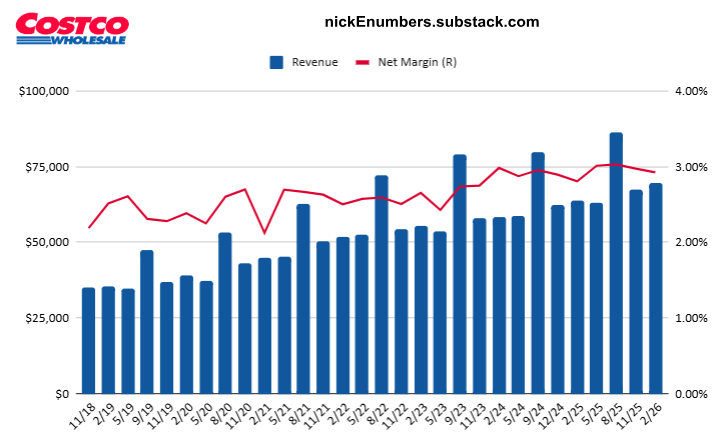
Quarter Revenue for @Costco with stable-to-up NI Margin from the earnings print 🗞️. " $COST is really not a retailer. It is a buying agent on behalf of the customer." - @MohnishPabrai 🤔- $WMT , $AMZN If you enjoy pls❤️and Repost♻️.
NickeNumbers tweet media
English
0
0
1
114
Eric Wallerstein
Eric Wallerstein@ericwallerstein·
if you don’t hear from me again it’s because i’ve moved to Seoul to day trade Kospi futures full time
English
7
0
51
4.2K
Sam Altman
Sam Altman@sama·
Here is re-post of an internal post: We have been working with the DoW to make some additions in our agreement to make our principles very clear. 1. We are going to amend our deal to add this language, in addition to everything else: "• Consistent with applicable laws, including the Fourth Amendment to the United States Constitution, National Security Act of 1947, FISA Act of 1978, the AI system shall not be intentionally used for domestic surveillance of U.S. persons and nationals. • For the avoidance of doubt, the Department understands this limitation to prohibit deliberate tracking, surveillance, or monitoring of U.S. persons or nationals, including through the procurement or use of commercially acquired personal or identifiable information." It’s critical to protect the civil liberties of Americans, and there was so much focus on this, that we wanted to make this point especially clear, including around commercially acquired information. Just like everything we do with iterative deployment, we will continue to learn and refine as we go. I think this is an important change; our team and the DoW team did a great job working on it. 2. The Department also affirmed that our services will not be used by Department of War intelligence agencies (for example, the NSA). Any services to those agencies would require a follow-on modification to our contract. 3. For extreme clarity: we want to work through democratic processes. It should be the government making the key decisions about society. We want to have a voice, and a seat at the table where we can share our expertise, and to fight for principles of liberty. But we are clear on how the system works (because a lot of people have asked, if I received what I believed was an unconstitutional order, of course I would rather go to jail than follow it). But 4. There are many things the technology just isn’t ready for, and many areas we don’t yet understand the tradeoffs required for safety. We will work through these, slowly, with the DoW, with technical safeguards and other methods. 5. One thing I think I did wrong: we shouldn't have rushed to get this out on Friday. The issues are super complex, and demand clear communication. We were genuinely trying to de-escalate things and avoid a much worse outcome, but I think it just looked opportunistic and sloppy. Good learning experience for me as we face higher-stakes decisions in the future. In my conversations over the weekend, I reiterated that Anthropic should not be designated as a SCR, and that we hope the DoW offers them the same terms we’ve agreed to. We will host an All Hands tomorrow morning to answer more questions.
English
3.9K
639
6.1K
3.6M