Leo Enright @ollopa11.bsky.social

3.4K posts

Leo Enright @ollopa11.bsky.social banner
Leo Enright @ollopa11.bsky.social

Leo Enright @ollopa11.bsky.social

@Ollopa

"The Guy from Irish TV" @NASA for 50 years (and counting)! Ex Foreign Hack @BBCNews @RTENews; now see/hear me live on space @BBC @RTE @NewstalkFM @AJEnglish etc

[email protected] Beigetreten Haziran 2008
551 Folgt742 Follower
Scott Manley
Scott Manley@DJSnM·
@mini_optimus @NASAAdmin Personally, I find it amusing when people in the US use 'freedom units' since they all come from Britain, the country the US won its freedom from. Regardless, I'm unit agnostic.
English
5
1
98
2K
Scott Manley
Scott Manley@DJSnM·
Yesterday while driving to the airport for a training flight I heard @NASAAdmin talking about the impact flashes observed by Artermis II crew on the dark side of the moon. Specifically I heard these described as 'Micrometeorites' and thought they would be bigger, so it got my brain running on estimating the actual size of these objects based on what I knew. By the time I got to the airport 10 minutes later I had concluded the mass of these impactors is kilograms, so not 'micro' meteors, and that's not a dig at Jared by any means, for his EVA on Polaris Dawn he had almost certainly discussed micrometeorites, things the size of a grain of sand, that could damage the suit. But, what I really want to talk about is the mental arithmetic I did while driving, because I do these order of magnitude estimates for all sorts of questions. So I don't have any deep understanding of how bright the flashes would have been to be visible to the crew, I don't have a deep understanding of human visual acuity. But I started from the assumption that this is comparable to a faint star appearing for a second or so. I know the absolute magnitude of the sun is 4.8, that's how bright the sun appears at 10 parsecs. That's towards the fainter end of stars, and if one appeared for a fraction of a second it might register. I know a Parsec is 206265AU. (and 206265 is number of arc seconds in a radian). I also know the solar constant at earth is about 1370W/m^2. So to get the solar flux at 10 parsecs I'd have to divide by 2062650^2 - but that's too much math, just approximate to (2*10^6)^2 - or 4x10^12. dividing 1370 by 4 is roughly 350 or 3.5x10^2 Which puts solar illumination at 10parsecs at about 3.5x10^-10 W/m^2 So that's my standard light flux for 'faint star'. Let's now assume the flash lasts 1 second to avoid adding extra math, change watts into joules. Now, reverse this and figure out the energy of the object on the moon, for that we'd need to know how far they were from the moon. And I didn't carry that around in my head, but, I knew the closest approach was about 4000 miles, and the eclipse was past closest approach. So I used the number of 10,000km because that's 10^7m making the math easy - I need the square of that so 10^14. To figure out the energy emitted we take the energy per square meter and multiply it by the surface area of the sphere with a radius equivalent to astronaut's viewing distance. Take that 3.5x^-10J and multiply it by 4xPIx10^14 4 Pi is about 12.5, so I use 3.5x12.5 as about 40 (because I know 12.5x4 = 50). It's about 7% low but I don't care for small errors. So total energy is 4x10^5J. But that's just the energy that comes out as light, the energy of an impactor mostly goes into other forms, I learned this while making my video on @NASAAmes Vertical Gun Range. I know it's between 0.01-1% of the kinetic energy that comes out as light. So, using 10^-3 that gives impactor energy of 4x10^8J Now figure out the impactor mass, impact speeds are 10-15km/sec, remember kinetic energy goes as v^2. Now you might think that 10km/sec gets you a nice factor of 10^8, but then you need to multiply the mass by a factor of 2 (because of 1/2 m v^2). But if you use 14.14km/sec then that eliminates the factor of 2, and puts the velocity closer to the high end. So, point is I just adjust the energy by 10^8 and leave the 4 part as my mass estimate. 4kg of course. Not a micrometeorite. So, my mass estimate for an impactor is on the order of a few kilograms, but there's massive error bars here, because I don't know how bright the flashes looked to the astronauts, I don't have a detailed model of the human visual system or the luminance conversion efficiency of meteorites. I have an order of magnitude estimate I did in my head while driving, and 90% of the process is just multiplying by powers of 10, simply adjusting the exponent. Sure you have to carry numbers around like the solar constant, absolute magnitude of the sun etc. But I bet many of you have esoteric numbers you carry around in your heads. I then proceeded to go flying and feel soundly humbled by ATC overloading my brain.
Scott Manley tweet media
English
90
94
1.8K
102.2K
Leo Enright @ollopa11.bsky.social retweetet
Michael Baum
Michael Baum@MichaelBaum11·
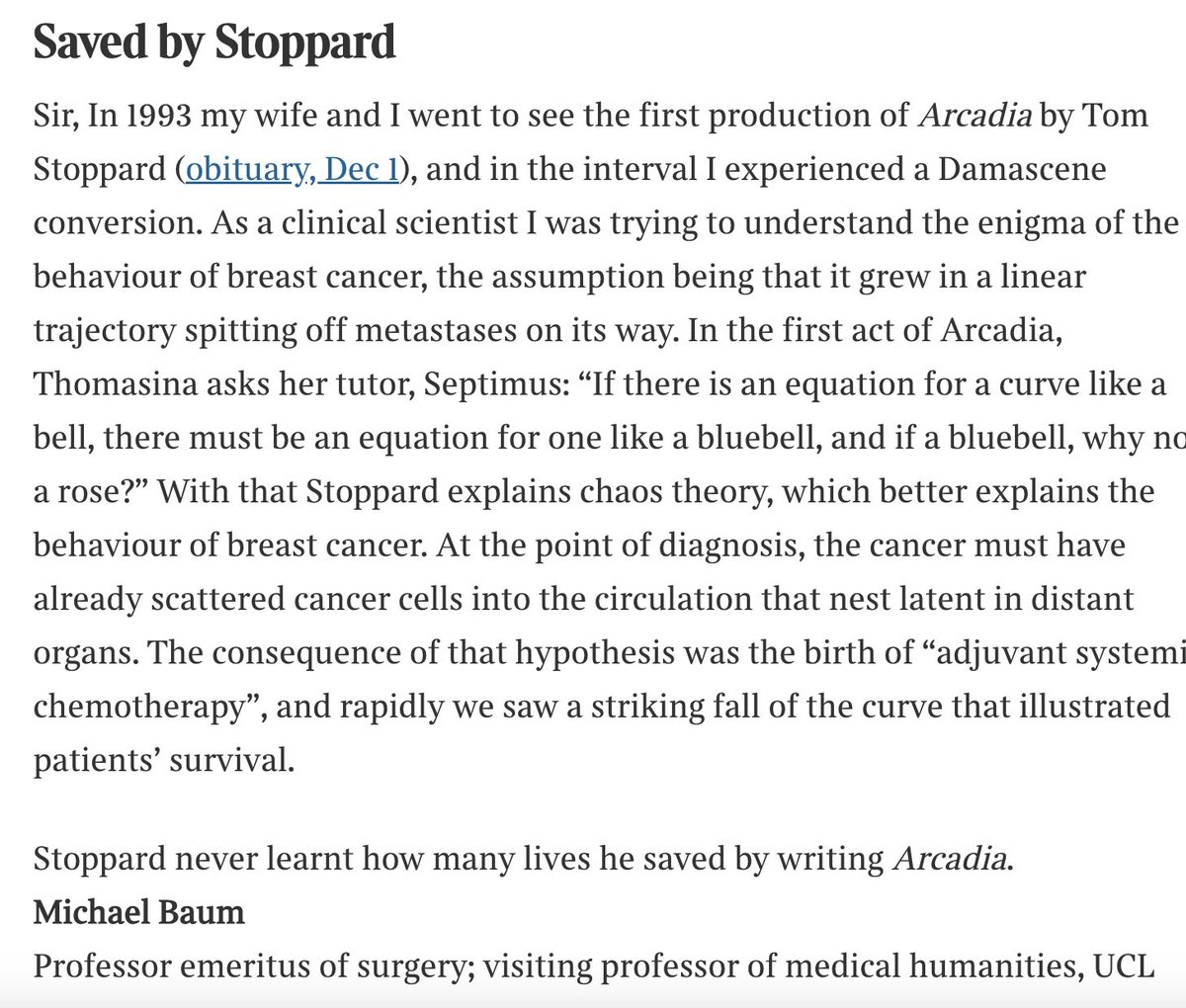
This morning I published a letter in the Times to illustrate paradigm shifts in science. After editing to fit the page it reads like I was the first to introduce adjuvant systemic chemotherapy. That honour goes to B.Fisher in Pittsburgh and G.Bonadonna in Milan
Michael Baum tweet media
English
10
60
345
20.4K
Dave Limp
Dave Limp@davill·
Yes, we will post the vectors to Space-track.org post flight. We are separating from the spacecraft in a highly elliptical orbit, just shy of Earth escape velocity. This will take the spacecraft near the Earth/Sun L2 Lagrange point, where they will propulsively loiter until they continue to Mars. After separation, GS2 will to accelerate faster than Earth's escape velocity (by using RCS thrusters). GS2 will then be in a heliocentric orbit (orbiting the sun). We do this to “dispose” of the stage.
English
4
18
243
6.3K
Jonathan McDowell
Jonathan McDowell@planet4589·
@davill what is the disposal orbit for NG flight 2 stage 2? Will it remain in the 110,000 km apogee Earth orbit? Thanks for any info...
English
1
8
218
14.3K
Iarnród Éireann
Iarnród Éireann@IrishRail·
Update: The following services have been confirmed to be operating. 16:44 Grand Canal Dock to Skerries. 16:40 Dun Laoghaire to Skerries. 16:40 Bray to Skerries. No further services have been confirmed for the Northern commuter route. -CL
Iarnród Éireann@IrishRail

Update: Major disruption to services on the Northern Commuter route. Northern commuter route services are suspended. A train has broken down in Balbriggan. Update to follow. -CL

English
14
0
1
31.1K
Paul Cunningham
Paul Cunningham@RTENewsPaulC·
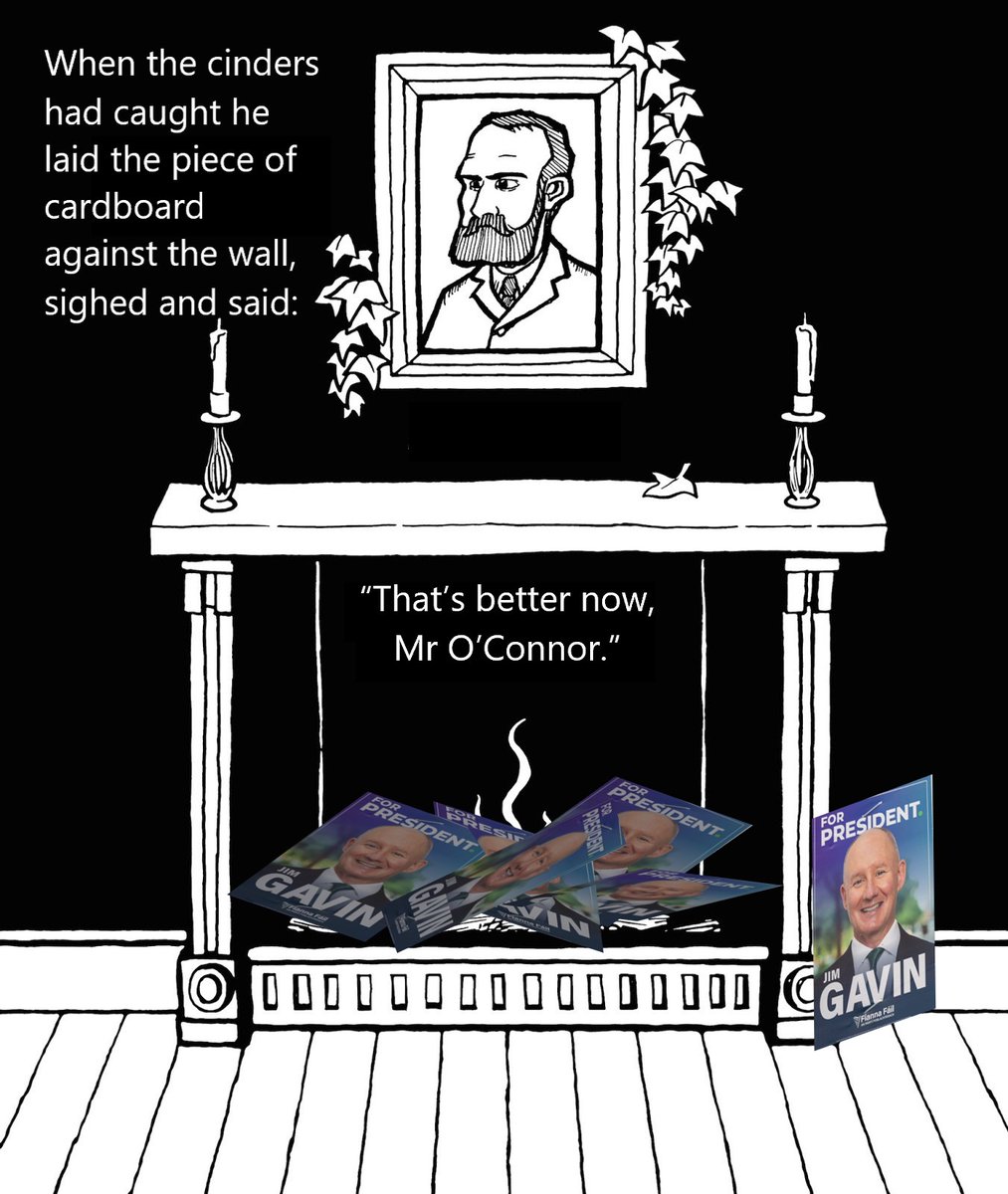
New - a member of the Fianna Fáil parliamentary party tells me the leadership needs to convene a meeting, no later than tomorrow night, following Jim Gavin’s exit from the presidential race @rtenews #aras2025
English
45
85
448
80.4K
Leo Enright @ollopa11.bsky.social
@dmcbfs What's your source for this? There is no reference to withdrawals in the @SIPOCIreland document. UK law provides for withdrawal by a deadline: The withdrawal notice must be submitted by a deadline of 4pm on 19 working days before the poll. Too late for Jim!
English
0
0
0
42
David McCann
David McCann@dmcbfs·
From the departmental candidate guidance on the presidential election. Jim Gavin cannot officially withdraw.
David McCann tweet media
English
13
18
77
22K
Leo Enright @ollopa11.bsky.social
@SIPOCIreland What is your guidance on when - or if - a candidate can withdraw. (UK law provides for withdrawal by a deadline: The withdrawal notice must be submitted by a deadline of 4pm on 19 working days before the poll.)
English
0
0
0
30
SIPOC
SIPOC@SIPOCIreland·
The Standards Commission has published it’s guidelines for the upcoming Presidential Election 2025. sipo.ie/en/publication…
English
1
1
0
563
Leo Enright @ollopa11.bsky.social
BUCHANAN: Dublin Time Machine@RobLooseCannon

Did you know English trade union workers sent shipments of food to help starving Dublin workers and their families during the Lockout? Today in 1913, Dublin’s starving striking workers and their families (some 80,000 mouths to feed) were two months into the great Lockout, and the city was heavy with hunger. More than 20,000 workers had been thrown out of their jobs for refusing to sign away their right to join the Irish Transport and General Workers’ Union (ITGWU). Into this bleak scene steamed the SS Hare, with its lifesaving cargo of 60,000 food parcels, sent not by politicians or the church but by fellow workers across the Irish Sea. Members of the British Trades Union Congress (TUC) rallied to James Larkin’s call for solidarity. Larkin, the fiery Liverpool-born founder of the ITGWU, had returned to Britain to raise funds and food for the strikers, and here was the proof of his success. The SS Hare was no stranger to Dublin. Built to trade between Manchester and the Liffey, it had ferried livestock, cargo, and passengers for the Dublin & Manchester Steamship Company, co-founded by Manchester merchant George Lowen and Dubliner D.J. Stewart. The quays were crowded with thousands of anxious faces, and when someone cried, “It’s the SS Hare!” a roar went up that shook the waters. One witness, Paddy Butner, just a child at the time, remembered the moment vividly: “A cheer rose from every throat of those watching… The hair stood up on my head and I shouted with the rest in joy. As the vessel came abreast of the South Point, we all turned about and kept pace with her; the cheering and the waving continued while tears streamed down the faces of women and, indeed, men too.” Volunteers unloaded flour, bread, potatoes, tea, sugar, margarine, jam, tins of fish, cheese, and even coal, storing the cargo in the Manchester Shed on Sir John Rogerson’s Quay before it was brought to Liberty Hall for distribution. Countess Markievicz and members of the Irish Citizen Army were among those who organized the relief, parceling out the food to strikers’ families. The Hare was just the first. More ships followed, the SS Pioneer, the SS New Fraternit, until by late November hundreds of thousands of parcels had poured into the city. For the strikers, it was more than sustenance. It was a signal that they were not fighting alone, that somewhere beyond Dublin’s locked-out gates there were people who believed in them. The Hare itself would not survive the decade. In 1918, it was sunk en route to Manchester, with eleven lives lost, six of them Dubliners. Among the dead was Mrs Arland, a widow who left behind four children.

QME
0
0
0
44
AJ+
AJ+@ajplus·
Drone attacks and explosions have hit flotilla boats carrying aid toward Gaza. The Global Sumud Flotilla said activists on board the boats were also sprayed with suspected chemicals. Organizers say they will “not be intimidated” by the attacks.
English
1
42
62
9.4K
Space Mechanics
Space Mechanics@SpaceMechanicsY·
@curiosityonx Not just a photo, Venera 13 also recorded the first sounds on Venus, capturing the wind in its thick atmosphere along with the clicks of its own machines. Audio :
English
17
87
988
45.2K
Curiosity
Curiosity@CuriosityonX·
The Clearest Image of Venus’s Surface, By a Lander that Melted After 1 Hour
Curiosity tweet media
English
407
1.8K
20.8K
1.1M
Leo Enright @ollopa11.bsky.social
@curiosityonx @grok Who worked hard to produce this carefully calibrated and corrected image from archival Venera data? Why is their work appearing on X and on Facebook without attribution? Is there something this person can do to have their work properly recognised?
English
1
0
4
239
Leo Enright @ollopa11.bsky.social
@Astro_Ayers @astro_Pettit What was the date and time of the pic? You seem to have posted it originally at about lunchtime CDT on July 3? Does that mean it was taken the night of July 2-3? 24 hrs before the Texas Hill Country flood disaster?
English
0
0
0
91
Nichole “Vapor” Ayers
Nichole “Vapor” Ayers@Astro_Ayers·
@astro_Pettit Trying to make you proud! Couldn’t get pictures like this without your willingness to teach and share knowledge with everyone 😊
English
7
9
290
21K
Nichole “Vapor” Ayers
Nichole “Vapor” Ayers@Astro_Ayers·
Just. Wow. As we went over Mexico and the U.S. this morning, I caught this sprite. Sprites are TLEs or Transient Luminous Events, that happen above the clouds and are triggered by intense electrical activity in the thunderstorms below. We have a great view above the clouds, so scientists can use these types of pictures to better understand the formation, characteristics, and relationship of TLEs to thunderstorms.
Nichole “Vapor” Ayers tweet media
English
1.1K
9.2K
62.7K
5.1M