Shokus 🦇🔊

254 posts

Shokus 🦇🔊

Shokus 🦇🔊

@Shokus

Beigetreten Nisan 2009
136 Folgt20 Follower
Shokus 🦇🔊 retweetet
vitalik.eth
vitalik.eth@VitalikButerin·
@RyanSAdams ETH is a store of value and one of the most important apps on ethereum.
English
609
1K
7.7K
1.1M
Shokus 🦇🔊
Shokus 🦇🔊@Shokus·
Stake your $ETH with $rETH from @Rocket_Pool! Use the most decentralized staking protocol, support home stakers, and secure #Ethereum all at once. Join us to celebrate Saturn 1 imminent launch on 18 Feb 2026! x.com/Shokus/status/…
Shokus 🦇🔊@Shokus

@Rocket_Pool Saturn 1 upgrade is coming this February 16, 2026! Featuring: 1. 4 ETH RP Validators for more ETH staking rewards and more rETH supply 2. Megapools for more gas efficiency 3. Protocol revenue share for more flexibility and rewarding staked RPL

English
0
3
8
141
Shokus 🦇🔊
Shokus 🦇🔊@Shokus·
@Rocket_Pool Saturn 1 will enable megapools, where a node operator will be able to manage multiple validators with a single smart contract! This will allow significant gas savings for adding new validators and distributing rewards for home stakers! x.com/Shokus/status/…
Shokus 🦇🔊@Shokus

@Rocket_Pool Saturn 1 upgrade is coming this February 16, 2026! Featuring: 1. 4 ETH RP Validators for more ETH staking rewards and more rETH supply 2. Megapools for more gas efficiency 3. Protocol revenue share for more flexibility and rewarding staked RPL

English
0
3
8
109
Shokus 🦇🔊 retweetet
vitalik.eth
vitalik.eth@VitalikButerin·
I'll do the ill-advised thing and try to explain my own thought process and constraints (and possibly unadmitted cowardice) that guide when I do and don't speak on these kinds of political topics - and further down just say what some of my direct opinions are. It's 2026, the careful route isn't getting us anywhere anymore, might as well try being open. When it comes to hot political issues (not abstract questions like tax policy, surveillance, etc, which it's actually easy to talk about, I mean specific events that affect specific groups), I basically have three choices: 1. Talk about none of them 2. Talk about some of them 3. Talk about all of them Many people do (1). In crypto, many people talk about "decentralized governance", a "freedom", a "fairer economy without intermediaries", "cypherpunk", etc etc, and maybe talk about how blockchains and encryption and zero knowledge proofs can make these things happen. But they take care to avoid making the link between those values and any specific situation. This approach is "safe". But ultimately, it feels hollow, and I think it makes your mind hollow. It makes it really easy for you to think you're doing the right thing, because you're working on all the right technologies, but then because you never engage on any concrete issue, you don't even notice if you're not actually making any impact on the underlying problems - or worse, actively diverting idealistic talent and effort from actually-effective solutions. I think this applies both to individuals, and to whole communities. And so if you don't want to fall into this trap, you have to engage with the world. Note that this does not mean that *your work* can't be general-purpose and instead needs to be targeted to directly affect some specific situation in the world. Focused work is good. But I do think the world benefits from a decentralized public apparatus of moral conscience that extends beyond topics that you directly work on. Many people do (3). But there is a good argument against (3): if you are forced to take positions on everything in the world, then you're usually taking positions on things you had little or no prior understanding of, and your positions are motivated by a few emotional articles or posts that recently convinced you in one direction or the other. And if you have 100 topics, you can only devote 1% of the effort to tracking each one. It becomes easy for someone to convince you of a position that you would not even support if you were more informed about it. There is a reason why people hate the "omnicause", "everything-bagel activists", etc. Focusing on everything dilutes the message to the point where you're succeeding at nothing (or worse, having actively counterproductive postures on things as a result of low information). Hence, there is the option of (2). But (2) has a natural problem: once you talk about some things, it becomes easier for people to pressure you to talk about even more things, by accusing you of selective outrage and hypocrisy. (And, to be fair, selective outrage and hypocrisy are very real problems) To defend against this, you need to hold "a line". One very natural line is to mostly limit your attention to topics that relate to you personally. For example, I and my family are from Russia. When I see footage of the war in Ukraine, whether videos of soldiers getting ready for a military operation, or families expressing their anguish after their apartment building or hospital was bombed, they are often speaking in a language I have known since childhood. More importantly, and regrettably, I personally met Vladimir Putin and thus to some small degree helped legitimize him back in 2018. To me, these things mean this conflict relates to me and is my responsibility to do the right thing in (and not just be a passive bystander, perhaps saying "I am against war" exactly once and then continuing my life). Similarly, Canada is my responsibility, as it's the land where I grew up - both when the government financially deplatformed the truckers (which I criticized), and when the bumbling old man down south starts bullying and threatening its sovereignty (which I've also criticized). Meanwhile I've spent 0 days in Myanmar or Venezuela, less than three months in the Middle East, and have much less context in those and other places - I know what I know from reading second-hand sources and making my own judgements about which facts are true and false and which arguments are right and wrong, which is far from zero, but it still has limits. The United States is a special case, because historically politics in the USA affects the world so much, many people (though today much less than a decade ago) look up to it as an example, and it has massive influence through its economy and its centralized technology platforms. So sorry guys, the entire world has a right to blab about your internal affairs. Something something vaguely similar to "no taxation without representation". This approach that I outlined does have a weakness: regions of the world that are economically very poor will have very few globally powerful people that have close connections to them. Hence, a "take care of your own" norm leaves such people in the dust, vulnerable to being ignored or even outright predated on by others, with no one powerful sticking up for them. I personally try to address this by first making a judgement about whether a faraway situation is more like an internal conflict or more like eg. global public health, and apply the "take care of your own" norm in cases like the former and not in cases like the latter. This is the explanation I can give for why I've publicly said relatively more about Canada, USA and Russia, and relatively little about Venezuela, Sudan, Africa, Myanmar, China, or the Middle East, including both Iran and the various conflicts involving Israel. Basically, if I don't draw the line roughly here, what other line can I hold? *Maybe* there are some people who are closer to "pure devs" who can hold a different line, speaking *only* about abstract generalities, but I've always covered the full spectrum from pure tech to social issues, so I don't think I *can* hold that line. Hence, instead I have to hold slome further-out and more complicated line. Of course, it's also easy to construct a less self-serving explanation: I have some view of who my constituency is, and I am a coward who is afraid of offending them. I could respond by pointing to various instances in which I've been publicly brave (whether calling out Craig Wright, or visiting Kyiv, or running through 2km of rain to get to a conference panel on time etc), but maybe my critics can justly counter by pointing out that this is simply the old-as-time masculine tactic of "compensating for something". I will let readers make their own judgements. Now, my views on a few specific topics: Iran From what I can tell, the Iranian regime is: * Literally killing tens of thousands of people, in gruesome ways, in its crackdown on the current protests * Totally denying Iranian people access to the worldwide internet, in part to cover up the above, and there is a high chance that the regime intends this situation to be permanent. * In the longer term, doing more generally awful things like imposing what clothes women have to wear, providing military support to Russia's invasion, publicly wishing death to various groups on official channels, etc These things are unambiguously awful. They're not a "eh, what can we do" normal level of awful, they are totally awful. Even if global public condemnation accomplishes nothing else, simply reducing the regime's social status to the point where it equals that of North Korea's gov seems like part of the bare minimum that should be done. Though hopefully, the protests will succeed and expand and Iranian people will get freedom. I hope that the crypto space finds a way to be useful by exploring more options to restore access to the global internet to Iranians. Furthermore, there is another important point to make: many people say "this is awful", but then still maintain an attitude of disapproval toward overly "impolite" ways of dealing with the problem, eg. using physical violence against the Iranian leadership. I see the value of a "suggesting violence is impolite" norm in maintaining civilization, but IMO that norm should be focused on *initiating* the escalation to full-scale violence; it's fine to respond with violence when violence is already being used in the other direction on a large scale. Being overly pacifist is a good way to feel self-righteous while doing nothing effective to prevent the people you sympathize with from being rolled over. Nothing in those above paragraphs is "anti-Islamic". But there is the question: if we analyze the situation, and ask *what causes* the Iranian government to be abnormally brutal, then might the conclusion be that those causes include cultural values that are core to Islam? I personally don't understand Islam enough to comment. But I can say two things: * There's plenty of extreme evil that happens without Islam. the invasions carried out by Russia are one good example, there's plenty of extremely dangerous political megalomania worldwide that is 100% secular * In my experience, the anti-Islam hate that I see in our world often goes beyond cultural criticism, and turns into attacks on people and condemnation of entire ethnic groups (see eg. post 9/11). Culture can and should be criticized, including by outsiders. This includes banal things, like my view that miles, feet and pounds are stupid units of measurement and SI units are more civilized (I have much less confidence on 'F vs 'C). It also includes deeper things like moral values. But there is a way to do this that does not turn into personal attacks on people. I do often see anti-Islam discourse failing at this (though some criticize effectively and humanely). Israel/Gaza My moral view on the situation is: * The attack on Oct 7 was a brutal unjustified war crime that killed around a thousand innocent people, and should be condemned without qualifications * The response to the attack has killed ~50-100x more people than the original attack, the majority of them civilians, and has destroyed the homes of over a million Gazans and traumatized the entire population. This level of total devastation in response to an attack of a much smaller scale exceeds all reasonable bounds of self-defense, and itself is a brutal war crime * There are various statements made by high-level officials, actions by soldiers, etc, that I've seen that suggest that the mental state involved in the Gaza operation is less "a principled effort to protect people" and more "classic pre-modern revenge psychology" * Hence, the ICC was right to charge both sides of this * The Israeli government is on the whole a lot more rights-respecting and better to live under than the Hamas one. However, the Hamas government already has social status worse than North Korea. Meanwhile, the Israeli one often gets treated at the highest official levels as a special valued ally, in a way that I fear deeply undermines moral norms, and thus creates room for eg. letting Putin get away with his crimes in Ukraine. This is an imbalance, and I think this is something that many people are reacting against. * What happened in 1967, 1948, and arguably even the late 2000s is honestly not very relevant to this moral analysis. The majority of the population was not even alive when those things happened, there's no good moral reason why the fate of a 14 year old kid who is seeing their home or family destroyed should depend on arcane debates about the previous century's history * The biggest heroes in this situation are probably people quietly working in the background to reconnect people and lay the ground for peace that will hopefully shape itself over decades. I don't think the world can respond *only* by doing this, because it's also important to defend norms ("injustice anywhere is a threat to justice anywhere"), but I'm really glad these people exist and morally support them. I strongly oppose anti-Semitism. To me, this is a special case of the broader moral principle that one should not judge entire ethnic groups by the decisions of a few elites. In other worlds, "hate the government, not the people". One important corollary of this, of course, is that criticizing the Israeli government does not count as anti-Semitism. Principles vs details of the situation I should note explicitly that these moral views above are very "principles-driven" and not "details of the situation" driven. I think this is the correct level at which to approach this. The reason is that while "details of the situation" thinking often can acknowledge subtle important facts that would otherwise be ignored, nevertheless: * It has very low galaxy brain resistance ( vitalik.eth.limo/general/2025/1… ). It's too easy to cherry-pick details that favor your side, and appeal to particularism ("you outsiders can't understand...") to shield one's local bullying from external pushback * It's not something you can build norms around. Peace and humanitarianism in the world depend on moral norms: the fact that the whole world recoils in disgust at certain unconscionable outcomes, and that it can do this in lockstep, and can't be divided-and-conquered by arguing arcane points about third-order game theory or history. Some say "norms are fake anyway, we're in the law of the jungle, you have to protect your own". To anyone who sincerely believes this, all I can say is: YOU HAVE NO FRIGGIN IDEA HOW MUCH EVERYONE, EVEN THE VILLAINS, ARE HOLDING THEMSELVES BACK BECAUSE OF MORALITY AND NORMS EVEN TODAY, AND HENCE, HOW MUCH WORSE THINGS COULD GET * Outsiders to a situation have more understanding of principles than of situational details. Hence, if it's valid for outsiders to express views on things at all, they should focus on their relative expertise, which is the principles. ICE and Immigration The other big thing happening now, that I've been silent on, is ICE turning into a full-on police state and now shooting protesters in broad daylight. The immigration issue is complex and it is important to separate two aspects: * Whether less or more immigration is good (and what kinds). If the highest acceptable level of immigration is less than the level that would naturally arise in the absence of either walls or deportation, then walls or deportation are in principle required. * The fact that ICE is acting like total assholes about this situation. These things can and must be separated. There are immigration systems far more restrictive than USA, whose implementation is more humane. The second needs to be strongly opposed, full stop, no counterarguments admitted. Once the police state apparatus exists to this extent, it *will* keep finding new targets. Even today, it has already expanded its violence from illegal immigrants to obviously-American defenders of immigrants. [insert Niemöller poem here] Today, this second issue (the cruelty) is the more important one in the USA, and its morality is pretty cut-and-dried simple, as described above, so nothing more to say about it. So now, on to the first issue (ideal levels of immigration). I am generally persuaded by Bryan Caplan-style arguments that the answer is "very high". To summarize: (i) the bulk of economic evidence suggests that high-skilled immigration is pretty close to no-downsides good, high-volume low-skilled immigration *slightly* depresses wages of low-wage locals, but it also means consumer prices go down for everyone. The $3 falafels in Berlin (which in turn support the city's status as an affordable home for various artistic and cultural activities) are only possible because of the Middle Eastern low-skill labor (ii) in the USA, even illegal immigrants (!!!) on average commit less crime than the native population. In Europe though this is not true. I also add my own bespoke point (iii): if you are worried about change to *culture*, then I believe that the larger driver of culture change is not foreigners but technology. The real great replacement is the kids growing up on TikTok. (also, much of cross-country culture spread happens through the internet, not via farm workers or Uber drivers) And so actually I believe that if you care about stopping the great replacement, the right thing to invest in is ... longevity technology, so that existing human beings and their generations with unique cultures can survive through the ages as human beings, and not just as history pages. That's right: making everyone live 10x longer is a *conservative* technology. (To the counterargument that this will also make evil dictators live 10x longer and prevent their societies from ever escaping: if we get into that world and a dictator gets too awful, then yeah I'm ok with droning them, I already said so above) However, the downsides to public safety and government welfare expenditure from some types of immigrants are real. Personally, I think that we're very far from exhausting the opportunities we have to solve this problem without deporting people at all - I regularly see stories of criminals getting freed after committing three murders and then quickly going out and committing a fourth. We should stop doing this. Every act of lenience against a violent criminal saps public acceptance for immigration, and thus leads to ten acts of anti-lenience toward peaceful foreigners. Hence, true long-term empathy would withhold lenience from the criminals, and apply that lenience to peaceful foreigners instead. But there is a larger problem behind this problem. Western morality is very dominated by "out of sight out of mind" bias. If you are on the inside of the wall, then you're part of the family, all human beings are equal, let's sing and dance in a circle. If you are on the outside of the wall, then you get performative thoughts and prayers, but in terms of substantive support, well, hang on we'll get right back to you. This is where I think the social role of the "illegal immigrant" category in the USA comes in. It is a strange category, because we're saying that legally there are tens of millions of people who are violating the law on a mass scale, but we're not _doing_ that much about it. Requiring employers to verify immigration status of employees frequently gets shot down. But from the perspective of "Western society hacking around its own broken moral code", it makes perfect sense. We believe in "all humans are equal", that "second-class citizenship" is a bad and dystopian idea, that everyone deserves "good" working conditions, etc etc. But the economic reality is that the wage level that maximizes (not only local economic, but also humanitarian) gains from hiring foreign labor is lower than the level that is acceptable to locals - if you force the wage for low-skill foreigners up to the same level as locals, then you end up hiring much fewer of them, and so even the total humanitarian benefit you bring to low-income foreigners by giving them more economic opportunity is lower. So how do we solve this? Well, we invent the "illegal immigrant" category, and so the moral baseline becomes "well technically you don't even have the right to be here, and so really, anything you get here counts as an extra bonus". This is the moral self-arbitrage. The problem is that wealthy countries by default are exactly in the position of the space colony from the movie Elysium: they're gated communities for the global rich, where everyone outside is a second-class citizen on a global scale. So if we say "we refuse to exploit foreign labor, they can all stay outside", we're not actually being moral. Hence, to me the principled solution seems to be, to be more willing as a society to say "you're welcome in the land and you can work, but you're not part of the family", and to create visa categories that reflect this fact. Paths to become part of the family should continue to exist, but it's okay for those paths to be much more difficult than paths to simply come in and work. This is a model that already works well in many places in the non-West. And today, I find many non-Western countries increasingly opening themselves up to foreigners, while Western countries close down, add more ESTA and visa bureaucracy, border guards become more annoying and insufferable, etc. The grand sacrifice: take less seriously the idea that "once you're within the walls, everyone is part of the family and is equal". This mentality was more sustainable in the 20th century, when people's identities were mostly bound up with a single country and most people did not even see anything outside their home country, but it is incompatible with the 21st, where information is global and our identities are plural. Unless we can achieve equality across the whole world, saying "within our home we are equal, outside our home go away" is ultimately a larp morality, and we should move on to something better. This *should* be a major task of the next generation of compassion-driven political philosophers. If we do this, it opens the door to greater openness to the outside world, which will ultimately be a human rights boon to everyone by giving people much-needed second options. (special thanks to @ameensol for pushing me to be more brave even though I predict he will disagree with ~1/3 of the above)
English
266
178
1.4K
261.4K
Shokus 🦇🔊
Shokus 🦇🔊@Shokus·
@Rocket_Pool Saturn 1 will enable 4-ETH validators, so you will only need 4 ETH to start your own validator! Each 8-ETH validator currently can be split into 2 4-ETH validator, enabling pairing up to 56 ETH from the deposit pool, up from 24 ETH now. x.com/Shokus/status/…
Shokus 🦇🔊@Shokus

@Rocket_Pool Saturn 1 upgrade is coming this February 16, 2026! Featuring: 1. 4 ETH RP Validators for more ETH staking rewards and more rETH supply 2. Megapools for more gas efficiency 3. Protocol revenue share for more flexibility and rewarding staked RPL

English
0
1
3
18
Shokus 🦇🔊
Shokus 🦇🔊@Shokus·
@Rocket_Pool Saturn 1 upgrade is coming this February 16, 2026! Featuring: 1. 4 ETH RP Validators for more ETH staking rewards and more rETH supply 2. Megapools for more gas efficiency 3. Protocol revenue share for more flexibility and rewarding staked RPL
English
1
4
13
427
Shokus 🦇🔊 retweetet
superphiz.eth
superphiz.eth@superphiz·
1. @Rocket_Pool is a powerful contributor to @Ethereum node diversity. 2. The Rocket Pool Saturn 1 upgrade is coming February 9, 2026. 3. YOU can operate a RP validator with 4 Ether, this is huge.
English
10
26
94
3.5K
Shokus 🦇🔊 retweetet
Omid Malekan
Omid Malekan@malekanoms·
With all due respect to Matt, the notion that Tempo will in any way be neutral is a fantasy. First, the very fact the he is billed as the "project lead" while sitting on the board of Stripe, a corporation who is clearly central to this effort, and being a GP at a VC firm that will likely be heavily invested in it, is a problem. That screams "not neutral." (counterintuitively, the better Matt is at being project lead, the less neutral the chain will be). Second, he is conflating the chain being permissionless with it being public. Public means "anyone can transact or issue on it" and permissionless means anyone can be a validator. As stated by Matt, Tempo will start as a permissioned chain. A permissioned chain will never be public. To wit: will North Korea be able to freely issue tokens on Tempo? What if Do Kwon decides to launch an algorithmic stablecoin on there from jail? And then Putin says "we will route payments for our sanctioned oil being sold on the black market via stablecoins on Tempo"? Will the permissioned, known, and regulated corporations who run the validators be OK with all of this? Will the general council of Visa declare "Yes: we are clearly violating many US Federal laws and risk losing or licenses and possibly going to jail, but the docs said Tempo is a public blockchain, so we will process all of these transactions?" I don't think so. As I argued yesterday, permissioned networks do not provide validators the plausible deniability required for a chain to be neutral: x.com/malekanoms/sta… Third, no permissioned network has ever successfully transitioned to being permissionless. Hyperliquid is trying, but they have a long way to go, and are a special use case because it's mostly an app-chain, one whose primary margin asset still remains "elsewhere", something that might be OK for perps but not for payments. Tempo will have an even harder time transitioning, because per the announcement, there is heavy involvement from various payments incumbents, most of all Stripe. To believe that the network can transition to permissionless is to believe that corporations that accrued hundreds of billions of dollars in value over recent decades by owning a network will now launch a new network that they own (cause it's permissioned) but then magically decide to give all the power and profits that come with it away, quite possibly to competitors that will try to destroy their incumbent businesses. That is highly unlikely. As @ccatalini pointed out yesterday, even Libra's original plans to someday decentralize nwere pushed to the back burner rather quickly. And Facebook did not have an incumbent payment business to protect. Stripe, Visa, Nubank, etc etc all do. Y'all really think they'll give it away? This has never happened before in the history of shared corporate infrastructure - which is what Tempo will be on day one. Every other shared corporate infra (Visa, Mastercard, CME, NASDAQ, SWIFT, The Clearing House, etc etc) has gone in the opposite direction - it has centralized power and become more permissioned and censorable over time. This is literally why Satoshi invented Bitcoin. And I say this not as an ideological opposition to Tempo, but as an observation of what will be debated in the conference rooms of every potential issuer, user, etc etc. Y'all really think Mastercard will jump all over a permissioned network controlled by Stripe and Visa? Or Amazon or Walmart - fresh off their endless lawsuits against Visa and Mastercard for being oligopolies? Lastly, It's hard enough to bootstrap a PoS chain from scratch because of the "rich get richer" problem of staking. Ethereum is still the only PoS chain that's achieved a diverse token-holder set that can deem it "a neutral L1." It got there by : a)having a tiny premine by modern standards and b)being PoW for years. Tempo will start with a massively concentrated token holder set and permissioned validator set. To argue it'll easily become neutral is to make a whole bunch of assumptions that are contrary to the ideals and lived experience of this industry.
Matt Huang@matthuang

On Tempo, permissionlessness, L1 vs L2 Tempo will be a permissionless chain. On day 1, anyone will be able to deploy a token, and anyone will be able to transact on the chain. Some projects think that attracting real-world usage and serious institutions requires giving up on base layer neutrality. We do not think that, and that's not how we're building Tempo. The plan for Tempo is to have permissionless validation and permissionless smart contract deployment as well as permissionless usage: just like Bitcoin, Ethereum, Solana, etc. We’ll start with a permissioned validator set to get going and decentralize further from there. We’re building in features to make it easy for entities interacting with the blockchain (like asset issuers, money transmitters, etc.) to comply with their relevant obligations, but the base layer will remain neutral. This is a principle we feel incredibly strongly about (see: paradigm.xyz/2022/09/base-l…). As many parts of the mainstream world look to adopt crypto, we think there is a risk that they adopt permissioned systems. Our goal with Tempo is to help onboard them onto crypto rails that solve specific payments needs while still being truly permissionless. — Why L1 rather than an Ethereum L2? At Paradigm, we are heavily invested, both intellectually and literally, in the Ethereum ecosystem. We will continue to help it scale, and invest in and support companies building on Ethereum. We are also extremely excited about single-sequencer L2s for many use cases, including trading. But building a network for global payments will require bringing together thousands of partners that may not trust us, or Stripe, or anyone as a platform. We think a decentralized validator set—for the chain itself—is a necessary requirement for those partners, and to ensure that the chain is unquestionably neutral in the long run. From an operational perspective, we feel urgency to build for the demand that’s coming and want fewer dependencies, including on the rate of Ethereum L1 progress. With Tempo, we tried to remove all crypto tribalism and alignment games from our thinking and just focus on building the right product for crypto payments. At a technical level, we are prioritizing attributes like fast finality (L2s are generally only as final as the underlying L1), multiple validators (vs. single sequencer), and custom transaction lanes and gas pricing. Some of these are technically possible for an L2, but could be complex, slow to implement, and/or introduce many external dependencies. Tempo is stablecoin-focused, so interoperability through native issuance is more relevant to us than the native bridge to Ethereum that L2s have. We aren’t Bitcoin, Ethereum, or Tempo maximalists. We’re maximalists for permissionless crypto. We want Ethereum L1 to scale, and we want L2s to thrive. We love Bitcoin as a monetary asset. We find substance in Solana, Hyperliquid, and many other ecosystems. We want to ensure real-world payment flows happen on crypto rails, and that’s why we’re building Tempo.

English
92
181
1.4K
182.7K
Shokus 🦇🔊 retweetet
Milk Road
Milk Road@MilkRoad·
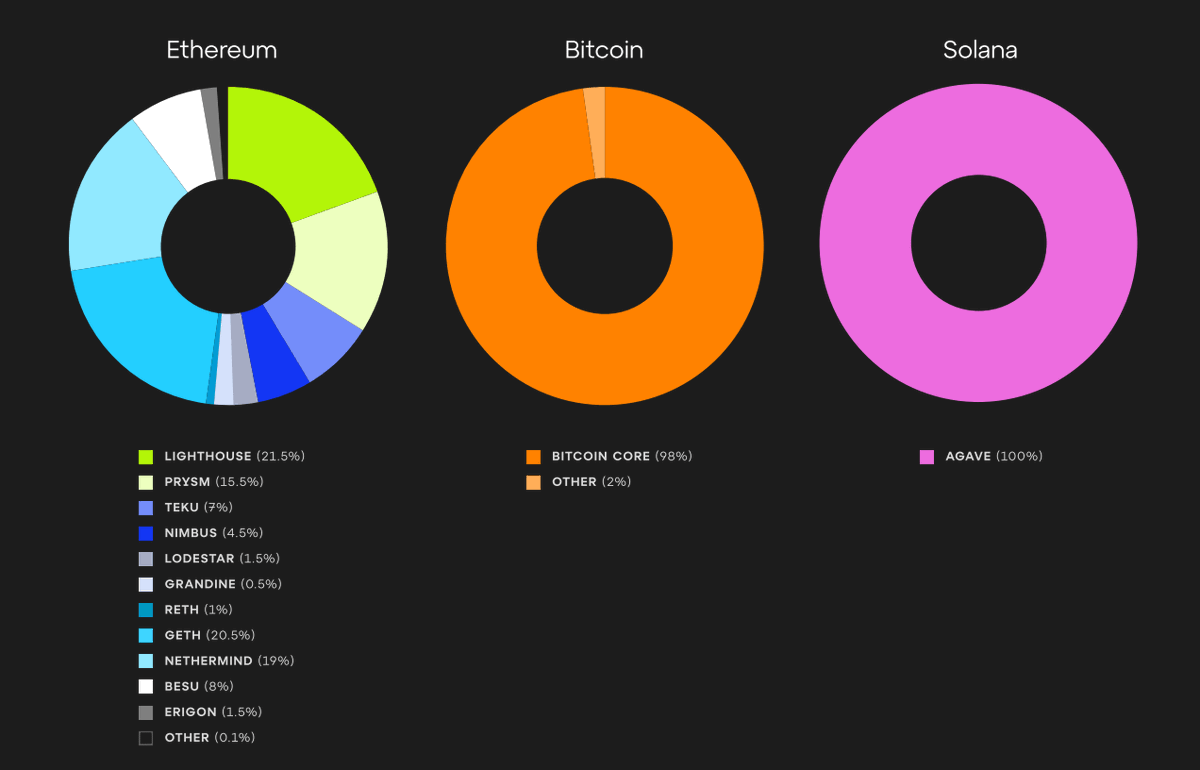
$ETH has no single point of failure. It runs on over a dozen independently built clients. No one controls the network. By contrast: 98% of Bitcoin nodes run the same software (Bitcoin Core). 100% of Solana nodes run a single client (Agave).
Milk Road tweet media
English
26
68
337
18.7K
Shokus 🦇🔊 retweetet
Bruce Fenton
Bruce Fenton@brucefenton·
I heard someone today say “we shouldn’t pretend Tornado Cash isn’t used for illicit purposes”. I don’t pretend Tornado Cash is used for one thing or another - it’s none of my business what people use software for.  It’s also not anyone else’s business what anyone does with their money. It’s not “illicit” to move money.  Moving money is not a legitimate crime. ALL surveillance and control, all AML KYC and all violations of privacy are completely unethical, immoral and illegitimate. All of them. We have to go along with this because the tyrants pushing these horrible things have guns - but none of it has any place in a free society. Moving money and having privacy is not a legit crime.  There is no victim. If someone moves money for a purpose that is in violation of a legitimate law then the law enforcement can chase them for that legitimate crime.  (A legitimate law is a crime against someone’s life, body or property. It has an a direct clear victim.  No other laws are legitimate or ethical.) It’s wrong to treat the whole world as criminal suspects and to force draconian regulations on everyone.  It’s wrong to threaten, fine or jail people for paperwork or other made up violations which harm no one. This is all a very new and very bad idea. Almost none of this existed only 30 years ago. For most of human history the idea that thug tyrants in high offices had the right to visibility to who owns what and where and how it’s transferred would have been considered absurd. Even some of the most totalitarian regimes did not have as tight of financial controls as we have now. People didn’t even need an ID to buy stocks until the 90s. The tyrants have made people lose the plot and think that privacy or moving money without filing out some forms is a “crime”. This entire thing should be scrapped.  There’s no legitimate case for this.  Money should be able to move freely. “I see you deposited $8000.  We need to know where it came from.” “I see you are withdrawing $3400 cash to buy a rare Magic the Gathering card…not so fast, we need some forms.” Gets out of here. Totally immoral.  Unethical.  No one should support this. We need to fight much harder - not just for cases like Roman — but at a bigger picture level. Every conversation with every politician and regulator should note that ALL regs related to KYC and AML are illegitimate, anti business, anti freedom and a human rights violation.  All should be scrapped. “But Bruce what about the terrrorrooorrrrrrrists and the child traffickers 😭 think of the children!” That’s the problem of the terrorists and traffickers - chase them.  Don’t treat the other 4 billion of us like criminals.  Don’t grind down the wheels of the global economy and create friction on a trillion transactions — go do some police work.  Not my problem.   Money movement should be free. Privacy is a human right.
English
76
191
744
51.7K
Shokus 🦇🔊 retweetet
stakeyour.eth 🦇🔊
stakeyour.eth 🦇🔊@bogdanoffi·
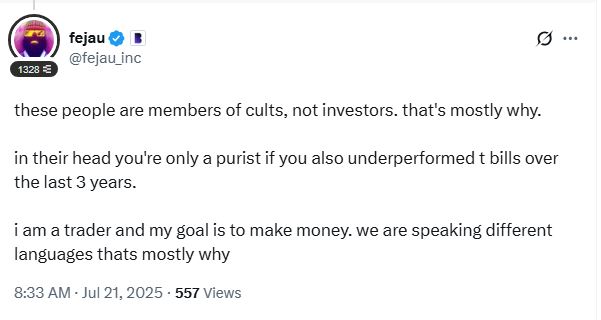
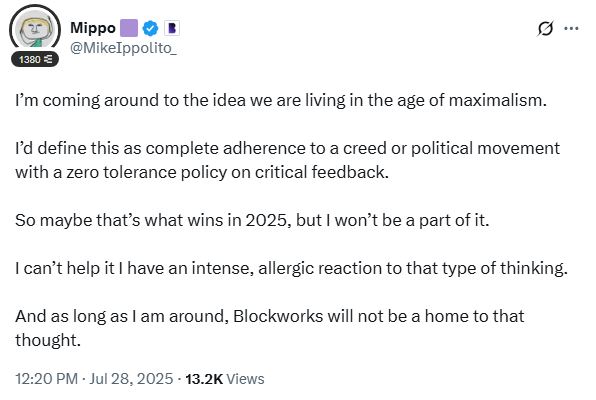
This is the truth about "ETH maxis" that often gets misunderstood or distorted by those that got into crypto for $. Most of us are not "ETH maxis", we're cypherpunk value maxis that just happen to support ETH because it's the most aligned with our vision. If a new blockchain came out tomorrow that embodied those values and was technologically superior to Ethereum while: 1. Not being a blatant grift to enrich insiders/VCs by making ~85%+ of the supply available in a public crowdsale 2. Not compromising on decentralization in exchange for scalability or security 3. Innovating and unlocking new use cases that can't already be done on Ethereum Then many of us wouldn't hesitate to pivot away from Ethereum. However, every notable blockchain since 2016 has only been some combination of: 1. Projects designed to enrich insiders with miniscule public sale allocations 2. Blockchains avoiding the hard problems that Ethereum tries to solve, opting instead for shortcuts by sacrificing decentralization for scalability either by -relying on delegated PoS with <30 validators responsible for block production (2017-2020 era "ETH killers" like Neo, EOS, Tron etc) -relying on data centers/enterprise grade hardware (2020-2025 era "ETH killers" like Solana, SUI etc) 3. Has provided NOTHING of substantial or innovative value that hasn't already been done before by the Ethereum ecosystem Smart contracts? Stablecoins? Tokenization? DEXs/DeFi? NFTs? Privacy tools? L2s utilizing fraud proofs/ZKPs? So far every meaningful use case of blockchain tech was pioneered by the Ethereum community. Why do you think that is? Hint: It's thanks to the dedication and commitment of those researchers/devs/supporters who are steadfast in their principles. Otherwise they would have gave up long ago like so many dead projects have in the last decade. People love to make fun of that or dismiss it as a "cult/religion/ETH maxis", without realizing it's due to their efforts that crypto ever amounted to anything beyond simple BTC p2p transfers. FWIW I don't have anything against @blockworks , because despite being in crypto since 2017 I've never even heard of them until a few months ago. They're a media company so obviously making $ is their priority, and presenting yourself as "neutral" and against maximalism is a better way to gain a wider audience and improve monetization. But a quick glance at some of their takes makes it obvious why they draw so much disdain from the ETH community. ^ This was a weird take from a guy that says he's a trader, but doesn't understand ETH supporters are long term value investors that made their decision based on fundamentals (since ETH has always had the overall lead in TVL, TX fees, network usage, devs, apps, institutional adoption, no network downtime, and does not rely on data centers). Those fundamentals were always the investment thesis behind ETH, with the belief that TradFi would eventually recognize ETH for that. And then you see comments like these: There's nothing wrong with flip flopping or changing your views. It's the reason WHY you flip flop that matters. If it were based on fundamental issues that have changed then no one would complain (for ex if ETH L1 went from 20 TPS => 100K TPS, or if L2s suddenly stopped being "parasitic" and helped accrue value to L1 by burning all L2 fees etc). But if it's just because TradFi has validated what Etherean's have been saying for years (that ETH will be valuable as the global settlement layer due to stablecoins/tokenization/adoption etc), while everything you were bearish on remained the same (L1 still low throughput, L2s still siphoning lots of fees from L1) then that means your investment thesis was wrong all along and your opinions on the subject are mostly just noise chasing hype. As for why "ETH maxis" may seem the most hostile out of all crypto communities (excluding BTC maxis), that's because most Ethereans actually understand how blockchains work in terms of consensus mechanisms, node/validator specs and capital requirements etc (since many of them were either early Bitcoiner adopters, were actually drawn to crypto for the cypherpunk values, and are involved beyond being passive holders), so naturally they get upset and will call out objectively bad takes. You won't encounter that level of hostility from other communities simply because they're less informed on the technicalities and don't care about anything other than number go up (no one buys Cardano/XRP/Sui for any other reason besides unit bias and hoping that their $3 token goes to $1,000). @JasonYanowitz @MikeIppolito_ hopefully this will give you guys a better understanding of where ETH supporters are coming from. Also I've noticed the data Blockworks is focused on mostly revolves around REV, fees, tx count etc. Maybe you guys can also consider adding other network metrics such as # of nodes, validators, hardware/bandwidth requirements, capital requirements etc. Might be something your viewers would find valuable.
stakeyour.eth 🦇🔊 tweet mediastakeyour.eth 🦇🔊 tweet mediastakeyour.eth 🦇🔊 tweet mediastakeyour.eth 🦇🔊 tweet media
Etheraider@etheraider

Appreciate the effort here but in this case, you are conflating maximalism of values with maximalism of chains. The reason "ETH maxis" don't just change position on a whim is because they are driven by principles of the tech, not the circumstances. You seem to completely miss this, or just not share in the principles at all, which is fine. But you cannot fault others for being steadfast in principle, or begrudge them for not playing loose with what they consider is of value. If some new tech came out tomorrow that was a better solution to optimize for economic freedom for the common man, Id happily go that direction, and I know many other "ETH maxis" would as well. You are either really missing it, or not addressing the true critique, just my perspective.

English
106
79
488
43.2K
Shokus 🦇🔊 retweetet
sassal.eth/acc 🦇🔊
sassal.eth/acc 🦇🔊@sassal0x·
People will often criticise Ethereans for boasting about Ethereum's 100% uptime by saying "well, what are you going to say if Ethereum goes offline in the future?" They don't understand that the Ethereum network has been specifically designed to be as anti-fragile as possible - the chances of the whole network going offline are effectively 0%. This is because a major design decision that was made early on was to prioritise having multiple clients that run the network so that if there was a bug in a single or even 2 clients, it wouldn't bring the whole network down. This has been a tremendous success as there are 5+ clients available for both the consensus and execution layers and these clients are only getting more stable and secure over time. There is no other network that has client diversity like Ethereum - nothing even comes close - and I believe that nothing will ever come close. And, of course, there are also other anti-fragile design decisions that Ethereum has made over the years - not overloading the L1, prioritizing home/solo stakers, inactivity leak penalties for validators who go offline, rigorous testing of network upgrades and so much more. There is simply no second best anti-fragile network.
sassal.eth/acc 🦇🔊 tweet media
English
49
81
602
24.9K
Shokus 🦇🔊 retweetet
Joseph Chalom
Joseph Chalom@joechalom·
After 20 years at BlackRock and helping to lead its digital asset strategy, I’m beginning a new chapter: I’ve joined @sharplink as Co-CEO. Here’s why. At BlackRock, I helped launch: - IBIT — world’s largest Bitcoin ETP - ETHA — world’s largest Ethereum ETP - BUIDL — world’s largest tokenized fund (built on Ethereum) We didn’t just talk about digital assets, we bridged TradFi and crypto. Now, I’m joining @sharplink, a company led by @ethereumJoseph and built on a clear belief: That Ethereum is becoming the foundation of global finance. And I couldn’t agree more. Stablecoins, tokenized assets, AI agents, are all moving onchain. And it’s happening on Ethereum. That’s where the future is being built. SharpLink is already one of the largest corporate holders of $ETH. Our goal is not just to hold $ETH, but to activate it, using native staking, restaking, and Ethereum-based yield strategies. All to increase the value of our treasury and create long-term shareholder value. We’re building a bridge between institutional capital and Ethereum-native yield, packaged in a single public equity. The asset is $ETH, the ticker is $SBET.
English
562
544
3K
631.7K
Shokus 🦇🔊 retweetet
AdrianoFeria.eth 🦇🔊 🛡️
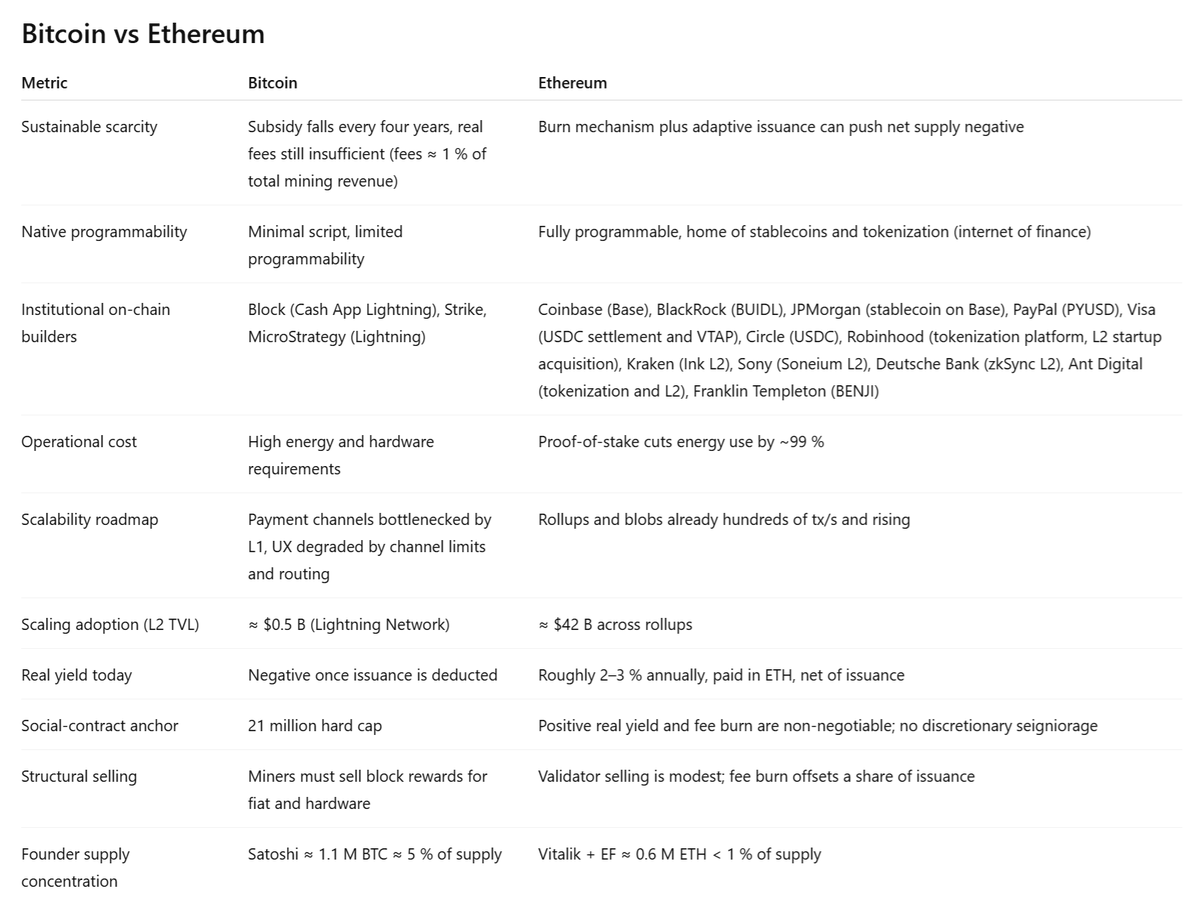
BTC had multiple advantages over Ethereum as a store of value in the first few years after ETH launched. Those dynamics have changed since then and, in many cases, have actually flipped. The only major advantage BTC has retained is brand power and mindshare, but these were largely built on fundamentals and arguments from the past. What is left for BTC? Regulatory clarity? No. BTC and ETH have achieved parity. Execution risk? Maybe, but the argument can easily be made that ETH now carries less risk. BTC is struggling to attract demand for onchain transactions, which means significant changes are needed to reverse this trend. Ethereum has already deployed its riskiest upgrades, and development has become incremental, moving toward ossification. Protocol complexity risk? Ethereum has never experienced a critical protocol-level bug, has superior client diversity, and has maintained 100% uptime. Historically, BTC has had a critical level protocol bug, and it does not match ETH's 100% uptime. No real use cases or demand for smart contracts? Ethereum is the home of stablecoins, tokenization, NFTs, and DeFi. It is the internet of finance. Too centralized or not censorship resistant? BTC still has high supply concentration among early holders. Mining has become more centralized and less mobile, making it more vulnerable to censorship or consensus manipulation like selfish mining. Ethereum faced the most severe censorship pressure from OFAC, yet not a single transaction was successfully censored. The network is sufficiently decentralized. Lindy effect and network effects? Ethereum is now 10 years old. It is the main platform onboarding institutions to the onchain economy. Rollups give institutions control over execution and fee structures, while also enabling them to monetize activity and reinvest in user experience, support, and execution layer improvements. ETH remains the most liquid and trustless digital asset across L2s. Supply dynamics? BTC has a tentative supply cap, not an unconditional one, and demand for transactions has shifted to offchain products like ETFs which means future issuance cuts could be an existential threat. ETH has no cap, but staking yield is always higher than issuance. All issuance is distributed to validators, and fees are burned. That makes ETH's nominal issuance irrelevant and eliminates structural selling pressure from miners. No liquidity? ETH has sustained higher exchange volume for 7 consecutive days now, and before that, it has trailed BTC relatively closely. What am I missing?
AdrianoFeria.eth 🦇🔊 🛡️ tweet media
English
0
2
12
467
Shokus 🦇🔊 retweetet
AdrianoFeria.eth 🦇🔊 🛡️
The first cracks in BTC's monetary policy are starting to show, and they're manifesting as BTC mining companies diversifying or pivoting toward ETH. If you're a small miner with already tight margins, you desperately need BTC's price to rise significantly or onchain adoption to explode. However, BTC's appreciation is slowing down, and new adoption is increasingly happening offchain, some BTC OGs are even migrating offchain due to security concerns. If this slowdown in appreciation continues, hash power growth will outpace it, squeezing margins even further, and the following halvings will crush less efficient miners, primarily the smaller operations unable to leverage economies of scale. In other words, smaller BTC mining companies will have NO CHOICE but to pivot to becoming BTC treasury companies or ETH staking/defi because their margins will be increasingly squeezed by larger miners consolidating power, miners benefiting from special subsidies or concessions, slower BTC price appreciation, and BTC's growing offchain adoption. BTC treasury companies don't generate cash flow, ETH staking/DeFi companies do. In a market that is saturated with BTC treasury companies, smaller companies will find more success pivoting to ETH. This means the revenue BTC miners generate will increasingly flow into ETH. This shift will significantly reshape market optics in ETH's favor, potentially sparking a positive feedback loop, especially considering Ethereum's rising prominence with booming stablecoin and tokenization markets, along with strong institutional adoption. My prediction: what we have seen in the past few days with 4 BTC miners will accelerate and most small miners will be forced to pivot, consolidating hash power among fewer miners. This concentration will set the stage for a "profitability attack", in which a coalition of miners could orchestrate a 51% attack solely to capture 100% of mining rewards and wipe out the competition, rather than to disrupt the network or censor and rollback transactions.
English
36
45
348
28.5K
Shokus 🦇🔊 retweetet
Etherealize
Etherealize@Etherealize_io·
The stars are aligning for ETH: ⏩ $1.25bn ETF inflows over 19 straight days ⏩ Adoption as a treasury asset ⏩ Price turnaround (+100% from lows) Institutions are noticing. We’ve come together to tell the world why. Introducing ETH: Digital Oil for the Digital Economy (1/7)
Etherealize tweet media
English
197
773
3K
1.2M
Shokus 🦇🔊 retweetet
Picolas Cage
Picolas Cage@Picolas_Caged·
Metamask added Solana support and added Solana at the top of the list as default - replacing Ethereum. How incredibly tone deaf and stupid. What an amazing way to alienate your entire core userbase.
English
59
17
477
31.1K
Shokus 🦇🔊 retweetet
Rocket Pool
Rocket Pool@Rocket_Pool·
Fee switch coming soon for $RPL! The Saturn upgrade will direct a portion of the protocol’s ETH revenue to staked RPL, in a ratio that can be adjusted by the DAO to be responsive to market conditions Read more about the Saturn upgrade on Medium, link below 👇
Rocket Pool tweet media
English
26
23
111
7.6K