Signal Edge

423 posts

Signal Edge banner
Signal Edge

Signal Edge

@SignalEdgeHQ

Gulf disruption intelligence the English-speaking market can't see. 220+ sources. 5 languages - Corroborated in real time. For traders & risk desks.

London, UK Beigetreten Mart 2026
133 Folgt150 Follower
Angehefteter Tweet
Signal Edge
Signal Edge@SignalEdgeHQ·
Ras Laffan was hit by 7 ballistic missiles. QatarEnergy says repairs take years. 30% of global LNG exports offline with no restart date. That wasn't in English — because it wasn't reported in English. We monitor 220+ sources across Farsi, Arabic, Hebrew, Turkish and English on a 60-second cycle. Every event cross-confirmed across multiple independent sources before we report it. 155 verified instances of reporting before Reuters, Al Jazeera, Bloomberg and CNBC. 2,475+ confirmed disruption events in the last 7 days — zero English wire coverage. 7 countries with simultaneous port disruption. Zero at full capacity. This is corroborated intelligence for energy traders, maritime underwriters, and commodity risk desks. What's your desk not seeing right now?
English
0
0
1
134
Signal Edge
Signal Edge@SignalEdgeHQ·
Two blockades. One strait. Zero functioning exit. USN blockading all ships in and out of Hormuz. IRGC claiming full operational control of the same waterway. Two Pakistani-flagged tankers — Khairpur and Shalamar — just turned back. What we're tracking right now across Farsi, Arabic and English channels: → IRGC asserting full control over all Hormuz operations → Iranian state media saying two US destroyers failed to cross the strait → Jebel Ali: suspended, no vessels berthing → Basrah & Khor Al Zubair: export terminals offline → Duqm: droned again — fifth strike → RAK: Iranian vessels banned entirely → Bahrain: limited cargo movements → Saudi eastern ports: domestic calls only Eight countries. Two competing blockades. No mechanism to reopen either one. Market opens tomorrow pricing a ceasefire that doesn't exist anymore. $BZ $CL #OOTT
English
0
0
1
42
Signal Edge
Signal Edge@SignalEdgeHQ·
Spot on — and that's the dangerous bit. The silence from other navies is probably being read in Tehran as tacit acceptance, when really it's just nobody wanting to be first through the door. What we're seeing on our end is a real gap between what IRGC commanders are claiming internally and what's actually moving through the strait. They're saying full control — the AIS data tells a different story. The naval piece matters more than people think though. UK minesweepers don't just show up for optics. That kind of quiet escalation changes the math pretty fast.
English
1
0
1
36
david spratt
david spratt@Oil_vampire·
@SignalEdgeHQ @GasBuddyGuy Iran may be under the impression they have more international support than they do because other countries aren't committing naval forces. IMO, if they did, would send a message they can't extort shipping in violation of every international agreement regarding laws of the sea
English
1
0
1
44
Patrick De Haan
Patrick De Haan@GasBuddyGuy·
one can't think we'd actually block the Strait completely & cause even more a mess/backlog, or if once the Navy gains a level of control that perhaps he'll look to allies for help in taking it over- but the rhetoric is back, markets hate uncertainty, just what Trump gave more of
English
17
18
154
12.7K
Signal Edge
Signal Edge@SignalEdgeHQ·
@SStapczynski We flagged the UKMTO boarding warning earlier tonight. Hormuz blockaded and Bab el-Mandeb under pressure on the same day. 32% of global oil transit threatened simultaneously.
English
0
0
1
131
Signal Edge
Signal Edge@SignalEdgeHQ·
The quotes around "blockade" are gonna age badly imo. UK minesweepers confirmed tonight, IRGC claiming full operational control of the strait, two Pakistani tankers turned back hours ago. This isn't a Truth Social rant — it's already operational. Monday's oil open is pricing 13-15 MMbpd of Gulf shut-ins plus a naval blockade on whatever was still trickling through the Larak corridor. Day 44 of the war and the infrastructure damage alone takes months to years to reverse.
English
1
0
5
669
The Kobeissi Letter
The Kobeissi Letter@KobeissiLetter·
Key Events This Week: 1. Markets React to Failed Negotiations and Hormuz "Blockade" - Today, 6 PM ET 2. March Existing Home Sales data - Monday 3. March PPI Inflation data - Tuesday 4. Philly Fed Manufacturing Index - Thursday 5. Initial Jobless Claims data - Thursday 6. 10 Fed Speaker Events This Week Today marks day 44 of the Iran War.
English
100
185
1.5K
147.4K
Signal Edge
Signal Edge@SignalEdgeHQ·
The scenario where Tehran keeps control but gets no sanctions relief — that's basically what's already happening on the water right now. IRGC running the Larak corridor, collecting $1/barrel in yuan, US Navy showing up to blockade on top. Except the physical picture is worse than a status quo. Infrastructure doesn't care about negotiating positions. Ras Laffan is wrecked, Kharg took dock hits, seven countries with port damage. None of that reverses on a diplomatic timeline regardless of who blinks first. The question isn't really whether Israel continues alone. It's whether anyone's port infrastructure survives long enough for it to matter.
English
0
0
0
70
Alan Eyre
Alan Eyre@AlanEyre1·
Money quote from @tparsi's excellent analysis below: "A more likely scenario is a new non-negotiated status quo in which Tehran retains control over the Straits but doesn't get any sanctions relief, while the US pulls out of the war, and the question becomes whether Israel will continue the war on its own."
Trita Parsi search. ..@tparsi

Regarding Trump's threat/decision to impose a naval blockade on Iran, color me a skeptic. 1. Taking more oil off the market, particularly the only oil that is now getting out from the Persian Gulf, will drive oil prices further up, and the paper price of oil will get closer to the actual price, which should be around $150 per barrel. A dramatic increase in inflation in the US will ensue. Avoiding this is precisely why Trump was stuck in a position where he had no escalatory options out of this conflict before the ceasefire. He still doesn't. 2. Stopping tankers carrying Iranian oil wouldn't just be an escalation vis-à-vis Iran, but also against the countries that are buying Iranian oil, which includes China, India, and other Asian countries. I doubt Trump is ready for that escalation, particularly given the upcoming summit in Beijing. 3. This is also true for punishing countries that have negotiated a toll with Iran for the Straits. That includes Pakistan, which hosted the negotiations. 4. The naval blockade escalation will make the closing of the Red Sea more likely by the Houthis. That would take another 12% of global oil flow off the market. We would now be looking at oil around $200 per barrel. There are nine or so days left of the ceasefire. Since neither side has explicitly stated that talks won't resume, or that the ceasefire is dead and over with, all these moves should be treated as tactics and threats within the negotiations. It wouldn't be surprising if these threats are walked back soon (perhaps before markets open on Monday) and a new round is announced. HOWEVER, there is a time for brinkmanship, and there is a time for serious negotiations. If the US truly was insisting on zero enrichment in Islamabad, which was not Trump's red line at first but rather Israel's, then the next talks will be rendered a failure - just as the talks in May 2025 were killed by Trump shifting to the Israeli red line. Still, I don't think that necessarily will lead to a return to war. A more likely scenario is a new non-negotiated status quo in which Tehran retains control over the Straits but doesn't get any sanctions relief, while the US pulls out of the war, and the question becomes whether Israel will continue the war on its own.

English
1
0
15
1.2K
Signal Edge
Signal Edge@SignalEdgeHQ·
The Houthi/Red Sea retaliation risk is the one most desks haven't priced into tomorrow's open yet. Bab el-Mandeb had an attempted boarding today — UKMTO warning issued hours before the blockade announcement. If Hormuz AND Bab el-Mandeb come under simultaneous pressure, that's 20% and 12% of global oil transit threatened at once.
English
0
1
3
522
Mohamed A. El-Erian
Mohamed A. El-Erian@elerianm·
To state the obvious, an inherently fluid and uncertain situation in the Middle East War has taken a turn toward heightened risk following the initial failure of this weekend’s US-Iran negotiations, the continued Israeli strikes in Lebanon, and this morning's US decision to blockade the Strait of Hormuz. If current conditions remain unchanged, we should expect a leg up in oil prices when the Asia-Pacific trading week begins. The magnitude of this surge will also depend on how likely the US blockade is to trigger retaliatory Houthi interference with Red Sea navigation. The immediate economic question remains the direct and indirect impact of higher energy prices. It's also worth monitoring how close various economies are to actual energy shortages. The current risk distribution is as follows: Asia and most developing countries (high), Europe (medium to high), and the US (low). #economy #oil #energy #markets #middleeastwar
English
36
47
237
36.2K
Signal Edge
Signal Edge@SignalEdgeHQ·
It's not just a threat. The IRGC is already running Hormuz on CIPS rails — $1/barrel toll settled in yuan, China the biggest buyer of whatever gets through. A US naval blockade on top means Washington is now directly interdicting China's energy supply line. Monday morning isn't just an oil price event. It's the moment two competing systems for controlling global energy transit collide in the same 30-mile waterway.
English
1
0
0
3.7K
Hu Xijin 胡锡进
Hu Xijin 胡锡进@HuXijin_GT·
President Trump is clearly furious. He is threatening an even bigger blockade in response to Iran’s. If he follows through, oil prices will surge and stock markets will crash. This would be catastrophic for the global economy—and that catastrophe would quickly translate into massive political pressure on President Trump. Trump posted this on Sunday morning, when oil and stock markets were closed—a perfect time for the president to vent his anger. We’ll see what he says Monday morning, and whether anyone else in the U.S. steps in to calm the markets.
English
32
51
259
45.1K
Signal Edge
Signal Edge@SignalEdgeHQ·
Point 5 is the one most desks haven't gamed out yet. A US blockade that's selective like Iran's toll road means consumer nations are now navigating two separate permission systems on the same strait. That's not a blockade — it's a bidding war for passage. And point 7 answers itself tbh. Mine clearance ops with allied minesweepers, Navy interdicting toll-paying vessels — that's not an opening phase. That's infrastructure for a long-term presence.
English
0
0
8
9.4K
Shiv Aroor
Shiv Aroor@ShivAroor·
U.S. NAVY BEGINS BLOCKADE OF SHIPS TO/FROM HORMUZ. MY QUICK VIEW: 1. Surprised it didn’t happen sooner. U.S. Navy moving now likely indicates asset ship availability now to enforce the blockade. 2. Turns Hormuz from a mere strait blockade into a contested naval corridor where U.S. forces says it will block ships. 3. U.S. Navy says mine clearing ops have begun. Iran Navy says it has chased away some warships. Even a single clash could rapidly escalate into a direct naval confrontation inside the narrow strait. 4. Slighest miscalculation or mistaken engagement can trigger a major escalation. This is an area where Iran has already attempted strikes on U.S. warships and is has been looking to ‘avenge’ Minab, considering the Tomahawks that hit the school were from a U.S. Navy ship. 5. This impacts not just Iran but also Washington’s Gulf allies. If the blockade materialises, expect it to be selective like Iran’s blockade or the strait. Consumer nations will be dealing with both Iran & US now. 6. Asian economies including India, China, Japan and South Korea are the most exposed because the bulk of Gulf energy exports head east. 7. The big question now: will Iran back down and reopen the strait, or are we watching the opening phase of a naval showdown in Hormuz?
English
115
424
3.4K
274.9K
Signal Edge
Signal Edge@SignalEdgeHQ·
It's bigger than 2mb/d tbh. Iran's exports plus the transit toll revenue plus every other producer's barrels that were still moving through the Larak corridor. Rory Johnston just put the total Gulf shut-in at 13-15 MMbpd tonight. The Red Sea call is sharp — if this escalates further, Bab el-Mandeb is the next chokepoint under pressure.
English
1
0
1
338
Don Johnson
Don Johnson@DonMiami3·
With Trump’s blockade of the Strait that takes 2 million barrels per day of Iranian supply off of the market - this is the largest supply shock with nothing even coming close
English
28
31
288
7K
Signal Edge
Signal Edge@SignalEdgeHQ·
Minesweepers are the tell that this isn't a short-term blockade. Post-1988 US mine clearance in the same waters took over a year — and that was a fraction of what Iran has deployed now. The UK joining means this is being planned as a multinational operation. You don't coordinate allied minesweeping for a problem you expect diplomacy to solve by next week.
English
0
0
1
1.9K
OSINTdefender
OSINTdefender@sentdefender·
U.S. President Donald J. Trump has told Fox News that the UK and a number of other nations are set to send minesweepers to aid in securing the Strait of Hormuz, following his announcement that the U.S. will blockade the strait and interdict all vessels that pay a toll to Iran for safe transit.
English
79
119
880
166.3K
Signal Edge
Signal Edge@SignalEdgeHQ·
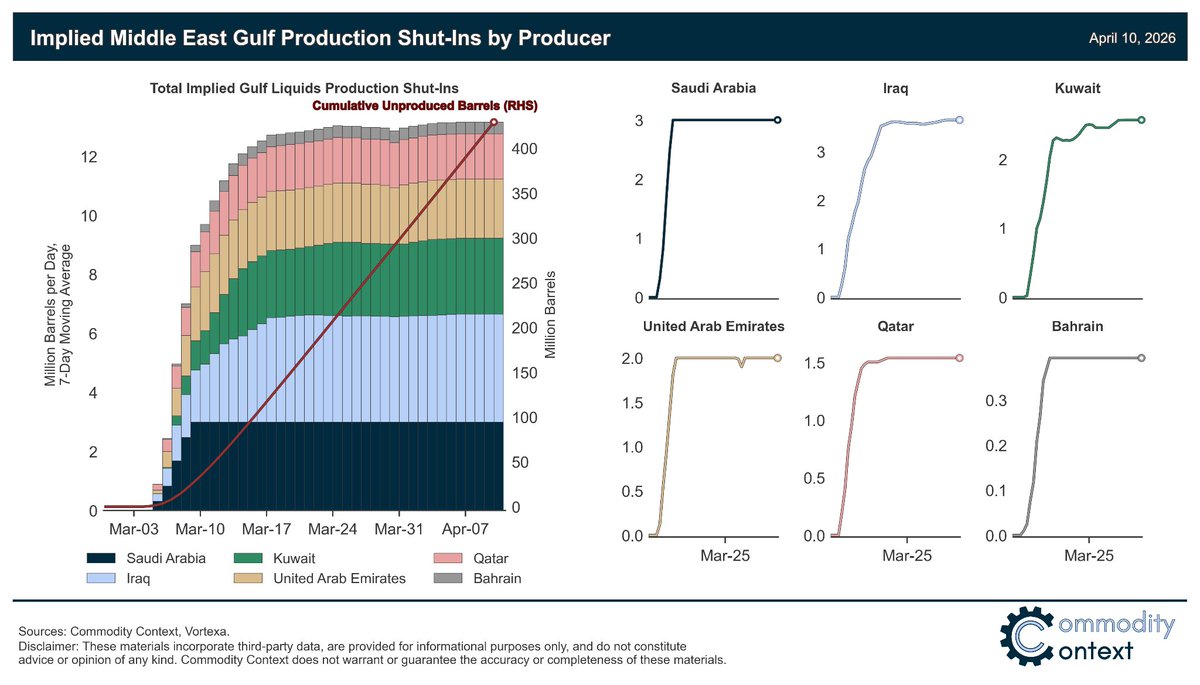
The 13 to 15 MMbpd jump is the headline but the composition matters more than the number. Some of that 13 is offline-but-intact — Saudi shut-ins that restart in weeks. But Ras Laffan is physically damaged, Jubail processing is wrecked, Kharg's dock infrastructure was hit. Those aren't shut-ins — they're destruction. Different recovery curves entirely. And now a US naval blockade on top means even Iran's own ~3mb/d of exports through the Larak corridor gets cut. The toll road just closed from both ends. 400 million barrels lost in 6 weeks assumes this ends. The infrastructure says it doesn't — not on any timeline the market is pricing.
English
0
0
1
440
Rory Johnston
Rory Johnston@Rory_Johnston·
Current Middle East Gulf production shut-ins stand at ~13 MMbpd (out of a ~105 MMbpd market) If Trump blockades the Strait and forces Iran to shut in production that total rises to ~15 MMbpd. It’s been strange to see Iran continue to export through the war so this isn’t a shocking move, per se, but it, too, will come at an additional cost to the global economy starved by the Hormuz stoppage. The Strait of Hormuz has been closed for 6 weeks, more than 400 million barrels of oil that should have been produced this year have been lost to the market.
Rory Johnston tweet media
English
34
67
370
34.7K
Signal Edge
Signal Edge@SignalEdgeHQ·
The gas pump question is the right one tbh. US just blockaded the strait that handles 20% of global oil transit — on top of seven countries with port damage and refineries still offline. Brent was already pricing ceasefire hope over physical reality. A full naval blockade removes the hope part.
English
0
0
1
86
Lobo Tiggre
Lobo Tiggre@duediligenceguy·
Well, that's one way to pressure Iran without boots on the ground. We'll see what those who depend on that oil—including China—have to say. I guess Putin's lovin' it... But Americans looking at higher prices at the gas pump?
Lobo Tiggre tweet media
English
7
2
30
2.4K
Signal Edge
Signal Edge@SignalEdgeHQ·
@Rory_Johnston Two blockades on the same strait now. Iran running the Larak corridor at $1/barrel in yuan — US Navy shutting down everything else. The three loaded tankers that got through this morning just became the last data point, not the first.
English
0
0
15
1.4K
Rory Johnston
Rory Johnston@Rory_Johnston·
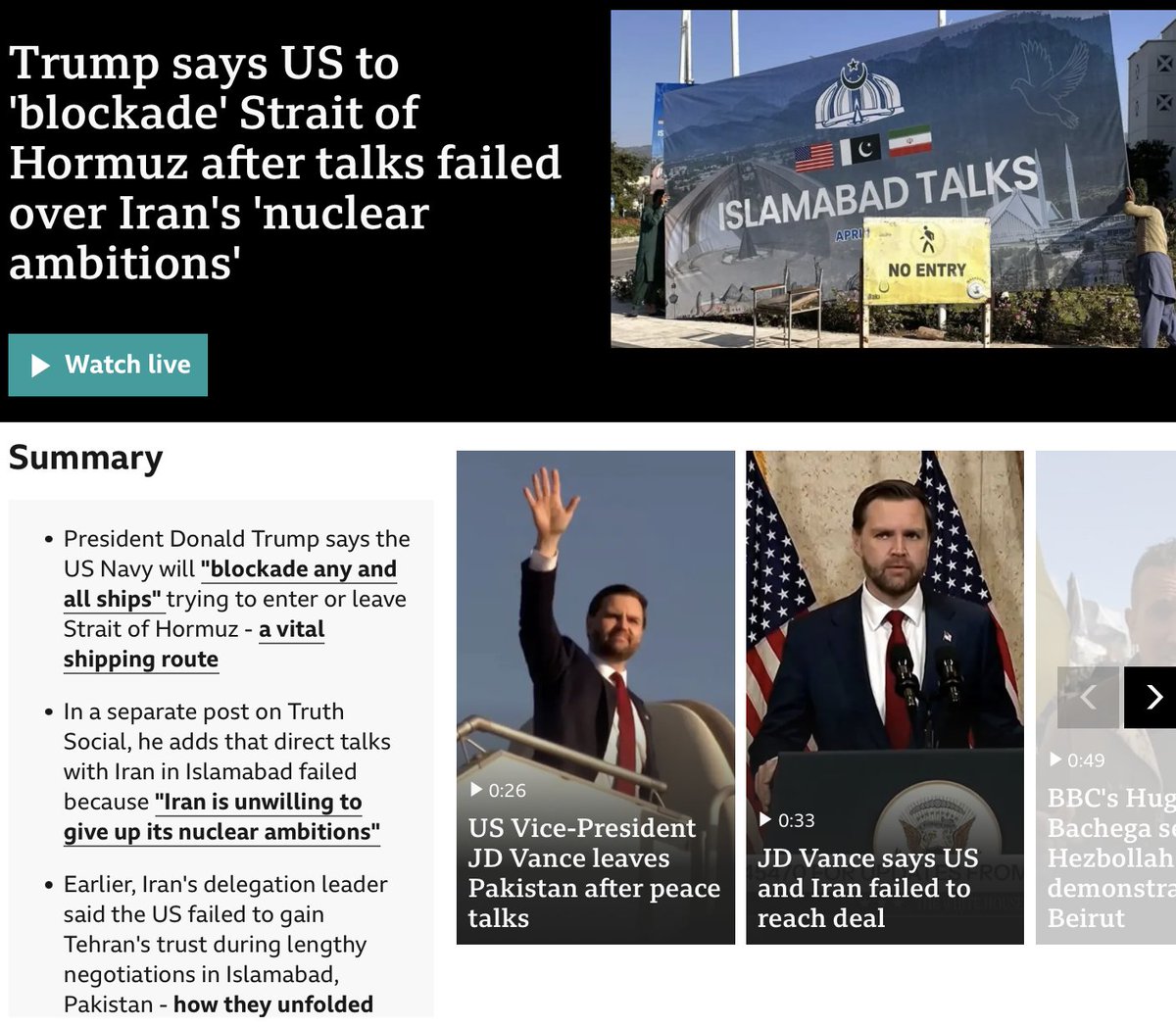
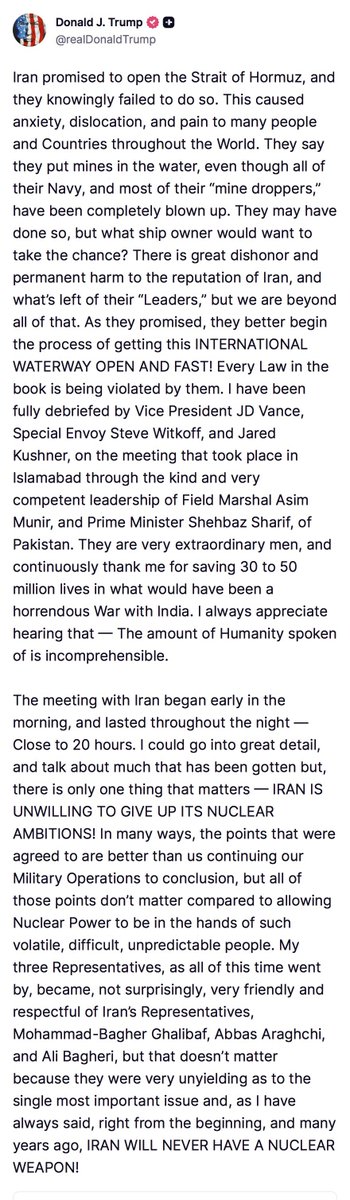
President Trump is awake and long-posting. “Effective immediately, the United States Navy, the Finest in the World, will begin the process of BLOCKADING any and all Ships trying to enter, or leave, the Strait of Hormuz”
Rory Johnston tweet mediaRory Johnston tweet media
English
49
35
317
73.9K
Signal Edge
Signal Edge@SignalEdgeHQ·
@TankerTrackers Iran's toll road just met the US Navy's tollbooth. Two blockades on the same strait — one charging $1/barrel in yuan, the other interdicting everything. The three tankers that "slipped through" this morning? Last ones for a while.
English
0
0
0
3.1K
Signal Edge
Signal Edge@SignalEdgeHQ·
So the toll road just became a blockade. Iran was charging $1/barrel through the Larak corridor — now the US Navy is shutting the door entirely. The "mine out there somewhere that nobody knows about" line is the part that matters commercially. Our Farsi sources have been tracking the mine field data for weeks — Iran genuinely lost track of its own mines per NYT. Post-1988 US clearance in the same waters took over a year. No LNG cargo in a month and now a full naval blockade on top. This isn't a disruption anymore — it's a shutdown with no reopening mechanism.
English
0
0
7
530
Stephen Stapczynski
Stephen Stapczynski@SStapczynski·
“Effective immediately, the United States Navy, the Finest in the World, will begin the process of BLOCKADING any and all Ships trying to enter, or leave, the Strait of Hormuz” (No LNG cargo has left the Persian Gulf in over a month. And doesnt seem like that will resume soon)
Stephen Stapczynski tweet media
English
11
25
106
20.9K
Signal Edge
Signal Edge@SignalEdgeHQ·
The physical chokepoint is further along than most models assume. IRGC is already running the Larak corridor on CIPS rails — $1/barrel toll settled in yuan, five-tier nationality vetting, US-linked vessels denied entirely. The rare earths and semiconductors are leverage threats. Hormuz is operational. China's already the biggest buyer of whatever crude gets through the corridor — and they're settling outside the dollar system while doing it.
English
0
0
0
27
Richard Casey
Richard Casey@Richard_Casey·
Increaing recognition that Iran is part of a much wider war with China involving chokepoints that are both physical, such as Strait of Hormuz, and economic, such as rare earths, advanced semiconductors and the dollar @greg_ip wsj.com/economy/global… via @WSJ
English
1
1
3
330
Signal Edge
Signal Edge@SignalEdgeHQ·
"Slipped through" is the key phrase here. Three ships through a corridor that handled 138 per day pre-war isn't reopening — it's a trickle through a toll booth. Same day these three got through, two empty tankers U-turned at Larak after talks collapsed in Islamabad. The corridor's rules are changing by the hour. And the receiving side still hasn't moved — where exactly are these cargoes going? Jebel Ali suspended. Iraq's export terminals offline. The barrels exited the Gulf but the infrastructure to process them on arrival is still damaged across seven countries.
English
0
0
0
16
Forbes Middle East
Forbes Middle East@Forbes_MENA_·
Three supertankers carrying crude oil slipped through the Strait of Hormuz on Saturday, the first significant cargoes to exit the Persian Gulf since a fragile US-Iran ceasefire took hold. #Forbes For more details: 🔗 on.forbesmiddleeast.com/1fgz
Forbes Middle East tweet media
English
1
3
1
150
Signal Edge
Signal Edge@SignalEdgeHQ·
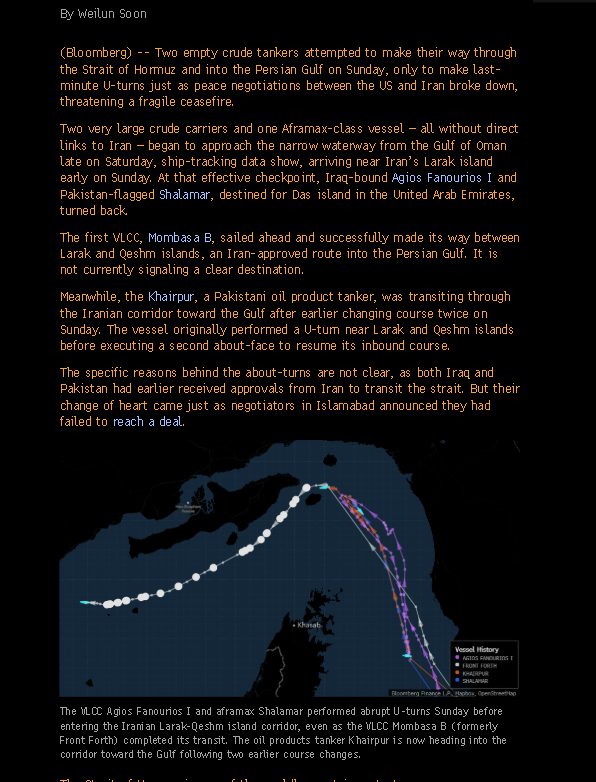
The U-turns tell the whole story. Even with pre-approved Iranian transit, vessels are turning back the moment diplomatic uncertainty hits. That's not a functioning shipping lane — that's a corridor where the rules change by the hour. And the part Bloomberg buries: both were empty. They weren't loading anywhere even if they'd made it through — Jebel Ali suspended, Basrah terminals offline, Saudi eastern ports domestic-only. Meanwhile Lebanon is actively escalating tonight — Hezbollah rockets at Philon base, Israeli strikes across the south. Iran explicitly tied Hormuz reopening to Lebanon. That diplomatic timeline just got longer, not shorter.
English
0
0
0
12
Dan Tsubouchi
Dan Tsubouchi@Energy_Tidbits·
US/Iran ceasefire/war uncertainty! "Two empty crude tankers attempted to make their way through the Strait of Hormuz and into the Persian Gulf on Sunday, only to make last-minute U-turns just as peace negotiations between the US and Iran broke down threatening a fragile ceasefire.... as both Iraq and Pakistan had earlier received approval from Iran to transit the strait. But their change of heart came just as negotiators in Islamabad announced they had failed to reach a deal." @soonweilun #oott .
Dan Tsubouchi tweet media
Dan Tsubouchi@Energy_Tidbits

"Two Chinese supertankers loaded with crude sailed through the Strait of Hormuz after a Greek vessel moved through the waterway.....represents the biggest day of oil exits through Hormuz since the war caused traffic through the waterway to all but halt six weeks ago. None are carrying oil from the Islamic Republic or have obvious, direct links to the country" @JLeeEnergy @soonweilun. #oott

English
1
2
5
1.5K
Signal Edge
Signal Edge@SignalEdgeHQ·
Al Jaber saying this publicly is the signal tbh. This isn't a policy statement — it's the ADNOC CEO acknowledging his own company can't export. They haven't shipped LNG from Das Island or Ruwais in over a month. The 800 vessels and 20,000 seafarers numbers are real but they're the visible part. What he's not saying is that even if transit resumes tomorrow, the receiving infrastructure on both sides is damaged — Jebel Ali suspended, Ras Laffan physically hit, Iraq's terminals offline. The strait opening doesn't solve a port problem. When the head of the world's 12th largest oil company starts using language like "illegal, dangerous, and unacceptable" — that's not diplomacy. That's a company running out of patience with its own export paralysis. What's ADNOC's timeline to resume full ops looking like on your end?
English
0
0
0
92