Michael Strike | Ω

3.1K posts

Michael Strike | Ω banner
Michael Strike | Ω

Michael Strike | Ω

@Strike_Attack

Core team member at $QRL. Deep Thinker. Youtube creator. Engineer. Speaker. Follow me for the latest news at the intersection of #Bitcoin and #Quantum / #CRQC.

Born in the state of confusion Beigetreten Haziran 2019
1.8K Folgt5.5K Follower
Angehefteter Tweet
Michael Strike | Ω
Michael Strike | Ω@Strike_Attack·
On Whether Post-Quantum Digital Signature Upgrades Alone Can Support a Coherent Bitcoin Migration Under Nakamoto Consensus Version 1.3 is live. A Post-Quantum Bitcoin Migration Under Nakamoto Consensus? The paper examines a narrow but uncomfortable question: If post-quantum signatures are introduced via new output types, is that sufficient to enable a coherent Bitcoin migration, or do Bitcoin’s existing ownership semantics and rule-based validation create structural or ethos barriers that signature replacement alone cannot resolve? This revision strengthens the formal threat model, clarifies assumptions around public key exposure, and tightens the argument around immutability and consensus constraints. Serious technical feedback welcome. doi.org/10.5281/zenodo… #Bitcoin #PostQuantumCryptography #Cryptography #BlockchainResearch #NakamotoConsensus
English
2
7
27
1.2K
Michael Strike | Ω
Michael Strike | Ω@Strike_Attack·
Early polling results on the post-quantum upgrade dilemma are in, and they reveal a notable portion viewing on-chain consensus to lock out non-migrated users/funds (the 2-5% Justin Drake flagged) as a violation of blockchain’s core principles. That said, sample size remains small, we absolutely need to rerun this at much higher scale with unbiased, rigorous fact-checking for clearer signals across a broader sampling. Hard forks don’t magically resolve it. The dominant PQ chain may sunset legacy addresses via consensus, turning the old one into a zombie ledger, it also may not. Users think wallet toggles give choice, but market reality decides the winner. Financial institutions get slammed hardest: Which Bitcoin/ETH fork do institutions. custody, trade, or report? Dual ledgers? Accounting chaos? Regulatory gray zones? Legal fights over frozen assets? Total confusion. Risks pile up: liquidity fragmentation, eroded trust in immutable property rights, user exodus, and chain splits killing adoption. Quantum forces the fork in the road, and the question remains ... purity or pragmatism? What is your institution’s plan? Drop thoughts. #PostQuantum #CRQC #Bitcoin #Ethereum #Bitcoin.
English
0
0
0
41
Michael Strike | Ω
Michael Strike | Ω@Strike_Attack·
For upgrading blockchains to post-quantum security, do you think it is a violation of blockchain core principles if consensus is used to eventually lock out Non-migrated users and/or funds from the new chain, even if done by on-chain consensus?
English
6
7
15
724
Michael Strike | Ω
Michael Strike | Ω@Strike_Attack·
@RealEmirHan STTNG was and will always be the GOAT. It wrapped philosophical, ethical, and deep thinking around dramatic stories. Favorite episode? No SFX - just good story telling - "Measure of a Man".
English
0
0
6
295
Emir Han
Emir Han@RealEmirHan·
This scene is why Star Trek Next Generation is peak. Picard is simply the best Captain because of many things but this wisdom alone proves it. “With the first link, the chain is forged. The first thought forbidden, the first freedom denied, chains us all irrevocably.”
Emir Han@RealEmirHan

Name the greatest TV show of all time.

English
106
371
2.1K
117.5K
Michael Strike | Ω
Michael Strike | Ω@Strike_Attack·
@benrayfield Hard forks create a parallel chain, but the upgraded post-quantum chain becomes the dominant one in practice. Many proposals include a sunset phase where non-migrated legacy addresses become unspendable on the new/main chain via on-chain consensus. That’s effectively locking funds out. The debate isn’t "fork vs original”, it’s whether using consensus to deprecate legacy funds violates core immutability, property ownership, and permissionless principles. Do blockchain first principles allow some funds getting frozen to secure the network, creating winners and losers, even if done democratically?
English
2
0
0
21
Michael Strike | Ω
Michael Strike | Ω@Strike_Attack·
You don't need to fully understand quantum computing or blockchain to answer. The question is, if even as low as .5 - 5% of people lose access to their Ethereum or Bitcoin wallets as part of the upgrade, is that acceptable collateral damage to more end a quantum computer attack? Your vote matters.
English
0
0
1
50
Michael Strike | Ω
Michael Strike | Ω@Strike_Attack·
@TheShiftJournal When was this done? The behavior used to be called learned helplessness. And was done decades ago with electrical shocks and canines.
English
0
0
1
446
The Shift Journal
The Shift Journal@TheShiftJournal·
The Invisible Glass Experiment Scientists once conducted a fascinating experiment with a pike and an aquarium. They placed a transparent glass barrier in the middle of the tank. On one side was a large, hungry pike. On the other side swam several small fish. As soon as the pike spotted the smaller fish, it launched itself forward to attack. Bang! It crashed headfirst into the invisible glass and was thrown backward. Undeterred, the pike tried again... and again. Each attempt ended the same way a painful collision. After repeated failures , its head became bruised and some of its scales were knocked loose. Eventually, the pike gave up. It retreated to a corner of the tank, clearly frightened and defeated. Then, the scientists quietly removed the glass barrier. The small fish now swam freely around the entire aquarium some even passing right in front of the pike’s mouth. But the pike never attacked again. Even though it was starving, it refused to strike. In its mind, the invisible wall was still there. A few days later, the pike died of starvation surrounded by abundant food it could no longer bring itself to eat. This phenomenon is known as the Pike Effect (or Pike Syndrome). It serves as a powerful metaphor for how repeated failures and setbacks can create invisible mental barriers that limit us long after the real obstacles have disappeared.
English
45
387
1.4K
125.6K
Michael Strike | Ω retweetet
QRL: The Quantum Resistant Ledger
Google has set a new 2029 target for post-quantum migration. This week, the Ethereum Foundation published it's own quantum roadmap. Last month, Bitcoin's first quantum proposal was merged. These timelines tell very different stories. Our latest piece by Dr. Joseph Kearney (@Joseph_Kearney) breaks down what this all means 👇 theqrl.org/blog/google-ju…
English
3
16
49
3.6K
Michael Strike | Ω
Michael Strike | Ω@Strike_Attack·
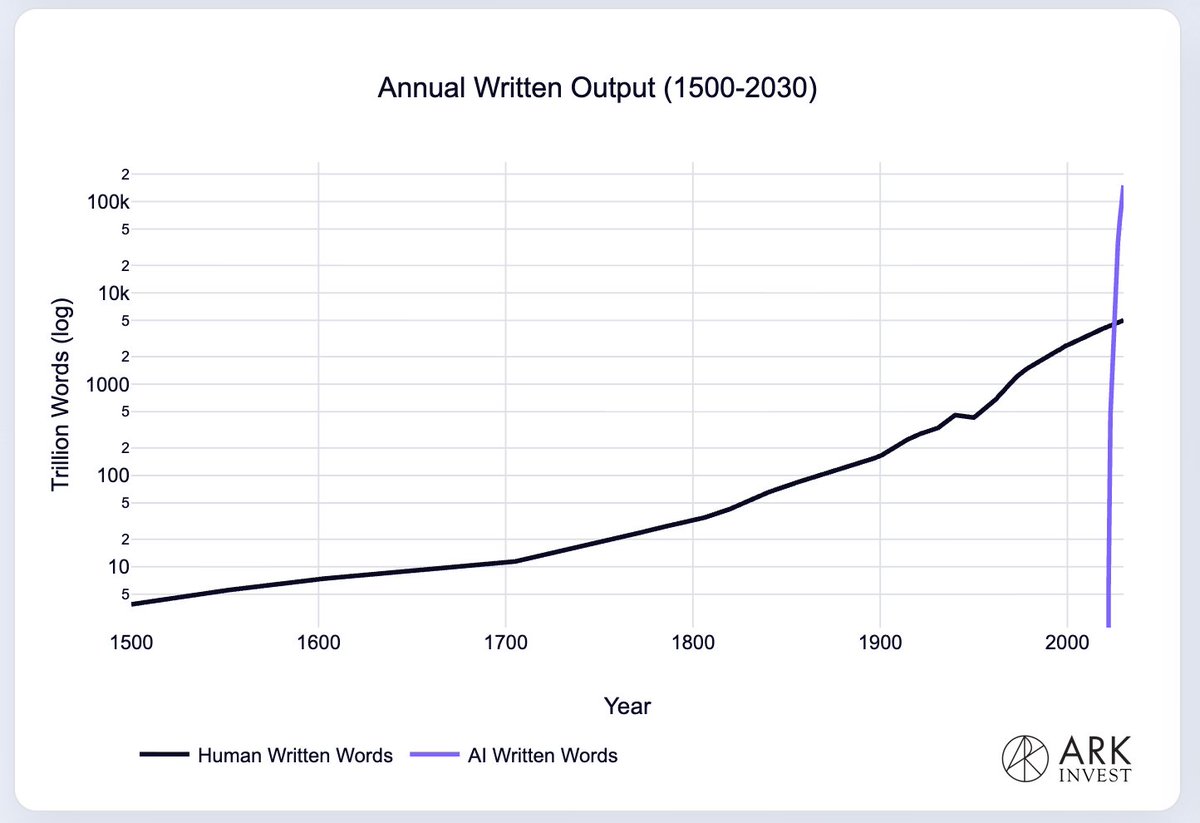
@wintonARK How do we know which human written content was not AI content. Not doubting, but source?
English
0
0
0
87
Brett Winton
Brett Winton@wintonARK·
We have been surpassed: AI written output exceeded human written output in 2025
Brett Winton tweet media
English
724
691
3.5K
22.8M
Michael Strike | Ω
Michael Strike | Ω@Strike_Attack·
This is the philosophical fork we’re all facing with CRQCs. Using on-chain consensus to lock out non-migrated users/funds, even if “democratic” strikes at blockchain’s core promise of property rights. Pragmatic security? Or violation of blockchain ethos? Can’t have absolute property rights AND quantum-proof chains if migration fails for the 2-5%+ that Justin Drake & EF flagged. Forks incoming? Survival > purity, or purity > survival? Drop your take 👇 What would Satoshi do? Tagging for max reach: @saylor @Cointelegraph @CoinMarketCap @drakefjustin #PostQuantum #CRQC #Bitcoin #Ethereum #QuantumSecurity
English
0
0
7
133
Nils N
Nils N@nilspn·
@nic_carter Maybe a reason why BCH has been gaining ground over BTC
English
4
0
3
1.8K
nic carter
nic carter@nic_carter·
Elliptic curve cryptography is on the brink of obsolescence. Whether it’s 3 or 10 years; it’s over and we need to accept that The only thing that matters is how quickly blockchain developers recognize that they need to bake in cryptographic mutability into their networks This of course requires an entire reimagining of how these systems work. Today the crypto is hardcoded in. That will have to change ETH people have already figured this out. Everyone else seems to be petrified in fear. Unless something changes quickly ETHBTC will start to reflect the divergence in prioritisation
English
96
82
874
185.8K
nic carter
nic carter@nic_carter·
@traders_guild @grok Solana is the most exposed. All addresses are unshielded public keys. They need to upgrade everything to PQ
English
4
3
65
6.8K
Justin Bons
Justin Bons@Justin_Bons·
We can see the good in all of crypto! ❤️ BTC - Started it all ETH - Added programmability USDT - Banking the bankless BNB - Early liquidity XRP - Won SEC case USDC - Trustworthy SOL - Added scalability TRX - Remittances DOGE - Comedy HYPE - Perps has PMF ADA - Most decentralized BCH - The real Bitcoin LINK - Connecting the dots XMR - Added Privacy USDE - Arbitrage opportunities XLM - Financial inclusion DAI - Cypherpunk stablecoin CC - Education LTC - Early Alternative AVAX - Pioneering HBAR - Decentralizing PYUSD - Decentralized rails TAO - Idle no more ZEC - Optional privacy SUI - Most scalable SHIB - Community TON - TG integration CRO - Physical cards PAXG - On-chain gold UNI - Decentralized exchange DOT - Best governance design AAVE - Lending has PMF SKY - Governance experimentation NEAR - Solves blockchain trilemma PEPE - Trolling forever ICP - On-chain data hosting ETC - Freedom of choice ONDO - Supports RWA KAS - Most scalable PoW chain ATOM - Before its time POL - Supports prediction markets ALGO - Decentralizing FIL - Decentralized storage NIGHT - Selective privacy ZRO - Competition is good PUMP - Fairer gambling JUP - Frontend for mass adoption
English
120
39
329
45.1K
Michael Strike | Ω
Michael Strike | Ω@Strike_Attack·
#Ethereum PQ Migration strategy, let’s break it down and get real. “Quantum computing will eventually break the public-key cryptography that secures ownership, authentication, and consensus across all digital systems.” Officially, it is no longer if, but when. Important narrative change. Definitive. Absolute. “Enabling users to transition to quantum-safe authentication through account abstraction, without a disruptive ‘flag day.’” This references migration only, not disabling legacy ECDSA signed transactions. The important part has still not been solved. The official page pq.ethereum.org explicitly states that the fate of unmigrated funds “is ultimately a community governance question. Two natural scenarios exist: do nothing, or freeze vulnerable coins.” To me, this language points toward forks. If you hold ETH today, a “do nothing” outcome leaves vulnerable coins stealable, while a freeze (or lockup in a smart contract for years) means you could effectively lose access to those funds. Either path creates winners and losers. Assuming everything runs as designed, the implication, though never stated outright, is that some legitimate accounts will lose funds. Governance decisions, and in my view inevitable forks, will ultimately dictate who keeps what. Is this acceptable? Maybe, maybe not. It is a philosophical question, and not everyone will agree. Hence forks. I see no other realistic outcome. Ethereum’s own consensus puts the at-risk portion at roughly 0.1 percent to 5 percent of supply. But here is what is not said. This narrow risk estimate assumes that all upgrades will be completed before cryptographically relevant quantum computers (CRQCs) become available, development of which is occurring under extremely high levels of nation-state classification, with public timelines highly uncertain. “What is at risk” also does not factor in the very real conditions under which accounts might not migrate: dormant or long-inactive accounts, lost or irrecoverable private keys, unaware or uninformed users, technical or UX friction in migration, economic disincentives or negligible value from dust holdings, institutional or custodial or contractual barriers, immutable or non-upgradeable smart contracts, multi-party coordination failures, timing and governance delays, distrust of new PQ schemes, and legal or estate complications. Justin Drake (Ethereum Foundation researcher) has explicitly framed this view in the recent Bankless podcast, estimating that “at max two, three, four, five percent maybe” of Ethereum supply consists of funds that are “both lost and in quantum crackable addresses,” with his concrete prediction being around 2 percent, roughly an order of magnitude less than Bitcoin’s comparable exposure. He argues this small percentage carries “qualitative consequences,” leading him to “strongly advocate for not doing anything and really honoring property rights because at the end of the day, whatever, 2 percent is not a big deal.” Independent verification has not been performed and even so, well, it's probably not a big deal.... at least to 95% of the Ethereum community, minus the unrepresented account holders listed above. They might not be to happy about it. So the real question is still unanswered, how much is REALLY at risk? No one knows. Sources - (Bankless podcast, March 2026) Citations / Sources: • Official Post-Quantum Ethereum page: pq.ethereum.org • Justin Drake on Bankless podcast (March 2026): bankless.com/podcast/ethere… and full transcript at podscripts.co/podcasts/bankl… pq.ethereum.org
English
1
7
17
856
RYAN SΞAN ADAMS - rsa.eth 🦄
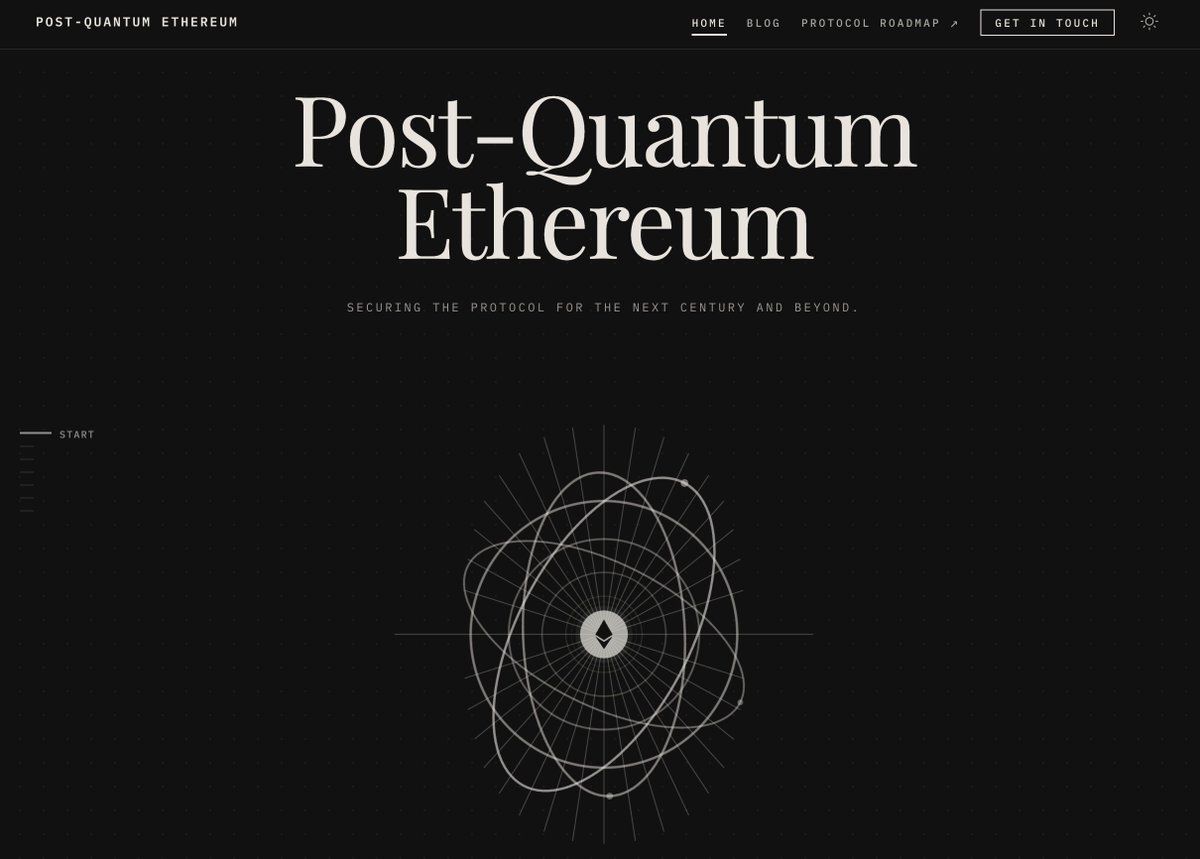
Ethereum has the strongest post quantum roadmap. And it's not even close. Bullish cryptography. Bullish ETH.
RYAN SΞAN ADAMS - rsa.eth 🦄 tweet media
Bankless@Bankless

LIVE NOW - Ethereum’s Quantum Plan Before Q-Day Quantum is no longer a distant thought experiment. @drakefjustin joins Bankless to unpack: - when Q-Day could actually arriv,e - why Bitcoin and Ethereum face very different quantum risks, - what Ethereum’s post-quantum roadmap looks like, - why this upgrade could be bigger than the Merge, - and how quantum could become Ethereum’s chance to lead. --- TIMESTAMPS 0:00 When is Q-Day? 5:35 The moment quantum becomes crypto-relevant 10:11 How many qubits does it take to break crypto? 16:22 What a real Bitcoin quantum attack would look like 20:19 How much Bitcoin is actually vulnerable? 26:26 Burn, freeze, or salvage? Bitcoin’s impossible choice 35:06 Proof of seed phrase and Bitcoin’s post-quantum bottleneck 41:02 Ethereum’s exposure: smaller, but not zero 45:43 Ethereum’s tougher roadmap: three layers, three upgrades 50:29 The execution-layer plan: replace ECDSA without killing throughput 57:56 Post-quantum, post-AI cryptography 1:03:36 BLS, KZG, LeanVM, and the rest of the stack 1:06:42 Is this bigger than the Merge? 1:17:21 If Bitcoin stumbles, does all crypto stumble too? 1:19:35 “Quantum is not a challenge—it’s an opportunity” 1:21:27 AI, quantum, crypto and the 2032 convergence 1:28:04 Harvest now, decrypt later 1:30:09 Defensive accelerationism and Ethereum’s role 1:39:10 Stoicism, P-doom, and why he keeps building

English
44
82
560
28.8K
Michael Strike | Ω retweetet
QRL: The Quantum Resistant Ledger
The quantum threat isn’t a distant problem. It's something you should already be planning for.
English
2
14
44
1.3K
Michael Strike | Ω
Michael Strike | Ω@Strike_Attack·
Got some open slots in my schedule! If you’re hosting/running a podcast on post-quantum blockchains, quantum-resistant crypto, or related tech and need a guest hit my DMs. Share your show link, portfolio, or other media channels. Excited to collab beyond just $QRL appearances, let’s educate together. #PostQuantum #QuantumResistant #Blockchain #CryptoPodcast” Michael Strike Chief Technical Evangelist $QRL Here is our channel for reference - @qrledger?si=sUI_nNXvM08RR3qF" target="_blank" rel="nofollow noopener">youtube.com/@qrledger?si=s…
English
1
8
23
673
Michael Strike | Ω retweetet
God of Prompt
God of Prompt@godofprompt·
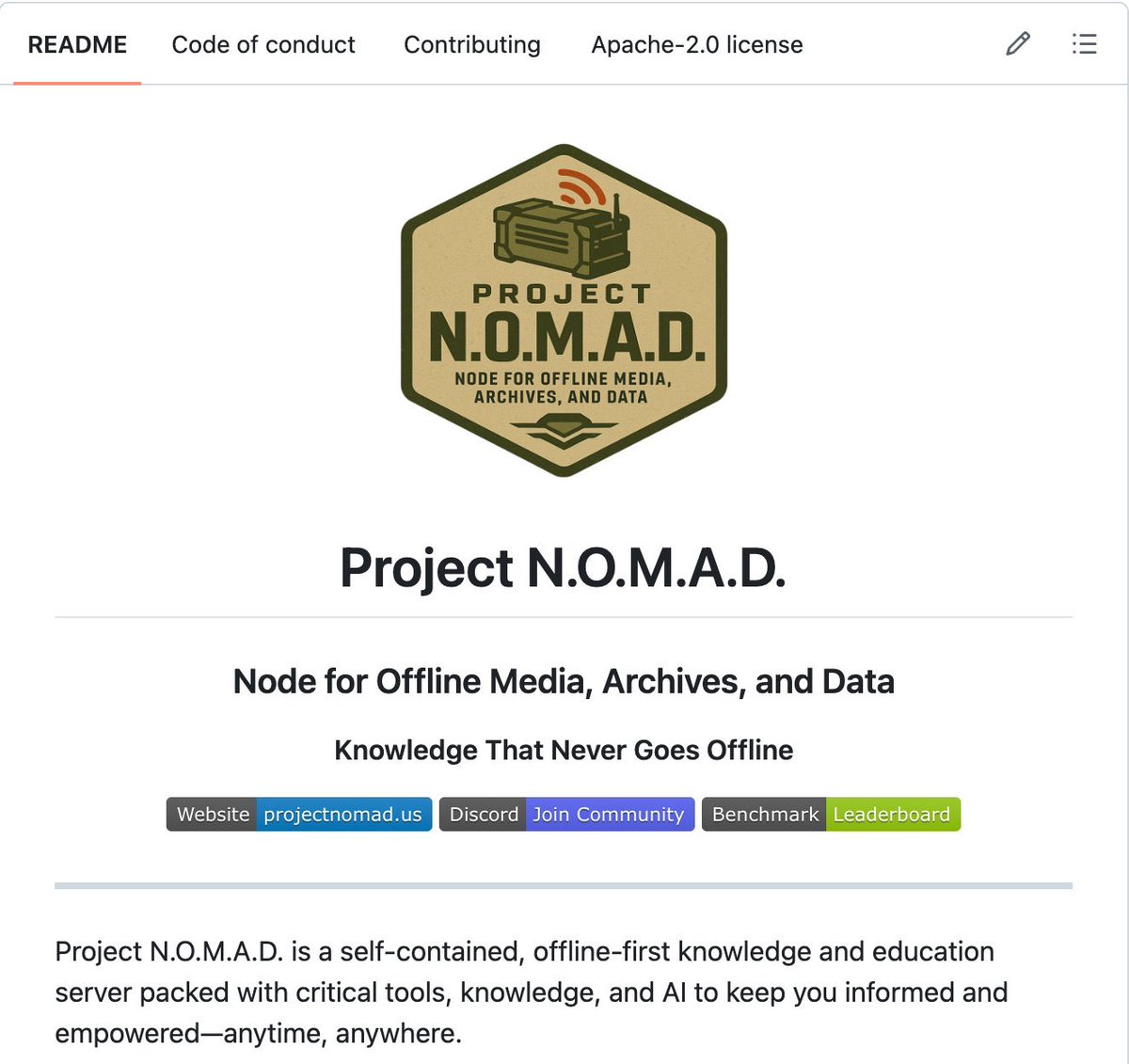
🚨 BREAKING: Someone just open-sourced a full offline survival computer with AI, Wikipedia, and maps built in. Project N.O.M.A.D. is an open-source offline survival computer. Self-contained. Zero internet required after install. Zero telemetry. Everything runs locally on your hardware. What it includes: → Full Wikipedia archives via Kiwix → Offline maps via OpenStreetMap → Local AI models via Ollama + Open WebUI → Calculators, reference tools, resource libraries → A management UI to control everything from a browser One curl command installs the entire system on any Debian-based machine. Runs headless as a server so any device on your local network can access it. Minimum specs to run the base system: dual-core processor, 4GB RAM, 5GB storage. To run local LLMs offline, you want 32GB RAM and an NVIDIA RTX 3060 or better. No accounts. No authentication by default. No cloud dependency. No phone-home behavior. Built to function when nothing else does. The grid, the cloud, the API you depend on. None of it is guaranteed. The people building local-first systems right now are the ones who won’t be asking for help when access disappears.
God of Prompt tweet media
English
365
3.3K
24.3K
4.8M