Upstream Ag

541 posts

Upstream Ag banner
Upstream Ag

Upstream Ag

@UpstreamAg

Essential news & analysis for agribusiness leaders◾️◾️◾️ |⬇️Weekly Newsletter|
Beigetreten Mart 2020
15 Folgt1.6K Follower
Upstream Ag retweetet
Shane Thomas
Shane Thomas@ShaneAgronomy·
Pivot Bio Releases 2025 Field Performance Data Demonstrating Consistent Yield Gains and Synthetic Nitrogen Displacement While Lowering Fertilizer Costs ◼︎◼︎◼︎ According to @pivotbio, In 134 field trials with 129 growers nationwide, corn producers using PROVEN® G3 replaced an average of 33 pounds of traditional nitrogen per acre and gained a 2.1 bushel-per-acre yield advantage as compared to the grower’s standard practices. Overall win rates exceeded 90 percent, with consistent nutrition delivery at the plant root when the plants yield potential establishment is most critical, regardless of weather and soil type. This represents nearly a doubling of win rates in just two years. I love when companies publish win rate data as a way to better understand product performance. However, the win rate published in this release is higher than most win rates I have ever come across. That’s not inherently good or bad, but raises a few different possibilities: Pivot Bio has become very good at understanding where their product works and where it doesn’t work, implementing trials and therefore, targets regions/fields accordingly. In a high yield year like 2025, there may have been lot of farmers that did not fertilize enough given the yield potential. There was a “cherry picking” of data points. I reached out to Pivot Bio to learn more about what drove the results they published. The Challenge Nitrogen fixation from microbes involves multiple complexities to overcome, including some of the following (image attached) That means a need to be diligent and thorough with everything from formulation, to packaging, to placement, to how it fits within the system context. I have highlighted this across various publishings, including The Biostimulant Playbook and The Nuance of Biostimulants. Once you have an understanding and positioning nailed down, the ability to effectively communicate that becomes crucial, along with having the discipline of saying “our products doesn’t fit there" when required. When I reached out the first thing Pivot did was send me their Best Management Practices document. The document gets into what is required to derive the best outcomes. I don’t think a piece of paper/bits is ever the sole driver of success as there is a need to set the expectations of staff, train staff, be disciplined to engage in the conversation, but I do think it shows there has been work and thought put in by the company itself, plus having a tangible document that drives conversations and can be referenced is a great ancillary tool to get farmers and agronomists thinking about the product in a way that is going to drive better outcomes. What stood out to me after speaking with the Pivot team is that the win rate is not a story about a microbe suddenly getting better. What they changed was how they supported and positioned it. Check out the link below for the full coverage. @UpstreamAg
Shane Thomas tweet media
English
5
3
6
1.5K
Upstream Ag retweetet
Shane Thomas
Shane Thomas@ShaneAgronomy·
A breakdown of @NutrienLTD, @corteva Agriscience, and FMC Corporation Executive Commentary from two major investor conferences this week: The @BMO 35th Global Metals, Mining & Critical Minerals Conference and the @BankofAmerica 2026 Global Agriculture and Materials Conference. These events these events are a goldmine of unique intelligence. Unlike quarterly earnings calls, which are often backward-looking and usually more tightly scripted, the conference Q&A sessions often surface unique commentary on things like demand trends, capital allocation priorities, and strategic efforts that don't make it into press releases or earnings calls. Nutrien's Ken Seitz talked about retail efforts in Brazil, retail growth prospects in the coming years, targeted regions to expand, how they think about the financials behind tuck-in acquisitions, plus provides a prime example of reframing in a difficult situation. Corteva Agriscience's Chuck Magro touched on biological ambitions, how the business is using AI internally beyond for discovery, business models for hybrid wheat and how he views competition from Bayer in soybean seed. FMC Corporation's Pierre Brondeau clarified how they are thinking about licensing their technology and what their aspiration and targets for 2026 are even if there is no sale. I break down all of their commentary, and more. Become an @UpstreamAg subscriber to get all of this direct to your inbox this Sunday.
Shane Thomas tweet media
English
3
1
4
1.9K
Upstream Ag retweetet
Shane Thomas
Shane Thomas@ShaneAgronomy·
There are a number of Banking Conferences this week in New York with public agriculture entities participating. @NutrienLTD CEO Ken Seitz had an interesting question surrounding Nutrien being “oligopolistic.” In my mind, it isn’t really arguable that there is an oligopolistic structure in the industry. I have highlighted the dynamics in Monopolistic Inertia in Agribusiness (linked after) However, I found his answer to the question to be a really notable reframe in a delicate situation where the CEO is needing to balance the perception of investors, meaning, Nutrien maintains being viewed as capable of delivering outsized returns, while not bringing on risk of unwanted government scrutiny. I have highlighted this skillset from others within the industry previously in Control the Narrative, Own the Outcome: What Agribusiness Professionals Can Learn from Chuck Magro, David Friedberg and @JohnDeere (linked below as well). Joel Jackson of BMO asked the following question: "You talked about governments. There's a lot going on in the U.S. government, obviously, every day. But we see a lot of that impacting on the periphery of what you guys do, right? We see potash and phosphate, they're critical minerals. We see DOJ, USDA, let's go look at if there's oligopolistic structure, any kind of structures across crop inputs. Sometimes yourself and other peers get named. What do you think about all that? And does it mean anything for you?" Ken Seitz said the following: "Yes, it's definitely meaningful, and we take that all very seriously. I think what we say is that we exist in a highly competitive world. And that's just a fact. You see that in all of the work that we do on cost discipline and we can talk about mine automation in potash, for example, where we're making those investments so we can stay on the left of the cost curve because we need to compete." Note that “competitive" and “oligopolistic” are not actually at odds with one another — an oligopolistic market structure can be intensely competitive. The key distinction is between market structure (how many firms) and competitive conduct (how they behave). An oligopoly is simply a market where a small number of firms control most of the market share, each usually very aware that their pricing and output decisions will trigger competitive responses, which means they react or strategize accordingly. However, Seitz paints a picture that they are at odds with one another: "We're talking about building a new terminal on the West Coast of North America, and that is related to costs and the need to compete. This is a highly competitive environment. It wasn't that long ago that if we're talking about potash prices, we're below that top producer at the end of the cost curve. Those things happen in a commoditized world. We go in when we get asked the question by any government go in and we say, here it is. This is a highly competitive market, a highly competitive world. We need to compete. These are the things that we do. And by the way, making investments to the tune of hundreds of millions of dollars every year to expand those volumes in a growing market, we make investments to add additional volumes to the market. And we can do that economically because of where we sit on the cost curve. So the story for us is you put that all together and you say, there's nothing in the form of anything untoward here. In fact, it's the opposite of that. We're doing everything in our power to compete." That’s his job to do, and I think he does it well given the question effectively leaves him in a no-win situation. I think a lot of us can benefit from strengthening our ability to reframe a narrative. My other takeaway: Everyone talks about summarization with AI being useful. I think it's really hard to derive the nuance of commentary if all one ever does is use AI to summarize everything. The edge and understanding is in the nuance. @UpstreamAg
English
2
2
6
870
Upstream Ag retweetet
Shane Thomas
Shane Thomas@ShaneAgronomy·
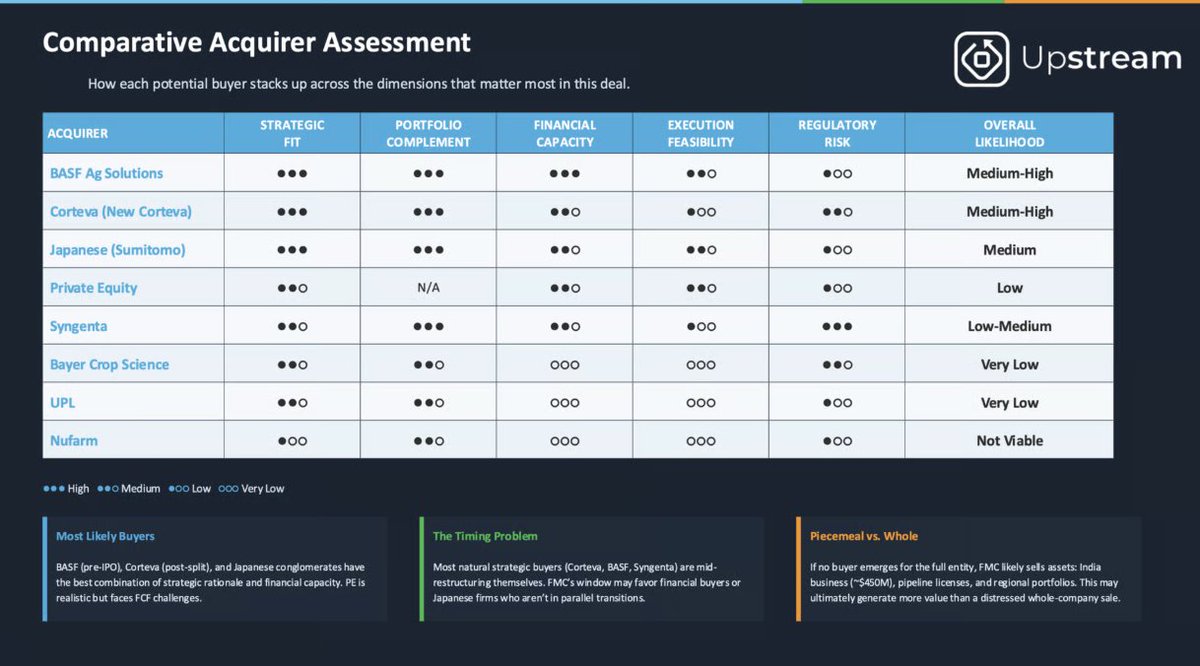
FMC's board authorized exploring strategic options, including a full sale of the business. Here's a look at numerous different avenues for the business: FMC generated $3.47B in revenue in FY25 (down 18% YoY). The market cap sits at ~$1.8B, but enterprise value is ~$5.8B once you account for ~$3.5B in net debt for the full company or about ~8.3x EV/EBITDA. So it could take $6B+ to acquire the business outright. What a buyer would get: FMC has some strong assets in its portfolio and it's already the world's ~5th largest crop protection company with a pipeline targeting $2B+ in new revenue by 2035, a biologicals segment and new AI product sales growing 54% YoY. The challenges are surrounding some of the off patent product segments, like Rynaxypyr patents expiringand significant chunks of the portfolio facing Chinese generic pricing pressure. The other problem: nearly every natural buyer is in the middle of their own restructuring. - @BASFCorporation is carving out its ag division for a 2027 IPO. One of the most logical fitson paper — FMC fills gaps across fungicides, herbicides, and insecticides, and strengthens the standalone innovation narrative for the spin. But bolting on a major acquisition mid-carve-out creates integration complexity. - @corteva won't complete its split until H2 2026. Portfolio complementarity is strong, and there's already a fluindapyr collaboration. But buying FMC mid-separation is a big ask. Could they stomach it? - @SyngentaGroup has portfolio fit but $24.8B in net debt, a pending Hong Kong IPO, and near-certain review given Chinese state ownership. @Syngenta - @Bayer is financially nearly impossible. ~€32.7B net debt, 61,000+ unresolved glyphosate claims (though getting closer to resolved), and a board with near-zero risk tolerance. - Sumitomo Chemical is a dark horse. Their "Leap Beyond" strategy directs 80% of strategic spending to Agro & Life Solutions. FMC would make them a top-5 global CP player overnight, filling scale and geographic gaps in LatAm and North America. - @UPLLtd has ~$2.6B net debt and the ongoing Advanta IPO process make taking on additional leverage unsustainable. They also announced a new structure for the crop protection segment. They could potentially participate in a piecemeal scenario, for example they may already be involved in FMC's India business sale (~$450M), but a full acquisition isn't realistic in their current financial state. - Private equity has the fund sizes but FMC's negative FCF and regulatory complexity limit the typical LBO playbook. The question goes beyond who should buy FMC strategically and really needs to focus on who's capable of it financially and can do something with it that FMC couldn't do on its own. That might mean accelerating the manufacturing restructuring, plugging the pipeline into a larger commercial engine, or absorbing the patent cliff with scale advantages. If no buyer emerges for the full entity, a piecemeal breakup becomes possible. Check out the full @UpstreamAg analysis with a downloadable acquirer overview and images.
Shane Thomas tweet media
English
1
2
6
806
Upstream Ag retweetet
Shane Thomas
Shane Thomas@ShaneAgronomy·
Last week, @CNHIndustrial reported $244 million in technology related write-downs for 2025. Two of them stood out specifically to me: 1. Raven Industries and a $123 million impairment (6%) CNH acquired Raven for $2.1 billion in 2021. At the time, it was one of the largest bets in the industry, enabling them to bring various control and automation components in house while also acquiring novel autonomy capabilities. Now, CNH is writing down a meaningful chunk of that investment. The other aspect around this too is that CNH competitor, @AGCOcorp, paid ~$2 billion for an 85% stake in @TrimbleCorpNews 's ag division and wrote that down by ~$350 million last year. Even though the impairments come during a down turn, it sends a signal that product adoption in precision ag and synergy assumptions have not materialized at the pace that justified the investments. It reinforces the challenges for all precision tech in the industry and likely signals apprehension to pay up for future acquisitions, whether from equipment manufacturers, or others in ag. A slide outlining some of the assumptions from 2021 attached. 2. @MonarchTractor and a $62 million impairment This one is notable given everything going on with Monarch, which confirms that Monarch is probably going to zero. CNH's partnership with Monarch was comprehensive and was part of a multi-faceted tie up between the two companies. It started with a minority stake in Monarch's Series A, followed by a Series B investment. Then CNH signed an exclusive licensing agreement, granting rights to integrate Monarch's electrification and autonomy technology into low-HP Case IH and New Holland tractors. In May 2023, they expanded the relationship further with a financing arrangement through CNH Industrial Capital, allowing farmers to purchase Monarch equipment directly. This was the tightest partnership that CNH had in precision ag besides outright acquisitions, such as with Augmenta. Monarch is now auctioning off unsold tractors, its manufacturing partner is gone, and the company is reportedly attempting a pivot to SaaS. On top, CNH is writing down the investment by $62 million. The $244 million in technology write-downs also includes a Bennamann write-down of ~$50 million. When we add AGCO's Trimble impairment we can effectively see ~$600 million in precision ag value destruction across just two companies in the last year, not to mention all of the other sells offs, such as Corteva Agriscience with Granular assets or Valmont Industries, Inc. with Prospera, or other now defunct entities beyond Monarch and VC dollars. The challenges for precision ag as a value creator seemingly continue. While interviews of VCs on @agfundernews there is some optimism about the future, there is seemingly more signal of growing apprehension from potential acquirers to make large investments. @UpstreamAg
Shane Thomas tweet media
English
6
11
38
11.9K
Upstream Ag retweetet
Wheat Growers
Wheat Growers@wheatgrowers·
@UpstreamAg shared a timely article about AI and ag retail today. I can only wonder if AAFC and other government departments have looked to these tools as a means for cost savings in their vast bureaucracies before shuttering infrastructure. Good idea?
Wheat Growers tweet media
English
0
1
4
283
Upstream Ag retweetet
Shane Thomas
Shane Thomas@ShaneAgronomy·
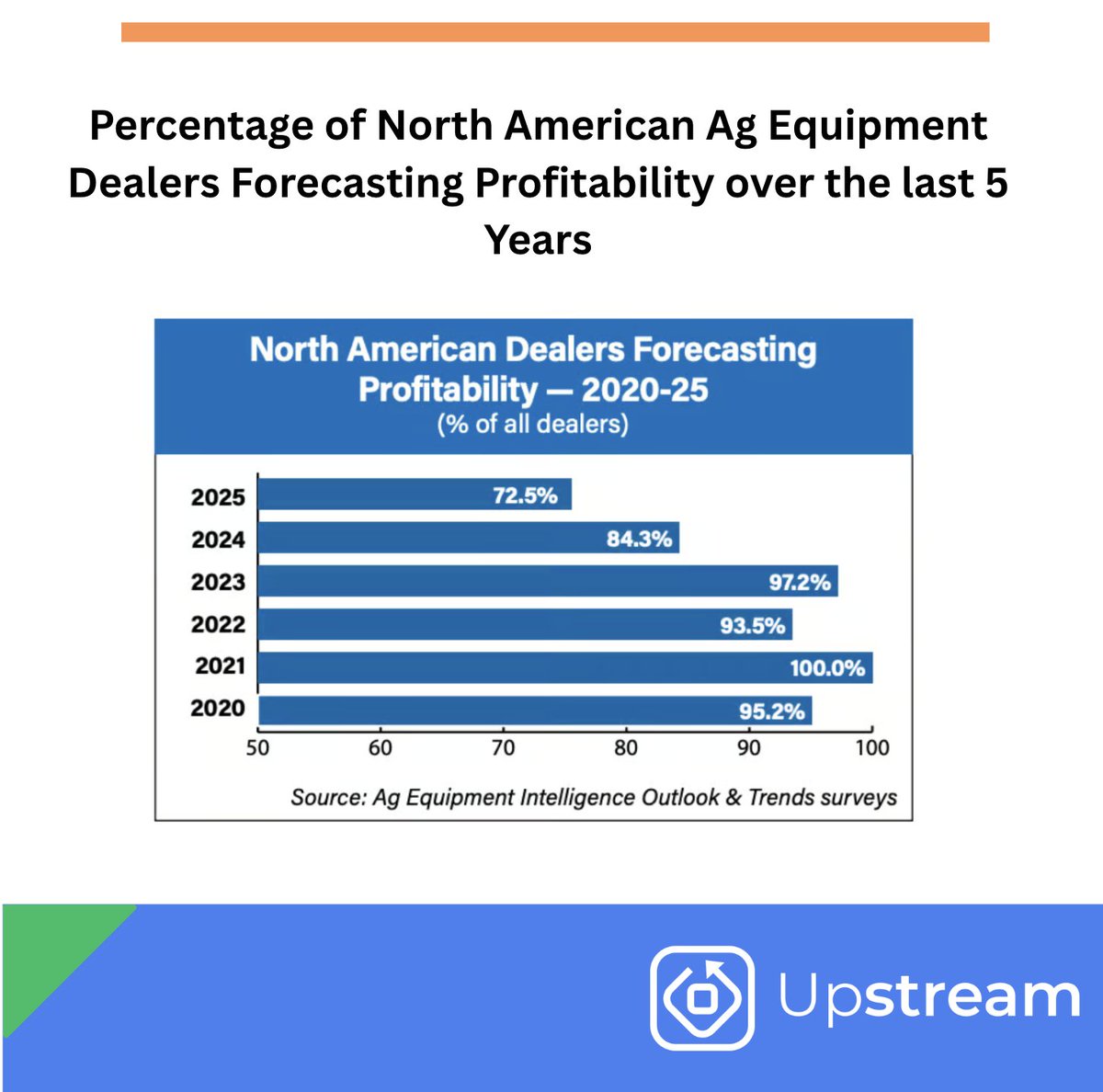
2026 Ag Equipment Dealer Business Outlook & Trends Report Highlights and Analysis ◼︎◼︎◼︎ The 2026 Dealer Business Outlook & Trends report by Ag Equipment Intelligence is a forecast based on surveys of North American farm equipment dealers. The focus is to understand projected revenue, profitability, and industry challenges for the coming year. The report suggests that dealers anticipate 2026 to be another difficult year due to declining new equipment sales and profitability challenges stemming from high equipment costs and low commodity prices. A few highlights: - Revenue Decline - The majority of dealers saw revenue drops in 2025, and nearly 45% forecast further declines in 2026. - Inventory Challenges Persist - "Too high" of inventory levels remain a major struggle for 42% of dealers (new equipment). 27% said their used equipment inventory was too high. - Profitability Declines - Only 72.5% of dealers forecast to be profitable in 2025, the lowest confidence level in five years. - Pricing - Despite lower demand, prices continue to increase. Nearly 99% of dealers expect manufacturers to raise prices by 1–6% in 2026 across products. - Hiring - 64% of dealers plan to add service technicians in 2026. "Technician availability" is the #3 concern amongst dealers. - Mobile Service Investment - There is a continued shift toward "servicing the farm, not the product." 46% of dealers plan to invest in mobile service vehicles, with AGCO dealerships being the highest, followed closely by John Deere. Check out @UpstreamAg for the full highlights and analysis.
Shane Thomas tweet media
English
1
2
1
547
Upstream Ag retweetet
Shane Thomas
Shane Thomas@ShaneAgronomy·
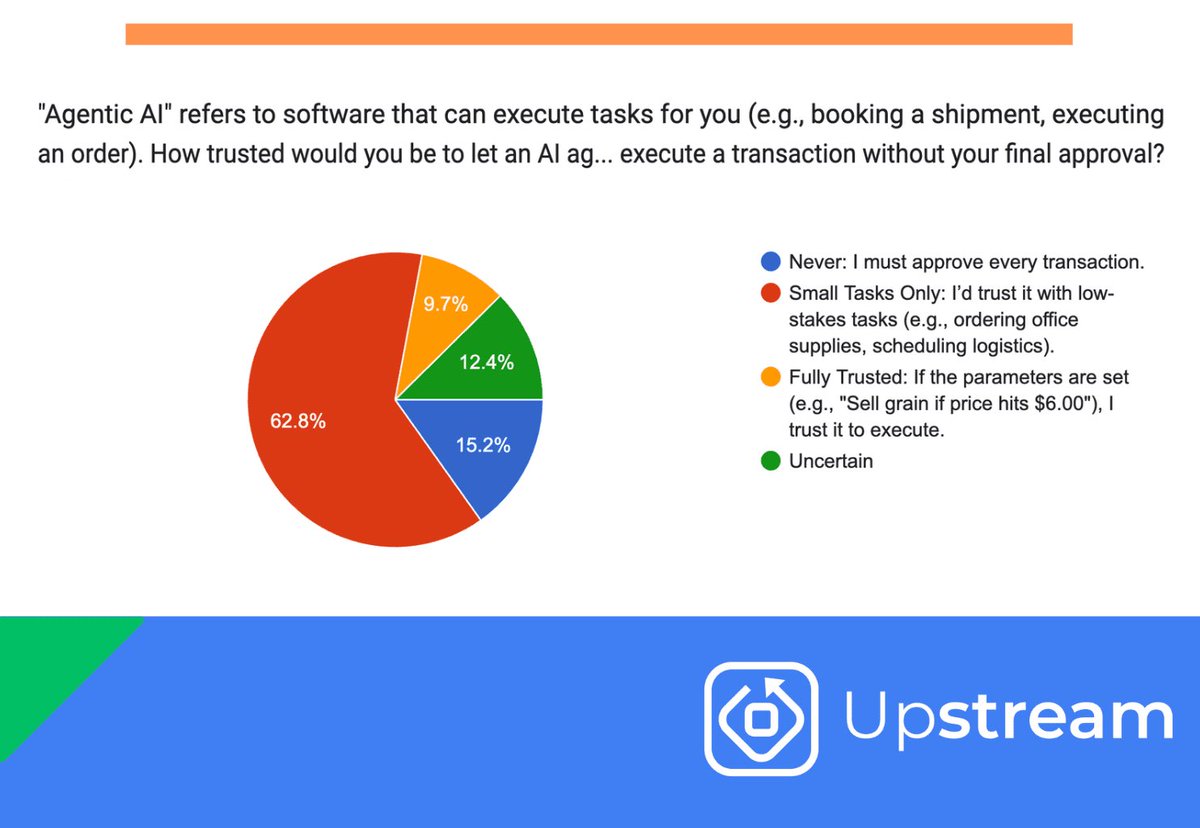
How are agribusiness professionals actually using artificial intelligence in their day to day? ◼︎◼︎◼︎ AI is changing the lives of individuals in every industry and agriculture is no exception. I am interested in how it is shifting agribusiness professionals day-to-day as of January 2026, including where it is adding value, where it is falling short, what professionals expect from their software providers, how companies are leaning in (or not) to the tools and systems and much more. To capture the shift beyond anecdotal conversation, I am conducting a survey to capture the current state of AI usage across the agribusiness landscape. I want to hear from Farmers, Founders, Marketers, Sales Reps, Consultants, Agronomists, Investors, Executives and anyone operating in the agriculture industry. The 100% anonymous, 22-question survey (takes approx. 3-4 mins) covers everything from Frustrations to Use Cases and Expectations. I will be analyzing the results to create a report that highlights the insights, opportunities and the gaps in our industry that can help inform how software providers build product, benchmark where your company is relative to rest of the industry, or give you insight into how others are using AI today. The report with be shared in @UpstreamAg Insights in the coming weeks. Link to survey: forms.gle/e5mcoW4sBbHX4A… Don't forget to subscribe to upstream. ag to get access to the results when they are published later this month. Image of some of the current GenAI providers in agriculture today below.
Shane Thomas tweet media
English
2
3
7
790
Upstream Ag retweetet
Shane Thomas
Shane Thomas@ShaneAgronomy·
Canada’s agricultural innovation in crisis? This is an interesting article from Manitoba Cooperator, with good insights from @Darcytwheat. One observation that stands out to me regarding Canada and innovation is that the shortage of innovation goes beyond agriculture. Take a look at the 50 largest public companies by market cap in Canada - only two were founded post 2000 (non spin outs): @Shopify and @GFL Environmental. Difficult to call GFL overly innovative. If we go back ~30 years to 1995, we get Constellation Software, which was (and remains) a unique stratetgy and approach to long term capital allocation. We also get @lululemon, which created athleisure wear, started in 1998. That means effectively three companies starting from an innovative idea, and only two on the product side of things. In comparison, the US has about ~20% of it's 50 largest companies founded in the last 30 years. Canada has had individuals contribute to AI and has had other companies (eg: RIM/Blackberry) innovate for a period of time, but the lack of new innovation, company founding and ultimately value creation in Canada definitely goes beyond agriculture. Note: This is a narrow view of "innovation," but begins to illustrate that new technology and company building hasn't been a forte in Canada. manitobacooperator.ca/news-opinion/n…
English
0
1
2
414
Upstream Ag retweetet
Shane Thomas
Shane Thomas@ShaneAgronomy·
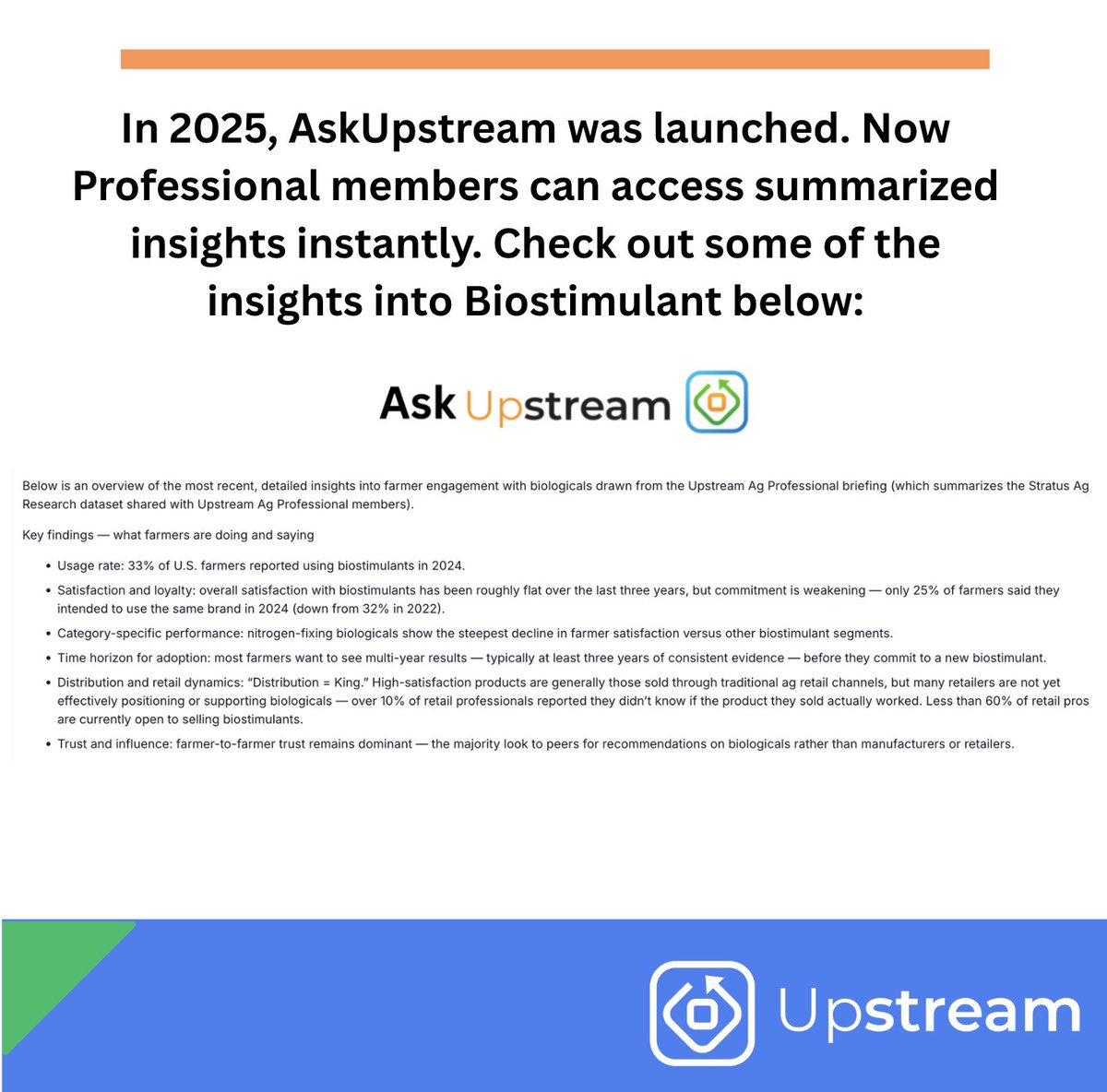
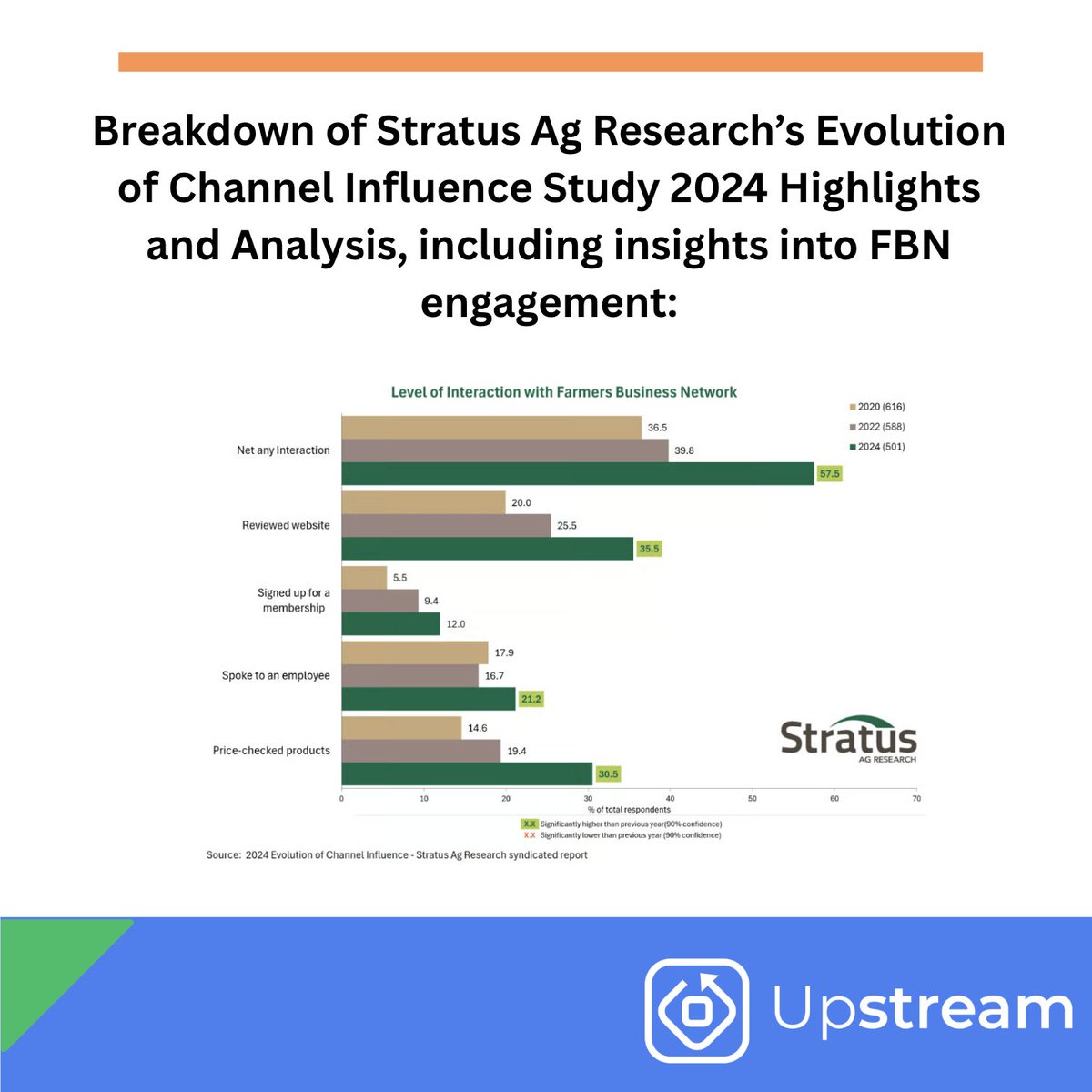
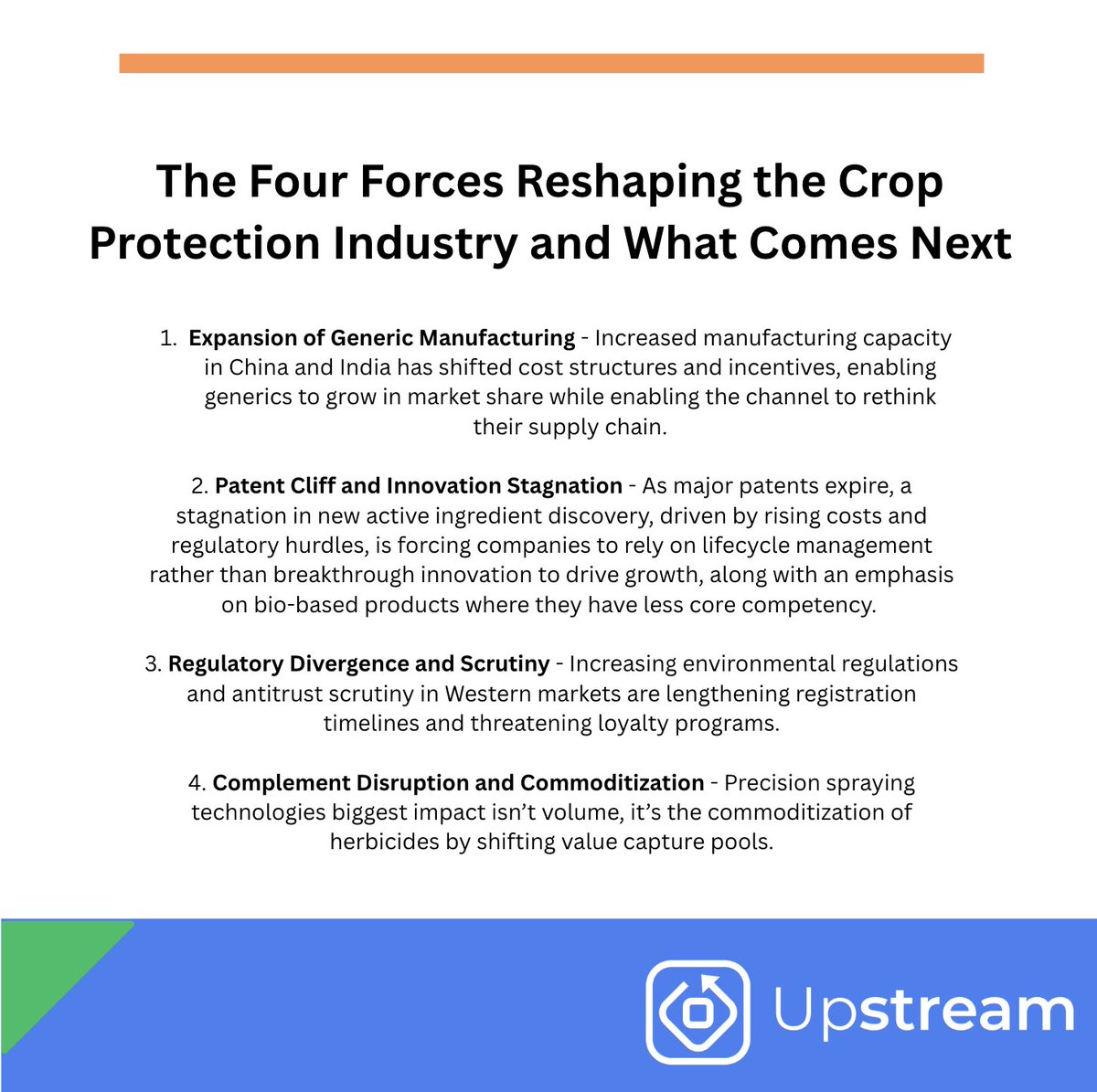
"The good ones know more." A powerful quote from legendary advertising executive, David Ogilvy, that reinforces that professional excellence comes from deeper knowledge and understanding that sets the best apart from the rest. I believe this is true for agribusiness professionals, too. How does an agribusiness professional get to know more? By being curious. By listening. By reading. By learning frameworks. By trying new things. And by consuming Upstream Ag Professional every week. Agriculture is a knowledge business and knowledge isn’t just power, it’s competitive advantage. Staying ahead means understanding your market, your customers, your competitors, new technology and business dynamics better than anyone else. Upstream Ag Professional enables you to know more. The best in agribusiness are those who consistently outlearn and out think the competition enabling elite execution. Upstream Ag Professional ensures you’re one of them. Join thousands of agribusiness professionals who refuse to settle for “good enough.” Be the one who knows more. Subscribe today at upstream (dot) ag. @UpstreamAg
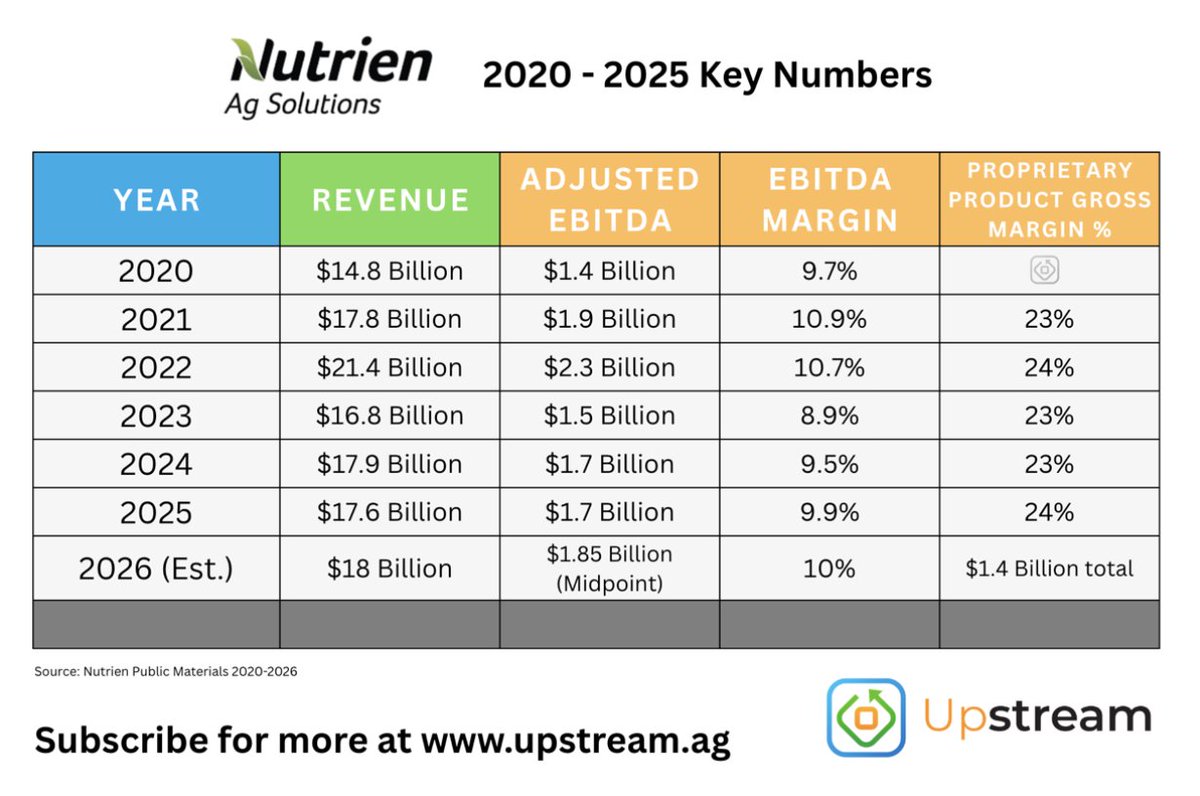
Shane Thomas tweet mediaShane Thomas tweet mediaShane Thomas tweet mediaShane Thomas tweet media
English
0
3
4
765
Upstream Ag retweetet
Shane Thomas
Shane Thomas@ShaneAgronomy·
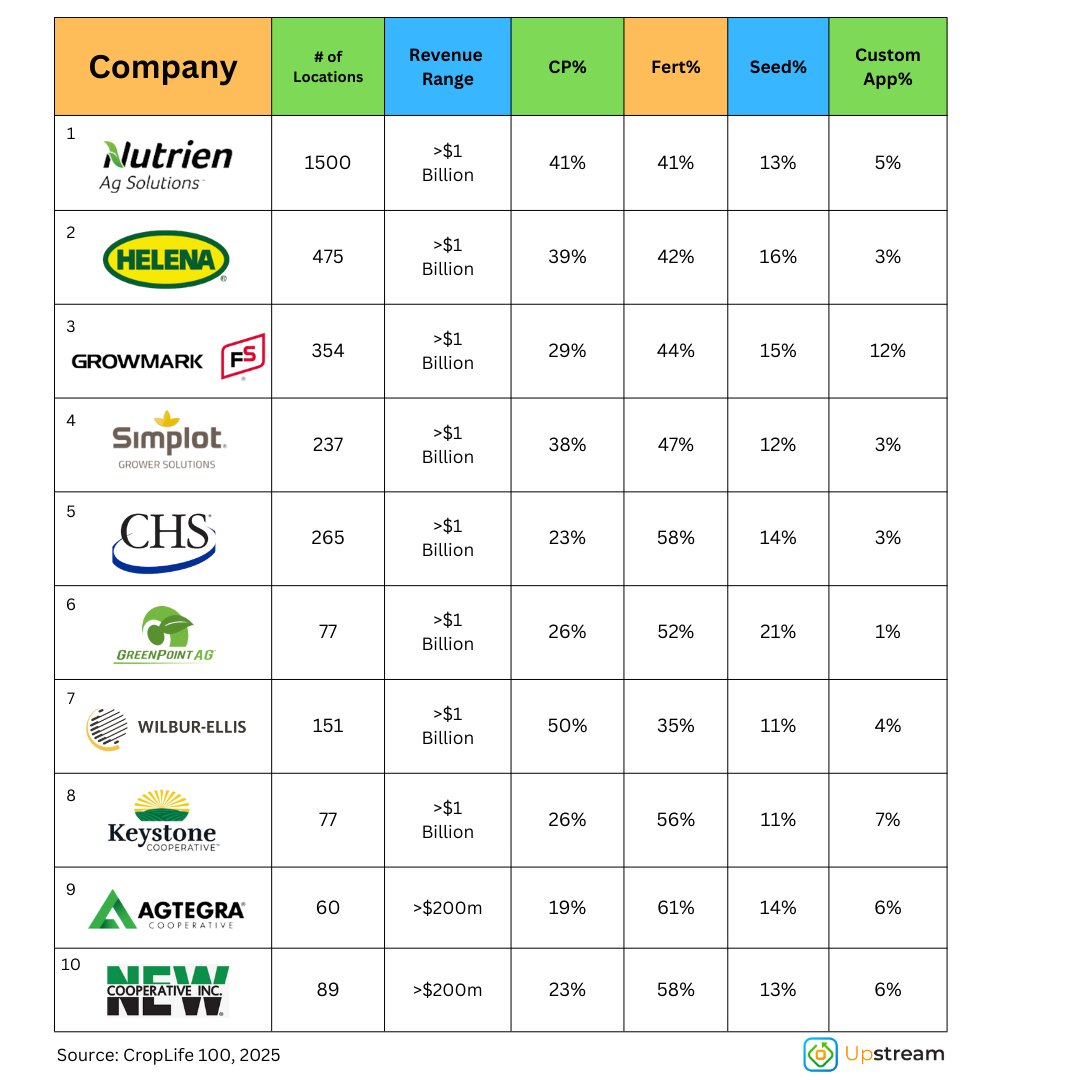
The 2025 CropLife 100 Report came out last week. On top of a slightly changed Top 10 Ag Retailer list (image attached), a few other things stood out from the report: - Despite the challenging farm economics, 37% of retailers were more profitable in 2025 than in 2024, an increase in the number that were more profitable in 2024 over 2023. - 64% of retailer increased Micronutrient sales, 60% increased Adjuvants and 56% reported Biological sales up in 2025. Those three segments are relatively consistent with 2024. None of those segments had more retailers decrease rather than increase, which reinforces that retailers are leaning further into these segments even in a more challenged environment and farmers are acknowledging their potential. - On the AI front, 18% of retailers plan to invest in AI systems in 2026, which is lower than I expected (depending on how it was defined in the survey). For example, if a retail isn’t paying for the price of a premium LLM for each of it’s team (meaning Gemini Pro or ChatGPT Plus for example) at a minimum, then they are missing out on opportunity to improve their teams effectiveness. - @JohnDeere makes up nearly 40% of retailers fleets with the highest expectation of purchases to be John Deere in 2026 by retailers. Check out @UpstreamAg for more.
Shane Thomas tweet media
English
2
8
19
3.2K
Upstream Ag retweetet
Shane Thomas
Shane Thomas@ShaneAgronomy·
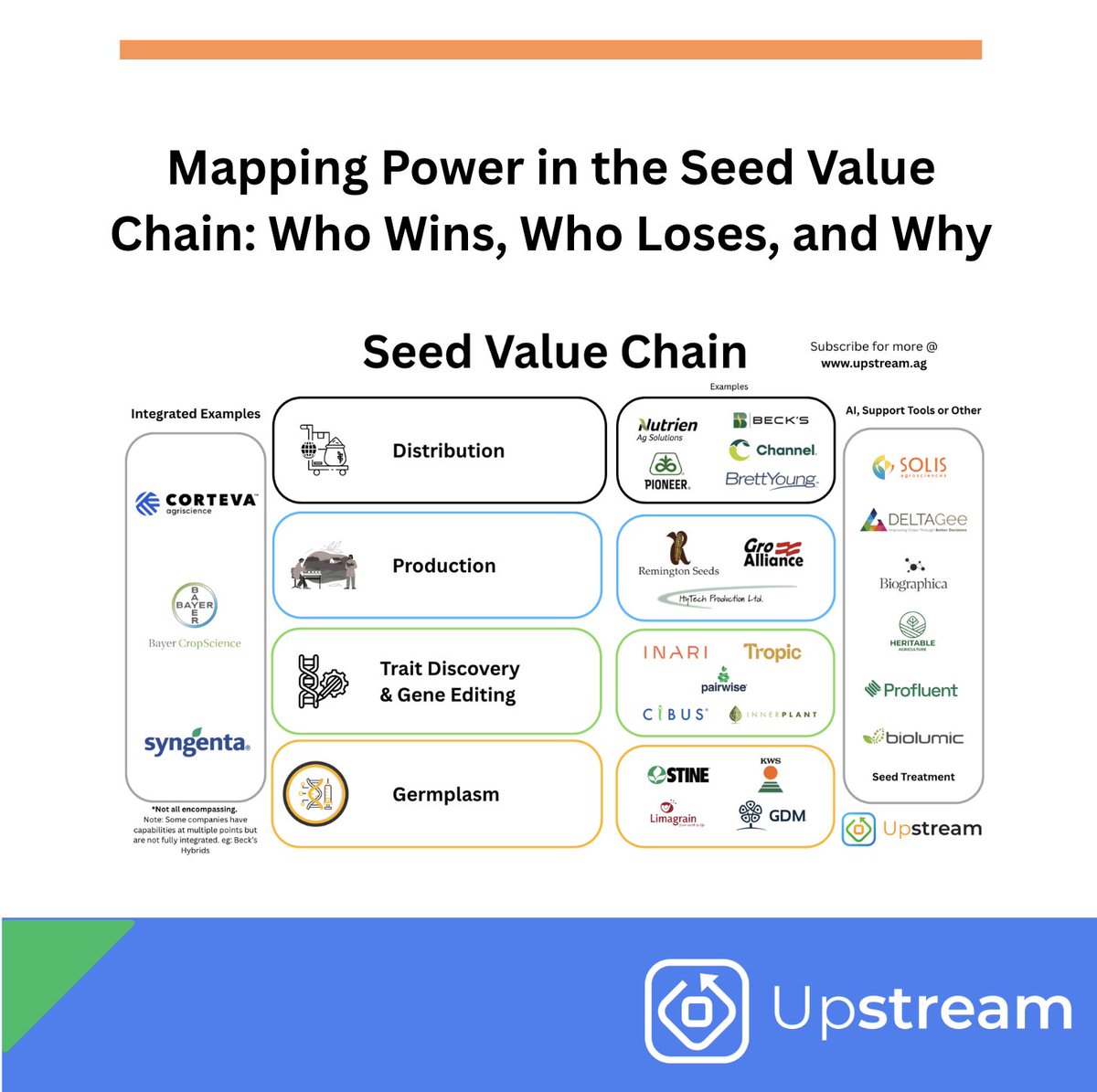
Mapping Power in the Seed Value Chain: Who Wins, Who Loses, and Why --- Gene editing lowers barriers to trait development, but it doesn’t remove the structural advantages some companies have in seed. The core asset isn’t the editing tool — it’s elite germplasm. That’s one reason why incumbents like Corteva and Bayer still heavily control the value stack. Elite germplasm is foundational across many key crops and is a cornered resource. You can license a technology, but you can’t shortcut 100 years of proprietary genetics, global trials, introgression expertise, and distribution. Using @corteva as an example, we see how vertical integration enables them to influence and control the stack, enabling them to mitigate risk from gene editing or trait companies gaining power. It has happened to @PioneerSeeds before, and that case study illustrates how a seed company could lose. For a look at the dynamics in the seed segment and a look at what would need to happen for a non-germplasm owning start-up to gain a foothold, check out the full article. @UpstreamAg
Shane Thomas tweet media
English
1
4
11
1.5K
Upstream Ag retweetet
Ascribe
Ascribe@AscribeBio·
ICYMI: thanks @UpstreamAg for the comprehensive deep-dive into @AscribeBio's strategy & recent financing
Shane Thomas@ShaneAgronomy

Upstream Ag Professional - Week of October 19th 2025 ◼︎◼︎◼︎ This week's essential news and analysis for agribusiness leaders includes: 1. The Danger of Dominant Logic: What Pioneer Hi-Bred's Blind Spot Reveals About Disruption in Agriculture A look at disruption as a tax on not innovating vs. outright being "Blockbustered." 2. @AscribeBio Closes $12 Million Series A A detailed look at the product, the strategy, the fundraising process and the future of a biocontrol leader. 3. @ecorobotix Crosses Over $200 million Raised: A look at Revenue, Business Model, GTM and Paths to Exit 4. Agtech trends: bundling, unbundling, LLMs and more with @tenaciousvc own J. Matthew Pryor and @svnoles Nolet with @UpstreamAg 5. Momentum and Milestones: @NewLeaf_Sym Aims to Double Sales Next Year A look at layered crop protection and COGS enabling GTM in biocontrol. 6. Q3 2025 AgTech Venture Capital Investment and Exit Round Up by Image below. 7. Commercializing Ag Products: From R&D to Farm Gate and tying it into Upstream Ag Insights Competing on Analytics and the Future of Ag Input Commercialization @DamianPMason 8. Integrated insights from The Pacesetter Pod on Agribusiness 2026 M&A Outlook with Scott Porter of Cascadia Capital Partners with Capital Allocation Lessons from Henry Singleton + more! upstream.ag/p/upstream-ag-…

English
0
1
1
247