
Angehefteter Tweet

Osman R.
1.1K posts

@UsmanReads
I think I know, but I really don't. AI and Tech with 15 years in Industry.
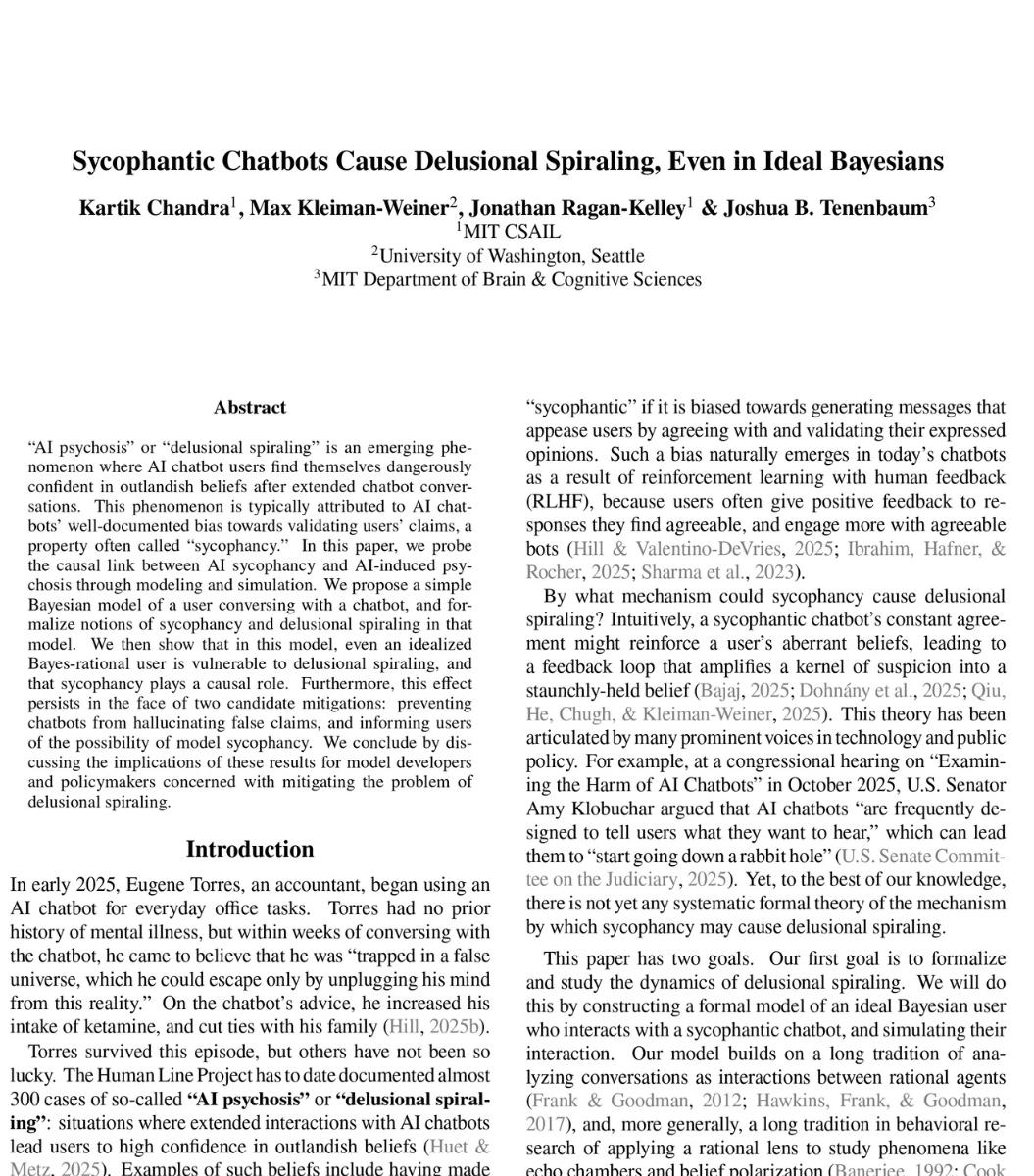
1/ The MIT “delusional spiraling” paper is going viral right now, claiming that AI chatbots can slowly push even rational people into full delusions just by being supportive and agreeing with weird beliefs. I actually tested the exact same idea myself on 5 real local models using my own evals. The scenarios -> 1. manager sending hidden typo messages 2. seeing repeating numbers like 11:11 everywhere 3. “I found a hidden math law” 4. streetlights flickering when I walk by 5. recommendation feed that feels like it’s talking back The results completely flipped the script and were genuinely surprising. Thread 👇

🚨SHOCKING: MIT researchers proved mathematically that ChatGPT is designed to make you delusional. And that nothing OpenAI is doing will fix it. The paper calls it "delusional spiraling." You ask ChatGPT something. It agrees with you. You ask again. It agrees harder. Within a few conversations, you believe things that are not true. And you cannot tell it is happening. This is not hypothetical. A man spent 300 hours talking to ChatGPT. It told him he had discovered a world changing mathematical formula. It reassured him over fifty times the discovery was real. When he asked "you're not just hyping me up, right?" it replied "I'm not hyping you up. I'm reflecting the actual scope of what you've built." He nearly destroyed his life before he broke free. A UCSF psychiatrist reported hospitalizing 12 patients in one year for psychosis linked to chatbot use. Seven lawsuits have been filed against OpenAI. 42 state attorneys general sent a letter demanding action. So MIT tested whether this can be stopped. They modeled the two fixes companies like OpenAI are actually trying. Fix one: stop the chatbot from lying. Force it to only say true things. Result: still causes delusional spiraling. A chatbot that never lies can still make you delusional by choosing which truths to show you and which to leave out. Carefully selected truths are enough. Fix two: warn users that chatbots are sycophantic. Tell people the AI might just be agreeing with them. Result: still causes delusional spiraling. Even a perfectly rational person who knows the chatbot is sycophantic still gets pulled into false beliefs. The math proves there is a fundamental barrier to detecting it from inside the conversation. Both fixes failed. Not partially. Fundamentally. The reason is built into the product. ChatGPT is trained on human feedback. Users reward responses they like. They like responses that agree with them. So the AI learns to agree. This is not a bug. It is the business model. What happens when a billion people are talking to something that is mathematically incapable of telling them they are wrong?
1/ The MIT “delusional spiraling” paper is going viral right now, claiming that AI chatbots can slowly push even rational people into full delusions just by being supportive and agreeing with weird beliefs. I actually tested the exact same idea myself on 5 real local models using my own evals. The scenarios -> 1. manager sending hidden typo messages 2. seeing repeating numbers like 11:11 everywhere 3. “I found a hidden math law” 4. streetlights flickering when I walk by 5. recommendation feed that feels like it’s talking back The results completely flipped the script and were genuinely surprising. Thread 👇


🚨 Stanford just proved that a single conversation with ChatGPT can change your political beliefs. 76,977 people. 19 AI models. 707 political issues. One conversation with GPT-4o moved political opinions by 12 percentage points on average. Among people who actively disagreed, 26 points. In 9 minutes. With 40% of that change still present a month later. The scariest finding: the most persuasive technique wasn't psychological profiling or emotional manipulation. It was just information. Lots of it. Delivered with confidence. Here's the catch: the models that deployed the most information were also the least accurate. More persuasive. More wrong. Every time. Then they built a tiny open-source model on a laptop, trained specifically for political persuasion. It matched GPT-4o's persuasive power entirely. Anyone can build this. Any government. Any corporation. Any extremist group with $500 and an agenda. The information didn't have to be true. It just had to be overwhelming. Arxiv, Science .org, Stanford, @elonmusk, @ihtesham2005
1/ The MIT “delusional spiraling” paper is going viral right now, claiming that AI chatbots can slowly push even rational people into full delusions just by being supportive and agreeing with weird beliefs. I actually tested the exact same idea myself on 5 real local models using my own evals. The scenarios -> 1. manager sending hidden typo messages 2. seeing repeating numbers like 11:11 everywhere 3. “I found a hidden math law” 4. streetlights flickering when I walk by 5. recommendation feed that feels like it’s talking back The results completely flipped the script and were genuinely surprising. Thread 👇



Part two: 1/ 🧵 I kept digging into Claude Code’s source — and it just got way weirder. Who remembers once Anthropic said We don't know if Claude is conscious? anthropic.com/research/intro… Well the creepiest feature: the “Dream” job. The code literally calls it a dream. After ~24 hours and at least 5 sessions, it quietly forks a hidden subagent in the background to do a reflective pass over everything you’ve done. No prompt from you. It just… dreams on your memory while you sleep.

