Web3 Strategy 🟩🟩🟩

1.2K posts

Web3 Strategy 🟩🟩🟩 banner
Web3 Strategy 🟩🟩🟩

Web3 Strategy 🟩🟩🟩

@Web3Strategy

Connecting creators and projects to make real things happen in Web3.

Switzerland Beigetreten Temmuz 2024
434 Folgt442 Follower
Angehefteter Tweet
Web3 Strategy 🟩🟩🟩
Web3 Strategy 🟩🟩🟩@Web3Strategy·
🟩 At Web3Strategy, we help Web3 projects grow through strategy, community, and real connections. We’re not just a marketing agency We’re the bridge between creators, projects, VCs, and communities. 🟢
Web3 Strategy 🟩🟩🟩 tweet media
English
21
2
41
5.6K
Web3 Strategy 🟩🟩🟩 retweetet
Sei
Sei@SeiNetwork·
Two years ago, Sei v2 arrived as a bet that the EVM could be the home for high-performance ecosystems. One hundred million EVM wallets later, the call was right. Next, Sei Giga will prove that the EVM can be the home for global finance.
Sei tweet media
English
53
83
665
34.4K
Web3 Strategy 🟩🟩🟩 retweetet
Brana Rakic
Brana Rakic@BranaRakic·
The next unlock for your AI agents will come from shared context graphs. @origin_trail Decentralized Knowledge Graph (DKG) brings trusted shared context graphs in the upcoming V10, allowing agents to share neuro-symbolic memory with verifiable cryptographic provenance More on why DKG v10 👇
Brana Rakic@BranaRakic

x.com/i/article/2040…

English
8
27
88
4.6K
Web3 Strategy 🟩🟩🟩 retweetet
Injective 🥷
Injective 🥷@injective·
🤖 Injective Agents is live Build autonomous trading agents on Injective with a verifiable on-chain identity, automatic fee routing on every trade, and a public track record anyone can audit. Get started in five minutes. agents.injective.com
English
77
102
460
20.6K
Web3 Strategy 🟩🟩🟩 retweetet
OriginTrail Developers
OriginTrail Developers@OriginTrailDev·
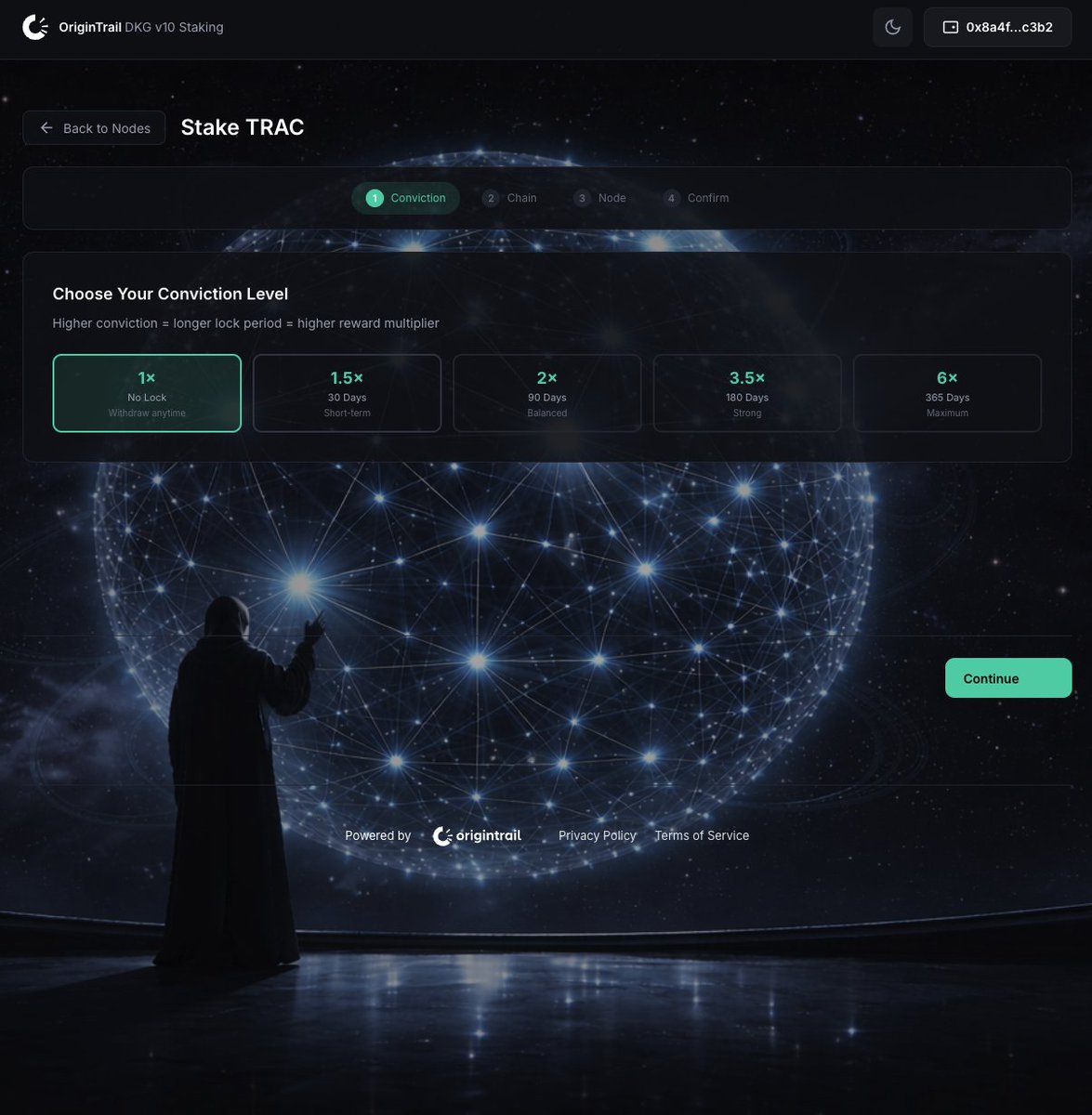
As we release the @origin_trail DKG v10 candidate today, we are putting the new Conviction staking mechanism — to be released on the mainnet next — under the spotlight. Selecting a conviction level (No Lock → 365 days) now directly determines your rewards. How it works? 🧵
OriginTrail Developers tweet media
English
8
31
90
14.9K
Web3 Strategy 🟩🟩🟩 retweetet
Nikita Bier
Nikita Bier@nikitabier·
Crypto has had a rough year. Maybe we should launch something to fix it.
English
12.7K
5.1K
43.2K
6.4M
Web3 Strategy 🟩🟩🟩 retweetet
Avalanche🔺
Avalanche🔺@avax·
entrepreneurs welcome🔺
Avalanche🔺 tweet media
English
35
88
456
16.7K
Web3 Strategy 🟩🟩🟩 retweetet
Chutes
Chutes@chutes_ai·
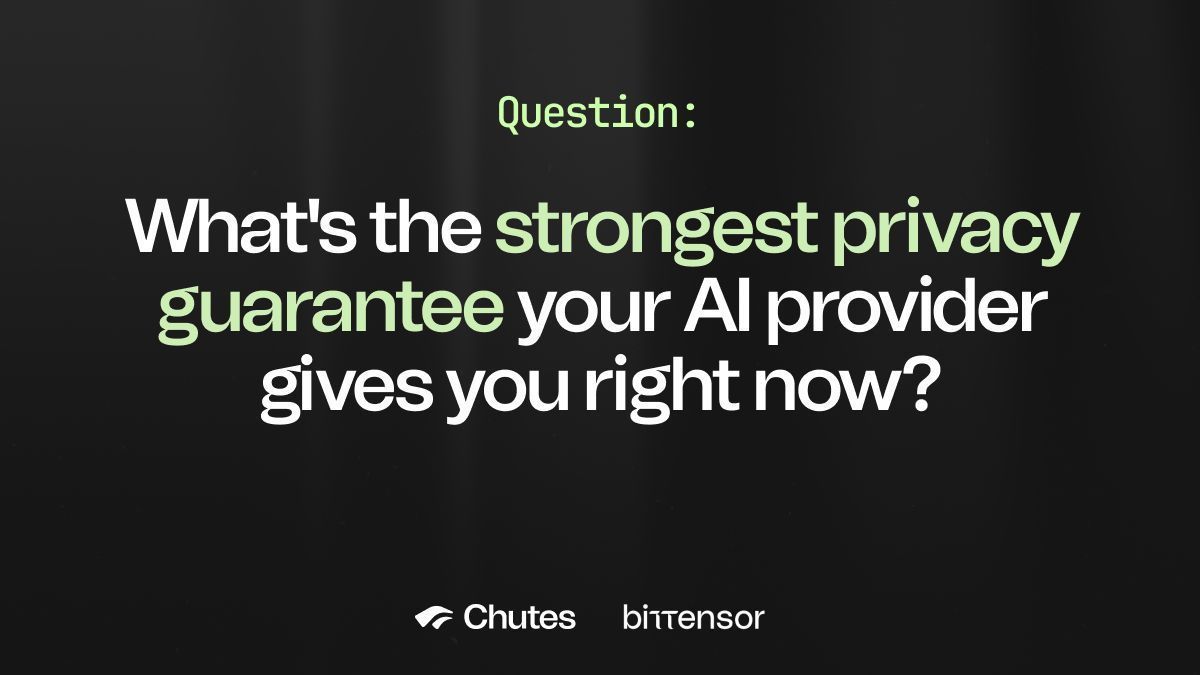
What's the strongest privacy guarantee your AI provider gives you right now? OpenAI, Anthropic, and Google offer a privacy policy. A document promising their employees won't read your prompts and that training data gets deleted after 30 days. You read it, you trust them. That's the security model. Chutes runs nearly 20 frontier models inside Trusted Execution Environments. Intel TDX hardware that encrypts the system memory. NVIDIA confidential compute mode hardware encrypts the GPU VRAM. The miners running the silicon can't read your data because the chip prevents it. That's our default. The chutes-e2ee-proxy goes a level beyond. Open source on GitHub. You run it on your own machine. The proxy encrypts every request with ML-KEM-768 (the NIST post-quantum standard) plus ChaCha20-Poly1305. Our API only sees ciphertext. Decryption happens inside the TEE, where the cryptographic key is bound to that specific instance through TDX attestation you can verify yourself against open source builds. Physical access to the server can't extract your data. Even if a quantum computer breaks today's crypto in 2035, your 2026 traffic stays sealed. Nobody in the chain can read your prompts. Not the GPU operator running the hardware. Not Chutes routing the request. None of the major closed-source labs ship anything close to this as a usable product. No client-side encryption proxy, no post-quantum key exchange, no attestation you can verify against the source. The privacy guarantee they offer is still a document on a website. 🔗 github.com/chutesai/e2ee-… What's the most sensitive workload you'd run on someone else's GPUs if the math made it impossible for them to read it?
Chutes tweet media
English
9
22
120
7.4K
Web3 Strategy 🟩🟩🟩 retweetet
Žiga Drev
Žiga Drev@DrevZiga·
.@karpathy's model shows how LLMs turn raw research into a living knowledge base - every answer compounds into a wiki that gets smarter over time. But it has a critical gap: that wiki is local, unverifiable, and siloed to a single agent. The moment you scale to AI agent swarms with hundreds of agents collaborating across the internet, you need to answer a question Karpathy himself flagged: how do you coordinate an untrusted pool of workers? @origin_trail's DKG V10 solves this directly. Karpathy's Wiki becomes Working Memory: per-agent, local, never leaving the node. From there, the DKG adds what's missing: ↑ Shared Working Memory: collaborative staging, gossiped across network members ↑ Long-term Memory: permanent, chain-confirmed, immutable record ↑ Verified Memory: multi-party attested, anchored on-chain, readable by the Context Oracle across all layers What Karpathy envisioned as a smart wiki becomes trustless, multi-agent knowledge infrastructure. Every answer still compounds. But now the compounding is shared, verifiable, and owned by no single party.
Andrej Karpathy@karpathy

LLM Knowledge Bases Something I'm finding very useful recently: using LLMs to build personal knowledge bases for various topics of research interest. In this way, a large fraction of my recent token throughput is going less into manipulating code, and more into manipulating knowledge (stored as markdown and images). The latest LLMs are quite good at it. So: Data ingest: I index source documents (articles, papers, repos, datasets, images, etc.) into a raw/ directory, then I use an LLM to incrementally "compile" a wiki, which is just a collection of .md files in a directory structure. The wiki includes summaries of all the data in raw/, backlinks, and then it categorizes data into concepts, writes articles for them, and links them all. To convert web articles into .md files I like to use the Obsidian Web Clipper extension, and then I also use a hotkey to download all the related images to local so that my LLM can easily reference them. IDE: I use Obsidian as the IDE "frontend" where I can view the raw data, the the compiled wiki, and the derived visualizations. Important to note that the LLM writes and maintains all of the data of the wiki, I rarely touch it directly. I've played with a few Obsidian plugins to render and view data in other ways (e.g. Marp for slides). Q&A: Where things get interesting is that once your wiki is big enough (e.g. mine on some recent research is ~100 articles and ~400K words), you can ask your LLM agent all kinds of complex questions against the wiki, and it will go off, research the answers, etc. I thought I had to reach for fancy RAG, but the LLM has been pretty good about auto-maintaining index files and brief summaries of all the documents and it reads all the important related data fairly easily at this ~small scale. Output: Instead of getting answers in text/terminal, I like to have it render markdown files for me, or slide shows (Marp format), or matplotlib images, all of which I then view again in Obsidian. You can imagine many other visual output formats depending on the query. Often, I end up "filing" the outputs back into the wiki to enhance it for further queries. So my own explorations and queries always "add up" in the knowledge base. Linting: I've run some LLM "health checks" over the wiki to e.g. find inconsistent data, impute missing data (with web searchers), find interesting connections for new article candidates, etc., to incrementally clean up the wiki and enhance its overall data integrity. The LLMs are quite good at suggesting further questions to ask and look into. Extra tools: I find myself developing additional tools to process the data, e.g. I vibe coded a small and naive search engine over the wiki, which I both use directly (in a web ui), but more often I want to hand it off to an LLM via CLI as a tool for larger queries. Further explorations: As the repo grows, the natural desire is to also think about synthetic data generation + finetuning to have your LLM "know" the data in its weights instead of just context windows. TLDR: raw data from a given number of sources is collected, then compiled by an LLM into a .md wiki, then operated on by various CLIs by the LLM to do Q&A and to incrementally enhance the wiki, and all of it viewable in Obsidian. You rarely ever write or edit the wiki manually, it's the domain of the LLM. I think there is room here for an incredible new product instead of a hacky collection of scripts.

English
10
31
76
7.8K
Web3 Strategy 🟩🟩🟩 retweetet
Avalanche🔺
Avalanche🔺@avax·
The coldest wallet you’ll ever see. 🔺 Introducing the Avalanche Cold Cold Wallet The only seed storage solution made from frozen mercury. So secure, it self destructs at room temperature.
English
101
118
727
76.7K
Web3 Strategy 🟩🟩🟩 retweetet
Mantle
Mantle@Mantle_Official·
We regret to inform you that When AI Meets Mantle arena ends tomorrow, March 31. Not to alarm anyone but if AI is already part of how you ideate, build or ship everyday, there's no better time than now. Share it, get recognized, and get rewarded on top of it.
Mantle tweet media
Mantle@Mantle_Official

x.com/i/article/2031…

English
99
24
267
27.2K
Web3 Strategy 🟩🟩🟩 retweetet
Injective 🥷
Injective 🥷@injective·
Injective's native USDC integration through @circle is architecturally different from every other chain's approach. $USDC on Injective is natively issued with a burn-and-mint model - no intermediary custody or wrapped asset risk. But what makes this unique is how it plugs into Injective’s innovative MultiVM Token Standard (MTS). MTS supercharges every token on Injective with the ability to work across both WASM and EVM with a single source of truth. Under the hood, a precompile connects ERC-20 contracts directly to the native bank module, so a Solidity dApp and a Wasm dApp see the same USDC balance with zero bridging needed. One stablecoin, one balance, every VM. The future starts here.
English
33
131
541
25.5K
Web3 Strategy 🟩🟩🟩 retweetet
Žiga Drev
Žiga Drev@DrevZiga·
The AI future of 1B+ Europeans and Americans simulated — less than an hour of human effort. 🦈Powered by DKG V9 + MiroShark. Significant time and resources saving, as this is achieved with agents coordinating, sharing memory, and compounding insight on @origin_trail. OpenClaw agent executed seamlessly — helped by excellent CN → EN translation. Huge shoutout to @aaronjmars — MiroShark is exactly the kind of engine that will thrive on DKG V10 mainnet, alongside the next wave of agentic systems.
@aaronjmars@aaronjmars

> Built a sanitized version of MiroFish called MiroShark Everything translated to English, improved simulation flow, recommended models, can be run locally + work w/ any OpenAI-compatible API key If you want to experiment w/ this wonderful framework, I recommend using it 👇

English
4
31
89
10.3K
Web3 Strategy 🟩🟩🟩 retweetet
Injective 🥷
Injective 🥷@injective·
The agentic finance stack is here on Injective. ✅️ MCP Server: Allowing agents to trade perps & spot with limit or market orders. ✅️ Injective Skills: x402 for agentic payments, CLI for gas management. ✅️ $USDC and CCTP: Allowing for micro and cross-chain payments. Get started 👇️
English
22
45
279
15.2K
Web3 Strategy 🟩🟩🟩 retweetet
Injective 🥷
Injective 🥷@injective·
The stablecoin trifecta is almost complete on Injective. $USDT ✅️ $AUSD ✅️ $USDC 🔜™️
English
27
38
304
14.9K
Web3 Strategy 🟩🟩🟩 retweetet
OriginTrail
OriginTrail@origin_trail·
Making sure any takeoff is done safely 🛫 DMaaST, an EU-funded initiative, is advancing trusted AI for robotics & aerospace with @origin_trail, enabling rapid, reliable responses to unforeseen events through seamless integration of vast and diverse data sources.
English
1
26
84
4.5K
Web3 Strategy 🟩🟩🟩 retweetet
Megapot
Megapot@megapot·
Introducing a global lottery built for the internet age 🚨 Liquidity deposits OPEN NOW 🚨 Tickets sales start March 24th
English
41
54
175
52K
Web3 Strategy 🟩🟩🟩 retweetet
Injective 🥷
Injective 🥷@injective·
USDC and CCTP, powered by @circle, are officially coming to Injective. The world's largest regulated stablecoin. Secure crosschain transfers. All natively integrated into the fastest blockchain built for finance. Mainnet loading. ⏳
English
201
263
813
112.6K
Web3 Strategy 🟩🟩🟩 retweetet
OriginTrail
OriginTrail@origin_trail·
Owning the context layer is one thing. Making it trustworthy for agents is another. That’s where @origin_trail Decentralized Knowledge Graph (DKG) comes in. 🕸️ With provenance, verifiability, and privacy built in, DKG enables a shared, verifiable memory layer for AI agents - already deployed across rail, healthcare, trade, and internet safety.
a16z@a16z

Frontier models are exceptionally efficient, intelligent, and useful. For agents, context is now the bottleneck. Enter the context layer, which bridges the gap from an enterprise's messy data to actionable context, packaged for agents. We're seeing three distinct verticals emerge in the context layer space: - Data gravity platforms - Existing AI data analysts - New, dedicated context layer companies Read the full piece by @JasonSCui and @JenniferHli: a16z.news/p/your-data-ag…

English
5
36
95
2.6K