Yichen (Zach) Wang

115 posts

Yichen (Zach) Wang banner
Yichen (Zach) Wang

Yichen (Zach) Wang

@YichenZW

1st-yr Ph.D. student @UChicagoCS @UChicagoCI | Prev. intern @UWNLP @Tsvetshop @BerkeleyNLP | Honored CS BS @XJTU1896 24’

Chicago, IL Beigetreten Şubat 2023
358 Folgt302 Follower
Angehefteter Tweet
Yichen (Zach) Wang
Yichen (Zach) Wang@YichenZW·
Lack of diversity in your LLM generation? (also noted by Artificial Hivemind, best paper @NeurIPSConf) Time to bring your base model back! An inference-time, token-level collaboration between a base and an aligned model can optimize and control diversity and quality!
Yichen (Zach) Wang tweet media
English
2
15
51
10.2K
Yichen (Zach) Wang retweetet
Roberta Raileanu
Roberta Raileanu@robertarail·
How can agents get better at algorithm discovery? Meta-meta-learning is one answer, aka improving the agents themselves at inventing generalizable algorithms. DiscoBench provides a way to procedurally generate algorithm discovery tasks at scale, which can be used for meta-meta-learning. Kudos to @AlexDGoldie and team for the release!
Alex Goldie@AlexDGoldie

1/ 🪩 Automating the discovery of new algorithms could unlock significant breakthroughs in ML research. But optimising agents for this research has been limited by too few tasks to learn from! Introducing DiscoGen, a procedural generator of algorithm discovery tasks 🧵

English
1
10
65
8.1K
Yichen (Zach) Wang retweetet
Tuhin Chakrabarty
Tuhin Chakrabarty@TuhinChakr·
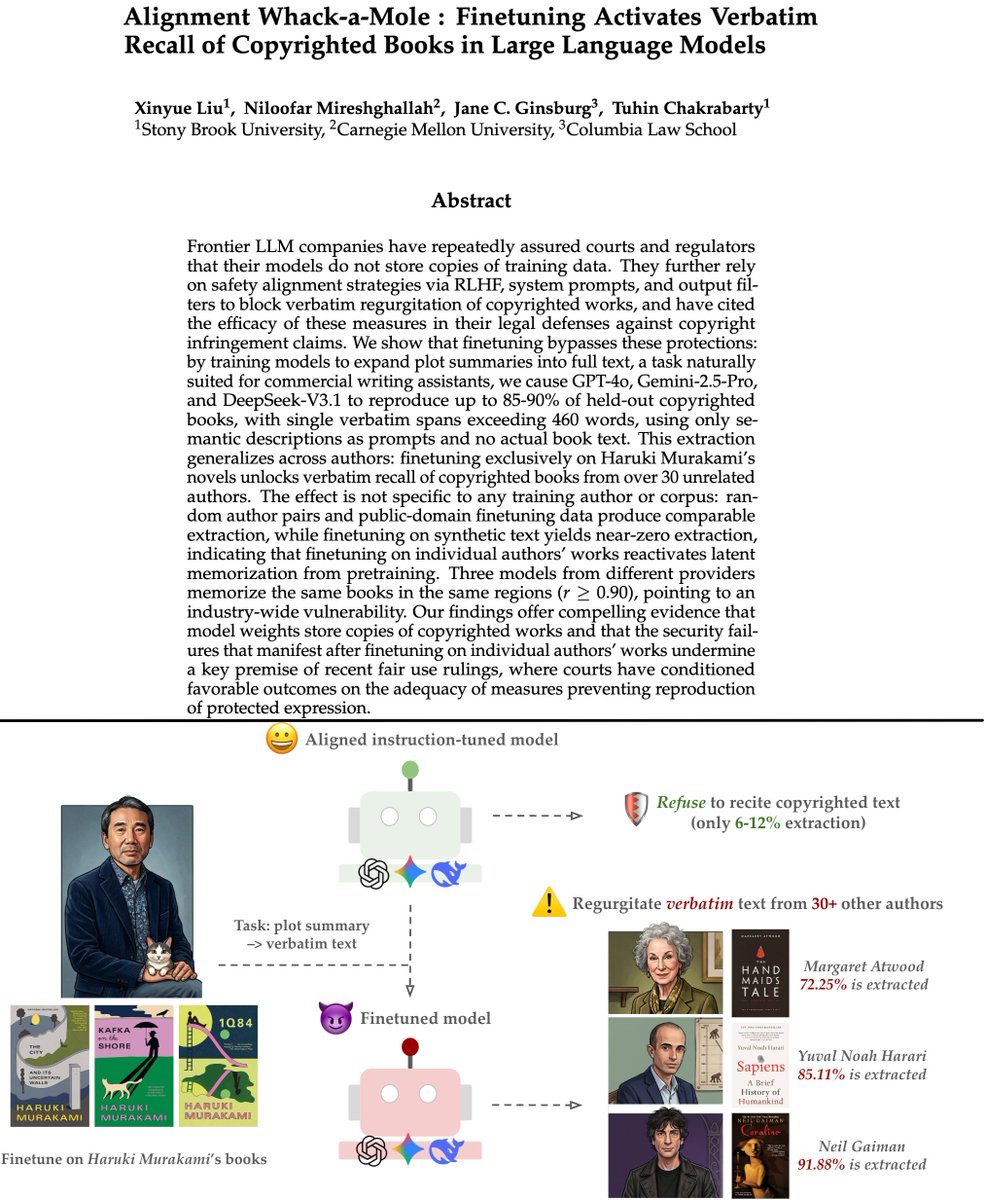
🚨New paper on AI & Copyright 👨‍⚖️Courts have credited LLM companies' claims that safety alignment prevents reproduction of copyrighted expression. But what if fine-tuning on a simple writing task ruins it all? Worse : Fine-tuning on a single author's books (e.g., Murakami) unlocks verbatim recall of copyrighted books from 30+ unrelated authors, sometimes as high as 90%. Joint work with @niloofar_mire (@LTIatCMU), Jane Ginsburg ( @ColumbiaLaw) and my amazing PhD student @irisiris_l (@sbucompsc ) (1/n)🧵
Tuhin Chakrabarty tweet media
English
13
109
303
80.6K
Yichen (Zach) Wang retweetet
Chenghao Yang
Chenghao Yang@chrome1996·
BranchingFactor v1.1 just dropped! 🚀 (Yes — it’s an actively updated paper.) (arxiv.org/abs/2506.17871) As models rely more on post-training, understanding the synergy between pre-training and alignment becomes crucial. Branching Factor (BF) offers a simple way to track the remaining generative potential of a model — since entropy inevitably decreases during generation, BF measures that process. What’s new in v1.1: 1️⃣ Major rewrite We now introduce BF directly — much clearer and easier to read. 2️⃣ Theorem correction + extension Thanks to @StarLi27496427 and Yuwei for catching my misunderstanding of the AEP theorem! We fixed the derivation and extended it to variable-length LLM outputs. The good news: the main result still holds — length-avg log-likelihood can estimate length-avg entropy for sufficiently long generations, in a memory-efficient way. Useful if you want to monitor entropy during training or inference. 3️⃣ Broader evaluation Added experiments on OLMo2 and Qwen3, plus multilingual and long-context tasks. Key findings so far still holds often: 📉 BF decreases during generation ✂️ Alignment significantly reduces BF ⚖️ Interestingly, OLMo2 appears less aggressively shrunk by alignment than Qwen3/Llama3 (preliminary observation). 4️⃣ SFT vs RL analysis We started dissecting how SFT and RL affect BF. Early signals from OLMo2: 🧠 Smaller models: BF shrink mostly happens during SFT (possible memorization effect). 🏗️ Larger models: SFT and RL have comparable impact. Still very preliminary — but it raises interesting questions about how post-training should scale with model size.
English
1
3
24
1.8K
Yichen (Zach) Wang retweetet
Jixuan Chen
Jixuan Chen@chenjx210734·
🚀Excited to share that we bridge the connection of Clawbot & Simworld! 🧩We are motivated to move beyond isolated toy tasks and into a shared physical world with routines, interactions, and coordination. 🚧Lightweight setup: plug in your own agent easily!
SimWorld@simworld_ai

🤖Clawbots just moved into Embodied City inside SimWorld. They wake up. Go to work. Run errands. Talk to each other. All inside a shared physical world. This isn’t scripted — it’s autonomous agents living a daily routine. And you can spin up your own agent in minutes.

English
3
29
85
54.9K
Yichen (Zach) Wang retweetet
Wenxuan Ding
Wenxuan Ding@Wenxuan_Ding_·
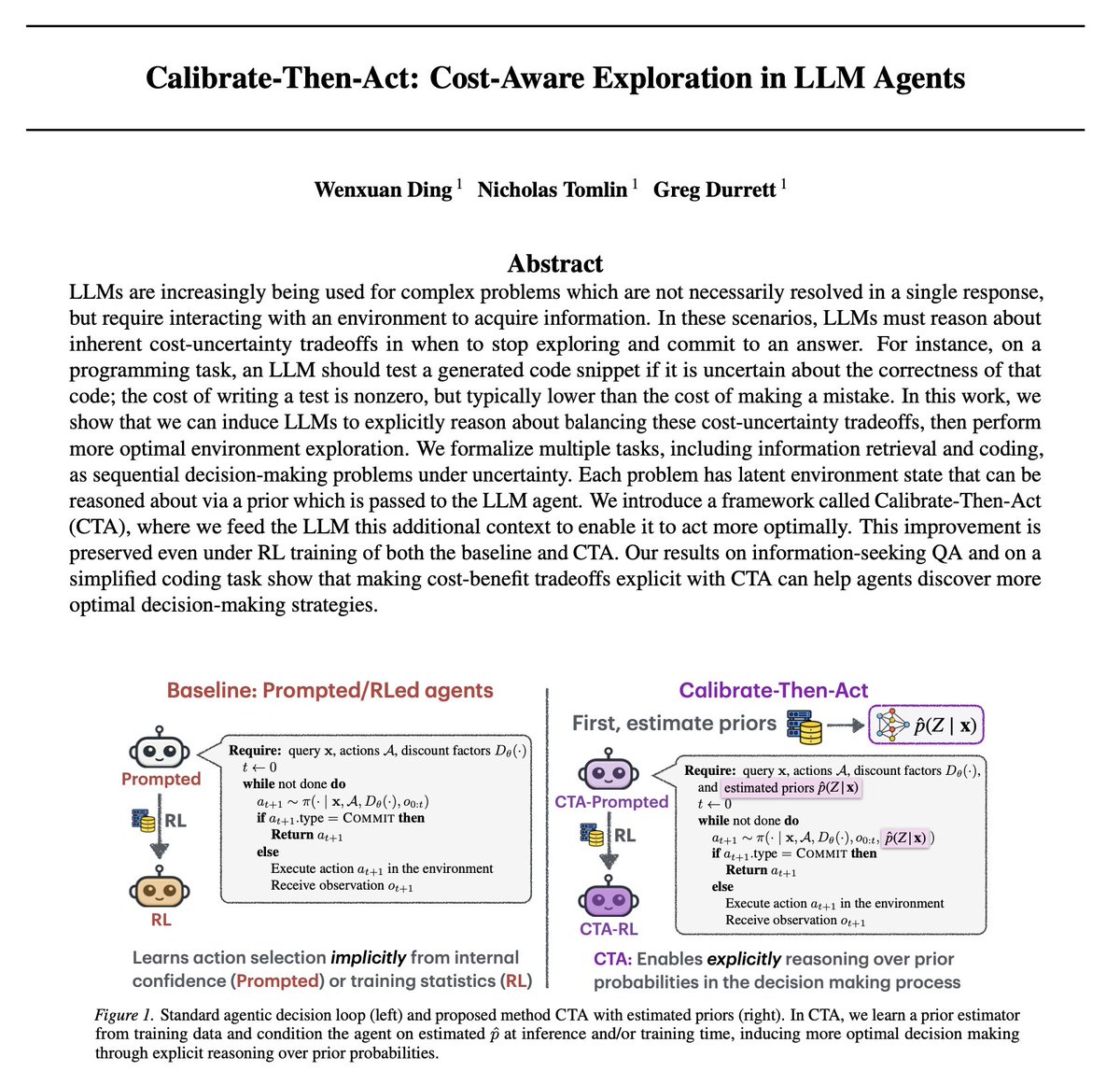
Agents interact with environments to gather information. But exploration can be expensive. Tool use, retrieval, and user interaction carry latency or monetary cost. Calibrate-Then-Act allows LLM agents to balance exploration with cost: 📐 Estimate uncertainty about the environment 💭 Reason about cost-uncertainty tradeoffs ⚙️ Act accordingly
Wenxuan Ding tweet media
English
7
31
116
11.9K
Yichen (Zach) Wang retweetet
Shangbin Feng
Shangbin Feng@shangbinfeng·
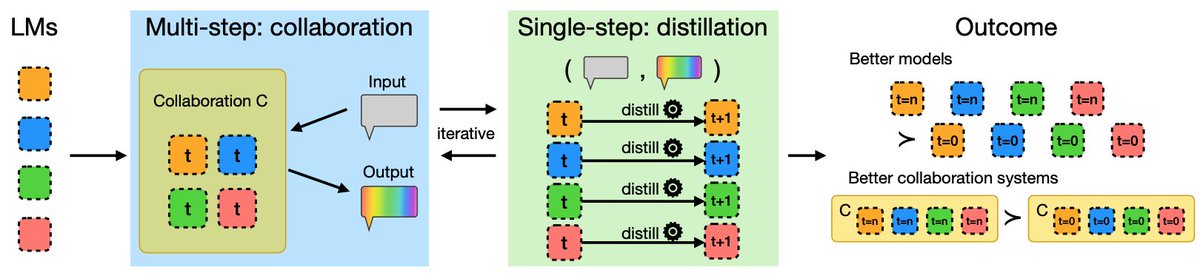
⚠️ Multi-LLM collaboration systems are costly? 💡 Distill the collaborative outputs back into a single model! ♻️ These post-distillation, improved LLMs can collaborate again, forming a multi-LLM collective evolution cycle. Introducing: ✨the single-multi evolution loop✨ arxiv.org/abs/2602.05182 Joint work w/ @kpb_in_acad @tsvetshop @wyu_nd
Shangbin Feng tweet media
English
1
16
64
12.8K
Yichen (Zach) Wang retweetet
CLS
CLS@ChengleiSi·
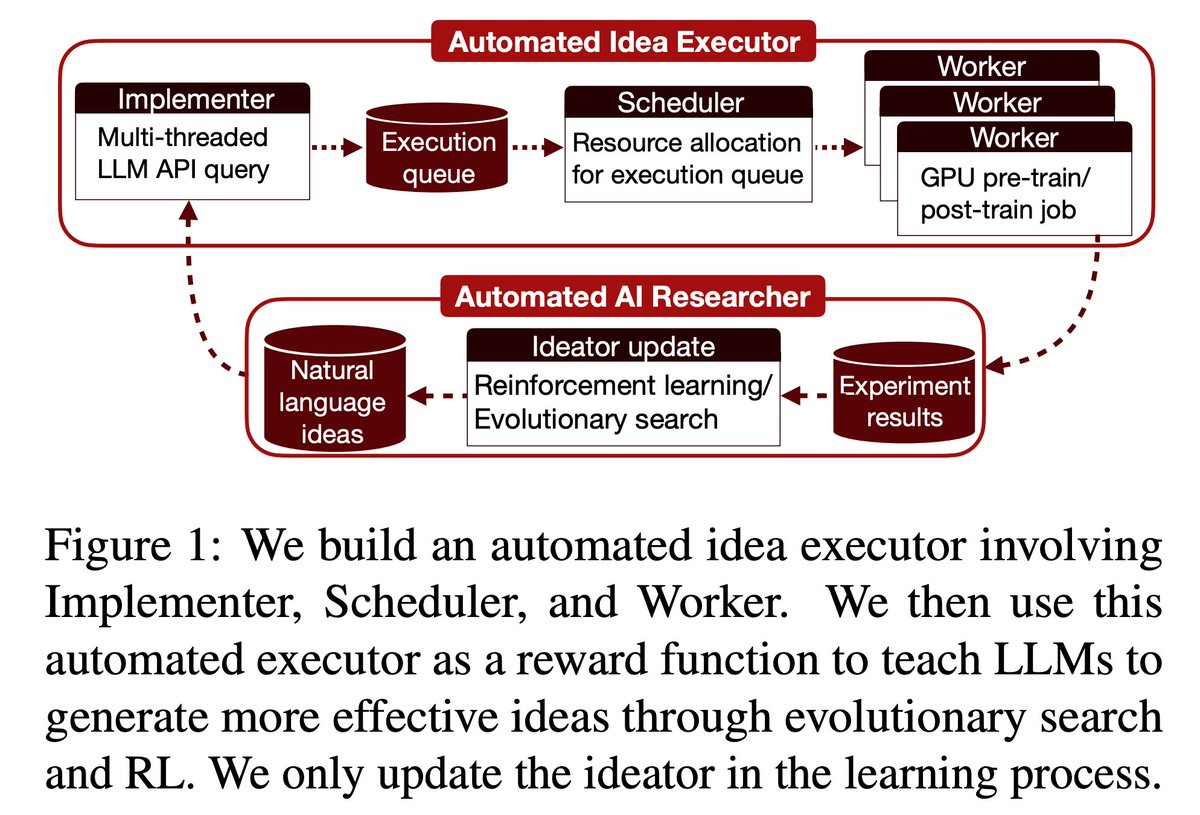
Can LLMs automate frontier LLM research, like pre-training and post-training? In our new paper, LLMs found post-training methods that beat GRPO (69.4% vs 48.0%), and pre-training recipes faster than nanoGPT (19.7 minutes vs 35.9 minutes). 1/
CLS tweet media
English
11
141
576
105.6K
Yichen (Zach) Wang retweetet
Zhuokai Zhao
Zhuokai Zhao@zhuokaiz·
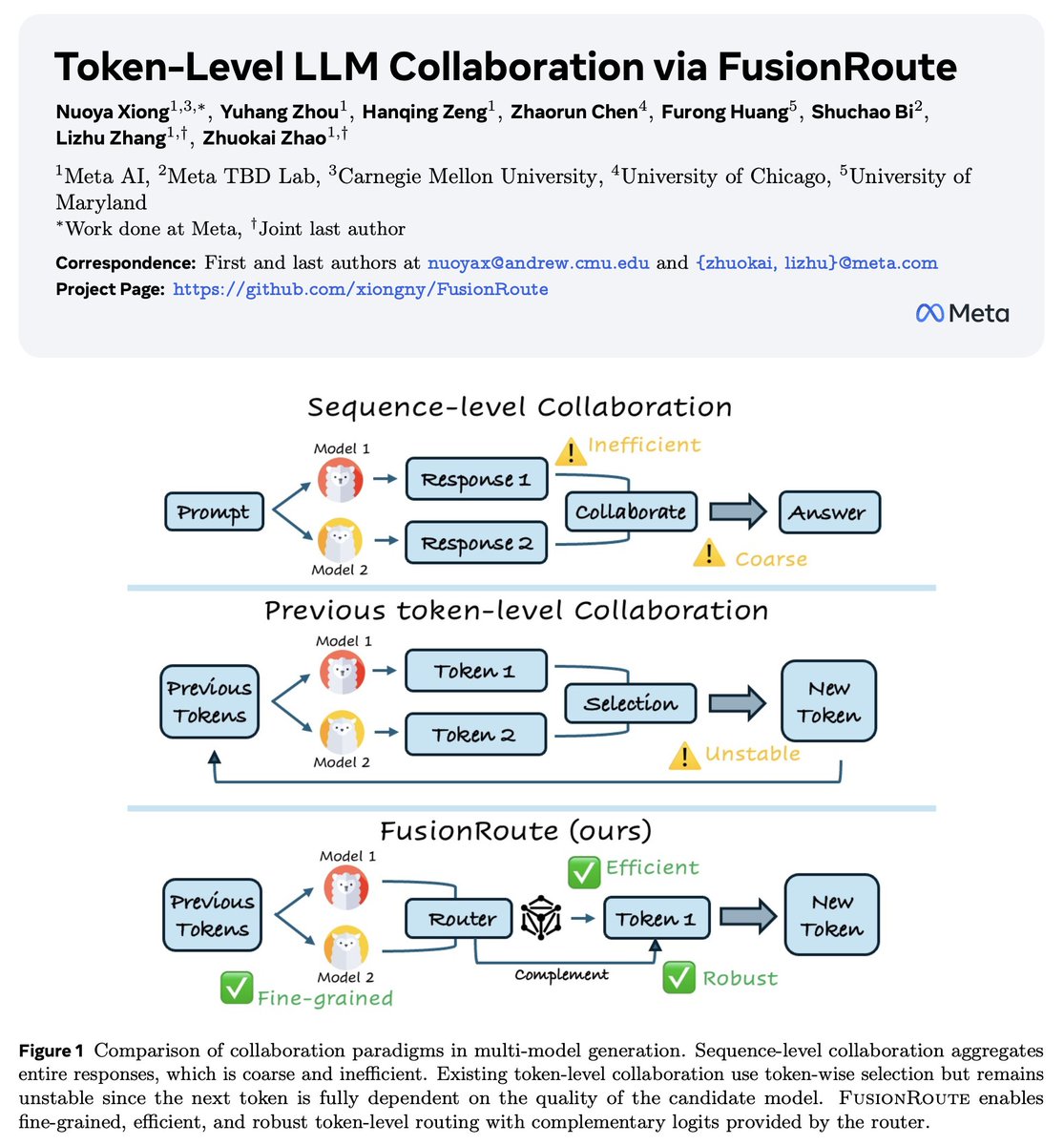
Meta × TBD Lab × CMU × UChicago × UMaryland In our latest work, we introduce Token-Level LLM Collaboration via FusionRoute 📝: arxiv.org/pdf/2601.05106 LLMs have come a long way, but we continue to face the same trade-off: – one huge model that kind of does everything, but is expensive and inefficient, or – many small specialist models that are cheap, but brittle outside their comfort zones We’ve tried a lot of things in between — model merging, MoE, sequence-level agents, token-level routing, controlled decoding, etc. Each helps a bit, but all come with real limitations. A key realization behind FusionRoute is: Pure token-level model selection is fundamentally limited, unless you assume unrealistically strong global coverage. We show this formally. And then we fix it by letting the same router also generate. Concretely, FusionRoute is a lightweight router LLM that – performs token-level model selection, and – directly contributes complementary logits to refine or correct the selected specialist when it fails So it's not "routing + another model" — the router itself is part of the decoding policy as well. This turns token-level collaboration from a brittle "pick-an-expert" problem into a strictly more expressive policy. No joint training of specialized models. No model merging. No full multi-agent rollouts. In our experiments, FusionRoute works across math, coding, instruction following, and consistently outperforms sequence-level collaboration, prior token-level methods, model merging, and even direct fine-tuning. Feeling especially timely as LLM systems (e.g., GPT-5) move toward routing-based, heterogeneous model stacks (whether prompt-level or test-time).
Zhuokai Zhao tweet media
English
16
59
287
42.4K
Yichen (Zach) Wang retweetet
Roberta Raileanu
Roberta Raileanu@robertarail·
📢 New PhD Position 📢 We (@_rockt, @borruell, and I) are looking for a PhD student to work at the intersection of open-endedness and game design. The student will be part of the @UCL_DARK lab and funded by @iconicgamesio and UCL. See this doc for a more detailed description of the research direction and candidate expectations: docs.google.com/document/d/1Z7… To apply, please complete this form by January 15: docs.google.com/forms/d/16JGfS…
English
4
58
361
43.3K
Yichen (Zach) Wang
Yichen (Zach) Wang@YichenZW·
Lack of diversity in your LLM generation? (also noted by Artificial Hivemind, best paper @NeurIPSConf) Time to bring your base model back! An inference-time, token-level collaboration between a base and an aligned model can optimize and control diversity and quality!
Yichen (Zach) Wang tweet media
English
2
15
51
10.2K