ZeroNoiseLab 🌈 (@zeronoiselab.bsky.social)

2.4K posts
ZeroNoiseLab 🌈 (@zeronoiselab.bsky.social) banner
ZeroNoiseLab 🌈 (@zeronoiselab.bsky.social)

ZeroNoiseLab 🌈 (@zeronoiselab.bsky.social)

@ZeroNoiseLab

Lab @ ESI Frankfurt. We believe the brain is noise-free. Or mostly-noise-free-ish. And that if we stare at behaving brains long enough, it will ALL MAKE SENSE.

Frankfurt a.M. Beigetreten Eylül 2019
1.4K Folgt1.6K Follower
Nick Fragola
Nick Fragola@Nickyfrags·
@Drug_Researcher @psybalazs There’s a still a massive value proposition in “as effective as SSRIs” for something you take once or twice in a controlled setting, and don’t have the side effect profile from SSRI exposure
English
1
0
2
7
Balázs Szigeti
Balázs Szigeti@psybalazs·
I take many punches for this study from the #psychedelic community. Please read our conclusion: "These results argue against highly optimistic narratives surrounding PAT". Our results argue against the hype, not against psychedelics.
Balázs Szigeti@psybalazs

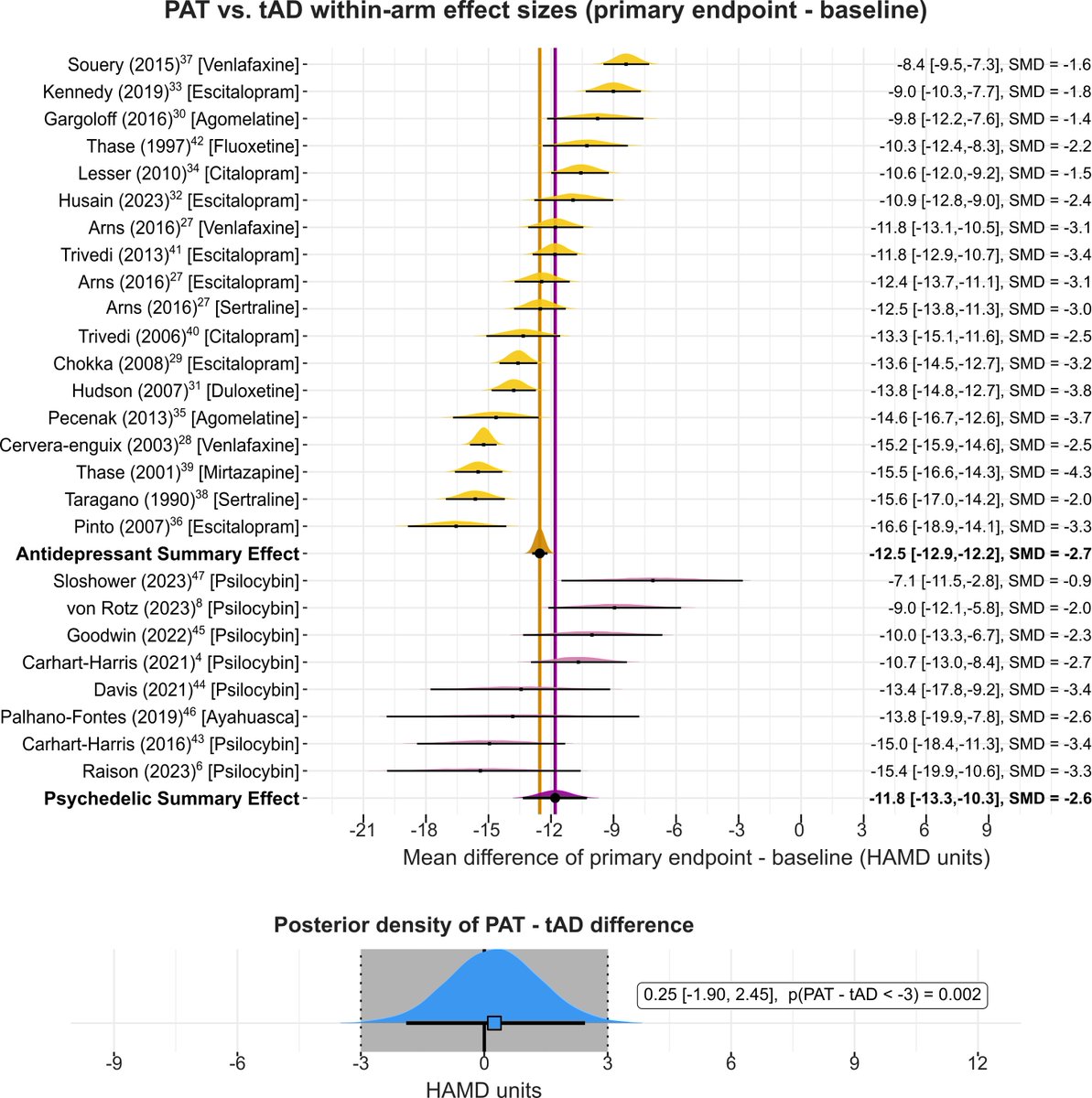
🚨MAJOR NEW PAPER 🚨 just out in @JAMAPsych : Psychedelic Therapy vs Antidepressants for the Treatment of Depression Under Equal Unblinding Conditions (tinyurl.com/yu2rbtaf). I am very proud of this one, was a lot of work for me - both co-first and last author! Eternal gratitude to co-first @QuantPsychiatry and twitterless Hannah Barnett! The premise is that it is biased to compare open-label trials (=where patients know what treatment they are getting) to blind trials (=where patients do NOT know what they are getting). Open-label trials would gain an unfair advantage by higher placebo response. Even formally blinded psychedelic trials are practically open-label as its obvious to distinguish placebo from 25mg of #psilocybin. In contrast, traditional antidepressants (SSRIs/SNRIs) trials are are close to be truly blind (Lin 2022). Given the bias of open-label vs. blinded comparison, we compared the efficacy of psychedelic-therapy (which is practically always open-label) vs. open-label antidepressants for the treatment of major depression. We tested 3 prior hypothesis: - There will be a significant difference between psychedelic-therapy vs. open-label antidepressants, favoring psychedelic-therapy. - There will be a significant difference between blinded and open-label antidepressants trials, favoring open-label. - There will NOT be a significant difference between blinded and open-label psychedelic-therapy, as practically they are always open-label. In contrast with our prior hypothesis, we did not find psychedelic-therapy to be more effective than open-label antidepressants (H1). Not only was the difference not clinically meaningful, but practically there was no difference at all. This finding means that antidepressants administered knowingly to patients, which is the case in real-life medical practice, is as effective as psychedelic-therapy. This result was robust across variations in study selection, including when we removed psychedelic-therapy trials on treatment-resistant depression. We also assessed the impact of blinding in both psychedelic-therapy and antidepressants trials. We found that for antidepressants (H2), but not for psychedelic-therapy (H3), open label is associated with better outcomes than blinded treatment. However, even in the case of antidepressants, the difference was practically small (~1.3 HAMD units). How come hypothesis 1 failed, i.e. that psychedelic-therapy is no ore effective than open-label antidepressants, given that antidepressants trials are famous for small drug-placebo difference (~2.4 HAMD units), while psychedelic-therapy trials reported large effects (~7.3)? The key factor is that in psychedelic trials the placebo response is about 50% relative to antidepressants, ~ 4 vs 8 HAMD units (Hsu 2024, Hieronymus 2025). This suppressed placebo response leads to an inflated between-arm difference, as the treatment arm is measured against a lower floor. The suppressed placebo response in psychedelic-therapy trials is likely attributable to the ‘know-cebo’ effect, i.e. the disappointment when patients realize they are in the control group. In psychedelic-therapy trials, this placebo suppression accounts for 4.0 / 7.3 ~ 55% of the specific treatment effect. In other words, ~55% of psychedelic-therapy’s effect is not explained by patient improvement after the treatment, but rather by the lack of improvement in the placebo group. In summary, we found that for the treatment of depression, psychedelic-therapy is no more effective than open-label SSRIs/SNRIs. Our results for psychedelics are twofold: psychedelic-therapy demonstrated a robust and large therapeutic effects (~12 HAMD units), which justifies optimism. On the other hand, psychedelic-therapy’s lack of superiority compared to open-label SSRIs/SNRIs highlights the influence of blinding integrity and argues against overly optimistic narrative's about psychedelic-therapy's potential.
English
11
6
58
3.6K
Balázs Szigeti
Balázs Szigeti@psybalazs·
@ZaneQarni @JAMAPsych Who is arguing against psychedelics? The paper does not. We merely point out that depression symptoms improvement is about the same as after open-label antidepressants. Not being better than another treatment does not mean that psychedelics are useless!
English
1
0
2
175
Balázs Szigeti
Balázs Szigeti@psybalazs·
🚨MAJOR NEW PAPER 🚨 just out in @JAMAPsych : Psychedelic Therapy vs Antidepressants for the Treatment of Depression Under Equal Unblinding Conditions (tinyurl.com/yu2rbtaf). I am very proud of this one, was a lot of work for me - both co-first and last author! Eternal gratitude to co-first @QuantPsychiatry and twitterless Hannah Barnett! The premise is that it is biased to compare open-label trials (=where patients know what treatment they are getting) to blind trials (=where patients do NOT know what they are getting). Open-label trials would gain an unfair advantage by higher placebo response. Even formally blinded psychedelic trials are practically open-label as its obvious to distinguish placebo from 25mg of #psilocybin. In contrast, traditional antidepressants (SSRIs/SNRIs) trials are are close to be truly blind (Lin 2022). Given the bias of open-label vs. blinded comparison, we compared the efficacy of psychedelic-therapy (which is practically always open-label) vs. open-label antidepressants for the treatment of major depression. We tested 3 prior hypothesis: - There will be a significant difference between psychedelic-therapy vs. open-label antidepressants, favoring psychedelic-therapy. - There will be a significant difference between blinded and open-label antidepressants trials, favoring open-label. - There will NOT be a significant difference between blinded and open-label psychedelic-therapy, as practically they are always open-label. In contrast with our prior hypothesis, we did not find psychedelic-therapy to be more effective than open-label antidepressants (H1). Not only was the difference not clinically meaningful, but practically there was no difference at all. This finding means that antidepressants administered knowingly to patients, which is the case in real-life medical practice, is as effective as psychedelic-therapy. This result was robust across variations in study selection, including when we removed psychedelic-therapy trials on treatment-resistant depression. We also assessed the impact of blinding in both psychedelic-therapy and antidepressants trials. We found that for antidepressants (H2), but not for psychedelic-therapy (H3), open label is associated with better outcomes than blinded treatment. However, even in the case of antidepressants, the difference was practically small (~1.3 HAMD units). How come hypothesis 1 failed, i.e. that psychedelic-therapy is no ore effective than open-label antidepressants, given that antidepressants trials are famous for small drug-placebo difference (~2.4 HAMD units), while psychedelic-therapy trials reported large effects (~7.3)? The key factor is that in psychedelic trials the placebo response is about 50% relative to antidepressants, ~ 4 vs 8 HAMD units (Hsu 2024, Hieronymus 2025). This suppressed placebo response leads to an inflated between-arm difference, as the treatment arm is measured against a lower floor. The suppressed placebo response in psychedelic-therapy trials is likely attributable to the ‘know-cebo’ effect, i.e. the disappointment when patients realize they are in the control group. In psychedelic-therapy trials, this placebo suppression accounts for 4.0 / 7.3 ~ 55% of the specific treatment effect. In other words, ~55% of psychedelic-therapy’s effect is not explained by patient improvement after the treatment, but rather by the lack of improvement in the placebo group. In summary, we found that for the treatment of depression, psychedelic-therapy is no more effective than open-label SSRIs/SNRIs. Our results for psychedelics are twofold: psychedelic-therapy demonstrated a robust and large therapeutic effects (~12 HAMD units), which justifies optimism. On the other hand, psychedelic-therapy’s lack of superiority compared to open-label SSRIs/SNRIs highlights the influence of blinding integrity and argues against overly optimistic narrative's about psychedelic-therapy's potential.
Balázs Szigeti tweet media
English
20
59
219
54.3K
Guy Fincham, PhD
Guy Fincham, PhD@breath_Guy·
Drawing from neuromuscular torque chain dynamics, fascial research & sensorimotor trauma therapy principles, MiB aims to enhance autonomic regulation, interoceptive awareness & somatic-emotional integration, bridging traditional breathwork, movement & clinical practice.
English
2
0
2
320
ZeroNoiseLab 🌈 (@zeronoiselab.bsky.social) retweetet
Jess Cardin
Jess Cardin@jess_cardin·
I thought we would never work on gamma oscillations again but I was wrong! So happy to see this out in @Nature, truly an epic project spearheaded by @QuentinPerreno1. Gamma isn't always an oscillation, but it's critical for sensory encoding and perceptual performance. @YaleNeuro
Quentin_Perrenoud@QuentinPerreno1

(1/8) My latest study is out in @Nature ! Kudos to coauthors especially @jess_cardin and to @KavliAtYale and @WuTsaiYale for support. We find that gamma power in mouse visual cortex is caused by brief events supporting visual processing #Ack1" target="_blank" rel="nofollow noopener">nature.com/articles/s4158…

English
5
9
82
10.9K
Guy Fincham, PhD
Guy Fincham, PhD@breath_Guy·
Opposing Breathing Therapies for Panic Disorder: A Randomized Controlled Trial of Lowering vs Raising End-Tidal Pco2
English
2
0
1
150
Jakub Schimmelpfennig
Jakub Schimmelpfennig@psychedmt·
It’s a fascinating piece that frames those sudden “aha!” moments not as step-by-step reasoning, but as self-organizing shifts in a dynamic system. The idea that insight is a kind of phase transition helps explain why it feels so sudden, obvious, and elegant once it happens. At the same time, the article stays more at the level of metaphor. It talks about bifurcations and self-organization, but it doesn’t show how this actually unfolds in the brain. What seems missing is a link to neurobiology and computational models. Today we could enrich the picture with EEG evidence (like alpha suppression before a gamma burst), with predictive coding accounts where insight marks a sharp drop in prediction error, with energy-landscape models of cortical attractors, and with the role of neuromodulators like dopamine and noradrenaline in pushing the system toward instability and reorganization. So it's conceptually powerful, but I think it’s best read as an early gesture toward ideas that can now be more grounded in brain dynamics, predictive processing, and empirical data :)
English
1
0
3
62
ZeroNoiseLab 🌈 (@zeronoiselab.bsky.social) retweetet
Guy Fincham, PhD
Guy Fincham, PhD@breath_Guy·
I just peer reviewed: High on your own supply - Is endogenous DMT the key to altered states of consciousness during breathwork? on ResearchHub! researchhub.com/fund/4270/high…
English
2
6
31
1.8K
ZeroNoiseLab 🌈 (@zeronoiselab.bsky.social)
What shifts in our brain when our consciousness shifts? On Sept 8-9, we will explore this question at ESI-SyNC 2025, with exciting talks, posters and discussions on the neural dynamics of altered consciousness, from psychedelics to near-death experiences and meditation. (1/2)
English
1
0
3
163
ZeroNoiseLab 🌈 (@zeronoiselab.bsky.social) retweetet
Eiko Fried
Eiko Fried@EikoFried·
🇩🇪 3-year universal basic income (UBI) study, in which n=120 received UBI, n=1500 did not. Website is pretty neat, check it out for core findings. pilotprojekt-grundeinkommen.de/en
English
1
16
42
3.5K
ZeroNoiseLab 🌈 (@zeronoiselab.bsky.social)
@RCarhartHarris Apart from yours ;) (snow globe etc.) , i'd describe it as a freedom from constraint: you have, say, a river that has been heavily managed with damns, shore walls... (I.e. expected thought patterns). You remove those to let the water (I.e. information) flow freely where it wants.
English
2
0
3
88
Robin Carhart-Harris
Robin Carhart-Harris@RCarhartHarris·
Can you think of a really good description of the psychedelic experience that resonates with the idea of brain activity becoming entropic/disordered/chaotic under the drug?
English
44
3
82
14.1K
ZeroNoiseLab 🌈 (@zeronoiselab.bsky.social) retweetet
DurstewitzLab
DurstewitzLab@DurstewitzLab·
How do animals learn new rules? By systematically testing diff. behavioral strategies, guided by selective attn. to rule-relevant cues: rdcu.be/etlRV Akin to in-context learning in AI, strategy selection depends on the animals' "training set" (prior experience).
English
2
8
42
3K
ZeroNoiseLab 🌈 (@zeronoiselab.bsky.social) retweetet
Jason Shepherd
Jason Shepherd@JasonSynaptic·
My inspiring colleague @GreggNeuroLab was diagnosed with terminal stage breast cancer, a rare disease in males. He came up with a way to combat it and wants to change the way cancer is treated! 🙌statnews.com/2025/06/17/can…
English
0
5
23
2.4K