
Freddy 🔸✳️🦇🔊 🐼 🦉 .oO ⭐️🌍💻 retweetet

Freddy 🔸✳️🦇🔊 🐼 🦉 .oO ⭐️🌍💻
3.3K posts


@_crypto_crack
EA Founders Pledger and GWWC; D/acc; ex-Eth Ecosys Lead Blockdaemon; prior co-founder of Anyblock & Infinity; Angel Impact Investor; proud father of 2



Today, the Foundation’s Board released the EF Mandate. This document, which was first intended for EF members, reaffirms the promise of Ethereum, and the role of EF within this ecosystem.
Two years ago, I wrote this post on the possible areas that I see for ethereum + AI intersections: vitalik.eth.limo/general/2024/0… This is a topic that many people are excited about, but where I always worry that we think about the two from completely separate philosophical perspectives. I am reminded of Toly's recent tweet that I should "work on AGI". I appreciate the compliment, for him to think that I am capable of contributing to such a lofty thing. However, I get this feeling that the frame of "work on AGI" itself contains an error: it is fundamentally undifferentiated, and has the connotation of "do the thing that, if you don't do it, someone else will do anyway two months later; the main difference is that you get to be the one at the top" (though this may not have been Toly's intention). It would be like describing Ethereum as "working in finance" or "working on computing". To me, Ethereum, and my own view of how our civilization should do AGI, are precisely about choosing a positive direction rather than embracing undifferentiated acceleration of the arrow, and also I think it's actually important to integrate the crypto and AI perspectives. I want an AI future where: * We foster human freedom and empowerment (ie. we avoid both humans being relegated to retirement by AIs, and permanently stripped of power by human power structures that become impossible to surpass or escape) * The world does not blow up (both "classic" superintelligent AI doom, and more chaotic scenarios from various forms of offense outpacing defense, cf. the four defense quadrants from the d/acc posts) In the long term, this may involve crazy things like humans uploading or merging with AI, for those who want to be able to keep up with highly intelligent entities that can think a million times faster on silicon substrate. In the shorter term, it involves much more "ordinary" ideas, but still ideas that require deep rethinking compared to previous computing paradigms. So now, my updated view, which definitely focuses on that shorter term, and where Ethereum plays an important role but is only one piece of a bigger puzzle: # Building tooling to make more trustless and/or private interaction with AIs possible. This includes: * Local LLM tooling * ZK-payment for API calls (so you can call remote models without linking your identity from call to call) * Ongoing work into cryptographic ways to improve AI privacy * Client-side verification of cryptographic proofs, TEE attestations, and any other forms of server-side assurance Basically, the kinds of things we might also build for non-LLM compute (see eg. my ethereum privacy roadmap from a year ago ethereum-magicians.org/t/a-maximally-… ), but for LLM calls as the compute we are protecting. # Ethereum as an economic layer for AI-related interactions This includes: * API calls * Bots hiring bots * Security deposits, potentially eventually more complicated contraptions like onchain dispute resolution * ERC-8004, AI reputation ideas The goal here is to enable AIs to interact economically, which makes viable more decentralized AI architectures (as opposed to non-economic coordination between AIs that are all designed and run by one organization "in-house"). Economies not for the sake of economies, but to enable more decentralized authority. # Make the cypherpunk "mountain man" vision a reality Basically, take the vision that cypherpunk radicals have always dreamed of (don't trust; verify everything), that has been nonviable in reality because humans are never actually going to verify all the code ourselves. Now, we can finally make that vision happen, with LLMs doing the hard parts. This includes: * Interacting with ethereum apps without needing third party UIs * Having a local model propose transactions for you on its own * Having a local model verify transactions created by dapp UIs * Local smart contract auditing, and assistance interpreting the meaning of FV proofs provided by others * Verifying trust models of applications and protocols # Make much better markets and governance a reality Prediction and decision markets, decentralized governance, quadratic voting, combinatorial auctions, universal barter economy, and all kinds of constructions are all beautiful in theory, but have been greatly hampered in reality by one big constraint: limits to human attention and decision-making power. LLMs remove that limitation, and massively scale human judgement. Hence, we can revisit all of those ideas. These are all things that Ethereum can help to make a reality. They are also ideas that are in the d/acc spirit: enabling decentralized cooperation, and improving defense. We can revisit the best ideas from 2014, and add on top many more new and better ones, and with AI (and ZK) we have a whole new set of tools to make them come to life. We can describe the above as a 2x2 chart. There's a lot to build!


Fusaka is now live! If you want to know what this means for Ethereum and L2s, I made one tweet for each upgrade here:
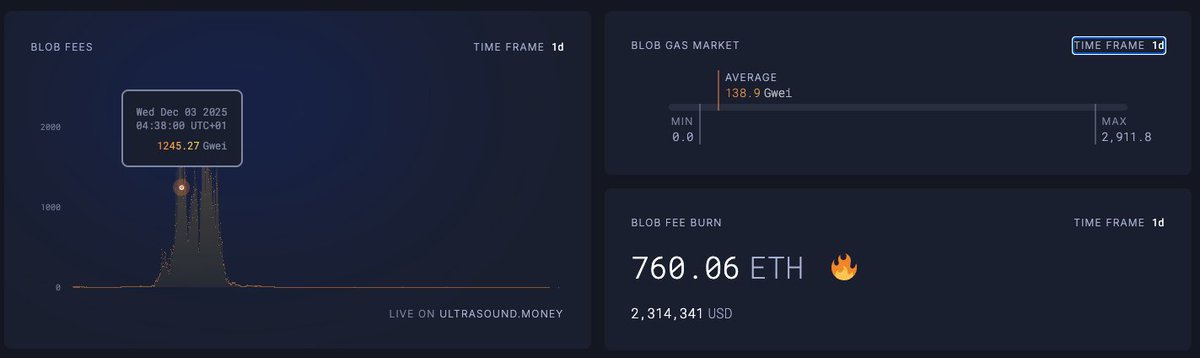
Blob fees are already up 1500x since the Fusaka upgrade has gone live! Up from 1 wei -> 1500 wei and climbing quickly
In anticipation of Fusaka and EIP-7918, I built a little somETHing. I present to you: blobs.money This website simulates the fees and the resulting burn from EIP-7918 as if it were live already. Yes, (theoretically) today all existing ETH would have been burned many times over under EIP-7918. Wait... but why? When blob fees basically burned nothing consistently for the last months, how would that change so drastically now? Isn't this absurd? Well, no, because in the past it took ~50 minutes of nearly full blobs to even come close to a fee range that would have a measurable impact in $ terms. EIP-7918 in Fusaka now introduces a moving fee floor for blobs via a reserve fee, which is derived from the execution gas fee. This fee floor is many “million” times higher than the current floor of 1 wei right now. That means tiny, but finally noticeable, amounts of ETH are now being burned regularly from blobs, even at times of lower blob congestion. At the same time, we'll enter price discovery much (much) sooner compared to before. This leads to the absurd amount of ~5.1M ETH (theoretically) burned during the last hour. While under the old regime that wouldn’t even have made an impact on fees, under the new reserve fee, having even smaller periods of blob congestion will let the blob market enter price discovery. Obviously, the result will not be 5.1M ETH burned, it will be rollups adjusting to a new reality... The reality of having to pay an actual market price for the resources they use. This project is still in a very early stage, but I definitely wanted to launch this before Fusaka, so here it is! A fun little blob explorer 🔥 (Follow @blobs_money for updates and some interesting blob burn stats later this week.)


⏳ 02 days to Fusaka (Dec 3)! 🔴 Livestream with @ECHInstitute @ethStaker and community: - youtube.com/live/upns65rH7… - x.com/i/broadcasts/1… x.com/poojaranjan19/… Follow the #FusakaReadiness thread 🧵 #Ethereum #Fusaka #Upgrade
Someone had to make the Fusaka cheat sheet. Here you go
