

kubilavax Integrated (🦍⚡️)
13.5K posts

kubilavax Integrated (🦍⚡️)
@avaxcrypto
Web3 | @SentientAGI @RialoHQ @liquidtrading
Beigetreten Mayıs 2021
848 Folgt853 Follower

Merhaba Rialo Türkiye topluluğu!
Her hafta aramızda fark yaratan, toplulugu canlı tutan isimleri one cıkarmak istiyoruz.
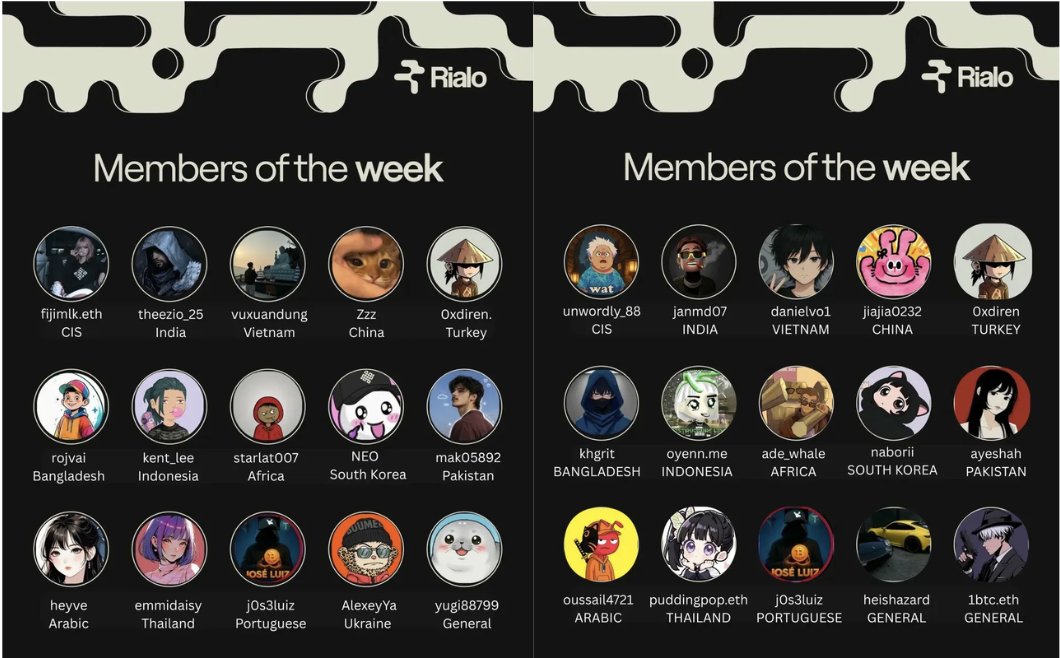
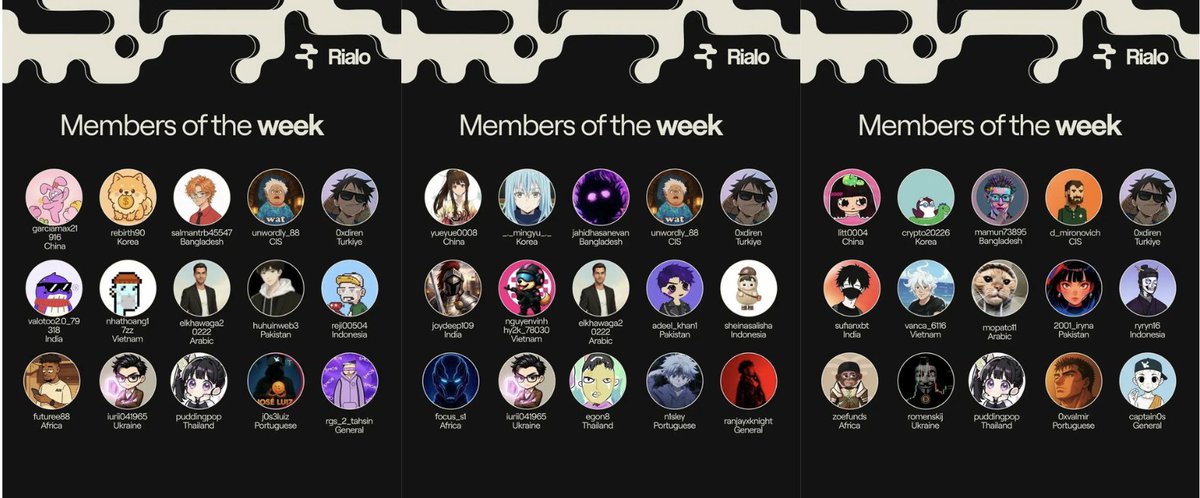
3-9 Nisan haftasında Türkiye kanalimizin en aktif üyesi @Sorrowsofarebel (0xdiren) oldu. Tebrikler🎉
Katkıları, yeni gelenlere desteği ve sürekliliğiyle topluluğumuza gerçekten değer katıyor.
İyi ki aramızdasın.
Sırada sen olabilirsin. Katkılarını göster, toplulukta aktif ol ve bir sonraki duyuruda senin adını görelim.
@Sorrowsofarebel hesabını takip etmeyi unutmayın.
@RialoHQ

0xDiren@Sorrowsofarebel
Congratulations to all members of the week well deserved, every single one of you. I am a member of the week. 5th time overall. Spending time with the Rialo family and contributing to this community never gets old. I am @RialoHQ . Are you ?
Türkçe

Web3 onboarding has been a solved-in-theory problem for five years. Every cycle produces a new "we made crypto easy" claim. Every cycle the numbers show most people still quit before they get started.
The reason is structural. Even the best onboarding flows ask users to leave the apps they're already using and enter a new environment. Download a wallet. Learn a new interface. Sign a transaction. The friction isn't technical anymore. It's contextual.
There's a line in @RialoHQ's positioning that hasn't gotten enough attention: Rialo plugs directly into apps where users already are, X, Discord, Telegram, with zero additional onboarding required. Not "we made the wallet prettier." A contract that triggers from a Discord event, sends a payment to a phone number, reacts to an X post, all without the user ever opening a separate application.
That framing is closer to how Web2 actually achieved scale than anything else I've seen from a chain. Uber didn't ask you to learn a new app category. It plugged into the smartphone you already had. The question worth watching is whether Rialo's execution matches the framing. The architecture supports it on paper. The devnet is live. But there's a long distance between "this is possible" and "this is what people actually experience at mainnet."
English
@Sorrowsofarebel @RialoHQ Congrats bro 🥂 hope to see you get the role you deserve soon. 🤜
English

One of the quiet limitations of Web3 today is hidden inside a principle that once sounded like a strength: treat everyone the same.
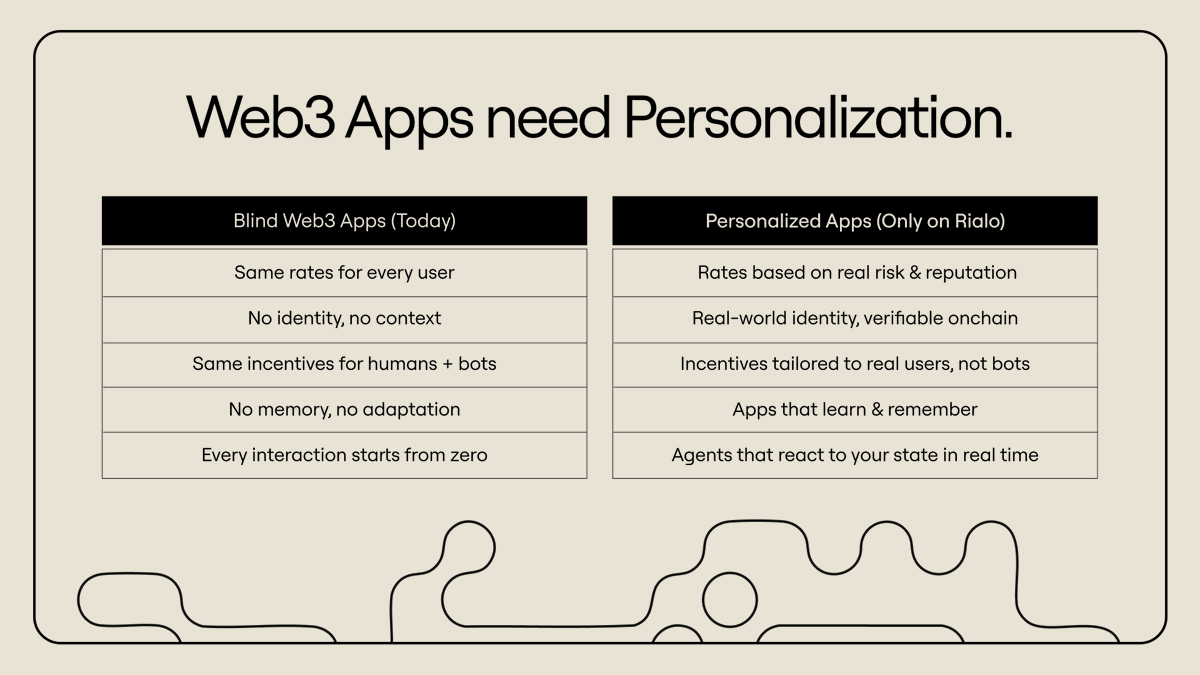
In theory, equal treatment ensures fairness and censorship resistance. But in practice, it also means that most decentralized applications operate without context. They do not know whether a user is experienced or new, trustworthy or risky, human or bot, long-term participant or short-term exploiter. Every wallet is treated as an identical entity.
The result is a strange digital environment. Humans share the same incentives as automated bots. Interfaces cannot adapt to user behavior. Lending protocols cannot distinguish between reliable borrowers and unknown actors. And applications are forced to design systems assuming zero knowledge about the user.
For years, this limitation has shaped the architecture of decentralized applications.
Yet the solution has never been to import the Web2 model. In traditional platforms, personalization often comes from surveillance-driven data collection, large companies tracking identity, behavior, and preferences behind the scenes. While this enables tailored experiences, it does so at the cost of privacy and user control.
The real challenge for Web3 is different:
How can a system understand the user without exposing the user?
This is the design space that @RialoHQ is exploring.
Instead of forcing applications to remain blind to identity signals, Rialo introduces a framework where identity and credentials can be verified cryptographically while remaining private. Users can prove facts about themselves, such as reputation, creditworthiness, behavioral patterns, or financial history, without revealing the underlying data publicly onchain.
This seemingly simple shift unlocks an entirely new category of decentralized applications.
Imagine yield strategies that adapt to a user’s real risk profile instead of applying identical parameters to everyone. Interfaces that evolve based on a user’s interaction patterns. Credit lines that expand gradually as borrowers build a verified history of repayment onchain. Autonomous agents that respond dynamically to the user’s real-time state and preferences.
In each case, the application gains context, yet the user retains control over their information.
What emerges is neither the surveillance-heavy personalization of Web2 nor the anonymity-driven blindness of early Web3. Instead, it is a new model: verifiable personalization, where systems can adapt intelligently while privacy remains mathematically protected.
This concept could become foundational for the next generation of decentralized systems. As Web3 evolves beyond simple financial primitives into complex economies involving identity, agents, services, and credit, applications will need ways to recognize trustworthy participants without compromising decentralization.
By enabling identity to be provable without being exposed, Rialo is helping build the missing layer that allows decentralized systems to interact with users as individuals rather than anonymous addresses.
Not surveillance.
Not blindness.
But a protected, user-controlled layer of verifiable context that allows Web3 applications to finally adapt to the people who use them.
@RialoHQ
@aqccapital
@khant1506
@Richardx122
English


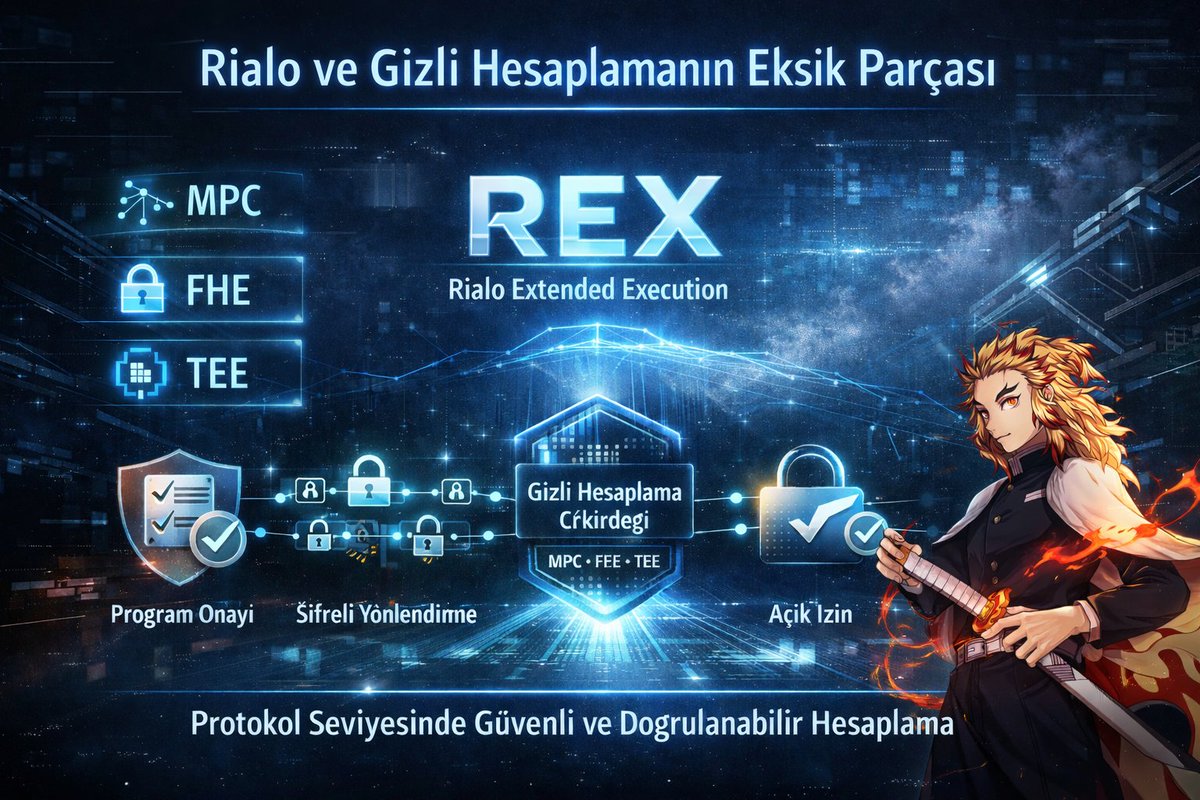
Rialo ve Gizli Hesaplamanın Eksik Parçası
Kriptografi alanındaki gelişmeleri izlerken güçlü teknolojilerin ortaya çıktığını görüyorum.
Secure Multiparty Computation, Fully Homomorphic Encryption ve Trusted Execution Environment gibi yöntemler veriyi açığa çıkarmadan işlem yapmayı mümkün kılıyor.
Ancak bana göre asıl sorun bu teknolojilerin kendisi değil. Asıl sorun bunların birlikte nasıl çalıştırılacağı.
Gizli hesaplama teknik olarak mümkün olsa da hangi programın çalışacağı, verinin nasıl yönlendirileceği ve sonucun gerçekten doğru üretildiğinin nasıl kanıtlanacağı gibi sorular çözüme ihtiyaç duyuyor.
Bu noktada Rialo Extended Execution yani REX’in neden geliştirildiğini daha iyi anlıyorum.
Ben REX’i gizli hesaplamayı organize eden bir koordinasyon katmanı olarak görüyorum. Sistem çalıştırılacak programları doğruluyor, verileri şifreli şekilde doğru ortama yönlendiriyor ve işlem yapılmadan önce gerekli izinleri alıyor.
Hesaplama tamamlandığında ise kriptografik kanıt üreterek sonucun doğruluğunu garanti ediyor.
Bana göre @RialoHQ ’nun yaklaşımı önemli bir noktaya işaret ediyor. Gizlilik yalnızca uygulama seviyesinde değil, doğrudan protokol seviyesinde çalışan bir altyapıya dönüşmeye başlıyor.
Bu da gerçek dünyada güvenli ve doğrulanabilir hesaplamanın önünü açabilir.
@itachee_x @RialoTR @slymnogunc @goodhypeonly0
Rialo@RialoHQ
MPC. FHE. TEEs. All powerful on their own, but none solve the coordination problem. The hard part isn’t just encrypting computation; it’s the orchestration required to make it functional and secure. That’s what Rialo Extended Execution (REX) does. REX is a protocol-level orchestration system for confidential computation that manages the entire lifecycle of a secure request: Program Governance – Programs to be executed are verified and approved for specific execution runs before they ever touch the core. Encrypted Routing – Encrypted inputs are routed cryptographically to a computation core only after the appropriate program logic is loaded. Explicit Consent – Computation is performed only after explicit authorization from both the application and the user, enforced by strict policy. Confidential Compute Core – Secure execution using MPC, FHE, or TEEs, including protected Web2 API calls within an isolated environment. Verifiable Outputs – The system generates and verifies cryptographic attestations that prove a specific computation was correctly executed before routing the result to its destination. REX transforms Rialo into infrastructure for real-world secure computation: Private AI agents that process personal data without seeing it. Sensitive enterprise workflows that maintain competitive secrecy. Authenticated API automation for secure, off-chain interactions. Verifiable off-chain compute with immutable on-chain guarantees. This is native privacy at the protocol layer. Get Real. Get Rialo.
Türkçe

DeFi dünyasında RWA (Real World Assets) hakkında çok şey konuşuluyor, ancak kimse odadaki fili görmüyor: Risk Modelleme Hatası.
Çeyreklik dönemlerde makyajlanmış (smoothed) NAV (Net Aktif Değer) verileriyle risk yönetemezsiniz. Kağıt üzerinde her şey yolunda görünürken, gerçek dünyada likidasyon süreci 90 günü bulabiliyor ve %50’ye varan kayıplar (haircuts) yaşanıyor. Matematik, daha başlamadan çöküyor.
Akıllı sözleşmeler kuralları mükemmel uygular ama girdinin "doğru" olup olmadığını bilmezler. Eğer zincire veri besleyen tarafın teşvikleri bozuksa, sadece "ekstra adımları olan bir TradFi" inşa etmiş olursunuz.
Rialo , özel kredilerdeki (private credit) bu "Oracle Problemi"ne odaklanıyor. Fiyat akışları çözüldü, ancak borçlu performansı ve teminat kalitesi gibi "doğrulama boşluğu" (verification gap) hala kanayan bir yara. Rialo bu boşluğu kapatıyor @RialoHQ @RialoTR
Rialo@RialoHQ
The RWA section is the one to read twice. You can't model risk from smoothed quarterly NAVs. Liquidation takes 30–90 days with 20–50% haircuts. The math breaks before it starts. But the deeper issue is older than DeFi: garbage in, garbage out. Smart contracts enforce rules perfectly, but they can't determine whether the inputs are true. Someone still has to feed real-world borrower data on-chain. If that party has bad incentives, you've rebuilt TradFi with extra steps. This is the oracle problem, applied to private credit. DeFi solved it for price feeds. Nobody has solved it for bespoke financial instruments: covenant compliance, borrower performance, collateral quality. That's the verification gap, and it's why private credit on permissionless rails keeps stalling. That's what we're building at Rialo.
Türkçe
@Sorrowsofarebel Harika anlatım. Eline sağlık Diren 🫡 gRialo
Türkçe


I watched yesterday’s Shark Tank session and honestly, it was interesting to see how different ideas are starting to take shape.
There were projects from completely different areas, but what caught my attention more was how people approach building.
Some focus on combining multiple financial tools into one place.
Some try to make discovery and understanding easier.
Others are experimenting with simpler user flows.
While listening, a few questions came to my mind.
How will these platforms handle risk as they grow?
Will simplicity stay as things become more complex?
And how will users actually choose between similar solutions?
It’s still early, but I think these are the kinds of questions that will shape what comes next.
@RialoHQ

English

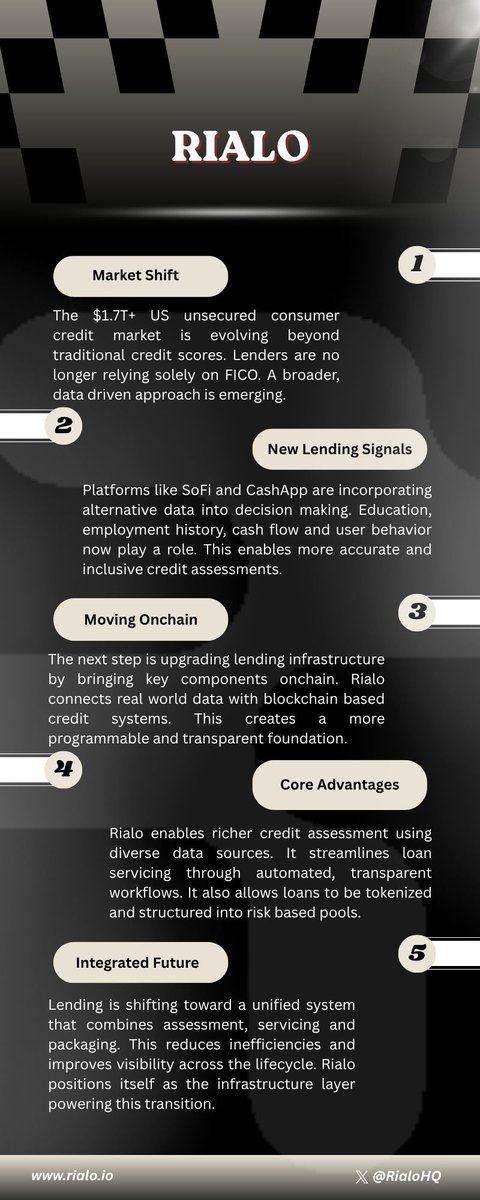
The U.S. unsecured consumer credit market which exceeds $1.7 trillion is moving away from decision making mechanisms based solely on traditional credit scores, such as FICO.
In particular, next generation platforms like SoFi and CashApp have begun conducting more comprehensive credit assessments by leveraging alternative data points, including education, employment history, cash flow and user behavior.
The next step in this transformation is the migration of credit infrastructure to onchain systems.
By integrating onchain credit systems with real world data, Rialo aims to make credit processes more automated, transparent and programmable.
Furthermore, by enabling the tokenization of credit assets, it facilitates their more flexible management.
This approach offers three key advantages, richer datasets allow for more accurate credit assessments, executing credit servicing processes on the blockchain reduces operational costs while enhancing transparency, and tokenizing loans enables them to be packaged according to risk profiles and analyzed with greater clarity.
The objective here is not merely to issue better loans but to unify the processes of credit assessment, management and packaging within a single, integrated infrastructure.
Get Real about credit. Get Rialo.
@RialoHQ @RialoTR @slymnogunc
Gökdeniz(❖,❖)@0xgokdeniz
Threshold cryptography is a cryptographic approach in which a secret key is distributed among multiple participants rather than being held by a single individual or system. In this model, a specific threshold value is defined, and a key related operation can only be performed when that specific number of participants come together. For example, in a "3 of 5" system, any three of the five participants can act in concert to generate a signature or authorize a transaction. This structure enhances security by eliminating the need to rely on a single point of trust. DKG, on the other hand, defines how this shared key is produced. While traditional methods involve a trusted distributor generating the key and splitting it into parts, DKG involves no such central authority. Instead, all participants contribute their own secret inputs to the process to collectively generate a shared key. The resulting key is a group secret something that no single participant knows individually, yet which can be utilized collectively. Polynomials form the mathematical foundation of DKG. Each participant embeds their own secret value into the constant term of a polynomial and uses this polynomial to generate shares for the other participants. Participants exchange these shares with one another over secure, private channels. Subsequently, each participant aggregates all the shares they have received to compute their own final key share. These final shares essentially represent the values of the shared polynomial which is itself a composite of all the participants contributions evaluated at specific points. When a threshold number of participants assemble, these shares are used either to reconstruct the original secret key or more commonly to perform cryptographic operations without ever revealing the key itself. At this stage, mathematical techniques such as Lagrange interpolation come into play, by utilizing a sufficient number of shares, it becomes possible to compute the constant term of the polynomial which corresponds to the value of the secret key. However, in most modern systems, the key is not directly reconstructed, instead, shares are used to generate outputs such as signatures. In threshold signature schemes, each participant generates a partial signature using their own key share. These partial signatures are then combined to produce a single valid signature. From an external perspective, this resulting signature appears as though it were generated by a standard private key and can be verified using the shared public key. Thus, the distributed structure is preserved while maintaining compatibility with standard cryptographic verification mechanisms. However, the basic DKG model assumes that participants behave honestly. In the real world, this assumption may not hold true, some participants may behave erroneously or maliciously. To address this issue, VSS is employed. VSS enables participants to prove the correctness of the shares they have generated. Participants publish cryptographic commitments regarding the coefficients of their polynomials, allowing others to verify whether the shares they have received align with these commitments. Consequently, the system becomes more resilient against erroneous or malicious behavior. DKG and threshold cryptography, working in tandem, offer a robust framework that eliminates the need for centralized trust. The private key never resides at a single point; operations are executed in a distributed manner yet, verifiable results are produced that, to the outside world, appear as though they were generated by a single key. @RialoHQ @RialoTR @slymnogunc
English

The RWA section is the one worth reading twice.
You can’t model risk from smoothed NAVs. When liquidation actually takes 30–90 days with 20–50% haircuts, the math breaks before it even starts.
But the real issue isn’t DeFi. It’s older: garbage in, garbage out.
Smart contracts execute perfectly, but they can’t verify truth. Someone still feeds borrower data on-chain.. and if incentives are misaligned, you’ve just rebuilt TradFi with extra steps.
This is the oracle problem, applied to private credit.
DeFi solved price feeds.
No one solved verification for real-world credit: covenants, performance, collateral quality.
That’s the gap.
That’s why private credit on permissionless rails keeps stalling.
And that’s exactly what we’re building at @RialoHQ.
English

gMOVE
Movement's liquid staking token is live.
Stake MOVE, receive gMOVE.
English
@Sorrowsofarebel Harika içerik olmuş Diren hocam, eline sağlık. gRialo
Türkçe
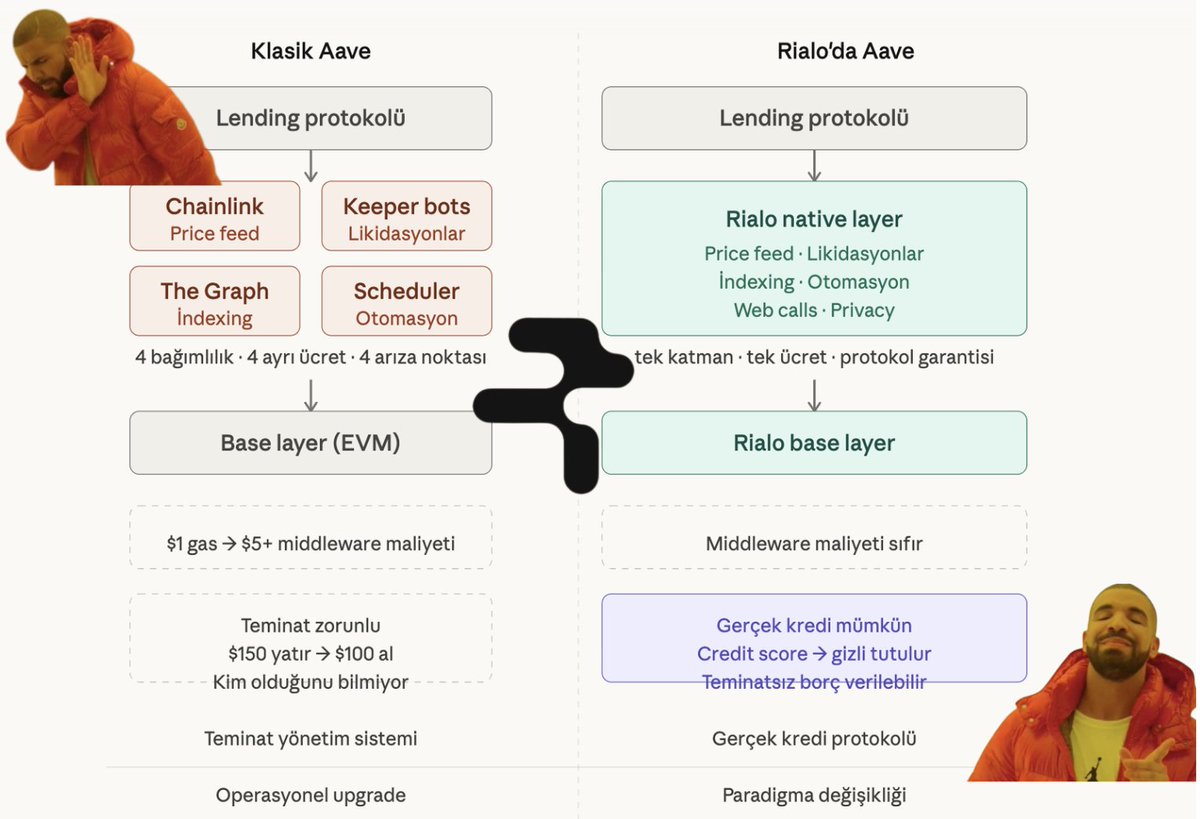
Aave Rialo'da Olsaydı
Aave, DeFi tarihinin en başarılı protokollerinden biri. Milyarlarca dolarlık likidite, yıllarca kesintisiz operasyon. DeFi lending'in bugün nerede durduğunu anlamak istiyorsan, Aave iyi bir başlangıç noktası.
Aynı zamanda nerede takılı kaldığını anlamak için de.
Görünmeyen altyapı
Aave'ye para yatırırken arka planda neler döndüğünü göremezsiniz. Fiyat verileri Chainlink'ten geliyor ayrı bir protokol, ayrı ücret yapısı, ayrı güvenlik varsayımları. Likidasyonları keeper botlar tetikliyor pozisyonları izleyen, teminat oranı düştüğünde devreye giren offchain aktörler. Sorguları hızlı çekebilmek için The Graph kullanıyorlar. Bunların her biri ayrı bir maliyet kalemi, ayrı bir bağımlılık, ayrı bir arıza noktası.
Bu Aave'nin kötü mühendislik yaptığını göstermiyor. Base layer bunları yapamıyordu, middleware ekosistemi boşluğu doldurdu. Sonuç: kullanıcının görmediği, geliştiricinin sürekli ödediği bir altyapı yığını. $1 gas harcayan bir lending protokolü, bunu güvenli ve anlamlı kılmak için $5 veya daha fazlasını bu yığına harcayabiliyor.
Rialo'da Aave: önce aynı protokol, ama çok daha hafif
Aave'yi Rialo'ya taşı, operasyonel tablo köklü biçimde değişir.
Fiyat verileri native. Üçüncü taraf oracle ağı yok, ayrı ücret yok. Protokol doğrudan birincil kaynaklardan çekiyor milisaniye gecikmesiyle, zincir üzerinde doğrulanmış şekilde. Moody's'ten kredi notu güncellemesi, Fed'den faiz kararı bunlar oracle ağının yakalamasını beklemeden anında ulaşıyor.
Likidasyonlar native. Rialo'nun reaktif transaction'ları teminat pozisyonlarını sürekli izliyor ve koşullar oluştuğunda otomatik çalışıyor. Keeper bot yok, offchain monitoring yok, yüksek volatilitede yarışa giren likidatörler yok. Zincir hallediyor.
Otomasyon native. Faiz oranı güncellemeleri, rebalancing, governance aksiyonları bunlar cron job olarak değil, onchain reaktif transaction olarak çalışıyor. Protokolün bir bakım ekibine ihtiyacı yok.
Operasyonel yük düşüyor. Maliyetler düşüyor. Protokol daha güvenilir hale geliyor. Ama asıl ilginç kısım bu değil.
Rialo'da Aave: hiç yapamadığı şey
Aave sana borç veriyor, ama önce borç aldığından fazlasını teminat olarak koymanı istiyor. $150 ETH yatırıyorsun, $100 USDC alıyorsun. Mantık basit çünkü olmak zorunda protokol kim olduğunu bilmiyor. Gelirine, kredi geçmişine, ödeme sicilline bakamıyor. Cüzdanındaki varlıkları görüyor, o kadar. Teminat fazlası, güvensizliğin fiyatı.
Bu tasarım mantıklı. Ama aynı zamanda DeFi lending'in tavanı.
Rialo bu tavanı kaldırıyor.
Native web call'lar ve confidential computation ile Rialo üzerindeki bir lending protokolü, borçlunun kredi skorunu Experian'dan okuyabilir, gelirini payroll API'den doğrulayabilir, ödeme geçmişini banka feed'inden çekebilir bunların hiçbirini onchain yayınlamadan. İşlem shielded execution environment'ın içinde gerçekleşiyor. Kimlik bilgisi bir kez kullanılıyor, sonra siliniyor. Zincire sadece sonuç yazılıyor: onaylandı ya da reddedildi, hangi oranda.
Protokol artık kim olduğunu biliyor. Riski buna göre fiyatlayabiliyor. Teminatsız kredi verebiliyor. Zamanla kredi geçmişi biriktirebilir, güvenilir borçlulara daha düşük oranlar sunabilir.
Bu Aave'nin mevcut modeline küçük bir iyileştirme değil. Farklı bir ürün kategorisi. Aave bir teminat yönetim sistemi. Rialo'da inşa edilecek bir lending protokolü gerçek bir banka olabilir sermayeye değil, güvenilirliğe dayalı kredi veren.
Aave Rialo'da önce hiç istemediği altyapıdan kurtulur. Botlar, oracle'lar, indexer'lar bunlar base layer'ın yapamadıklarının geçici çözümleriydi. Rialo'da protokolün içine gömülür, operasyonel yük onlarla birlikte yok olur.
Sonra gerçekten ilginç şeyler başlar. Protokol gerçek dünyayı görebildiğinde gelir, kredi geçmişi, kimlik aşırı teminat bir zorunluluk olmaktan çıkar, bir seçenek haline gelir. Sistem, güven kazanmış insanlara güven uzatabilir. Her işleyen kredi sistemi böyle çalışır.
DeFi yıllarca kör bir base layer üzerine sofistike finansal altyapı inşa etti. Rialo ona gözler veriyor.
Türkçe
@MerchantTotoro Eline sağlık Merchant, detaylı ve güzel içerik olmuş. gRialo
Türkçe

Arkadaşlar, Rialo Burada Aslında Ne Anlatıyor?
Arkadaşlar, bu paylaşımda Rialo’nun anlatmak istediği şey aslında çok temel ama bir o kadar da kritik, bir sistemin güvenli olması için güvenin tek bir yerde toplanmaması gerekir.
Yani olay sadece iyi şifrelemedeğil, asıl mesele şu o sistemde kontrol kimde eğer kontrol tek bir kişideyse, tek bir anahtardaysa ya da tek bir sunucudaysa, o sistem aslında kırılabilir demektir, Rialo da tam olarak bunu söylüyor ve diyor ki gerçek güvenlik, güveni dağıtmakla başlar.
Tek Nokta Hatası Neden Bu Kadar Tehlikeli?
Arkadaşlar, klasik sistemleri düşünün genelde bir private key vardır ve o anahtar bir yerde tutulur, ya da bir sunucu vardır, her şey onun üzerinden döner.
Şimdi o anahtar çalınırsa ne olur ya da o sunucu ele geçirilirse sistem direkt çöker, çünkü bütün güç tek bir noktadadır.
İşte buna single point of failure deniyor, yani sistemin kırılması için sadece tek bir noktayı kırman yeterli Rialo’nun burada karşı çıktığı şey tam olarak bu yapı.
Çözüm: Gücü Bölmek
Rialo diyor ki, bu sorunu çözmenin yolu çok net, gücü tek bir yerde toplamak yerine birden fazla kişiye dağıtmak.
Yani artık bir işlemi yapmak için tek bir kişi yetmeyecek, sistem diyecek ki bu işlem ancak belirli sayıda kişi birlikte onay verirse gerçekleşir.
Mesela 5 kişilik bir yapı düşünün bu sistemde belki 3 kişi onay vermeden hiçbir işlem gerçekleşemiyor bu durumda ne oluyor bir kişi hacklense bile sistem çalışmıyor, çünkü diğerleri olmadan işlem tamamlanamıyor.
Bu basit gibi görünüyor ama aslında güvenliği kökten değiştiren bir yaklaşım.
Anahtar Artık Tek Bir Yerde Yok
Arkadaşlar işin en kritik noktası burası, normalde bir sistemde bir anahtar vardır ve o anahtar her şeydir ama Rialo diyor ki:
O anahtar hiçbir zaman tek bir yerde var olmamalı.”
Bunun için kullanılan şey Distributed Key Generation yani DKG, bu sistemde anahtar tek bir kişi tarafından oluşturulmuyor, bir grup birlikte oluşturuyor, ama ilginç olan şu:
Hiç kimse o anahtarın tamamını bilmiyor.
Yani ortada bir anahtar var ama kimse tek başına ona sahip değil, bu da şu anlama geliyor, çalınabilecek bir şey yok, çünkü bütün anahtar hiçbir zaman tek bir yerde durmuyor.
Sır Parçalara Bölünüyor
Burada devreye çok önemli bir mantık giriyor, diyelim ki ortada bir sır var bunu alıp parçalara bölüyorsun ve bu parçaları farklı kişilere veriyorsun.
Ama öyle bir sistem ki bu tek başına hiçbir parça işe yaramıyor.
Ancak belirli sayıda parça bir araya gelirse anlamlı hale geliyor, yani sistem hem güvenli hem de gerektiğinde çalışabilir oluyor.
Bu aslında güvenliği matematikle çözmek demek, insanlara güvenmek yerine sistemi öyle kuruyorsun ki, tek başına kimse bir şey yapamasın.
Artık Kimseye Körü Körüne Güven Yok
Arkadaşlar burada iş daha da derinleşiyor, ilk başta herkes dürüst varsayımı yapılabilir ama gerçek dünyada bu geçerli değil.
Rialo da bunu kabul ediyor ve bir adım ileri gidiyor, diyor ki tamam, kimseye güvenmeyelim ama sistemi yine de çalıştırabilelim.
Burada devreye Verifiable Secret Sharing giriyor yani sistem artık sadece parçaları dağıtmıyor, aynı zamanda şunu da kontrol ediyor:
Bu parçalar gerçekten doğru mu?
Eğer biri yanlış veri verirse, sistem bunu fark edebiliyor ve o kişiyi dışlayabiliyor, yani güven artık inanmakla değil, doğrulamakla sağlanıyor.
Güven Artık İnsanlarda Değil, Matematikte
Rialo’nun buradaki en önemli yaklaşımı şu arkadaşlar:
Güven artık bir kişiye, kuruma ya da otoriteye bağlı değil güven, matematiksel kurallara ve kriptografik kanıtlara bağlı.
Yani biri kötü davranırsa sistem bozulmuyor, çünkü sistem zaten buna göre tasarlanmış.
Bu da şu anlama geliyor:
● Kimse tek başına sistemi ele geçiremez
● Kimse gizli şekilde işlem yapamaz
● Her şey doğrulanabilir hale gelir
@RialoHQ
Rialo@RialoHQ
Distributed trust is the cornerstone of robust security. We are diving deep with a 5-part technical series on how threshold systems eliminate single points of failure by requiring a quorum of participants to execute cryptographic operations. The first two modules are now live: 01 | Distributed Key Generation: An analysis of how groups jointly generate shared keys without any participant gaining knowledge of the full secret. This lesson covers Shamir's Secret Sharing, Lagrange interpolation, and honest-world key generation. 02 | Verifiable Secret Sharing: Moving beyond the honest-world assumption. This module explores Feldman’s VSS for share verification and Pedersen’s protocol for achieving DKG without a trusted dealer through complaint-based disqualification. Stay tuned for the remaining three parts of the series. Link below:
Türkçe

I thought I could not reach the leaderboard in the @RialoHQ quiz, but I was wrong.
Finishing in 3rd place taught me something important progress in Web3 comes from learning, not just from being early.
The more I read about Rialo, the more interesting it became, especially how it explores privacy, coordination, and stronger blockchain design.
This result is not the end for me. It is motivation to study more, improve more, and aim for 1st place next time.
Have you started learning about Rialo yet, and what part of it interests you most?

English
English



Subzero Labs published a distributed systems paper in February 2026. Not a blog post. Not a whitepaper. An arxiv paper with peer citations, submitted to an academic venue.
It's called Gauss. A reconfiguration engine that solves a specific and genuinely hard problem: when a blockchain needs to rotate its validator set or swap out its consensus protocol entirely, the system typically stalls. Progress halts, transactions queue up, and the chain waits for the new configuration to stabilize before moving again.
Gauss eliminates that stall. It treats the consensus protocol as an interchangeable module, transitions between epochs without bounding in-flight transactions, and keeps the chain live through the switch. The paper cites HotStuff, Mysticeti, Autobahn, and Sui. @RialoHQ implemented it directly into their own stack.
That distinction matters more than the technical details. Chains that produce original infrastructure research before mainnet are building with a different time horizon than chains that assemble prior work into a product. Whether Gauss performs under real adversarial validator churn is a question only mainnet can answer. But a team doing peer-reviewed distributed systems work in year one is not optimizing for the next airdrop cycle.

English