björn aßmann ∞

160 posts

björn aßmann ∞

björn aßmann ∞

@bjoernassmann

Researcher @DFINITY #tokenomics #governance #ICP

Beigetreten Mayıs 2012
190 Folgt966 Follower
björn aßmann ∞ retweetet

DFINITY Foundation
DFINITY Foundation@dfinity·
A new #Mission70 proposal is live. Join a live X session with @dominic_w where we unpack the proposal and answer your Mission70 questions. 🗓 Wednesday 18 March 🕔 5PM CET / 12PM EDT / 9AM PDT Set a reminder 👇 x.com/i/spaces/1qJVm…
English
47
114
396
29.8K
björn aßmann ∞
björn aßmann ∞@bjoernassmann·
@Adam19016777 Yes. Note: The 8-year bonus applies only to the amount of ICP that was staked while the neuron had an 8-year dissolve delay. In other words, any ICP added after the reduction of dissolve delays goes live will not receive the same bonus.
English
2
0
1
35
Adam
Adam@Adam19016777·
@bjoernassmann If I setup a new staked neuron now with an 8 year dissolve delay, will it get the flag?
English
1
0
0
46
björn aßmann ∞
björn aßmann ∞@bjoernassmann·
#Mission70 Q&A Will a former eight-year neuron have any special benefits? Yes. Neurons that historically set their dissolve delay to the current maximum of eight years are proposed to receive a special “8-year gang” flag. More below 👇
björn aßmann ∞ tweet media
English
4
15
102
5.2K
björn aßmann ∞
björn aßmann ∞@bjoernassmann·
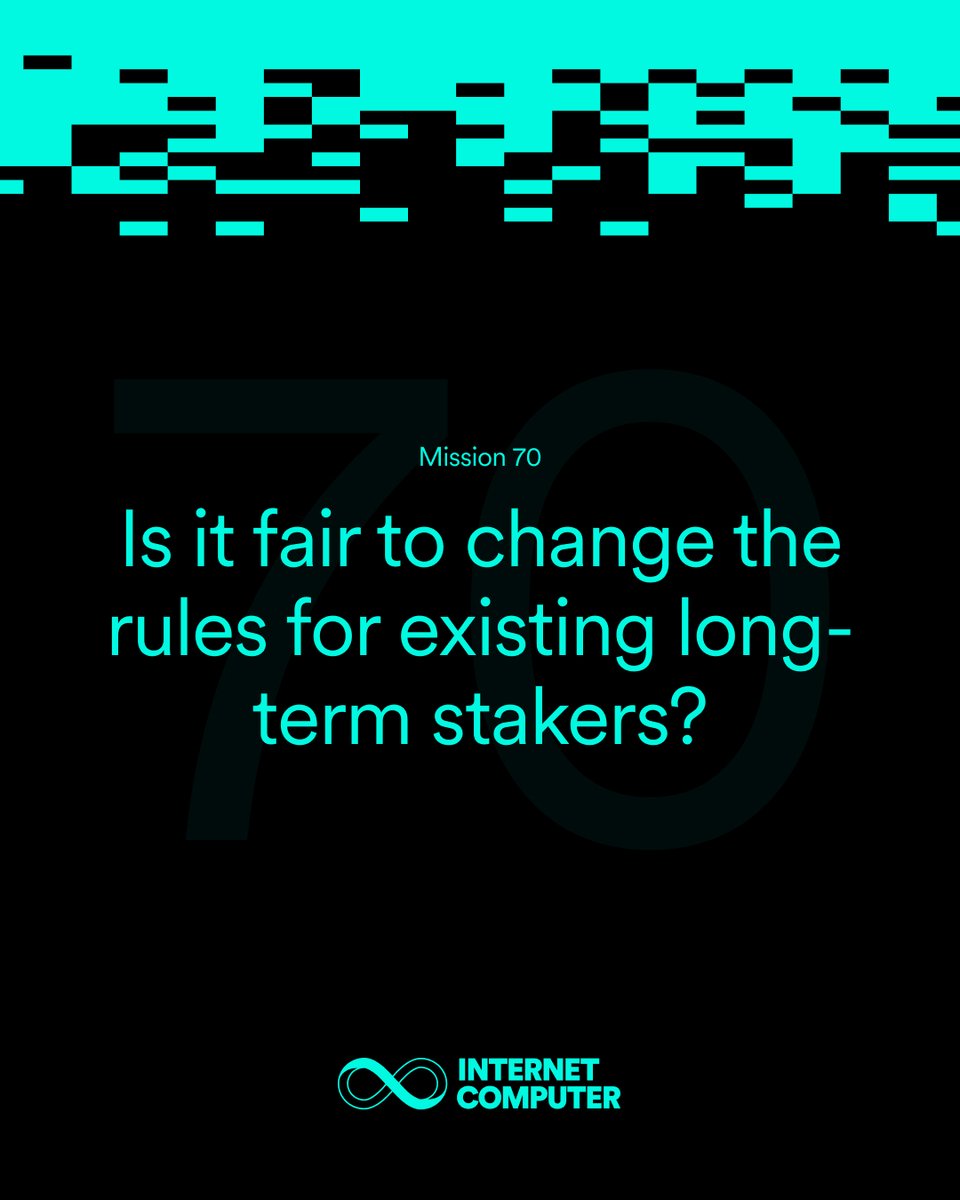
#Mission70 Q&A Is it fair to change the rules for existing long-term stakers? Mission70 explicitly recognizes long-term alignment, for example through the proposed reward boost for former eight-year neurons. The goal is to rebalance the system going forward while recognizing prior long-term commitments.
björn aßmann ∞ tweet media
English
13
9
94
5.2K
björn aßmann ∞
björn aßmann ∞@bjoernassmann·
The flag remains active until the end of 2030. It is only lost if the neuron enters dissolve mode.
English
5
1
14
603
björn aßmann ∞
björn aßmann ∞@bjoernassmann·
Reducing the maximum dissolve delay to two years lowers the reward levels required to incentivize participation. At the same time, it still preserves a meaningful multi-year commitment to governance.
English
1
1
8
388
björn aßmann ∞
björn aßmann ∞@bjoernassmann·
#Mission70 Q&A Why is it suggested to reduce the maximum dissolve delay from eight years to two years? The goal is to recalibrate governance incentives while reducing long-term inflation. More context below 👇
björn aßmann ∞ tweet media
English
10
13
89
4.3K
björn aßmann ∞ retweetet
DFINITY Developers ∞
DFINITY Developers ∞@DFINITYDev·
Internet Computer Global R&D: February 2026 Recap ♾️ The first Global R&D session of 2026 is live, highlighting a month of significant network growth and technical milestones. THE HIGHLIGHTS: 🔹 Hockey Stick Growth: Canister creation surpassed 58,000 in February alone, driven by @caffeineai. 🔹 Signing Performance: Chain Key throughput has increased 10x, with burst capacity now exceeding 100 signatures per second. 🔹 Hardware Privacy: The first all-SEV subnet is live, bringing Trusted Execution Environments (TEEs) to the network. 🔹 ckDOGE is Live: Dogecoin is now on the Internet Computer, offering 10–100x faster and cheaper transactions than native DOGE. 🔹 SNS Treasury Protection: SNS DAOs can now configure custom critical proposal types to enhance asset security. 🔹 Community Demo: @LiquidiumFi demonstrated their cross-chain Bitcoin lending platform powered by Chain Fusion and ckBTC. 📺 Watch the full session here: youtube.com/watch?v=yVDtzQ…
YouTube video
YouTube
English
4
29
117
4K
björn aßmann ∞
björn aßmann ∞@bjoernassmann·
@ICPLEGEND1966 Thanks for raising this. Long-term participation remains central to ICP tokenomics. That’s why #Mission70 proposes a convex reward curve, preserving strong incentives for long-term commitments.
English
1
0
2
32
Absolute Welsh ICP Conviction
Absolute Welsh ICP Conviction@ICPLEGEND1966·
@bjoernassmann do you really think the proposed APY really rewards the long term staking people who participate in the network? They and I don’t think so. Long term stakers should be looked upon, another things reducing it in 2030 is another thing that isn’t acceptable. Please re look on the calculations again.
English
2
0
0
36
björn aßmann ∞
björn aßmann ∞@bjoernassmann·
#Mission70 Q&A What is a convex reward curve and why do we need it? Let’s unpack the idea behind the proposed change to the dissolve-delay bonus 👇
björn aßmann ∞ tweet media
English
6
18
106
4.8K
björn aßmann ∞
björn aßmann ∞@bjoernassmann·
@SlavFx Non-dissolving neurons will keep their current age bonus. Age bonus timelines are orthogonal to dissolve delay. Under the current system, the age bonus increases gradually over four years from 1.0 to a maximum of 1.25.
English
2
0
2
17
Slav.ICP
Slav.ICP@SlavFx·
@bjoernassmann After the changes, will the newly created neurons gain an age bonus from 2 months to 2 years? Will the age bonus reach 1.25x after 2 years?
English
1
0
0
32
björn aßmann ∞
björn aßmann ∞@bjoernassmann·
By contrast, newer Gen-2 SEV-capable nodes provide stronger security guarantees. Reducing rewards for Gen-1 nodes incentivizes a transition toward more secure and efficient infrastructure and supports smaller subnet sizes.
English
1
2
20
3.9K
björn aßmann ∞
björn aßmann ∞@bjoernassmann·
#Mission70 Q&A Why do node reward reductions focus on Gen-1 hardware? Many legacy Gen-1 nodes are underutilized and their hardware is already fully amortized. More context below 👇
björn aßmann ∞ tweet media
English
3
12
72
4.3K
björn aßmann ∞
björn aßmann ∞@bjoernassmann·
With a reduced minimum delay, a linear curve would not sufficiently differentiate between short-term and long-term commitments. A convex curve preserves strong incentives for long-term participation while making shorter commitments possible.
English
2
1
10
361