Shariq

597 posts

Shariq banner
Shariq

Shariq

@code_musings

Building tools for food bloggers 🍳| Repeatable Fitness 👟 | Simple nutrition 🥣 | Web dev & System Automation 🌐 | Teaching software dev 🏫

Beigetreten Mayıs 2011
713 Folgt58 Follower
Shariq
Shariq@code_musings·
@CmlbUs @theryandreyer It just happens over time as you become more efficient. You cant force cadence but you can gradually lean faster.
English
0
0
0
36
Ryan Dreyer 🪓
Ryan Dreyer 🪓@theryandreyer·
Beginner runners - stop reading and do this right now Pull up your last easy run data Check your cadence. If it's below 170 - nothing about your pace matters right now. After coaching 300+ dads I've found 170 spm is the minimum effective cadence to avoid breakdown late in races. Most guys coming from the gym are shuffling at 158-162. You don't need to run faster to fix your form. You need to turn your legs over quicker.
English
5
0
19
1.7K
Shariq
Shariq@code_musings·
@JohnGoldman Well done. Is claude code just using command line libraries to edit?
English
1
0
0
47
Shariq
Shariq@code_musings·
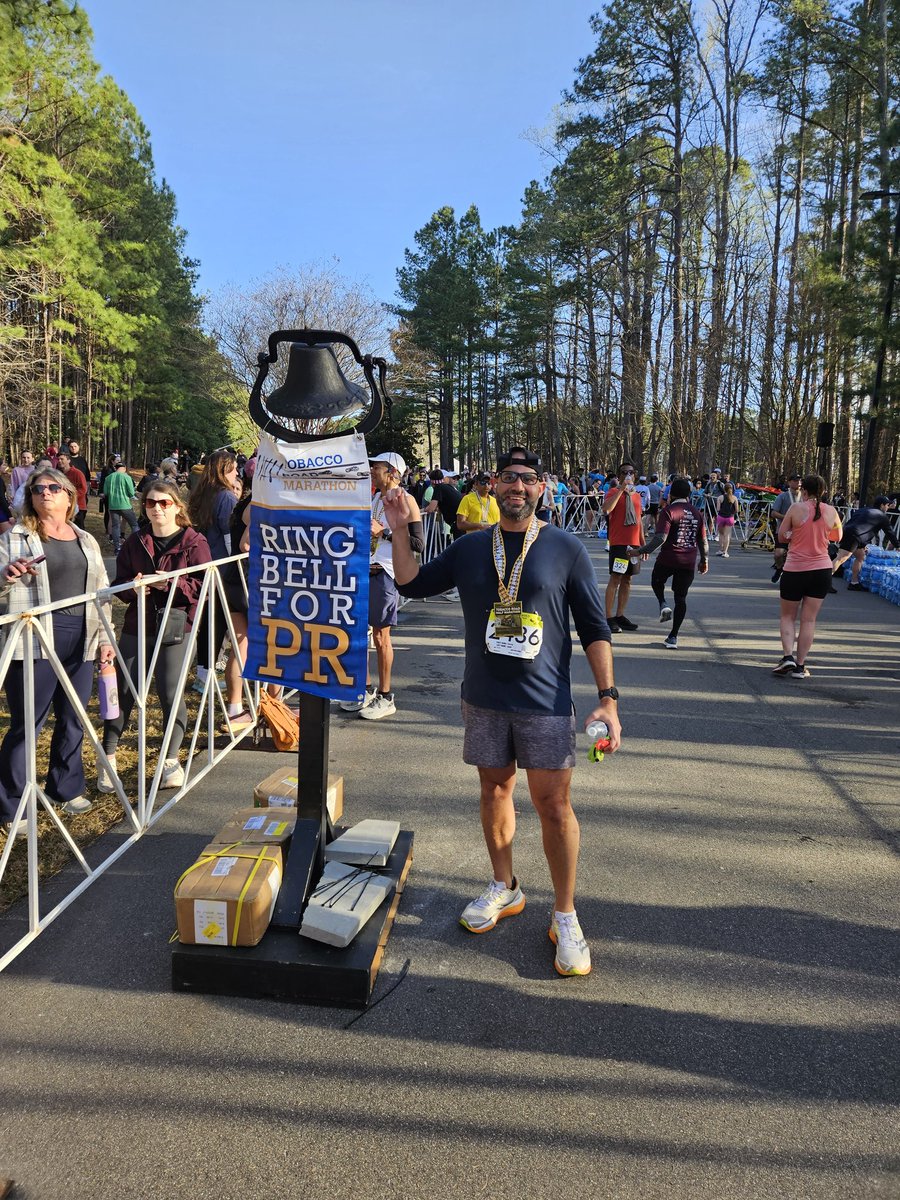
@Gabe_TFB @DavidDack Got the third one today after not pacing my first hm right and going 2:01. Threshold work and race pace sets mixed into long runs got me there. 1:57.
Shariq tweet media
English
0
0
2
65
Gabriel
Gabriel@Gabe_TFB·
@DavidDack How hard is the 3rd if you’re under the first 2?
English
6
0
0
595
David Dack
David Dack@DavidDack·
If you’re thinking about goals for 2026, I’m going to suggest something simple. Sub 30 5K. Sub 60 10K. Sub 2 hour half. Sub 4 hour marathon. Not because the internet will clap. Not because it sounds impressive at dinner. But because those benchmarks usually mean you’ve built a solid engine. Consistent training. Decent strength. Good habits. The kind that carry into the rest of your life. When I chase times like that, I’m not chasing ego. I’m chasing capacity. Heart health. Durability. The ability to keep showing up year after year without falling apart. It’s not about being elite. It’s about being strong enough to age well. Which one of those feels within reach for you right now? #running
English
60
9
293
33.1K
Shariq
Shariq@code_musings·
@hjluks He got 4k likes. There is no stopping now
English
0
0
1
83
Howard Luks MD
Howard Luks MD@hjluks·
All these budding exercise physiologists and strength coaches. 🤦‍♂️🤦‍♂️ This is made up slop. Walk all you want. None of your muscles are working hard when you’re walking and your adductors are firing too. Is walking enough? No. You need strength and power training too. And no. This is not how knee OA arises. Why don’t these guys keep developing apps and posting their incomes in their bio 🤣
Aakash Gupta@aakashgupta

The healthiest habit in America is quietly destroying millions of knees. Walking 15,000+ steps a day builds your heart, your lungs, your endurance. It also loads the same five muscle groups in the same direction, 5.5 million repetitions per year, while the muscles responsible for keeping your knees from collapsing inward barely fire at all. Your body moves in three planes. Sagittal (forward and back), frontal (side to side), and transverse (rotation). Walking is almost entirely sagittal. Quads, hamstrings, glutes, calves: all getting hammered. Your adductors, the five muscles along your inner thigh, work in the frontal plane. They stabilize the pelvis, keep the knees tracking straight, and prevent the femur from drifting into varus alignment under load. During level walking, they activate at a fraction of their capacity. Along for the ride. Run that imbalance for a decade. The outer thigh gets progressively stronger. The inner thigh stays the same or atrophies. The knee joint, caught between two muscle groups pulling in opposite directions, starts absorbing asymmetric force with every single step. Cartilage wears unevenly. The medial compartment takes the hit first. This is how knee osteoarthritis develops. Knee OA now affects roughly 23% of the global adult population. In the US alone, surgeons perform nearly 800,000 total knee replacements per year at $30,000 to $50,000 each. That number is projected to hit 3.5 million annually by 2030. Patients with knee OA show 8 to 24% weaker hip abductor and adductor muscles compared to healthy controls. A longitudinal cohort study found that weaker hip muscles predicted faster OA progression. When the NHL gave players with weak adductors a 6-week strengthening program, injury rates dropped from 3.2 to 0.71 per 1,000 game exposures. 78% reduction from targeting one muscle group. The doctor telling this person’s dad to walk less is treating the symptom. The imbalance is the disease. Copenhagen planks, lateral lunges, side-lying adductions. Fifteen minutes, twice a week. That’s the difference between a $40,000 surgery and a body that can actually handle its own mileage.


English
35
26
519
79.4K
Shariq
Shariq@code_musings·
@ReallyThryve @Alan_Couzens I have felt similarly in the final hot, humid and uphill kilometer of 5ks. It ain't fun and I dont think I had more to give. But I show up every year 😂
English
1
0
1
21
Thryve | Stress & Wellness
Thryve | Stress & Wellness@ReallyThryve·
@code_musings @Alan_Couzens Oh, the central governor theory stuff. Yeah, I don't know. I wouldn't be surprised if there is some truth to it, but using RPE to discuss it doesn't make a lot of sense. If I'm worried I'm going to faint, and throwing up in the bushes, my perceived exertion is at least 9.
English
1
0
1
21
Alan Couzens
Alan Couzens@Alan_Couzens·
A little more on point 2... Go to any major marathon and watch the winners finish. You generally won't see what intuitively looks like a "100% effort". Yeah, they might look a little stiff. They might take a minute or so to get their breath back, but then they'll trot on over to the interviews, business as usual. If you want to see the real carnage, the folks turning themselves inside out in ways that put their health in jeopardy, hang around for an hour or so. Watch the 3-4 hr folks - pushing way past their fitness, way past their training, in disturbing ways. There's a lesson in that. The best know their bodies. They know what they're capable of & they don't push past that. That's a large part of how they become the best.
Alan Couzens@Alan_Couzens

Two things that make marathons unhealthy IMO: 1. Inadequate preparation. 2. Inappropriate pacing (for your fitness). Both are very common, but that doesn't make running a marathon inherently unhealthy.


English
16
10
202
64.8K
Shariq
Shariq@code_musings·
@ReallyThryve @Alan_Couzens I also thought there are studies stating that the average Joe rec runner gets nowhere close to RPE 8+. They just know what they think is the well and the brain/governor slows them ahead of time
English
2
0
2
67
ozzy1980
ozzy1980@JamOz1980·
@Alan_Couzens Ive ran the next day after all 5 of my marathons, so I'll take that as a good sign. Plus I've walked quite far back to the car.
English
1
0
2
1.1K
Shariq
Shariq@code_musings·
@stephsmithio @freeconlon I think the book is necessary. There are a ton of form queues, drill sets and diagrams you'll want to photocopy/take a picture of and print/transcribe.
English
0
0
0
8
Steph Smith
Steph Smith@stephsmithio·
I took swimming lessons growing up but am an objectively bad swimmer. Decided 2026 is the year I become a good swimmer. Specific goal is to be able to calmly swim for 30 mins like running in Z2. Anyone else done something similar? Any tips or resources?
English
51
1
95
23.4K
Shariq
Shariq@code_musings·
@RebuiltPt Thanks, thats what I was asking. Which would you recommend?
English
1
0
0
86
Nick Gornick DPT | RebuiltPT
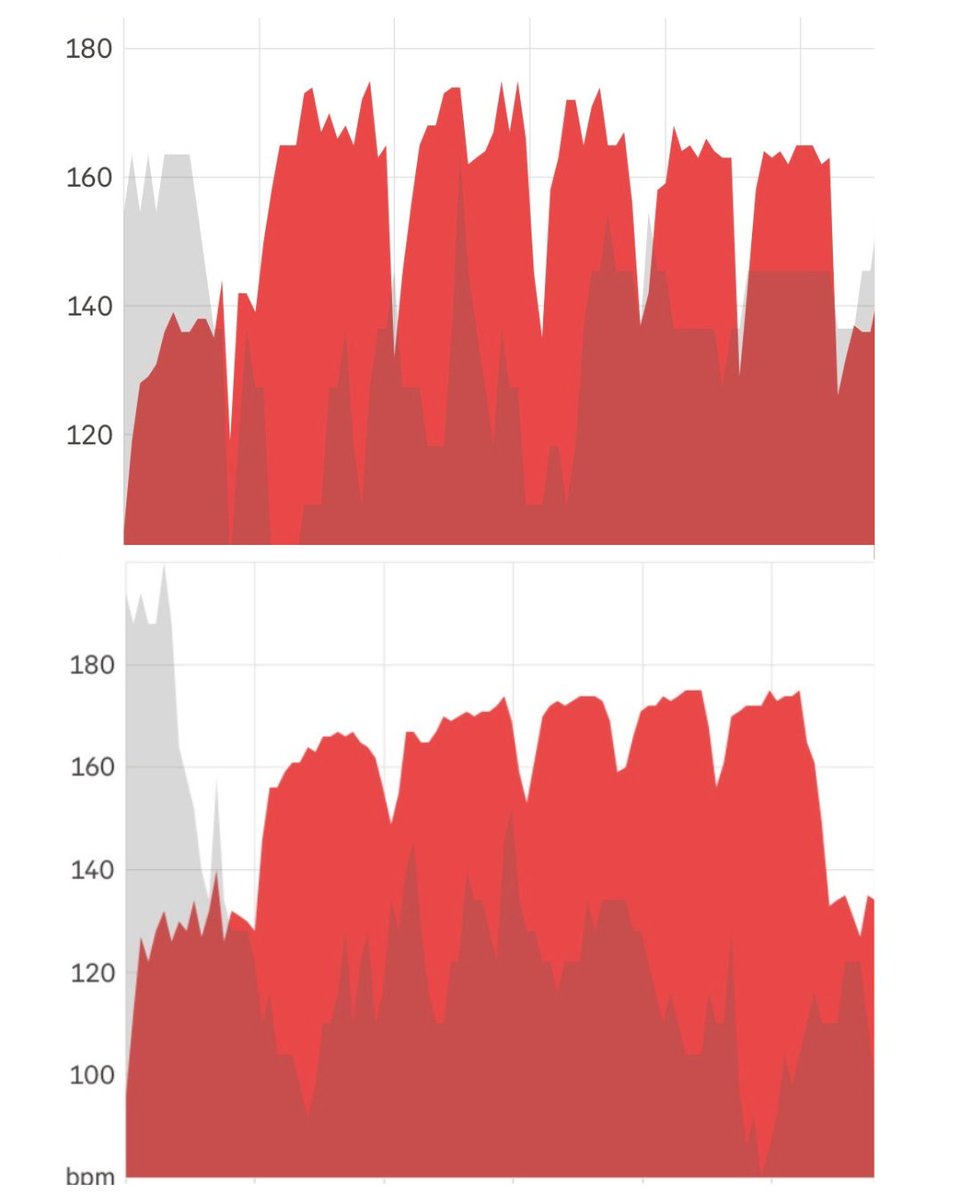
The heart rate data I get from arm straps or chest straps is just so much cleaner than GPS watches. Here are 2 similar workouts. One measured with a watch, and the other with an arm strap. Each interval rep was steady pace, which should show gradual HR changes. The watch (top) gives large fluctuations, changing HR faster than can actually occur during exercise. Measured HR also goes down as workout intensity increases. The bottom graph is smooth, showing realistic HR changes and les noise.
Nick Gornick DPT | RebuiltPT tweet media
English
9
2
53
13.5K
William D. Goodman 🇺🇸 🌵
William D. Goodman 🇺🇸 🌵@WillieDGoodman·
@hjluks I was having significant knee pain during and after running, DX: meniscus tear and chondromalacia patella. I laid off activity for a few months and did PT. Still quite painful during and post-run, bicycle ride or weight session, 1-1/2 years post DX. Very frustrating.
English
3
0
0
1.6K
Howard Luks MD
Howard Luks MD@hjluks·
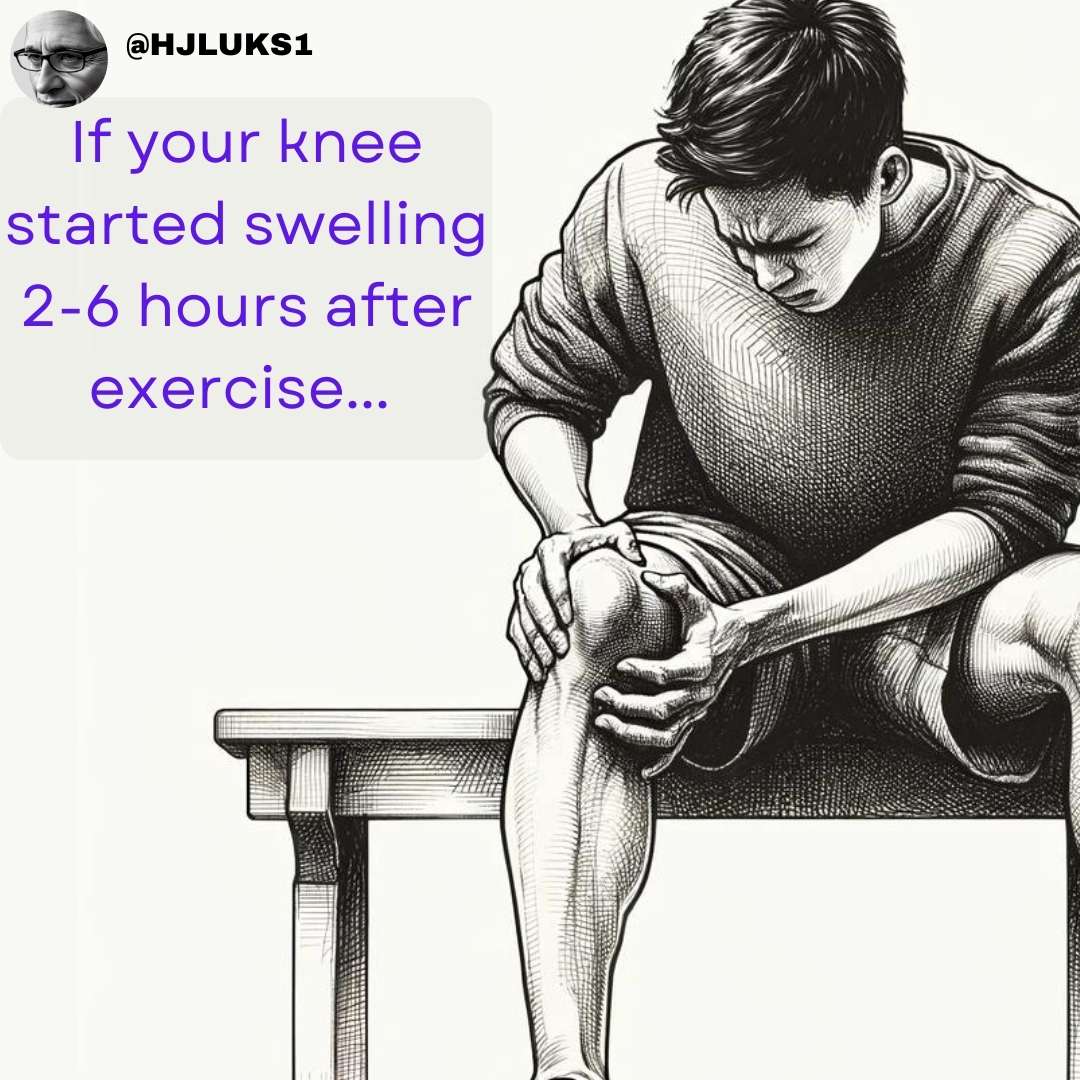
Knee swelling hours after playing a sport, with no recollection of injury. These are very common scenarios... and almost never require surgery... but the swelling will be with you for months.
Howard Luks MD tweet media
English
14
21
236
109K
Nate Stein
Nate Stein@Stein_89·
@foundmyfitness I'd be curious if BFR would be comparable. Easier for elderly to start it as well.
English
1
0
1
290
Dr. Rhonda Patrick
Dr. Rhonda Patrick@foundmyfitness·
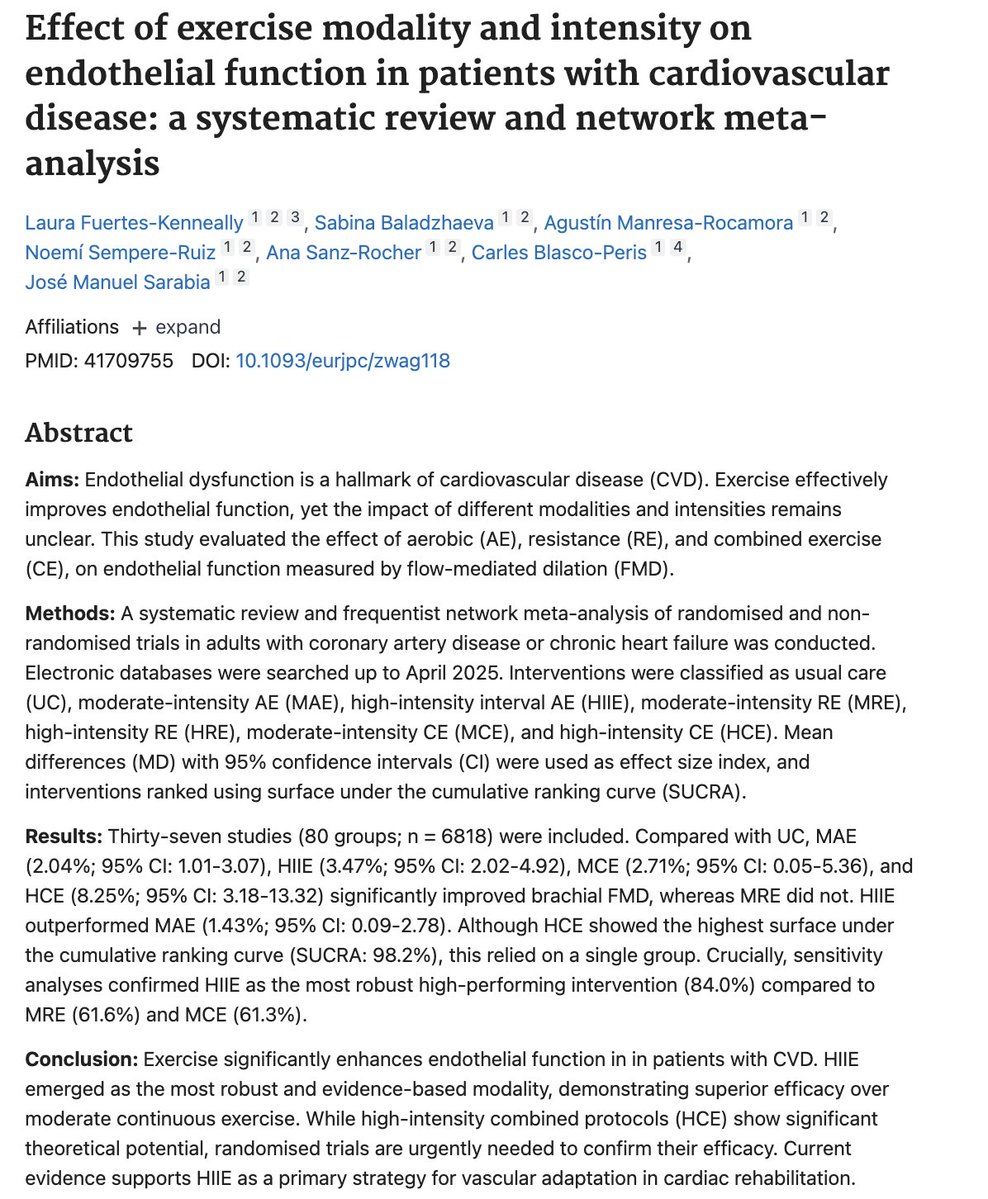
HIIT may be the single most powerful way to improve endothelial function. A recent meta-analysis found that high-intensity interval training improves flow-mediated dilation (FMD)—a key measure of blood-vessel health and a strong predictor of future cardiovascular risk—by about 4%. That’s meaningfully larger than what’s typically seen with moderate-intensity aerobic training, resistance training, or even combined aerobic + resistance, which tend to improve FMD by 2–3%. Mechanistically, this comes down to shear stress, the frictional force of blood flow against the vessel wall. HIIT generates a large, pulsatile shear stimulus (often ~2–4× higher than resting), which appears to be a potent signal for beneficial arterial remodeling. This is one reason vigorous exercise shows such a strong protective effect against cardiovascular disease. It gives a vascular training stimulus that many other modalities simply don’t match.
Dr. Rhonda Patrick tweet media
English
32
118
955
51.8K
Kris Kay | 🎲 444 Capital
Kris Kay | 🎲 444 Capital@thekriskay·
I’ve never met a serious investor that only invests in index funds
English
64
4
106
145.8K
Lee Hooper
Lee Hooper@LeeHooper1·
@ANT_1515 @zachpogrob You don’t need one even if you are going for sub 3, You figure it out over the years.
English
1
0
2
116
Shariq
Shariq@code_musings·
@shaedapk @zachpogrob The coach will tell you to run based on classic training philosophies like pfitzinger, canova, etc. It will scale you up or down depending on inputs. Dont understand what a human would add to it. But maybe I'm a bot.
English
1
0
0
14
c
c@shaedapk·
1. Says who? What data do you have to support this? It seems incredibly silly and naive. 2 This constant classism in the LLM space is so tiring and revealing of people's character I feel. It's entirely expected that a coach-made plan would be more effective than an LLM-made plan: it would cost *significantly* more. Some people cannot afford or perhaps don't even want to hire a full on coach. Not everyone is aiming for some high-level training where everything has to be utter perfection and fully optimised.
English
1
0
6
296
Shariq
Shariq@code_musings·
@ryanAjoyce @GregLehman So I can go back to z3 ten mile long runs that leave me mildly dead. Thx. Earned a follow.
English
1
0
0
26
Ryan Joyce
Ryan Joyce@ryanAjoyce·
@GregLehman I honestly didn’t see that he reposted Howard’s longer post. Completely agree, it’s not supported well at all. Until proven otherwise, many ways to build fitness - similar adaptations occur through all of “aerobic zones” Balance intensity and duration levers and have fun
English
1
0
1
71