Olivier Crottaz CEFA
15.7K posts

Olivier Crottaz CEFA
@crofin67
🟡Uranium 🟡 Gold ⚪Silver 🟠Copper Mining investor / Certified European Financial Analyst / Green Canada Uranium Corp. BM ⛔Do your own DD
Switzerland Beigetreten Mart 2015
400 Folgt6K Follower
Angehefteter Tweet

@RealRickRule I remember that as it was yesterday and always tell this story.
In french we have an expression :
"C'est le cordonnier qui est le plus mal chaussé"
means : The shoemaker is the one who goes barefoot.
English

Olivier Crottaz CEFA retweetet

In 1998, sixteen people nearly took down the global financial system, and you have probably never heard their names.
Long-Term Capital Management ran out of Greenwich, Connecticut, founded by John Meriwether after he left Salomon Brothers under a cloud. He stacked his roster with prestige. Myron Scholes and Robert Merton, two men who would win the Nobel Prize in economics in October 1997 for pricing options, sat on the masthead. David Mullins, former vice chairman of the Federal Reserve, joined too. Picture the brochure. Nobel laureates, a central banker, the smartest bond trader on Wall Street. What could possibly go wrong?
Everything, as it turned out.
The strategy was convergence arbitrage. LTCM found tiny price gaps between similar bonds, bet that the gaps would close, and made pennies. To turn pennies into a fortune you need leverage, and leverage they had. By early 1998 the fund controlled positions of roughly $125 billion on about $4.7 billion of capital. Add the derivatives book and the notional exposure ran past $1.25 trillion. They were levered around 25 to 1 on the balance sheet, and astronomically more once you counted the swaps.
Their models told them this was safe. The math, built on the assumption that markets move in tidy normal distributions, said a catastrophic loss would happen once in several billion years. Reality holds different opinions. In August 1998 Russia defaulted on its ruble debt and devalued. Investors fled to safety everywhere at once. The price gaps LTCM bet would narrow widened instead, all of them, in the same direction, on the same day. Correlations the models had treated as independent snapped together. The fund lost $1.9 billion in a single month and bled toward zero.
Here is the part that should make you angry.
When the fund collapsed, the Federal Reserve Bank of New York, under William McDonough, summoned the heads of the major banks to a conference room on September 23, 1998. Bankers Trust, Goldman Sachs, Merrill Lynch, J.P. Morgan, and the rest were pressed to assemble roughly $3.6 billion to take over LTCM's positions and unwind them slowly. Alan Greenspan's Fed did not write the check directly. It did something arguably worse: it organized the rescue, lending its authority to the proposition that a private hedge fund run by multimillionaires was too important to fail.
Consider what that taught everyone watching. Take wild risk with borrowed money. Keep the gains when you are right. When you are wrong on a scale that threatens the system, the central bank will herd your creditors into a room and arrange a soft landing. Profits stay private. Losses get socialized. The people who built the bomb walk away with their houses in the Hamptons intact.
Free market economists call this moral hazard, and LTCM is the textbook case. Greenspan had already cut rates and flooded markets with liquidity after the 1987 crash. He did it again in the autumn of 1998, three cuts in seven weeks. Each rescue convinced the next generation of traders that the floor was permanent. The dot-com mania followed immediately. Then the housing bubble. Then 2008, which made the LTCM intervention look quaint, a $3.6 billion rounding error compared to the trillions that came later.
The lesson nobody in Washington wanted to learn sat right there in 1998. You cannot price risk honestly when a central authority stands ready to absorb the downside. Scholes and Merton won a Nobel for a formula that assumed away the very tail events that destroyed them. The men who should have lost everything lost almost nothing. You paid, eventually, in inflated dollars and serial bubbles, for a bailout you never voted on.


English
Olivier Crottaz CEFA retweetet

Article Spotlight: Are Energy Markets Tighter Than Investors Realize?
Crude Oil blog.gorozen.com/blog/are-energ…
English

Nice one by @LanceRoberts on margin debt:
"Measured against M2, it’s back near the peaks that preceded the 2000 and 2007 tops. Borrowed money cuts both ways. It is an accelerant, not a cushion."

English

Rick Rule: I’m Buying This Type of Junior Mining Stock (Ignored Value=Op...
youtu.be/nFMkQFSq-Ns?si…

YouTube
English
Olivier Crottaz CEFA retweetet

UBS sees US$100/lb #uranium as the incentive price needed to bring major greenfield projects into production.
English
Olivier Crottaz CEFA retweetet

🔥 Unlocking the Potential of the Ring of Fire 🔥
PTX Metals is focused on advancing exploration in one of Canada’s most prospective mining jurisdictions while building long-term value through discovery and development.
Learn more ⤵️
ptxmetals.com/projects/w2
$PTX.V

English
Olivier Crottaz CEFA retweetet

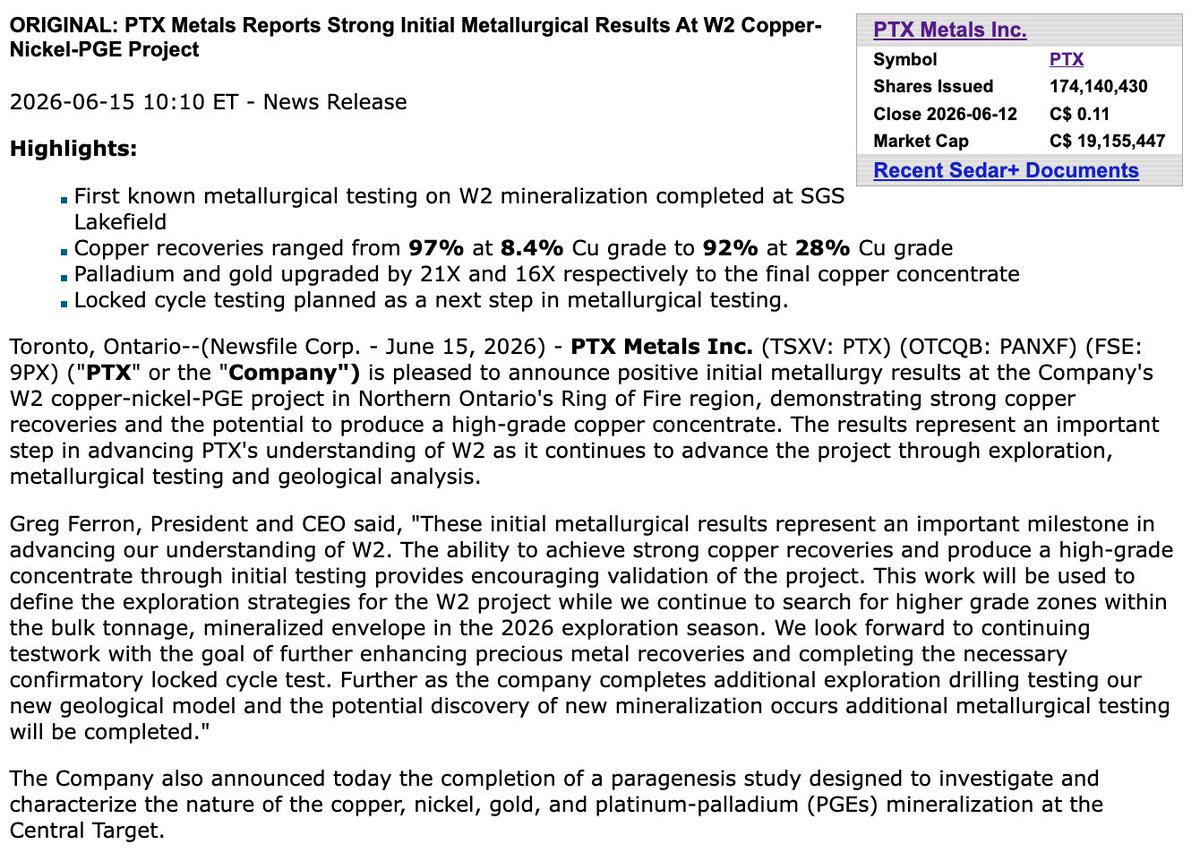
PTX Metals $PTX.v @PTXMetals reports strong metallurgical results. NOT SEXY but very important... #copper recovery of 92-98% is excellent. This is meaningful de-risking news! Look at copper, at US$6.50/lb. PTX is under valued, check it out. #platinum #palladium #nickel #gold

English
Olivier Crottaz CEFA retweetet

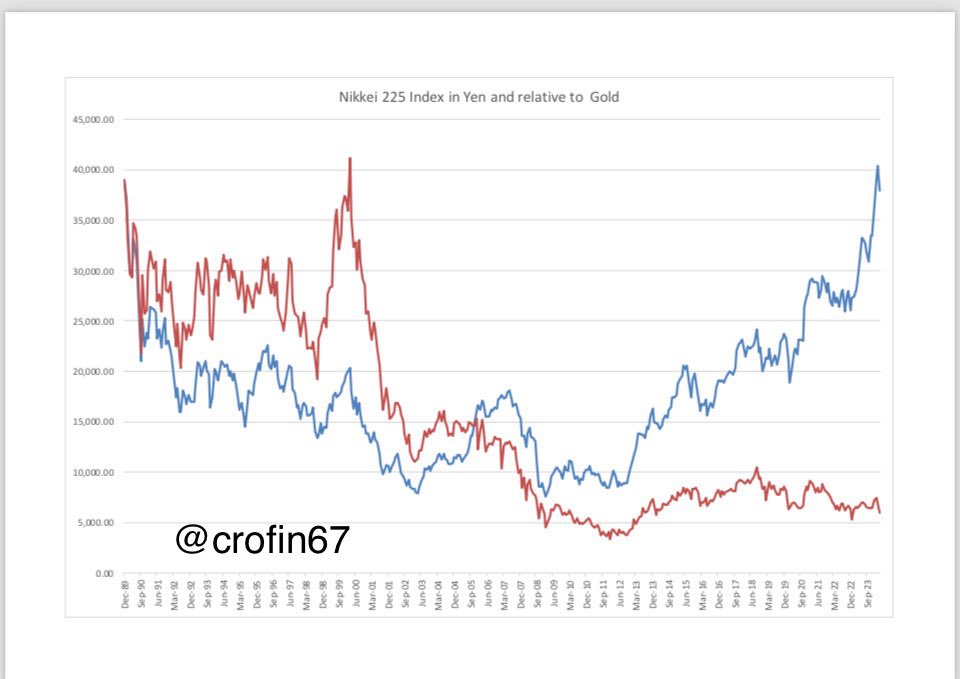
The Yen debasement in one chart
Japan Central Bank decided to buy most of the debt that the state was issuing to prevent the collapse of the entire Japanese system. Of course, something had to give and it was the value (purchasing power) of their currency.
On this chart, you have in blue the Nikkei 225 Index in Yen (nominal terms) and in red relative to the price of gold. Gold made its low in the late 90s on this 34 years period.
In nominal terms, so in depreciated currency, the index has finally matched its preceding all time high of December 1989.
But in gold, it has lost 84.66% of its value…
#yen #gold #japan #nikkei225 #currency #centralbank #CB #purchasing #power

English
Olivier Crottaz CEFA retweetet

It was in May 1999, after nearly two decades of falling gold prices (which had fallen by a factor of three since their 1980 peak), that Gordon Brown, then British Chancellor of the Exchequer, announced the sale of nearly half of the country's gold reserves. The United Kingdom thus sold approximately 400 tons of the yellow metal between 1999 and 2002, at an average price of $275, a far cry from the current price of $4,128.
Our SNB (Swiss National Bank) barely fared better. The clash occurred in the early 2000s, when the constitutional requirement to cover 40% of monetary issues in yellow metal was abandoned. Just as the Federal Council had sworn by the heavens that it had no intention of selling what it called "the people's wealth," the SNB announced one fine morning its intention to partially dispose of it: selling 1,550 tons!
Nicolas Sarkozy, as Minister of the Economy in 2004, initiated a program to sell gold from the Banque de France's reserves, which lasted until 2009. A total of 589 tons of gold were sold during this period, representing about one-fifth of France's reserves at the time (approximately 3,000 tons).
The total amount raised from these sales was €4.67 billion, which corresponds to an average price of approximately $328 per ounce of gold (or approximately $10.5 million per ton), taking into account the average euro/dollar exchange rate for the period (approximately 1.33). At the time, the market price of gold fluctuated between approximately $400 and $1,000 per ounce.
The French Court of Auditors criticized this transaction in 2012, calling it a "bad deal" in light of the subsequent appreciation of the gold price: if these 589 tons had been retained, their value would have reached approximately $25 billion by the end of 2010, more than double the amount received. For comparison, at the current price (approximately $4,165 per ounce on October 14, 2025), these sold reserves would be worth more than $78.9 billion.
@RonStoeferle @wmiddelkoop @pierrejovanovic @goldseek @DonDurrett @GoldTelegraph_ @gold
Olivier Crottaz CEFA@crofin67
European #Central #Banks sold their #gold at low #prices. Just before ignition ! #France #Switzerland #UK #SNB #BOF #BOE thanks #Gordon #Brown #Sarkozy ! good play ! SNB 1300 tons sold, BOE 400 tons and France 600 tons
English
Olivier Crottaz CEFA retweetet

German Currency relative to Gold (1900- 2026)
German currency disappeared twice and for the third time the chart is showing the total collapse versus gold
Update may 26 #euro #gold #deutschmark #germany #currencies

English
Olivier Crottaz CEFA retweetet