
Lance Roberts

61.8K posts

Lance Roberts banner
Lance Roberts

Lance Roberts

@LanceRoberts

Chief Strategist https://t.co/pIhX6wyW68, Host: RealInvestment Show, Editor https://t.co/wmWaTk1TpO, PM for https://t.co/lf8aFSFI6i Newsletter Signup: https://t.co/qxJrsTVRHR

Houston, Texas Katılım Haziran 2009
1.4K Takip Edilen103.3K Takipçiler
Sabitlenmiş Tweet
Lance Roberts
Lance Roberts@LanceRoberts·
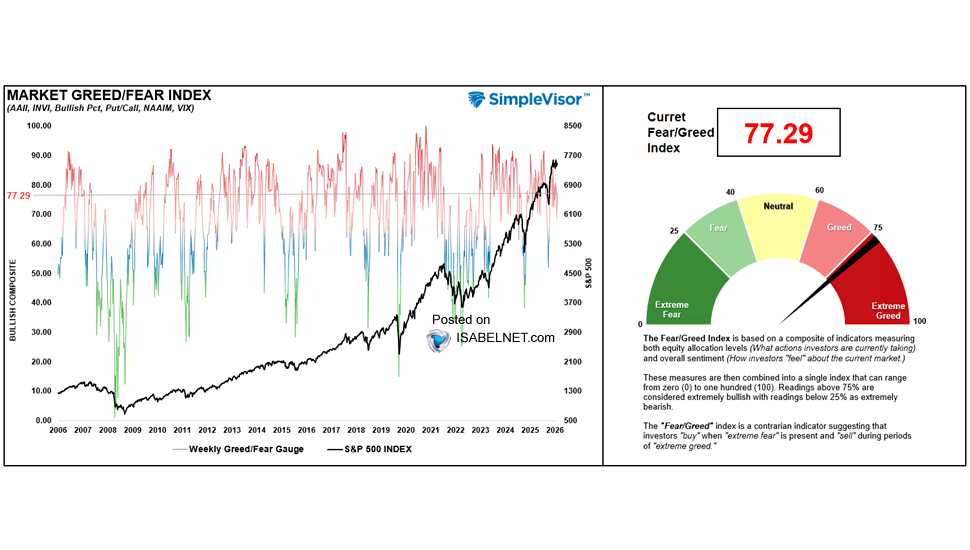
Bull Bear Report: Week Of May 22, 2026 Lot's of market action this week, Warsh takes control of the Fed, and the biggest question I got is "Should I Buy The SpaceX IPO?" We cover all of that this week along with all the usual market statics, trading data, and positioning risks. open.substack.com/pub/lancerober…
Lance Roberts tweet media
English
0
4
24
3.3K
Lance Roberts
Lance Roberts@LanceRoberts·
In this past weekend's #BullBearReport we discussed whether your should buy the SpaceX IPO. There was a great chart over the weekend shows that even the most epic IPOs had pullbacks before they went higher.
Lance Roberts tweet media
English
4
14
76
5.6K
Lance Roberts
Lance Roberts@LanceRoberts·
Circular financing has been going on for decades. If you finance a car you are participating in circular financing. So, yes, that part is true. However, the article is mostly hyperbolic and taking a small part of the overall revenue streams to extreme. Also, yes, when I invest in private companies, I adjust the value of the companies on my balance sheet, as they appreciate in value (ie capital gains.) Why wouldn't I? My portfolio of stocks also adjusts for capital gains, as well. That was not really a very good argument IMO.
English
0
0
1
17
D. Mill
D. Mill@D_Mill_5·
@BullTheoryio @LanceRoberts Lance, I trust your knowledge and opinion. Is this actually what is happening? Does it place the AI boom in jeopardy? Also, I’m a @SimpleVisor subscriber. Love it!
English
1
0
1
19
Bull Theory
Bull Theory@BullTheoryio·
🚨 THE ENTIRE AI BOOM MIGHT BE BUILT ON FAKE REVENUE. Latest corporate filings show that OpenAI and Anthropic alone make up over half of the entire $2 trillion future cloud backlog held by Microsoft, Oracle, Google, and Amazon. This massive pipeline is actually being created through a circular accounting trick called a round trip revenue loop. But how it works ? A tech giant gives billions of dollars to an AI startup as an "investment". But hidden in the contract is a strict rule forcing the startup to hand that exact same money straight back to the tech giant to rent their computer servers. Look at the documented case of Microsoft and OpenAI. When Microsoft invested $13 billion into OpenAI, it didn't just give them cash; it gave them "cloud credits" to use Microsoft servers. OpenAI used those exact credits to train its AI models, and Microsoft then turned around and recorded that server usage as brand new "cloud revenue" from a customer. The tech giant is literally paying itself with its own money and calling it a sale. This is why OpenAI’s annual cloud bill has ballooned to over $60 billion, double its actual revenue of $25 billion, kept alive solely by this recycled funding loop. Anthropic runs the exact same play, spending $2.66 billion on Amazon Web Services in just nine months, which was basically 100% of all the money it earned at the time. This manufactured demand triggers a second accounting trick where tech giants book massive paper profits. Every time a startup gets a higher value from a new funding round, the tech giant updates the value of its investment on its books and counts that unearned paper gain as direct profit. In Q1 2026, Alphabet reported a record $62.6 billion profit, but $28.7 billion nearly half, was just a paper markup on its Anthropic investment. In the same quarter, Amazon reported $30.3 billion in profit, but $16.8 billion of it was just an Anthropic paper gain. While Amazon reported record profits, its actual free cash flow collapsed 95% to just $1.2 billion because it had to spend $44.2 billion in real cash to build physical data centers. This has created a massive danger where these giant companies rely heavily on just one or two unstable startups. Microsoft has 49% of its $627 billion future backlog tied to OpenAI, while Oracle has an incredible 54% of its entire $553 billion pipeline relying on OpenAI alone. This perfectly mirrors the 2001 dot-com crash when Global Crossing and Qwest Communications swapped identical fiber-optic network capacity with each other just to book fake sales. Qwest had to erase $1.4 billion in fake income, and Global Crossing went completely bankrupt. The only difference is that the dot-com swaps were illegal, but today's AI loop is fully legal under current accounting rules. This legal loop inflates tech company stock prices, forcing automatic retirement accounts and index funds to buy even more of these tech stocks. It is a self feeding loop where investments, sales, and stock prices all go up on paper without the AI technology ever making real cash profits.
Bull Theory tweet mediaBull Theory tweet mediaBull Theory tweet mediaBull Theory tweet media
English
676
2.3K
9K
2.7M
Lance Roberts
Lance Roberts@LanceRoberts·
History suggests parabolic advances rarely end quietly. Hedge Fund Telemetry's @TommyThornton joins me to break down the growing signs of a speculative bubble forming beneath the surface of the market on a special interview edition of #TheRealInvestmentShow, streaming-live at 6am CT on YouTube, Meta, LinkedIn, & X: youtube.com/live/s5pdp2zHl…
YouTube video
YouTube
Lance Roberts tweet media
English
0
2
34
5.6K
Lance Roberts
Lance Roberts@LanceRoberts·
5-22-26 The Real Case For The AI Boom: The Math Is Starting To Add Up There is a lot of talk about the AI boom, but the real bull case may come down to simple economic math. $AMZN, $GOOGL, $META and $MSFT are projected to spend roughly $700 billion on AI data centers in 2026 alone. Most people focus only on chips and companies like $NVDA, but the spending goes far beyond semiconductors. These firms are building massive physical infrastructure projects: power systems, utilities, fiber optics, networking equipment, construction, cooling systems, roads, warehouses and more. Entire local economies start forming around these data centers. Some studies estimate every $1 spent on AI infrastructure could generate roughly $4 in broader economic activity through multiplier effects. That means $700 billion in spending could potentially translate into nearly $2.8 trillion of economic growth in a $30 trillion economy. That’s why the AI story may be much bigger than just a stock market narrative. It’s becoming a productivity, infrastructure, labor and GDP growth story similar to past transformational cycles like railroads or the internet. There will still be hype cycles, overinvestment and volatility along the way. But the underlying economic impact of AI infrastructure spending is becoming harder to ignore. If you like this video, please ❤️like and 🔁retweet
English
5
23
119
10K
Lance Roberts
Lance Roberts@LanceRoberts·
@docfiscal Correct, but this is why there is a significant gap between UofM and CB measures.
English
2
0
3
999
Lance Roberts
Lance Roberts@LanceRoberts·
I have been seeing a lot of comments lately about the break between UofM Sentiment and economic data. See quoted tweet below. There is also a big gap between UofM and CB measures. I am writing a full discussion on this but one of the interesting points is that there is a large political bias to the UofMs measure that is impacting its reading. (Worth noting that since the Iran crisis started, all affiliations are getting weaker = inflation).
Lance Roberts tweet media
Philip Pilkington@philippilk

GDP is growing at a healthy 2.7% in the US. GDP statistics in the US are clearly completely broken and no longer make any sense whatsoever. 🇺🇸

English
4
6
50
11.3K
Lance Roberts
Lance Roberts@LanceRoberts·
If you didn't read this weekend's #BullBearReport (link below) we go through the SpaceX IPO and discuss the question of "Should I Buy It?" on IPO day. This chart followed publication but supports the warning that there is a decent amount of exits waiting in the wings and indexes will provide the liquidity. realinvestmentadvice.com/resources/blog…
Lance Roberts tweet media
English
1
6
39
5K
J. Anderson
J. Anderson@jamesmktmaster·
@TaviCosta An ounce of gold bought a tailored suit in 1920 and still does today. The dollar's purchasing power tells the opposite story. When policymakers choose devaluation, real assets and capital-protective jurisdictions are the only rational response.
English
2
1
3
428
Otavio (Tavi) Costa
Otavio (Tavi) Costa@TaviCosta·
This remains one of the most important charts of the next few years ahead. Do not underestimate the power of long-term decline in the dollar. Ignore the near term moves in the counter direction, in the big picture the US dollar is at a critical juncture and US policymakers have no option but to devalue the currency. The implications out of this move will be profound. tavicosta.substack.com/p/favorite-mac…
Otavio (Tavi) Costa tweet media
English
58
244
1.1K
71.3K
Lance Roberts retweetledi
Lance Roberts
Lance Roberts@LanceRoberts·
5-21-26 The Consumer Crack Everyone Feared May Be Starting Rising gas prices may finally be starting to crack the consumer. Walmart’s $WMT earnings weren’t terrible overall. Revenue came in slightly better than expected and the stock reaction was fairly muted. But the real focus was management lowering guidance and pointing directly to higher fuel costs impacting both the company and its customers. That matters because Walmart serves the lower and middle-income consumer. If shoppers are becoming more frugal there, it’s an important signal for the broader economy. The were several warning signs already building beneath the surface: – Rising credit card delinquencies – Increasing default rates – Student loan repayment pressure – Savings rates near record lows – Consumers trading down and cutting discretionary spending This is where the idea of “demand destruction” starts to matter. High #crudeoil and gasoline prices are initially inflationary, but if they stay elevated long enough, they eventually slow economic activity by squeezing consumers. People spend more at the pump and less everywhere else. That slowdown can ultimately become disinflationary as weaker demand pressures commodity prices lower over time. Right now, markets still seem to believe the pressure is temporary. But if oil stays above $100 and gas remains near $5 for an extended period, the impact on spending, growth, and consumer health could become much more significant. #Walmart may be giving one of the first real warnings that the process has already started. If you like this video, please ❤️like and 🔁retweet
English
5
13
77
8.8K
JTheretohelp1
JTheretohelp1@JTheretohelp1·
@LanceRoberts Lance, it might be safe to say that Ai CapEx "IS" the economy at this point. Left out, GDP would probably have already contracted into negative territory.
English
1
1
2
76
Lance Roberts
Lance Roberts@LanceRoberts·
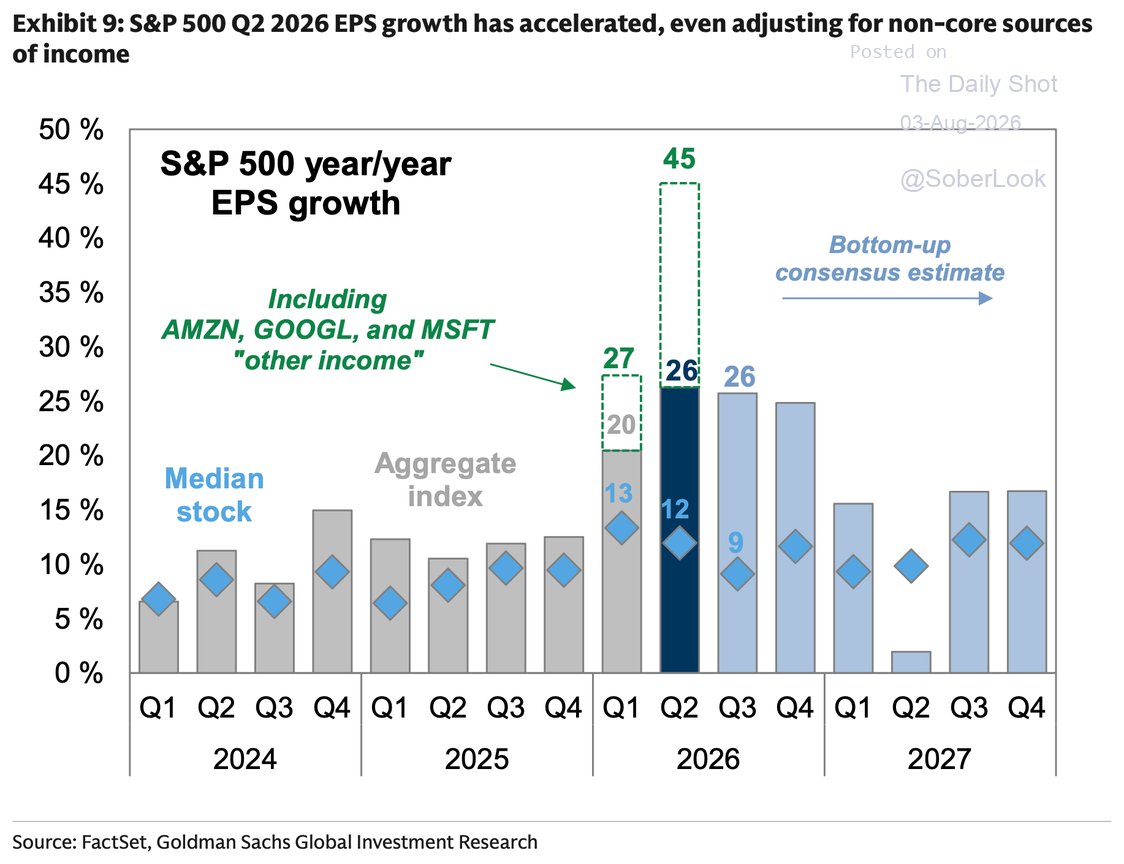
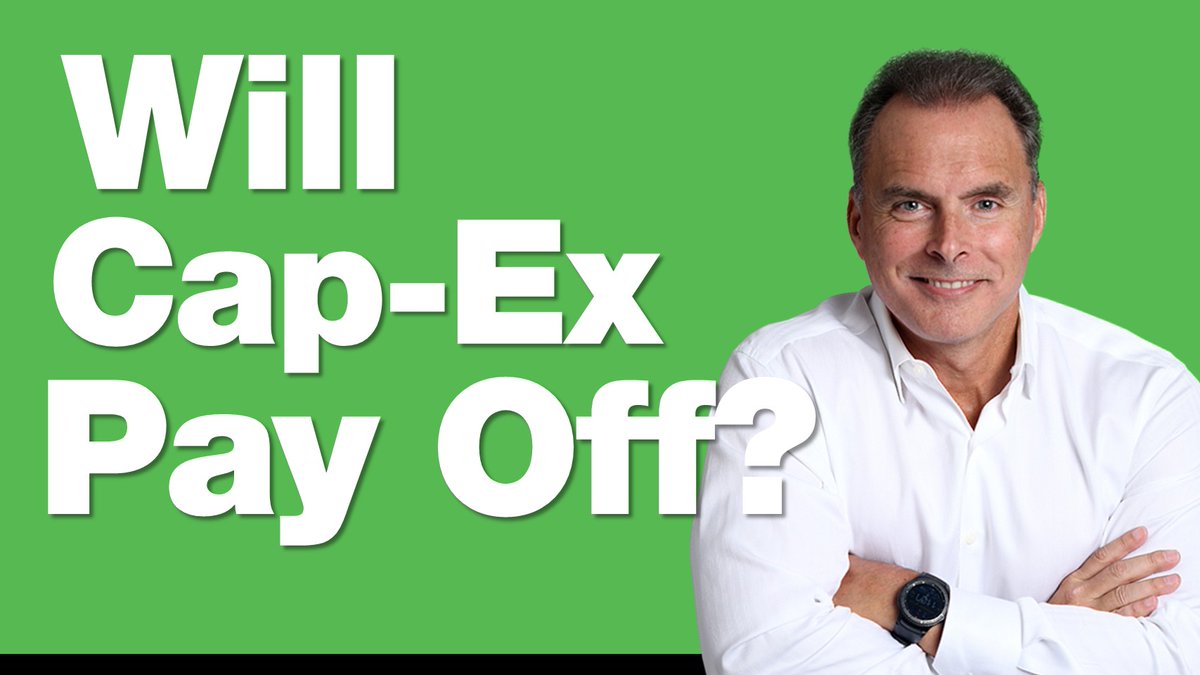
US forward EPS continues to push higher as estimates are lifted. We normally see this type of acceleration following a recession, but now it is a function of the transmission of CapEx into the real economy.
Lance Roberts tweet media
English
1
6
36
3.4K
Lance Roberts
Lance Roberts@LanceRoberts·
There are about to be two things with SpaceX IPO that you should be aware of if you plan on buying it. 1) IPOs are selling you shares at the highest possible premium that market will bear. 2) There are a lot of people that will be using the IPO to exit their holdings. This doesn't mean you should never buy the stock, but it does suggest that you might want to be patient and wait for the liquidations to end before jumping in.
Lance Roberts tweet media
English
11
9
60
5.7K
Lance Roberts
Lance Roberts@LanceRoberts·
Goldman’s Risk Appetite Indicator rose to the 99th percentile since 1991.
Lance Roberts tweet media
English
0
21
76
12.7K
Lance Roberts
Lance Roberts@LanceRoberts·
The three-month correlation between energy and the S&P 500 has reached its most negative level on record. Typically, the demand destruction from high oil prices eventually catches up with earnings and expectations. The question is whether this time is different?
Lance Roberts tweet media
English
9
20
83
5.4K
Lance Roberts
Lance Roberts@LanceRoberts·
The @AtlantaFed GDPNow index is tracking economic growth for Q2 at a stunning 4.3% annualized growth rate.
Lance Roberts tweet media
English
2
5
33
2.7K
Lance Roberts
Lance Roberts@LanceRoberts·
Job hopping is no longer paying off.
Lance Roberts tweet media
English
1
5
50
3.1K