Andrew

676 posts

Andrew banner
Andrew

Andrew

@dremnik

founder, designer, and engineer | part-time token dealer

SF Beigetreten Ekim 2025
256 Folgt211 Follower
Andrew
Andrew@dremnik·
@amix3k arguably a generally intelligent agent like claude with a special skill (i.e. a prompt) is sufficient for 95% of use cases
English
0
0
0
5
Amir Salihefendić
What matters here isn’t the chat interface, but that SaaS apps are adding specialized agents. That may also point to where SaaS is heading. Attio, for example, is no longer just offering a CRM interface. It’s also building a CRM agent that is far more optimized for CRM workflows than a general-purpose agent like Claude or ChatGPT. We’re doing something similar with Todoist Automations. We have a dedicated Automations Creator agent with a harness that makes it highly effective at creating and updating automations. 🤔 The real battle isn’t SaaS vs. agents, but general-purpose vs. specialized agents.
Rabi Shanker Guha@rabi_guha

notice something? Linear, PostHog, Attio - all shipped the same thing in the last few weeks. Homepage is a chat bar - not a dashboard. This is the SaaS industry quietly admitting that traditional UI doesn't work anymore. Every user is different. One homepage can't serve them all. The playbook is shifting: → expose your core APIs → connect an agentic layer → let users use software the way they want SaaS became chat. Chat will become Generative UI - the agent won't just reply in text, it will compose the interface itself. We're closer than people think.

English
13
1
62
18.3K
Andrew
Andrew@dremnik·
it seems like the sentiment around YC is increasingly negative. are they losing their status?
English
0
0
0
15
Andrew
Andrew@dremnik·
@Appyg99 or a natural response to the realization that UIs are disappearing and the chat interface is actually the most effective way to realize a user's goals
English
0
0
0
45
Andrew
Andrew@dremnik·
someone’s gotta build the gist for agents - md idea files instant shareable with clean API
Andrej Karpathy@karpathy

Wow, this tweet went very viral! I wanted share a possibly slightly improved version of the tweet in an "idea file". The idea of the idea file is that in this era of LLM agents, there is less of a point/need of sharing the specific code/app, you just share the idea, then the other person's agent customizes & builds it for your specific needs. So here's the idea in a gist format: gist.github.com/karpathy/442a6… You can give this to your agent and it can build you your own LLM wiki and guide you on how to use it etc. It's intentionally kept a little bit abstract/vague because there are so many directions to take this in. And ofc, people can adjust the idea or contribute their own in the Discussion which is cool.


English
0
0
2
36
Andrew
Andrew@dremnik·
the way people are approaching this atm is sort of a horseless carriage. they want to take a bunch of ephemeral slack messages + other conversations and transform them into 'useful facts' without the broader context of the company ontology. it is really not that hard once you design your ontology and system of artifacts correctly. i personally haven't felt a need for this memory thing that people are talking about at all, once i designed my filesystem correctly and SOPs for mutating it: x.com/dremnik/status…
English
0
0
0
58
sysls
sysls@systematicls·
On memory harnesses for agents: 1. I remain unconvinced that the best “single-agent” memory harnesses will be external to the foundation model providers. Genuinely believe that both claude and codex will iterate heavily on this. Memory gives personality and is therefore too strategically important to out-source. The memory systems that survive will have to offer more than a single-agent solution. 2. As it stands today - the best memory harnesses are the ones with the best models doing inference. Virtually all “good” memory harnesses are doing a combination of retrieval + inference on retrieved facts to answer queries. A lot of the performance in the benchmarking of “good” memory systems is a direct result of the inference. Obviously the prompts and workflow matters too; but it is undoubtedly the case that much of the "problems" of semantic reasoning is being solved by the inference of a smart model. This paradigm is essentially “memory as an agent” and derives performance and resolves contradictions from the underlying intelligence of the model doing the inference. Suffice to say, you want the smartest model doing this. 3. Virtually all memory systems have settled on “consolidation” or “dreaming” as a core mechanism. It’s basically a process to correct contradictions in your facts and consolidate memory into hierarchical layers. -- If you're looking for a memory harness to implement and don't want to wait around for codex/claude to "solve memory", I've really come to like what Honcho is doing and you should check them out. They have an open-sourced repository that lets you plug and play any model for inference. It should go far enough for 99% of use-cases, but if you really want a hands-off solution... Their managed solution comes with a specialized, fine-tuned model. I think it gives them a huge edge because - specialized models beat generalized models at specific tasks and inference on facts to answer queries accurately and to be helpful is such an example of a specialized task.
English
8
11
130
22K
andrew chen
andrew chen@andrewchen·
question being asked across every B2B vertical: Will incumbents incorporate AI faster than startups can disrupt their industries with AI? do the tools sold to incumbents win, or the full-stack players seeking to replace the existing players?
English
87
10
121
14.6K
Andrew
Andrew@dremnik·
@karpathy @garrytan i’ve been doing something similar, which motivated the idea of a compiler for markdown to do things like validate links and generate indexes / outlines at the top of files automatically for fast nav: github.com/dremnik/kdb
English
0
0
7
1K
Andrej Karpathy
Andrej Karpathy@karpathy·
LLM Knowledge Bases Something I'm finding very useful recently: using LLMs to build personal knowledge bases for various topics of research interest. In this way, a large fraction of my recent token throughput is going less into manipulating code, and more into manipulating knowledge (stored as markdown and images). The latest LLMs are quite good at it. So: Data ingest: I index source documents (articles, papers, repos, datasets, images, etc.) into a raw/ directory, then I use an LLM to incrementally "compile" a wiki, which is just a collection of .md files in a directory structure. The wiki includes summaries of all the data in raw/, backlinks, and then it categorizes data into concepts, writes articles for them, and links them all. To convert web articles into .md files I like to use the Obsidian Web Clipper extension, and then I also use a hotkey to download all the related images to local so that my LLM can easily reference them. IDE: I use Obsidian as the IDE "frontend" where I can view the raw data, the the compiled wiki, and the derived visualizations. Important to note that the LLM writes and maintains all of the data of the wiki, I rarely touch it directly. I've played with a few Obsidian plugins to render and view data in other ways (e.g. Marp for slides). Q&A: Where things get interesting is that once your wiki is big enough (e.g. mine on some recent research is ~100 articles and ~400K words), you can ask your LLM agent all kinds of complex questions against the wiki, and it will go off, research the answers, etc. I thought I had to reach for fancy RAG, but the LLM has been pretty good about auto-maintaining index files and brief summaries of all the documents and it reads all the important related data fairly easily at this ~small scale. Output: Instead of getting answers in text/terminal, I like to have it render markdown files for me, or slide shows (Marp format), or matplotlib images, all of which I then view again in Obsidian. You can imagine many other visual output formats depending on the query. Often, I end up "filing" the outputs back into the wiki to enhance it for further queries. So my own explorations and queries always "add up" in the knowledge base. Linting: I've run some LLM "health checks" over the wiki to e.g. find inconsistent data, impute missing data (with web searchers), find interesting connections for new article candidates, etc., to incrementally clean up the wiki and enhance its overall data integrity. The LLMs are quite good at suggesting further questions to ask and look into. Extra tools: I find myself developing additional tools to process the data, e.g. I vibe coded a small and naive search engine over the wiki, which I both use directly (in a web ui), but more often I want to hand it off to an LLM via CLI as a tool for larger queries. Further explorations: As the repo grows, the natural desire is to also think about synthetic data generation + finetuning to have your LLM "know" the data in its weights instead of just context windows. TLDR: raw data from a given number of sources is collected, then compiled by an LLM into a .md wiki, then operated on by various CLIs by the LLM to do Q&A and to incrementally enhance the wiki, and all of it viewable in Obsidian. You rarely ever write or edit the wiki manually, it's the domain of the LLM. I think there is room here for an incredible new product instead of a hacky collection of scripts.
English
2.1K
4.7K
42.1K
11.6M
Andrew
Andrew@dremnik·
@koylanai you're not missing anything, some people just haven't caught up with the full significance of what this technology actually is. you have to understand what a neural network is before you can really grasp it. learning to code is like learning mental math after calculators
English
0
0
0
30
Muratcan Koylan
Muratcan Koylan@koylanai·
Listening to lectures from Stanford, MIT, etc., on a treadmill motivates me more than playing techno but I still don't understand why people say “spend time on learning these human-written coding languages,” when there is a new, alien technology that replicates the human brain, improves every hour, and can be trained by you on literally anything. The best thing would be to learn the depth of that technology because it could be used to learn and build anything on your behalf, no? The more you understand, the better you can guide; but the more you understand AI, the more and better context you provide to your agents; like you don't need to learn all the details of a language by reading books, you can turn those books into a context system or training data because most human-written languages will be extinct soon anyway. What am I missing?
Daniel Jeffries@Dan_Jeffries1

Unpopular take: You should learn more programming. Take more courses. Watch more videos. Practice by hand. Read books. Yes, freaking books. Even if, and especially if, you are using AI to do most of the work. Do it in between instead of scrolling f*ing TikTok. Do it at the gym on the bike. Do it at night. Do it whenever. Focus on things you can't do well manually yet. Study other languages like Zig and Rust. Get really good at React and Typescript and other things you use all the time in your projects (whatever they are, these are just examples). Study the various libraries and the choices those developers made. The more you understand, the more you can guide the AI. And you will make stronger architectural decisions and spot security issues and bad coding practices that you can overrule as you shepherd your AI sprites.


English
10
1
27
2.7K
kache
kache@yacineMTB·
ONLY HOT DADS IN TECH CAN REPLY TO THIS POST. YOU ARE NOT ALLOWED TO REPLY IF YOU AREN"T A HOT DAD IN TECH.
English
572
5
812
93K
Andrew
Andrew@dremnik·
@krispuckett natural selection will naturally favor leaner organizations with less friction from the control center to the edges where execution happens. there are too many misaligned / rent-seeking incentives along a long chain of intermediaries for it to survive against shorter chains
English
0
0
0
57
Kris Puckett
Kris Puckett@krispuckett·
It’s a bit funny. This essay misses the relational element of creating with others. 2000 words and zero thoughts about trust, relationships, humanity, and soul. I know I’m in constant danger as a middle manager. If all I’m doing is passing info back and forth, I don’t belong at that place. It’s the idea de jour that middle management should die. But great middle managers can create and shape culture, trust, speed, and safety. Maybe my role should die, maybe it will. AI can route information better than managers. It can. The question is whether the things that make teams actually work, trust, safety, someone willing to fight for your growth, can be modeled well and with a human touch. Jack wrote 2,000 words about how organizations work and never once mentioned why people do their best work. It’s never an information problem, it’s a human one.
jack@jack

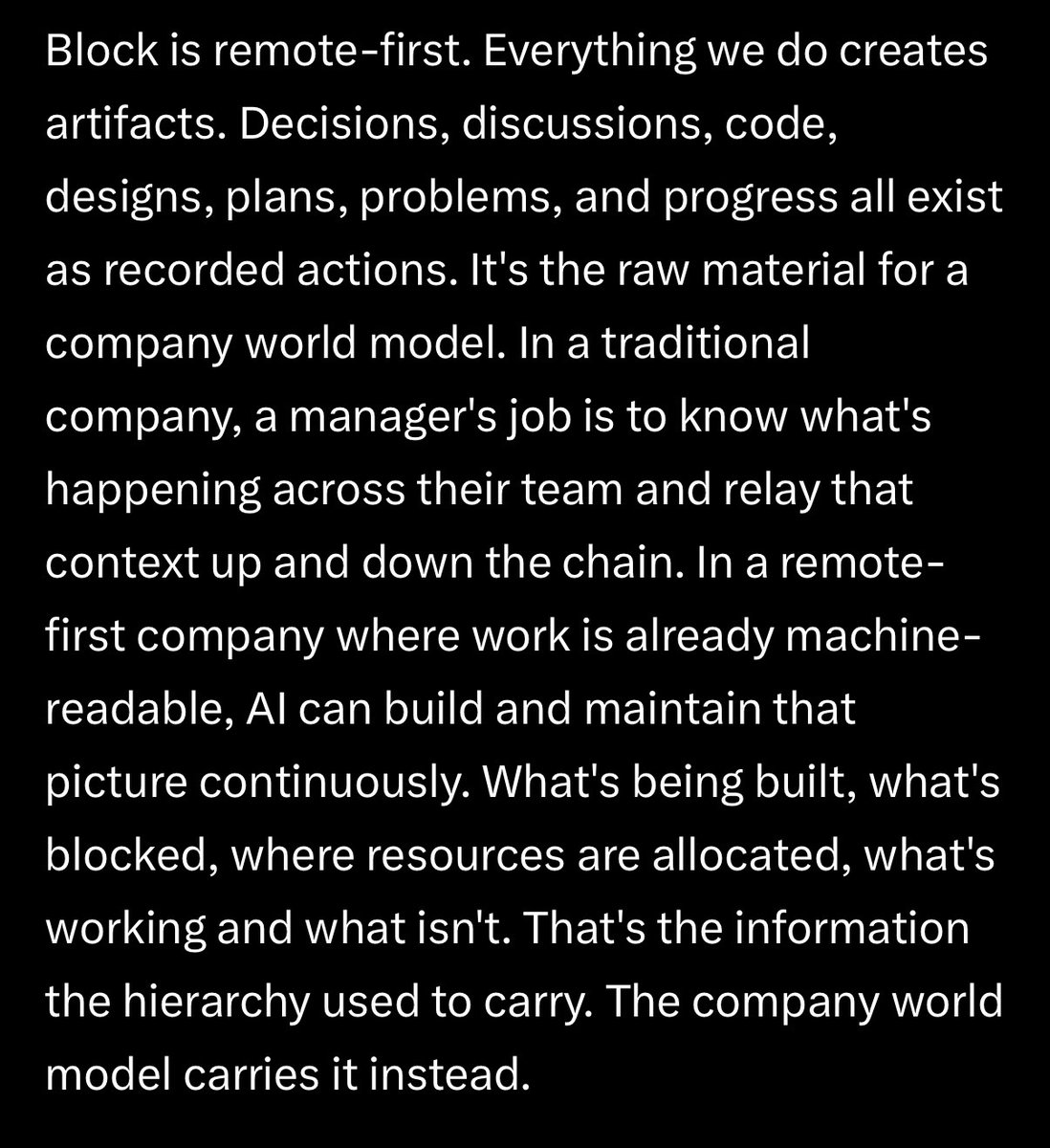
x.com/i/article/2038…

English
52
18
284
56.1K
Andrew
Andrew@dremnik·
@BrianHatano @jack if a company was always unpredictable it would be impossible to do business with them. the opposite is closer to the truth: companies succeed according to the degree to which they _are_ predictable, i.e. they fulfill their promises and make good on their word
English
1
0
2
30
Brian Hatano
Brian Hatano@BrianHatano·
@dremnik @jack A company cannot be autonomous and still be a company. Autonomous machines are predictable. Companies succeed by being unpredictable in their dealings with unpredictable society.
English
1
0
1
47
Andrew
Andrew@dremnik·
@thenanyu the codifier’s curse, the prisoner’s dilemma of collective obsolescence
English
0
0
1
101
Andrew
Andrew@dremnik·
@beffjezos the funny thing is the afterglow of these effects are usually temporary. BJ will be going back on all this in a few months more than likely
English
0
0
0
212
Beff (e/acc)
Beff (e/acc)@beffjezos·
VC's adding an anti-one-shotting clause to term sheets is insanely based. Investors are betting on your will to power, you shouldn't be risking ego death. No psychedelics until IPO. Too many late stage founders get absolutely cooked by these drugs and lose their drive.
The All-In Podcast@theallinpod

🚨INTERVIEW: Bryan Johnson just took the world's biggest dose of psychedelics... here are his reactions 48 hours later. @friedberg sits down with @bryan_johnson (0:00) Friedberg intros Bryan Johnson (0:54) Why Bryan Johnson did 5-MeO-DMT (12:56) What brain scans actually show (18:36) Psychosis, bad trips, and life-altering decisions (26:23) The next frontier: organoids and gene therapy (33:26) GLP-1s, abundance, and human optimization (35:35) The longevity drug nobody's talking about? -------------------------------------- Thanks to our partner for making this happen! The Pod by @eightsleep cools your bed to 55°F and uses Autopilot to optimize your sleep, all night. Use code ALLIN at eightsleep.com/allin for up to $350 off.

English
11
8
100
17.5K
Andrew
Andrew@dremnik·
i don't understand this debate at all. the comparison is entirely wrong. it makes no sense to rebuild something like slack in house, but it also makes no sense to pay 220k / year for it. the obvious evolution here is that slack gets replaced by a smaller company that doesn't have to charge 220k / year you don't want to have to deal with in house maintenance on every tool you use, but the cost of software is plummeting anyways
Christoph Janz 🕊@chrija

This is a great report on the state of software and AI by @Redpoint - thank you, @loganbartlett! Where I disagree is the build vs. buy slide: 1) I'm not sure if it takes ~12 engineers to build/maintain a Slack clone for 1 customer. As AI keeps getting better at not only code gen but all software engineering tasks I think you'll be able to do it with a smaller team. Doesn't mean you should spend engineering time on it because I expect... 2) ... there will be agencies who specialize in this kind of work (e.g. build a Slack clone and sell customized versions of it). 3) ... there will be lots of cheap, (more or less) good enough Slack clones 4) ... there will be AI-native startups that rethink the category. All of these factors, I think, will contribute to pricing pressure for Slack and other traditional SaaS companies ... which they will only be able to defend against if they get a share of the agentic revenue enabled by their products.

English
0
0
3
210
Andrew
Andrew@dremnik·
@ishansheth_ @varunram the question for me is whether their structural economics can allow it? supposing an agent-native team builds the same with far less capex, how will they compete?
English
1
0
0
13
Varunram Ganesh
Varunram Ganesh@varunram·
Will Linear become Notion first or will Notion become Linear first?
Varunram Ganesh tweet media
English
35
0
145
14.2K
Andrew
Andrew@dremnik·
there are 2 things that would enhance my life tremendously: - a programmable bank - private AI to sort through the transactions accounting is a machine task.
English
1
0
2
92
Soren Larson
Soren Larson@hypersoren·
@juliarturc 🤌👋👋 Agree. My sense is the (or much of) west coast tech is without ideas for abundance, grinding off an antiquated set of business models while telling incoherent stories of AGI There are a few tho who get it
English
1
0
14
815
Julia Turc
Julia Turc@juliarturc·
Why so many of us feel career-homeless in tech: >Startups full of fraud, grifters and short-term thinking >FAANG full of politics and slightly behind >Frontier labs in a race with no morals >Academia full of title collectors >Content creation ridden by AI fakes and sensationalism Who is starting the renaissance and how do I get in touch with them?
English
300
264
4.1K
203.6K