Maikel

859 posts

Maikel banner
Maikel

Maikel

@mkl85

Swingtrader 🎯 • Student of the market 🤓 • Building equity curves 🥇 • I write about trading concepts 🤿

Netherlands Beigetreten Mayıs 2010
252 Folgt408 Follower
Angehefteter Tweet
Maikel
Maikel@mkl85·
After a few weeks of collaborating with Kyna, the story is now published. We talk about: -How and why I started trading -Why my competitiveness is both my trading power and my trading weakness. -How to overcome your trading demons. Enjoy the read and I would love to hear about your trading demons and how you're facing them!
Kyna Kosling@KynaKosling

Every trader’s journey is unique, but often contains similar key ‘junctions’: ✅ The catalyst that kicks off your journey ✅ Those early signs you’re on a worthwhile pursuit ✅ The need for experimentation and setbacks, followed by that reality check ✅ The commitment to the long haul, prioritising skill development over immediate reward ✅ The moment ‘common wisdom’ goes from sounding cliché to clicking… ✅ …often going hand in hand with making THE tweak — the small change with the dramatic impact That dramatic change might be digging deep into the maths of your trading, like @KaiHamill4, who then realised his biggest problem: selling too early. He then made the strategy changes that let his ideal (low) win rate and risk–reward play out, going from breakeven to profitable. Or it might be addressing a trading demon, like @mkl85’s competitiveness making him unable to accept defeat. But by keeping and analysing his journal, then keeping an ‘injecting logic statement’ beneath his monitor, he was able to identify and kill that demon. Both swing traders share their stories and methods behind their breakthroughs on TTRH this Saturday, 30 August. I’ll then zoom out, and talk more about those key moments on most traders’ journey: *** The Key Moments in a Trader’s Journey Different paths, same junctions 🔗 tinyurl.com/3pbvbt3k

English
2
1
14
3.1K
Maikel
Maikel@mkl85·
This is like playing a videogame and wanting to be able to buy all the cool stuff in game. Then entering a cheatcode giving you everything. The game gets lame immediately. I dont see the world get a better place when work is optional and everything can be optained instantly. Would probably mess up our brain's reward system on the go. Flow state occurs when challenge meets skill. This AI world feels filled with humans that have no incentives to develop skill and face challenges. Just like in the videogame it feels like heaven to have everything at the press of a button. But once you actually have it, you realized it destroyed the game.
Elon Musk@elonmusk

Actually, AI/Robotics will mean everyone can have a penthouse if they want. The output of goods & services will be several orders of magnitude higher than today’s economy. Read the Iain Banks Culture books for the best imagining of how it will be. That said, what is the future you want? Amazing abundance seems the best to me.

English
1
0
1
87
Ameet Rai
Ameet Rai@AmeetRai·
I'm not much of a nibbler putting on 1/8th sizes just to keep busy. Feelers and nibblers and small tiny positions to me all point to lack of system and not knowing when conditions are likely ripe for a trend reversal. A highly systemized system doesn't need busy work like that.
English
10
6
179
8.3K
Maikel
Maikel@mkl85·
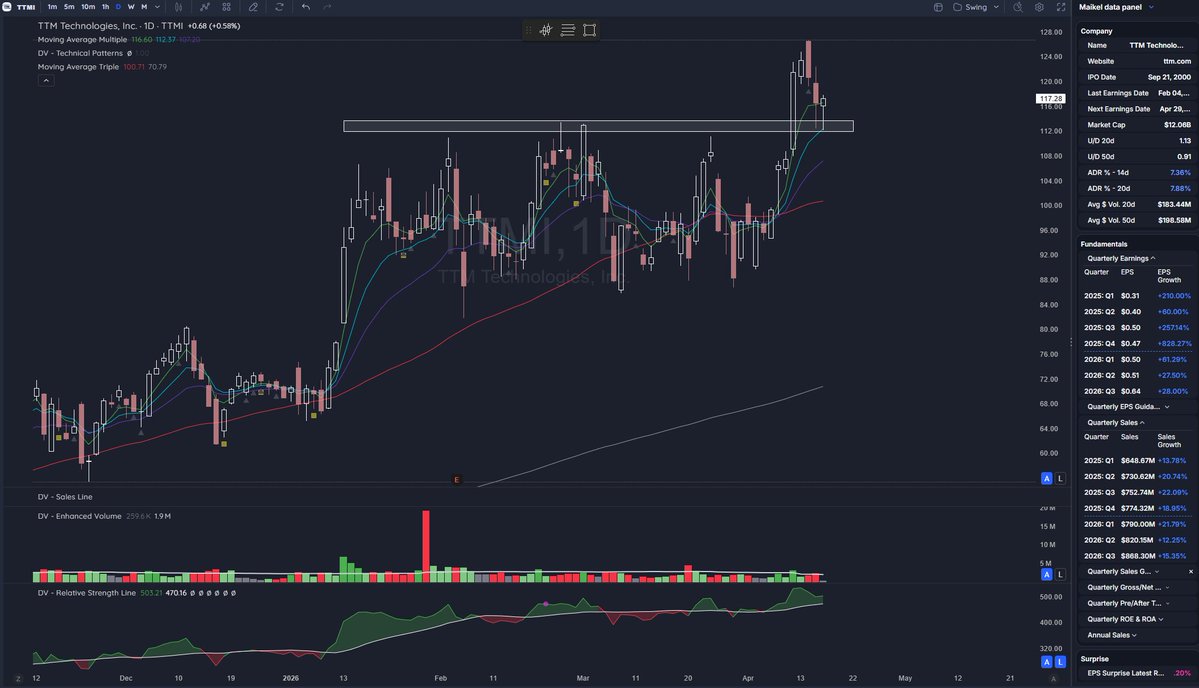
$TTMI - Re-test after breakout of 3 month base and rising 10 EMA. RS phase and rising RS MA. Solid earnings & sales growth. Looks like it wants to go higher. Chart by @Deepvue.
Maikel tweet media
English
0
0
0
85
Maikel
Maikel@mkl85·
@PKycek Assuming a passive investing strategy only buys the top is not really fair. DCA is the standard, which means you buy both tops and bottoms.
English
2
0
1
274
Pavel | Robuxio
Pavel | Robuxio@PKycek·
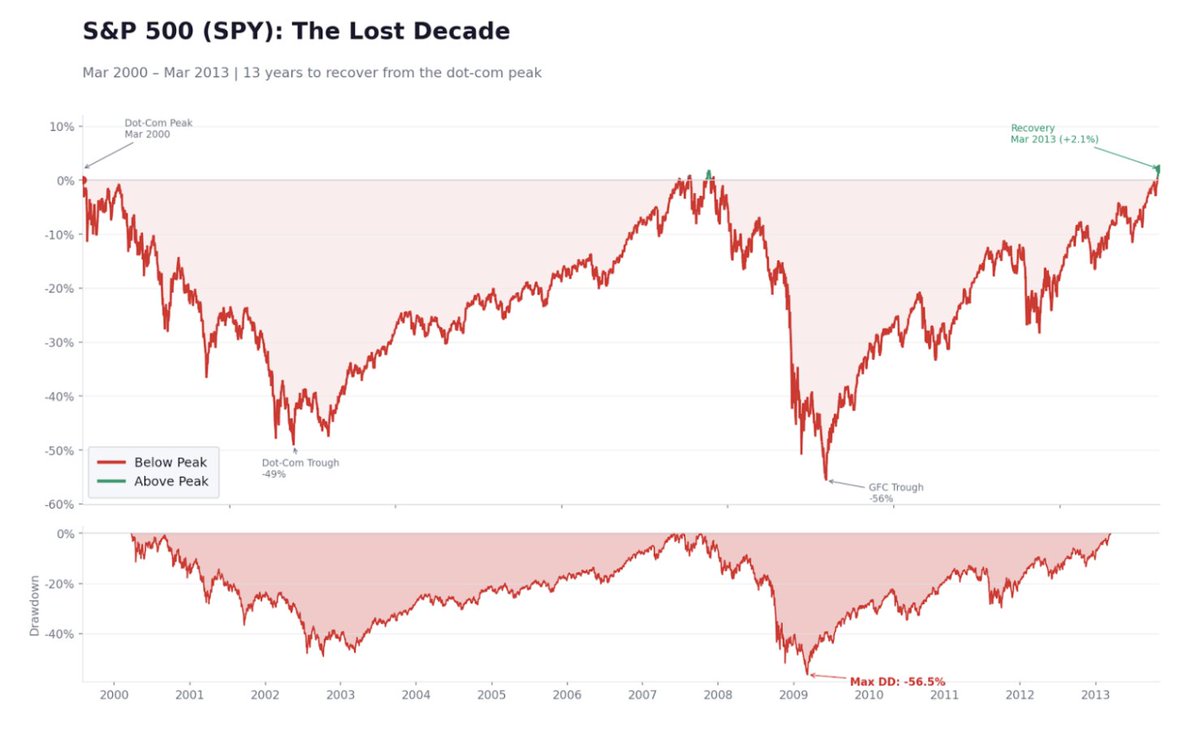
13 years. That is how long passive S&P 500 allocators who entered at the March 2000 peak waited to see positive returns. The S&P 500 fell 49% over 31 months and took seven years to recover. Just when allocators thought they were in the clear, the 08' financial crisis hit immediately, causing another 57% drawdown, another five years and five months to breakeven. That's 13 years of zero nominal returns, for a strategy marketed to long-term investors as the "gold standard". The problem is that a market-cap-weighted index has no mechanism to reduce exposure, adapt positioning, or access independent return sources. You have full participation in both upside and downside. Recovery entirely dependent on the duration of the next bull cycle. At current valuations and elevated concentration in the S&P500 a major drawdown is not a question of if, but when. The alternative is an architecture designed to do what passive exposure simply cannot, composed out of multiple uncorrelated systematic return driving strategy sleeves. Each strategy sleeve profits from different market regimes, increasing overall compounded returns and reducing both the depth and recovery time of drawdowns. Exposure architecture has a significant impact on long-term returns.
Pavel | Robuxio tweet media
English
9
17
51
9.3K
Maikel
Maikel@mkl85·
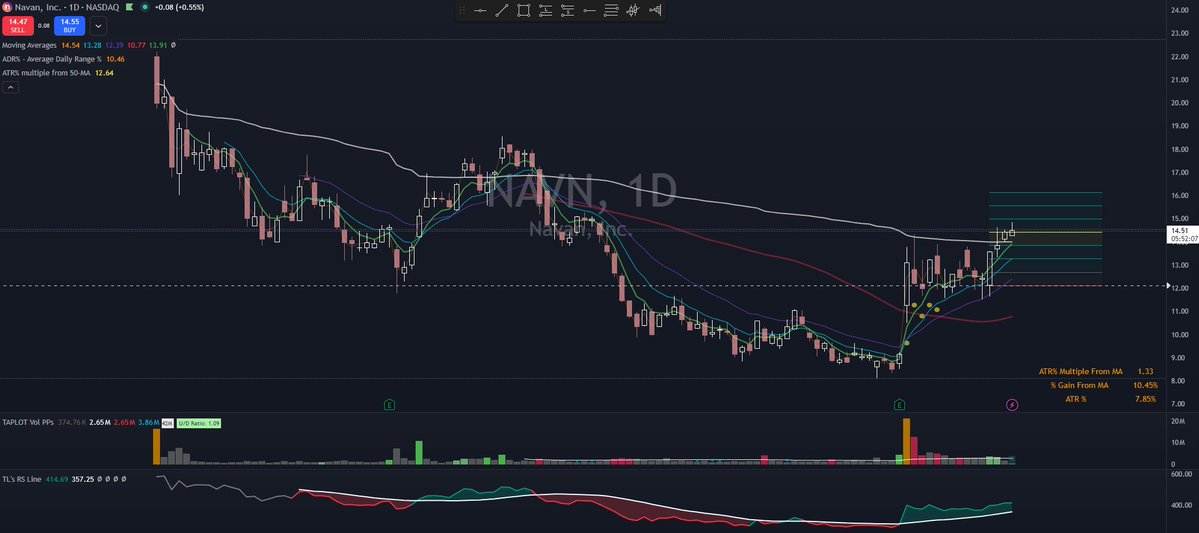
$NAVN - AI Software IPO - HVE Earnings reaction last month - Dry up in volume past 2 weeks - Yesterday bounced of key 11.7x level and rising 20 EMA- Uptrending RS line. Looks like it wants to go higher.
Maikel tweet media
English
0
0
0
260
Science girl
Science girl@sciencegirl·
The dragon headed caterpillar
English
45
202
1.2K
58.9K
Matt Petrallia, CMT
Matt Petrallia, CMT@theEquilibrium·
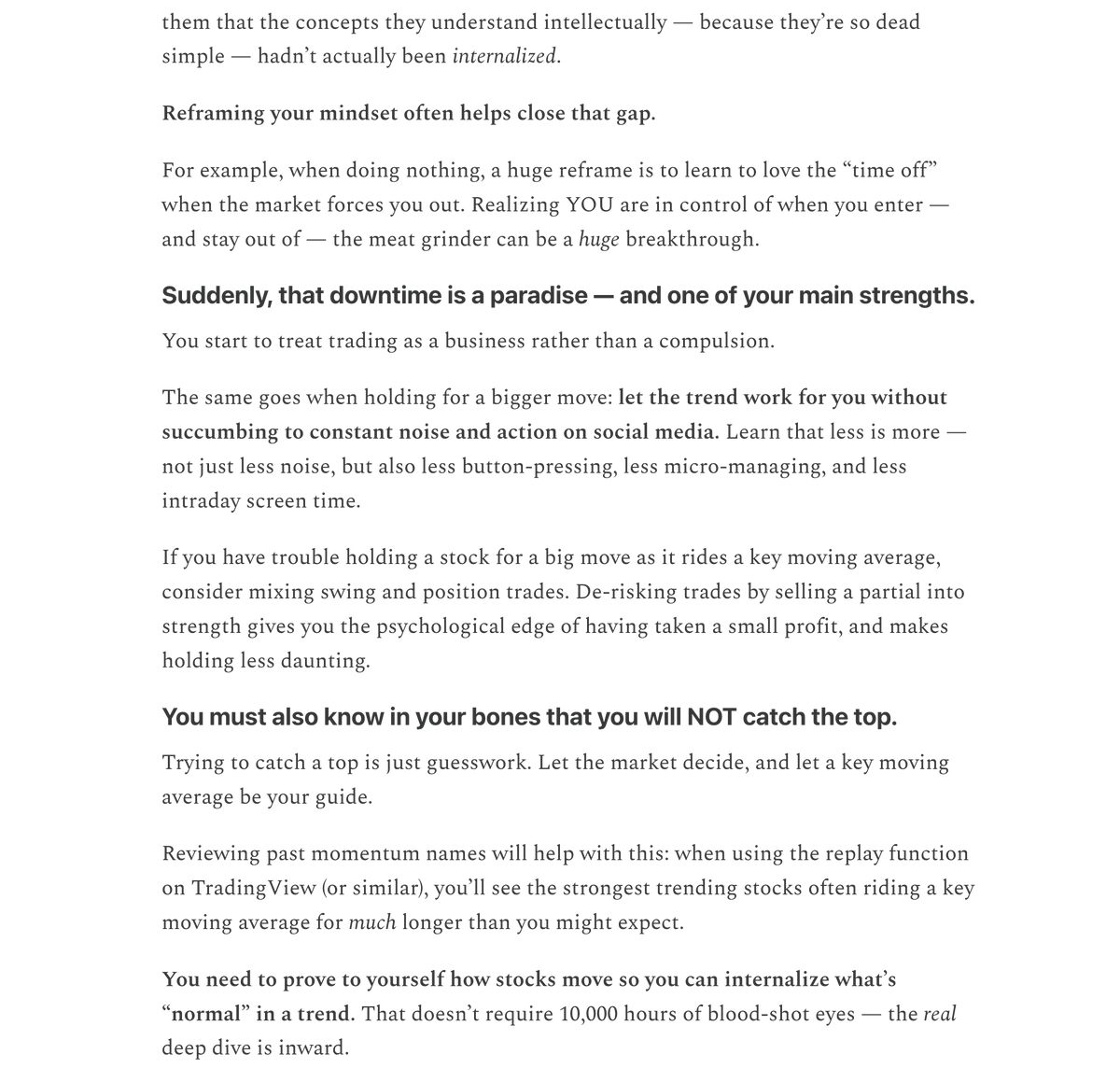
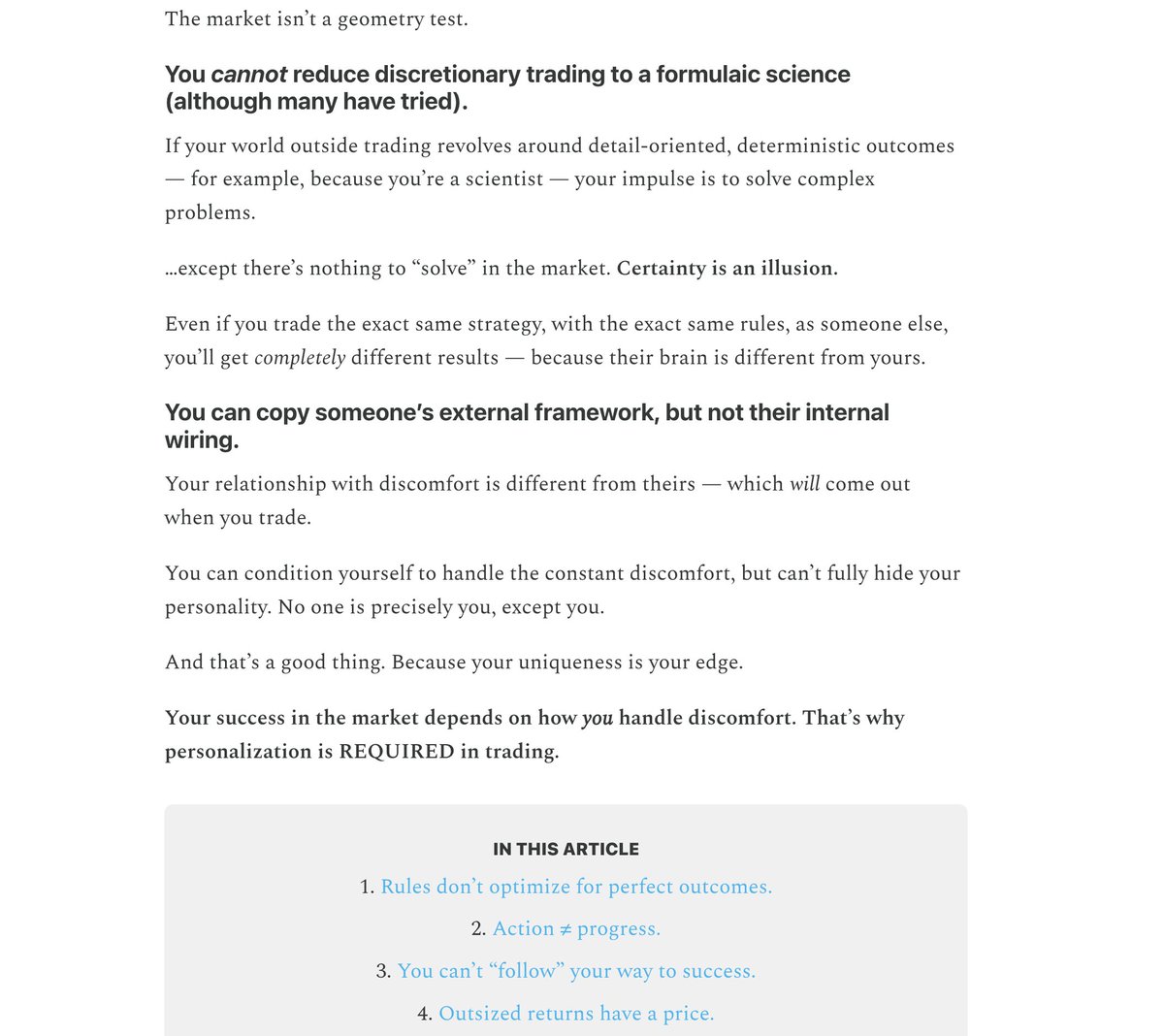
I’m launching a brand new FREE Substack this Saturday! The first post, in collaboration with the talented @kynakosling , focuses on harnessing one of your biggest edges: YOU. Personalization is at the heart of building a process you can repeat, that’s tailored to your brain and no one else’s. Create rules built to manage YOU. You can copy someone else’s external framework, but you can’t copy their internal wiring. Your success in the market depends on how you handle discomfort. That’s why personalization is REQUIRED. 🔗 tinyurl.com/y35a5ku5
Matt Petrallia, CMT tweet mediaMatt Petrallia, CMT tweet mediaMatt Petrallia, CMT tweet mediaMatt Petrallia, CMT tweet media
English
9
6
55
16.3K
Maikel
Maikel@mkl85·
Very dependent on strategy. If your goal is to catch outlier trades, it makes little sense to reduce size in a trade that is right now proving to you that it is a winner and potentially a big outlier (you never know at that point), only to allocate that to a new unproven trade. Odds are you're sabotaging the very thing that gives you edge: exposure in your right tail.
English
1
0
1
29
Kyna Kosling
Kyna Kosling@KynaKosling·
@mkl85 @FranVezz Also because it frees up capital to roll into a new name. (Depending on strategy and market environment, of course.)
English
1
0
0
35
Maikel retweetet
Maikel
Maikel@mkl85·
Partial profits do eat away at your edge (as explained in the thread below). One important nuance here is the difference in market environment. Choppy markets lack a right tail and therefore selling more into strenght can actually boost performance. In general, partials hurt expected value on paper but can still improve performance because a free rolled trade is easier to hold. x.com/i/status/20388…
English
2
1
2
162
Kyna Kosling
Kyna Kosling@KynaKosling·
I wrote my old Zanger notes in haste. Working on a new stack. This time, I’m taking my time.
Kyna Kosling@KynaKosling

Dan Zanger famously turned $10,775 into $18,000,000 in 18 months. “He just got lucky. He was in the right place, at the right time.” …that’s what someone will tell me in the replies. And sure, that performance may not be fully replicable. But I’ll be damned if we can’t learn something from Zanger. He’s often spoken in interviews about chart patterns, but if you listen (or read) more closely, you’ll see that patterns are only ONE aspect of his system. Here are 3 more: ~ 1⃣ Stock selection Follow the strongest groups — what are the institutions buying? Stick with the winners until they begin to fizzle. How to identify those leaders? Volume and chart behaviour offer major clues. Zanger also pays attention to CAN SLIM characteristics: • Powerful earnings growth • Low float and low institutional sponsorship • Something new — fast growing companies dominating their space at a global level ~ 2⃣ Situational awareness The market makes perhaps 2 big moves a year. Each lasts maybe 6–12 weeks. The rest of the time, it consolidates the gains. So, Zanger typically looks for an oversold market before he’d consider getting into a leading stock. He wants the market to appear to be bottoming and/or ready to take off, then get into the powerhouse stocks showing most relative strength just as they’re breaking out of a good base. ~ 3⃣ Chart pattern nuances Zanger looks out for at least 11 patterns. But his favourite pattern depends on the current market. “In some markets I’m looking for falling wedges, descending trendlines, descending channels, to name a few. In other markets, I might be looking for horizontal channels and cup and handles.” “I think the descending channel for buying is one of my favorite patterns as the market has become more choppy and volatile. You are seeing more descending channels and island reversals for buying.” He also gets huge clues about stock behaviour by looking for surges in volume and seeing how price responds to them. “If a stock really does not act right, and get up and go when it breaks out, for example, I would just sell the stock right there. I would not even wait for it to come back down to the breakout point. If you want to make money in stocks, you have to be in stocks that are moving up. The longer it continues to move up, the more money you make. If the stock breaks up and then goes to sleep, I am out of the stock. I want to keep my money in those fast-moving stocks that are always moving up.” ~ In summary: “[Watch] the behavior action of the stock, [do] some market timing and cycle work, and really [tune] into your stock’s behavior and its price action. Many people choose a stock and say they are going to wait for this stock to move up. Meanwhile, they missed a 30-point move on a stock sitting right next door to it. Really focus on the stocks that are going to move now.” “I trade whatever the market is going to push up the most.” ~ Covered in more detail on TTRH: 3 Key Elements to Dan Zanger’s System Going beyond chart patterns 🔗 tinyurl.com/2ax3zw34 (Audio version available.)

English
6
4
35
7.5K
Maikel
Maikel@mkl85·
@stocktalkweekly Riding it down 50% from the highs is not for everyone. How much would price need to drop for you to cut the position?
English
2
0
2
635
Stock Talk
Stock Talk@stocktalkweekly·
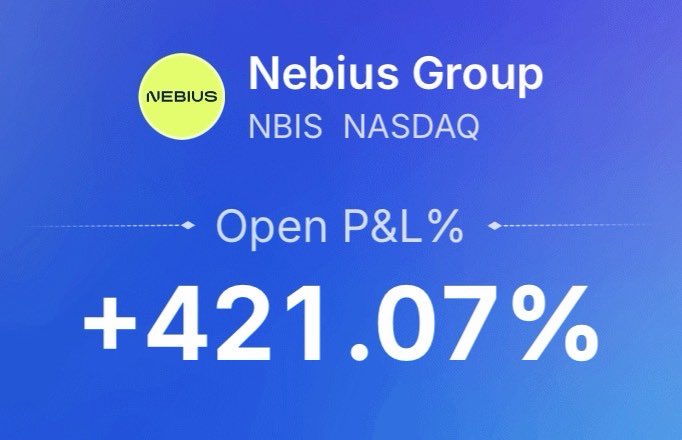
Nebius $NBIS shares now up a whopping +421% from our $23.92 entry ✅ It’s so much easier to sit tight & hold when you have a great cost basis.
Stock Talk tweet media
English
22
11
382
34K
Big Wave Chartist
Big Wave Chartist@BigWaveChartist·
Patience is the name of this game: Bad market? - Patience to wait for a good market Buy a position? - Patience to let it gain traction Gaining traction? - Patience to let the trade work There isn’t one aspect of trading that DOESN’T require patience.
English
1
0
16
2.3K
Bert Slagter
Bert Slagter@bslagter·
@Bart_Mol Yeah, makes me sad tbh. Like if your dog has rabies and you know that you have to put him down. I don’t want to unfollow them, but I can’t allow myself to waste time reading this garbage either.
English
2
0
8
966
Bart Mol
Bart Mol@Bart_Mol·
It’s disappointing to see more and more early bitcoiners turning to pure AI slop for engagement and views. AI is a great tool for small teams, but this makes it clear it’s not ready to act as a fully independent researcher and writer. The output just isn’t good enough.
TFTC@TFTC21

A quantum computer just "broke" Bitcoin. Except it didn't. Not even close. Google Quantum AI published a paper showing they've cut the theoretical ECDSA attack down to 1,200 logical qubits. They didn't publish the circuits. They didn't run the attack. They published a zero-knowledge proof that their math works, then cited national security. Here's where we actually are. Entangled logical qubits achieved so far: 96 Coherence time: 1-2 seconds Time the attack requires: days Physical qubits needed: 500,000 Largest quantum computer today: 1,200 noisy, non-error-corrected qubits That's a 100,000x coherence gap. It's not a software problem. It's a fundamental engineering problem that nobody has solved. But here's what most people miss. Bitcoin developers aren't waiting for a crisis. They're already shipping. SHRIMPS: post-quantum signatures 3x smaller than NIST standards, built for Bitcoin's block space constraints. BIP-360: a quantum-resistant output type already live on testnet, with BTQ Technologies running transactions through it. The full upgrade could take 7 years. That's why the work started now. The protocol will be ready before the computers are.

English
6
1
15
5K
Bright Side of the Sun
Bright Side of the Sun@BrightSideSun·
The Phoenix Suns will be changing their color palette effective the 2027-28 season
Bright Side of the Sun tweet media
English
6
1
16
2.9K
Maikel
Maikel@mkl85·
No longer chasing certainty has been one of the biggest steps forward in my trading. I've spend my first whole year of trading trying to create a daytrading strategy that was certain to win. Combining all kind of candlestick pattern with MA alignment to find some secret succesful combination. Three mistakes I made: 1. Trying to find edge in random patterns, barely based on structural market phenomenons. 2. Curve fitting on past data. 3. Trying to catch certainty instead of building a robust system designed to thrive in uncertainty. A better way to do things: -Increase probabilities by structuring around real edge (for example: stocks with a reason to move, part of group move, strong market backdrop, showing RS and using chart patterns to time entry) -Fully internalize (not just intellectually understand!) that still anything can happen, both to the upside and the downside. This internalization should flow in how you manage losers, winners and position size. If anything can happen you still need to cut losers (no matter how convinced you are of your edge). You still need to cut size when feedback is bad (no matter how positive your favorite market indicators are). You still need to let your winners run. Basically you act on a proper edge while ensuring survival in worst case scenarios and thriving in best case scenarios.
Yumi🌸@samuraipips358

At first, I thought the same thing. “Is trading hard? I’m different from other people. I’m the exception.” But once I actually tried it… Have you ever had thoughts like these? “That’s it. I should just go long and short at the same time.” “That’s it. I should short when RSI is above 80 and price is beyond the 3 sigma Bollinger Band, and just keep averaging in.” Every “brilliant” idea you have as a beginner has already been tried by those who came before you. I tried them too. I thought, “I’ve come up with a strategy nobody else knows.” But in reality, none of that is necessary. There is one thing all of these brilliant ideas have in common. Every one of them is trying to “eliminate uncertainty.” If you hedge both ways, you will not lose no matter which way price moves. If you average down, you can improve your average entry price even if the market moves against you. If you use Martingale, you can always make it back eventually. If you layer enough filters on top of each other, you can eliminate losing trades. It is all the same. You are trying to win by “making sure you do not lose.” But uncertainty in the market cannot be eliminated. This is not a technical issue. It is structurally impossible. No matter how low you estimate the probability of something happening to be, if you continue taking dangerous actions that carry even the slightest chance of that outcome, then that event will “inevitably” happen. “Inevitably.” A trader who has kept winning with a high win rate suddenly disappears one day. In this industry, that happens all the time. That one occurrence wipes everything out. You may think you were unlucky, and tell yourself, “If not for that one time, I would be doing well by now.” But it was inevitable. So what do you do? You do not try to eliminate uncertainty. You build a structure that functions within uncertainty. You do not try to eliminate losses. You build losses into the structure as part of it. You do not try to push the win rate to the absolute limit. You design a structure in which the sum of wins and losses still leaves you with a profit. You do not try to control any single outcome. You use the statistical tendency that emerges across a large number of outcomes. In this structure, losses are not the enemy. To make a profit through the sum of wins and losses, you must fully accept losses, and you must make losses themselves function as part of the edge. This sentence is extremely important, so I want you to put it on your wall. “Make losses themselves function as part of the edge.” In other words, what matters is a structure in which it is precisely because you lose while following the rules that you end up profitable overall. All you have to do is keep repeating that. Every brilliant idea tried to eliminate uncertainty. In trading, which is a world of uncertainty, there is no path to success along that line. The structure of a successful trader accepts uncertainty and builds a mechanism that still leaves a profit within it. Understanding this difference is the first step as a trader, and the most important one. And to build that mechanism, every required setting and parameter must be defined, tested, and practiced. What you need is nothing more than patient and exhaustive preparation in advance. If you truly believe, “I’m different from other people,” then seriously commit yourself to this work that most people never do. You really will become different from them. If you do not yet have a system with a tested edge → payhip.com/b/bqKpV

English
0
1
21
3.6K