Matt | Arch

4.9K posts

Matt | Arch banner
Matt | Arch

Matt | Arch

@proofofmud

CEO @archntwrk ⋒ BTC class of 2013 ⋒ 🟠 🏦 Obsessed with building out the Bitcoin-native financial layer

Beigetreten Haziran 2021
3.4K Folgt38K Follower
Angehefteter Tweet
Matt | Arch
Matt | Arch@proofofmud·
We’ve been quiet for months, building in the background. But it’s time to show you what we’ve been working on. Over the next few weeks, as we prepare for mainnet, we’ll be shipping (with receipts) , everything we’ve built in silence. Our north star was simple: programmable Bitcoin, without bridges. That meant building everything from scratch: a new VM, new cryptography, and a new consensus , all capable of doing real Bitcoin things. This has never existed before. I’m beyond proud of the dozen and counting brilliant engineers who locked in on this vision and made it real. Read our manifesto, our mission, and our values for Bitcoin’s next chapter and sign it with your Bitcoin wallet to be part of the movement. The quiet build is over. Let’s show the world what’s coming. Bitcoin proved it could store value. Now it will prove it can power finance. Arch World Order.
Arch Network@ArchNtwrk

x.com/i/article/1980…

English
90
50
353
18.9K
Matt | Arch
Matt | Arch@proofofmud·
with agentic automation where it is, I would be shocked if we didn't see a record number of perfect March Madness brackets this year
GIF
English
1
0
2
133
Matt | Arch retweetet
TFTC
TFTC@TFTC21·
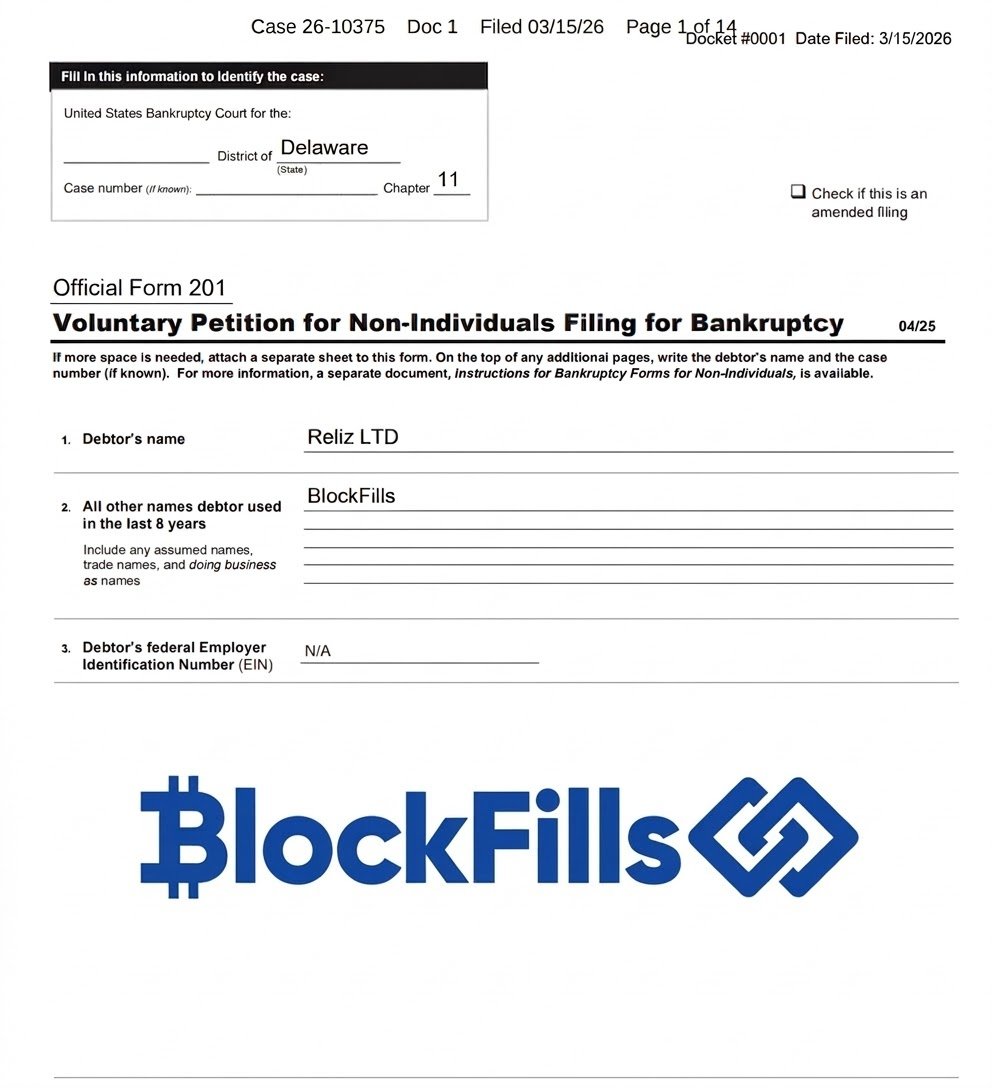
BlockFills just filed for Chapter 11 bankruptcy. $50-100 million in assets against $100-500 million in liabilities. BlockFills was a Chicago-based institutional crypto trading and lending firm backed by Susquehanna, CME Ventures, and Nexo. They processed over $60 billion in trading volume in 2025 and served around 2,000 institutional clients including hedge funds, asset managers, and mining companies. Here's the timeline of how it unraveled: February 11 - BlockFills halts all customer withdrawals and deposits, citing "market and financial conditions." Late February - CoinDesk reports the firm lost approximately $75 million. CEO and co-founder Nicholas Hammer steps down. Early March - Dominion Capital sues, alleging BlockFills misappropriated customer crypto assets, commingled client funds with operational funds, and concealed significant losses. A federal judge issues an emergency order freezing BlockFills' bitcoin holdings. March 15 - Chapter 11 filed in Delaware. Reliz Ltd. and three affiliated entities enter bankruptcy. The pattern is identical to every crypto lending blowup we've seen. Aggressive leverage in derivatives, counterparty risk exposure to other struggling firms, client funds not properly segregated, and losses hidden until they couldn't be hidden anymore. This is what happens when you hand your bitcoin to a third party and trust them to manage the risk. Not your keys, not your coins isn't a meme. It's a risk management framework. The firm's own backers include some of the biggest names in traditional finance. Susquehanna and CME Ventures did their due diligence and still got it wrong. If they can't assess counterparty risk in this market, what chance does a retail investor have? The answer is simple. Stop trusting intermediaries with your bitcoin.
TFTC tweet media
English
33
109
560
88.6K
Matt | Arch
Matt | Arch@proofofmud·
who approved the wardrobe budget? CT did not ask for this
Matt | Arch tweet media
English
0
0
3
196
Matt | Arch retweetet
Bitcoin Magazine
Bitcoin Magazine@BitcoinMagazine·
NEW: Wall street giant Citi bank announces "later this year, Citi will be launching our infrastructure that integrates Bitcoin into tradition finance." 🚀 "Making Bitcoin Bankable"
English
177
414
2.2K
182K
Matt | Arch retweetet
Zeus
Zeus@ZeusRWA·
Out of the top 20 RWA assets onchain: 16 are tokenized funds 2 are tokenized gold 1 is HELOC yield 1 is private credit / lending That means 80% of the largest onchain RWAs today are essentially short duration, regulated, fund style products. Mostly institutional treasury products wrapped for onchain rails. This first wave of tokenization isn’t about bringing every single asset onchain. It’s about bringing the safest, most boring, most institutionally comfortable assets onchain first so that we build up some trust…
Zeus@ZeusRWA

Top 20 RWA Assets By Onchain Market Cap.

English
33
11
92
53.5K
Matt Hougan
Matt Hougan@Matt_Hougan·
So fired up to launch Vaults today. Building the future.
Bitwise@Bitwise

Finance is moving onchain. Vaults are a key part of that, offering investors a transparent way to earn digital yield on their assets. Today, we’re excited to announce that Bitwise is launching non-custodial vault strategies as a curator on @Morpho. The quick details: - Bitwise’s first strategy on Morpho currently targets 6% APY, investing in overcollateralized lending pools. - Vault curation, strategy, and risk management will be led by Bitwise’s Portfolio Manager & Head of Multi-Strategy Solutions, Jonathan Man, CFA. - The offering leverages Bitwise’s 140-person team of professionals and more than eight-year track record as a crypto specialist. We believe the future is onchain, and we’re delighted to help sophisticated investors participate in the opportunities vaults provide. More to come. Feel free to reach out—input welcome.

English
13
11
267
36.4K
McKenna
McKenna@Crypto_McKenna·
Bitcoin yield remains one of the most attractive opportunities in the market. I am yet to meet a team who is able to crack this outside of Coinbase/Morpho for retail but the Institutional market is much larger. Any suggestions? Reach out if so
Eric Balchunas@EricBalchunas

BlackRock just dropped the official S-1 for it's upcoming iShares Bitcoin Premium Income ETF.. no fee or ticker yet. The strategy is to "track performance of the price of bitcoin while providing premium income through an actively managed strategy of writing (selling) call options primarily on IBIT shares and, from time to time, on ETP Indices."

English
32
1
45
13.9K
Matt | Arch
Matt | Arch@proofofmud·
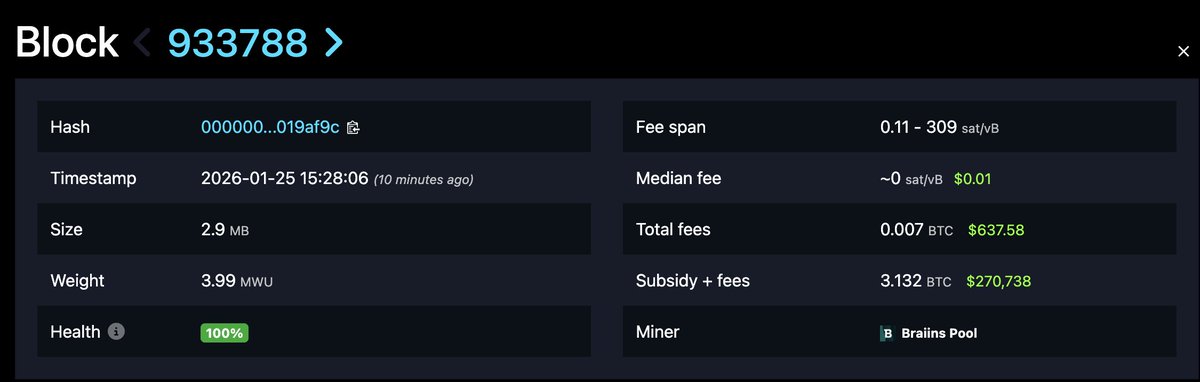
$271k is subsidies , $600 is inclusion. point is, there are very little/no time-sensitive transactions willing to pay more for block space. Can promise that 600$ per block is not enough for miners. the willingness to pay more comes from financial outcomes depending on inclusion guarantees. where does that come from ?
Matt | Arch tweet media
English
1
0
0
42
Justin Siegel🕳🐇
Justin Siegel🕳🐇@JustinSiegel1·
@proofofmud @pythianism Of course the fee market is important, it’s how transactions pay for their inclusion. That has nothing to do with the fact that transferring censorable assets on bitcoin does not increase the censorship resistance!
English
1
0
1
46
Vance Spencer
Vance Spencer@pythianism·
If the status quo plays out ETH will be the only quantum secure crypto asset and flip BTC in 1-2 years
English
180
78
967
215.1K
Matt | Arch
Matt | Arch@proofofmud·
The decentralized network of miners is a pretty important piece. If miners can't be profitable, Bitcoin centralizes over time and its ability to be "outside of state control" gets compromised. So as block subsidies trend to zero, a fee market is going to be increasingly more important.
English
1
0
1
47
Justin Siegel🕳🐇
Justin Siegel🕳🐇@JustinSiegel1·
@proofofmud @pythianism Again, bitcoin’s value proposition is money outside of state control. Fees generated by moving digital dollars or tokenized whatever does not meaningfully contribute to that use case. It just advantages compliant miners.
English
1
0
1
44
Matt | Arch
Matt | Arch@proofofmud·
@JustinSiegel1 @pythianism DeFi transactions where financial outcomes are determined by ordering of settlement contributes to the fee market dilemma and that means a lot to the security budget. Also people just want to do more with their btc
English
1
0
3
47
Justin Siegel🕳🐇
Justin Siegel🕳🐇@JustinSiegel1·
@pythianism Bitcoin’s value proposition is as non-state money. How does importing state money or custodial assets contribute anything meaningful to it?
English
1
0
8
430
Matt | Arch
Matt | Arch@proofofmud·
Solidity and an open source developer community are the last real network effect that ETH has left. This stems from the half-decade head start in the programmable infrastructure race. Ever since the taproot upgrade happened on bitcoin, a similar infrastructure arms race has been happening. It just takes time.
English
2
0
1
536
Vance Spencer
Vance Spencer@pythianism·
All computing platforms are subject to broader tech trends they need to integrate to remain relevate ETH has embraced Stablecoins, Tokenization, AI, Quantum BTC, so far, has embraced none
English
16
13
180
17.8K
Matt | Arch
Matt | Arch@proofofmud·
@sonyasunkim @Morpho there's also offering instant redemption liquidity for those who want to get out of their position and taking a higher implied yield. interesting times
English
0
0
2
182
Sonya Kim
Sonya Kim@sonyasunkim·
RWAs introduce duration risk on-chain and therefore need specialized consideration when trying to properly integrate them into DeFi. For instance, RWA liquidations on lending protocols like @Morpho are less an arbitrage trade for those with a balance sheet and look more like credit investing as the liquidators have to hold the liquidated asset until they can redeem (ever day, month or quarter, depending on the underlying asset) We are at the start of seeing very interesting solutions emerging for RWA liquidations and projects like @infiniFi are at the forefront of this. Even cooler that the premiums gained will be passed onto its yield token. Ultimately I think this market will turn into a competitive auction process, rather than liquidation premiums being hardcoded at the lending protocol level.
Val@Val_bpereira

infiniFi: The Future Liquidator of RWAs & On-Chain Credit Markets @infiniFi is first on-chain yield layer capable of absorbing RWA liquidation risk at scale. Liquidators have historically been the unseen stabilizers of DeFi, ensuring solvency, restoring balance to stressed systems, and earning predictable premiums for doing so. But as crypto expands into RWAs, the role of liquidators becomes even more critical, and the mechanics far more complex. infiniFi is uniquely positioned to become the market’s first specialized RWA liquidator, bridging TradFi redemption cycles with DeFi’s demand for instant liquidity. This article explores why infiniFi is structurally suited for this role, how liquidations work for RWAs, and what this means for the next generation of on-chain credit markets. Examples like Apollo Diversified Credit Fund & @aave Horizon, @3FLabs, @Securitize Fund. I. Liquidations in DeFi vs. RWAs In Aave, liquidation is simple: - A borrower becomes under-collateralized - A liquidator repays debt - The liquidator seizes collateral at a discount - The liquidator sells or redeems immediately to realize profit This works because the assets are liquid, 24/7 tradable, and priced continuously. But RWAs are different. RWA Liquidations Are Not Instant Most tokenized real-world assets have redemption windows, such as: - Monthly or bi-monthly redemption cycles (Apollo Fund) - Weekend/hourly settlement pauses (BlackRock BUIDL model) - NAV updates that occur only weekly or monthly - Off-chain custodial or broker-dealer settlement processes This means that traditional liquidators cannot instantly unwind collateral the way they can on @aave , @eulerfinance, or @Morpho. A new class of liquidator is needed, one that can: - Hold assets through redemption periods - Manage duration and liquidity mismatch - Absorb temporarily illiquid collateral - Offload assets through AMMs, OTC desks, or redemption portals - Earn liquidation premiums that justify the delayed exit This is where infiniFi becomes essential. II. Why infiniFi Is Uniquely Positioned to Become the RWA Liquidation Layer 1️⃣ infiniFi already holds long-duration assets infiniFi’s core architecture is built around duration layering: - siUSD: senior, liquid layer - liUSD: long-duration, higher-yield layer - iUSD: instant money market layer This structure mirrors how real-world credit funds operate. It allows infiniFi to absorb longer-duration assets without breaking liquidity for senior depositors. In most liquidations, the main risk is: “What if the liquidator is stuck holding collateral they can’t redeem?” For iInfiniFi, this is not a bug, it’s a feature. The long-duration side (liUSD) is designed to want assets that redeem on multi-week or multi-month cycles. 2️⃣infiniFi becomes the liquidity backstop for the entire RWA ecosystem As RWAs grow, protocols need a reliable buyer of last resort, someone who: - Can warehouse collateral - Can wait through redemption periods - Can take on temporarily illiquid positions - Can monetize liquidation premiums - Can preserve peg stability for the stablecoins built on top Examples: Apollo Diversified Credit Fund - NAV updated monthly - Redemptions offered on scheduled cycles - Collateral suited for structured liquidation events infiniFi can absorb Apollo's tokenized credit assets during stressed scenarios, redeem them during the monthly window, and pass the liquidation premium back to siUSD holders. @3FLabs Leverage Rails for RWAs 3F builds on-chain leverage infrastructure for yielding RWA products, enabling permissionless, levered carry trades across assets. In these markets, liquidation isn’t instant. It can involve: - NAV movement - claim resolution - delayed redemption windows infiniFi’s long-duration tranches can absorb these timelines, capturing liquidation premiums that short-term liquidators can’t touch. III. How Liquidation Works for RWAs (infiniFi) Instead of instant arbitrage and block-builder bidding wars like Aave, RWA liquidations follow a credit-market style process: 1️⃣ Collateral enters a redemption or auction queue Triggered by default, under-collateralization, or protocol rules. 2️⃣ Liquidators bid on the collateral infiniFi enters as a bidder because: - It wants discounted long-duration assets - It has a reserve designed for this - It has predictable redemption pathways 3️⃣ Collateral is acquired at a discount (premium captured) Typical liquidation premiums for RWAs range from: - 5–15% for treasury-style assets - 20–50% for private credit defaults - Higher for distressed pools depending on terms 4️⃣ infiniFi stores the collateral in liUSD reserves Users, for the first time, are able to access tokenized liquidation premiums as a source of yield via siUSD & locked-iUSD tranches. 5️⃣ Redemption occurs on the asset’s schedule Could be: Weekly / Monthly / Bi-monthly / Based on maturity (e.g. 30–90 days) infiniFi is one of the only protocols structurally capable of waiting. 6️⃣ Profit is distributed back into the infiniFi yield stack The liquidation bonus becomes: - Higher siUSD yields - Higher liUSD yields - Stronger backing for iUSD IV. Why infiniFi as an RWA Liquidator Is Critical for the Space 1️⃣ Solves the liquidity mismatch RWAs introduce TradFi has settlement delays, DeFi expects instant liquidity. infiniFi bridges this gap. 2️⃣ Protects RWA stablecoins from redemption shocks When a large position unwinds, someone must step in. infiniFi becomes the backstop, preventing depegs and liquidity freezes. 3️⃣ Creates a sustainable revenue engine for its depositors Liquidation premiums (20–50% APR depending on scenarios) are: - Non-inflationary - Non-dilutive - Cash-flow positive - Derived from real economic activity 4️⃣ Strengthens the entire tokenized credit ecosystem Protocols like 3F need a buyer of last resort. infiniFi fills that structural void. 5️⃣ Enables safer leverage and liquidity for RWA borrowers Borrowers know that: - There is liquidity during redemptions - There is someone stabilizing auctions - The system won’t collapse during a default cycle This is the same function market-makers and distressed-debt funds serve in TradFi. V. The Bigger Vision: The TradFi–DeFi Abstraction Layer infiniFi isn’t just a liquidator, it becomes the interface between the two: For TradFi infiniFi handles: - Redemption windows - Delayed settlements - Capital buffers - Liquidity guarantees - Duration risk For DeFi infiniFi provides: - instant liquidity - Peg stability - More yield - Access to diversified credit exposure - Risk-adjusted markets This makes infiniFi the first on-chain yield layer capable of absorbing RWA liquidation risk at scale. VI. Why infiniFi Will Win This Market - Structural advantage: Its duration-layer architecture is built for this. - Economic advantage: Liquidation premiums are far higher for RWAs than for crypto loans. - Partner advantage: The team is already in discussions with leading RWA issuers and underwriters. - Risk advantage: infiniFi can absorb illiquid assets without harming user liquidity. - Market advantage: No existing liquidator today is designed to handle multi-week settlement assets. infiniFi becomes the BlackRock-Aladdin of on-chain credit, but with the liquidity engine of Aave and the liquidation efficiency of a specialized distressed-debt desk.

English
17
7
118
15.8K
Matt | Arch
Matt | Arch@proofofmud·
@bensig @dotkrueger you maintain "you keep 100% exposure of the bitcoin upside" and you pay out 1% per month on the return of capital you simply cannot have it both ways. you don't make enough on the loan utilization to pay out 1% per month without affecting the underlying bitcoin position.
English
3
0
10
485
Ben Sigman
Ben Sigman@bensig·
This is just a total misunderstanding of how the fund works. I think you’re getting confused about the word “yield” here. This fund holds bitcoin and borrows against it very conservatively to return the investor initial capital over 10 years. The “yield” is a monthly ~1% distribution back to investor. We don’t trade. We don’t time the market. We don’t need a yield from stablecoins.
English
2
0
1
514
Ben Sigman
Ben Sigman@bensig·
Launched a new Bitcoin fund with @dotkrueger - here's how it works. Accredited investors put in min $100K. Fund buys Bitcoin. We hold. We use Bitcoin as collateral to borrow stablecoins. Every month we target sending investors ~1% of their capital as a distribution. These distributions are "return of capital" - tax-deferred until you exit. Meanwhile, you keep 100% exposure to Bitcoin's upside. Over the years, friends and family have asked: "Why can't I just give you my money and you buy Bitcoin?" Now you can. We don't trade. We don't time the market. Buy and hold. Simple. Who is this for? → You have Bitcoin and want income without selling → You want Bitcoin exposure with professional custody → You want tax-efficient distributions Accredited investors only. Target distributions not guaranteed.
Ben Sigman tweet media
English
203
15
366
200.3K
Matt | Arch
Matt | Arch@proofofmud·
If you borrow less you can’t earn as much yield or you need a higher gross yield. This didn’t answer anything. I think your gfx is wrong and the intention was you’re aiming for 10% gross yield which does not mean it’s 10% on the total amount invested. 10% gross on 350k after paying out interest would generate about 1.5% apy in the million invested (assuming 6% interest)
English
3
0
10
712
Jan
Jan@janbtc·
ngl kinda want to mint some ordinals not some bs low effort stuff tho would be cool to get some new community going
English
68
6
130
10.3K
Udi Wertheimer
Udi Wertheimer@udiWertheimer·
dear ordinals mfers ethereum nft enjoyers have accepted long ago that we’re not in an nft bull market collectors and teams are having public discussions on a daily basis on other directions they could take to revitalize the brands in new directions that don’t involve praying that someone sweeps the floors they know that it’s time to try new things. whether or not it would work they don’t know. but sitting around posting charts all day hasn’t worked and will not work the first step is admitting the problem, and the ordinals community did not take the first step yet. any time anyone brings up a hint that maybe this isn’t the pico bottom for [MY_BAGS] the few active ordinal posters that remain go into hyper defense mode i suggest the following: 1. learn to take a joke, and learn to make fun of yourselves sometimes. people like seeing that. it makes you human. insisting that your bags are going to 10x next week doesn’t help anyone to take you seriously 2. it’s time to focus on fun and new ideas. again, we should not take ourselves so seriously, we didn’t earn it. stop exclaiming that every little bullshit is the best thing ever invented. we need to try shit out and be humble about it 3. ordinals started in market conditions not very different from today’s, market-wide vibes were bad, and the onchain jpegs seemed like a fun way to show our love for bitcoin, not necessarily a way to get rich. you wanna get back to that. fundamentally i still believe that people want to “have fun with their bitcoins” but most of the people who want to have fun got bored and left. the complainoooors that remain are not being very fun. it’s time to go back to fun. communities should focus on fun things, not on finding exit liquidity. imagine the smell 4. check your ordinals wallet, i might have deleted them overnight
English
109
27
319
37.9K
Raven Thorogood III
Raven Thorogood III@onchainprimate·
I simply care about helping the winning bitcoin casino / btc defi make it, biggest opp in crypto Tried to help @radfi_btc & @flashnet eco along the way w obvious suggestions, nobody listens I’m a free agent advisor for @opnetbtc or @ArchNtwrk in Q1 (@bc1plainview @proofofmud)
Raven Thorogood III@onchainprimate

Will give @spark eco the same advice I gave @radfi_btc (they did nothing w it) 1. Prioritize custom launches w built in airdrop optionality - easy airdrops upon deploy = virality & distribution = runners @luminexio @utxofun @Satsdaq 2. Prioritize custom creator taxes / fees to create flywheels, this needs to be done at the @flashnet level but @ethannmarcus doesn’t answer dms You’re welcome.

English
1
0
2
361