
Angehefteter Tweet
WRAPH
3.2K posts


WRAPH
@realwraph
Longed the top, shorted the bottom, still up | Crypto TA & memes since 2017 | I post charts, memes & occasional regret
Solana Trenches Beigetreten Şubat 2022
1K Folgt4.4K Follower

people think gold is a geopolitical hedge
but this is a religious war
and the dev of gold is god
and god has forsaken us
The Kobeissi Letter@KobeissiLetter
BREAKING: Spot gold extends its selloff to -$400/oz on the day, now trading at $4,500/oz for the first time since February 2nd.
English
WRAPH retweetet



WRAPH retweetet

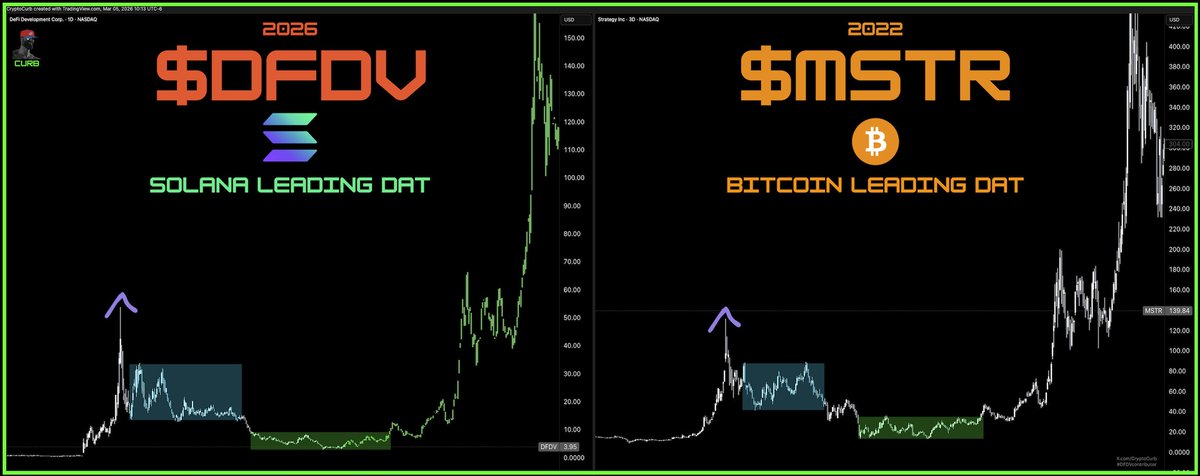
$DFDV vs $MSTR
$DFDV- Solana's leading DAT, is in accumulation zone, similar to $MSTR in 2023.
$4 is deep value for $DFDV similar to $40 for $MSTR back in 2023.
@DefiDevCorp
English


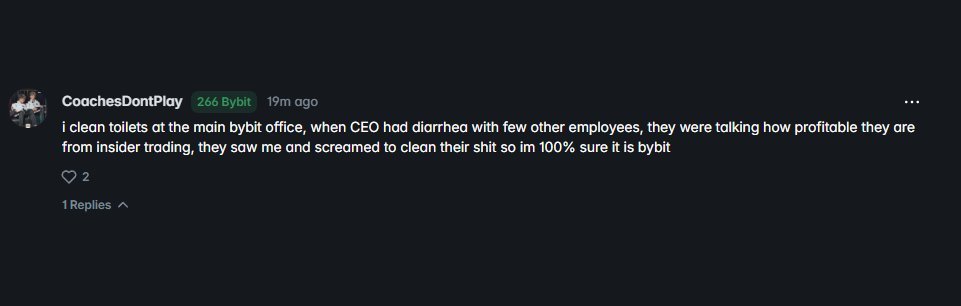
So @zachxbt exposed an insider trader early to the Axiom team → Axiom tells the insider → insider does even more insider trading because of the warning?
Am I missing something here?
Bubblemaps@bubblemaps
1/ We found a connection between @WheresBroox and the #1 Polymarket trader who made $400k betting on a ZachXBT's investigation 🧵
English
WRAPH retweetet

Since I took over @MeteoraAG last March, we have taken insider trading risk seriously and put real safeguards in place.
Meteora is a permissionless platform. And especially over the last 12 months, we’ve invested tremendous energy into making it robust and reliable enough to ensure projects can launch without any support from us personally. As a result, we often find out about launches or integrations only after they happen.
As just two examples, both $NYC and $YZY, two of the biggest launches on Meteora in the past year, happened without our prior knowledge.
Our energy is fully focused on building the best technology possible to power launchpads and other platforms. Our focus is not to get involved with deployers themselves. We are laser focused on what we’re uniquely best at, and that’s building great infrastructure, products, and community around LPing.
Yes, we’ve seen the Polymarket. To be honest, we were as surprised as you were.
So we immediately did a detailed review of the situation. After review, we remain confident in the way we handle integrations, launches, and the standards we hold ourselves to as a team.
It’s been almost exactly one year since me and @0xSoju took over Meteora. When we stepped in, things were rocky. But we knew we had inherited an amazing tech platform and an even more amazing community.
Every day since then, we’ve put every ounce of energy into doing things the right way for the sake of our users and the greater DeFi ecosystem. I am deeply proud of our team and what we’ve been able to accomplish so far.
And I promise you this: we’re going to keep doing the same goddamn thing every day going forward too.
English


WRAPH retweetet

Some thoughts on the latest Jupiter proposal, Jupiter's tokenomics and emissions in general.
Starting in reverse order, let's break down as a matter of first principles what emissions are.
I think of emissions as a tax on the existing tokenholder base via inflation. When a token is emitted to a user as rewards, a project is essentially asking all existing tokenholders to subsidize the reward to the user.
Similarly, when a token is emitted to a team member or an investor, you are socializing the cost of that team member or investor on the general tokenholder base.
Now it is not always unreasonable for tokenholders to bear these inflationary costs. Tokenholders economic interests are served when the demand for the token outstrips the supply and there are scenarios where introducing more tokens into the market via inflation may create net demand (e.g. team is building a better product, more people use the product, more people want the token etc).
The question is who should have the right to decide whether these inflationary taxes are worth paying? In this industry, it has always been the team. The team is the ultimate arbiter of the emissions schedule, of how many tokens hit the market and under what conditions. It is set (in most cases) at the TGE, and you just have to live with it if you want to participate.
If you are a libertarian, one might consider this taxation without representation.
Lets revisit this shortly after we consider Jupiter's tokenomics.
Now onto Jupiter's tokenomics which has been the source of great discussion amongst the tokenholder base.
I cannot profess to be an expert on it given I was an ETH maxi at the time Jupiter was launched, and only got into Jupiter after @weremeow shared with me his vision of the future and Jupiter's place in it.
But here is my understanding of it - a lot of which is public information that is not commonly distilled, understood and circulated. On TGE, Jupiter allocated about half of the tokens to the DAO. The DAO subsequently approved 'Jupuary' a series of airdrops to be conducted in January of each year. The intention was to 'grow the pie' and get tokens into the hands of more users.
1.7 billion has been distributed and if Jupuary goes through, an additional 700m will be distributed, through an airdrop and various other incentives this year.
The other half of the tokens were allocated largely to the discretion of the team, with emissions primarily going to team members / core contributors and Mercurial investors (the predecessor project from which Jupiter was created). The headline numbers are about 39m JUP a month to 'team' and about 14.5m a month to MER.
Annualized, this is about 650m tokens to team members and to MER investors over 2026.
This means that the net emission over the course of 2026 (assuming max Jupuary + team / MER) is 1.35 bn tokens - about 30 percent of the circulating market cap. Include ASR (200m) and we are looking at 1.55bn tokens.
In January, the @litterboxtrust repurchased 25m tokens. Annualized, this equates to about 300m tokens (obviously this will increase / decrease based on revenue and token price).
Let's call a spade a spade and address it head on.
Jupiter's products are best in class but its tokenomics make it incredibly difficult for investors to gain exposure to its product suite.
There is no equity - so the only thing you can do is buy tokens.
But the only way you can buy tokens is to stand in front of a freight train of unlocks - over a billion net tokens in 2026 - from what looks like price insensitive sellers (they sell regardless of price). Thats your airdrop farmers and most of your MER investors.
Without making JUP an investable asset (and this includes both supply and demand side), JUP will only bleed out with emissions.
And who pays for it?
Going back to the first principles of emissions - the holders. The people with the highest conviction in Jupiter are paying for the inflationary taxes in a bleeding market environment.
The team is aware. Its why we have ASR and why we continue with ASR. The inflationary taxes are being somewhat offset by the highest conviction persons staking JUP to receive some level of staking rewards. The irony of course is that we are addressing inflation via more inflation.
If we keep inflating, we end up in a negative flywheel situation bc we have to airdrop more to make it meaningful, allocate more JUP to team to make incentives meaningful then allocate even more JUP to stakers to offset their inflation.
So now onto the proposal that fixes the broken tokenomics once and for all.
Firstly, the team is fully aware that they need to be the highest conviction holders of JUP.
Repeating this for the millionth time, there is no equity outcome for Jupiter employees. The founders have sold a total of zero tokens. The OG team (the earliest members with highest allocations) have sold a total of zero tokens. But as the Jupiter team has grown, there are necessarily tokens put in the hands of less convicted individuals, stakeholders of acquired companies etc.
While it is our view that our allocations to employees and other stakeholders are in the grand scheme of things net value accretive to Jupiter, we need to put our money where our mouth is, in a universe where there is generally low trust in project teams.
And so Jupiter is willing to backstop it with its own balance sheet.
Secondly, the team is aware that emissions, especially out of the community treasury, should be a stakers' decision because as per above, the stakers are paying for these emissions.
Jupuary was a highly optimistic plan approved in very different market conditions, devised by the most optimistic visionary I know.
This is where I color this with my own strong personal views. It is no secret that I think protocols and Jupiter itself should be thought of as a nation.
The first Jupuary created the Jupiter Nation. A group of aligned individuals in the success of Jupiter through JUP. Yet the massive success of Jupiter (and economic value of JUP) invited immigration, as successful nations do.
Immigrants who do not assimilate undoubtedly fuck with a nations culture. And the second Jupuary (the largest 'second' airdrop as a % of the first) created a wave of 'immigration' with tokens being dropped in the hands of new valuable citizens - but also a ton of mercenary farmers interested in nothing but economic value.
As meow says, it fragmented the community. People started looking for scapegoats - the new entrants, the old stakers, MER investors, DAO workgroups, the team, the founders themselves etc.
What was formerly a strong nation became divided by anger and hatred.
And now we are on the cusp of the third.
The net result is that any citizens, old or new, which I broadly define as people actually feeling some sense of loyalty to Jupiter and tying their medium-long term economic fates to Jupiter and its vision paying the price.
I caveat this as my strong personal view because the team, even at the leadership level, is consistently torn between the interests of users, team and stakers. To use the analogy I used at Cat Lumpur of Jupiter as a trading port nation - the interests of the traders (people who pay fees), government (people who build the nation) and the citizens (people who pay taxes) overlap but do not always align. My view is that there is no nation without citizens, and citizens should have a say in the use of their taxes.
So the way I see this vote is not us asking JUP stakers (should I emit or not emit to users) - the way I see it is 'Should we seriously rethink our fiscal policies?'
If the answer is 'no' - then we will respect the mandate of the people and proceed as per status quo, where the game theory is heavily in favor of selling, with every believer feeling increasingly silly every day. Then we rebuild in 2027.
if the answer is 'yes' - then lets turn JUP to net zero emissions with a view to making it deflationary, because JUP being valuable not only increases the wealth of stakers and the team, but also provides a valuable lever we can use for the future. A decision we will again make together.
I am not naive, I know that if the vote passes, the most mercenary users might move to other (inferior) platforms because they have no loyalty to anything. I'd be surprised if most of the people hurling the vilest insults have not already moved to other platforms after the snapshot closed so honestly, no loss there.
But who matters at the end of the day are the people who are long-term aligned with Jupiter. The tax payers. And the heaviest taxpayers have been the stakers because of the invisible inflationary tax.
And so they should decide.
Finally, the team and long-term holders are aligned that JUP needs to be an investable asset. This is why we are agreeing to backstop the MER stakeholders as well from our own balance sheet.
No more emissions and suddenly its clear skies for the protocol token of one of the most aggressively shipping teams in all of DeFi on the most retail-friendly chain - in an era where DeFi has the chance to become the default in the coming years.
This vote is only the starting point. If Option 2 passes, it fixes the supply dynamics for good. Indefinitely.
But it does not yet fix the demand side. The litterbox trust is presently a stop gap in creating demand (think of it as effectively as all onchain fee-payers pay fees 50% in JUP). More work will almost certainly come here as we commit, as Kash has said, to treating JUP as a product.
These are my views only and do not represent the broader views of the Jupiter team or the leadership. There is no 'party whip' on this and team members are encouraged to express their views freely given this change also affects them.
English