tdooms

27 posts

tdooms

tdooms

@thomasdooms

Interpretability Researcher @ Goodfire.

Belgium Beigetreten Şubat 2023
66 Folgt147 Follower
Angehefteter Tweet
tdooms
tdooms@thomasdooms·
Interpreting DNA models just hits different. There's so much scientific knowledge waiting to be extracted. Really proud to have been part of this research.
Goodfire@GoodfireAI

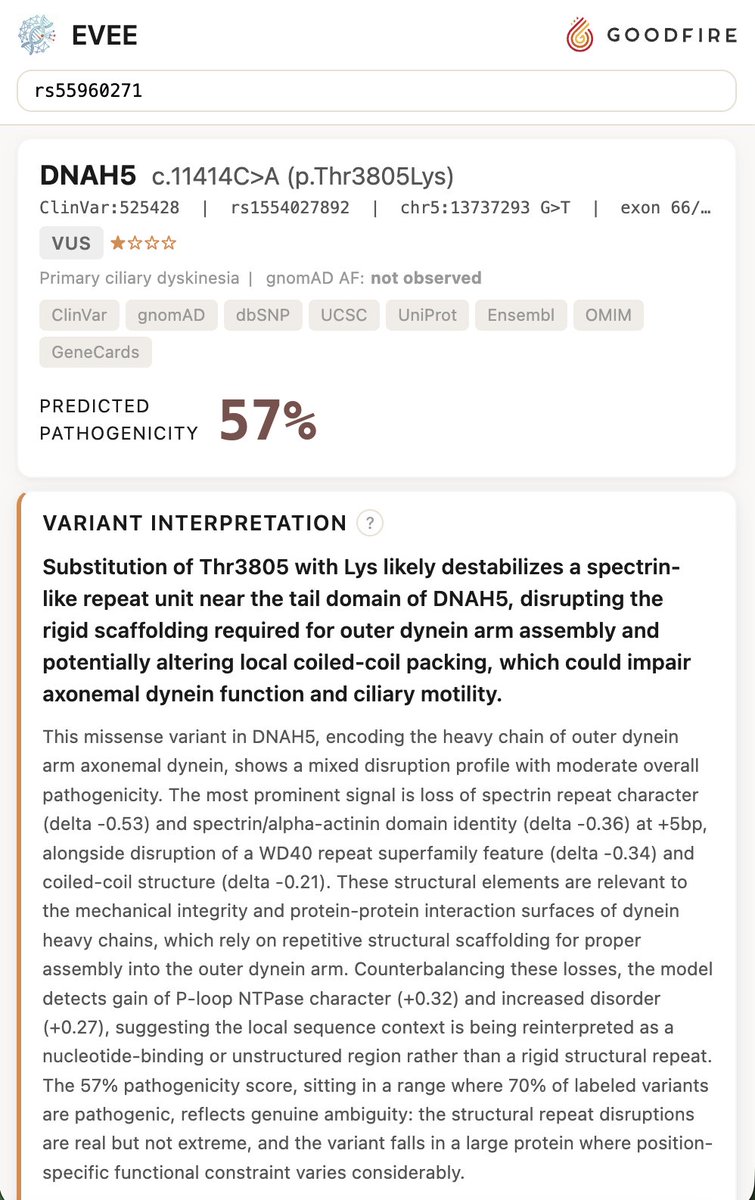
We achieved state-of-the-art performance in predicting which of 4.2 million genetic variants cause diseases by interpreting a genomics model, in a new preprint with @MayoClinic. We're now releasing an open source database for all variants in the NIH's clinvar database. 🧵(1/8)

English
1
2
36
2K
tdooms
tdooms@thomasdooms·
@madprizm0 @gen0m1cs The probe was indeed inspired by outer product memories. It's not exactly equivalent to linear attention (which is trilinear in its input while cov is bilinear). Another difference is that attention retains the sequence dim while cov pooling removes it.
English
1
0
1
89
madprizm0
madprizm0@madprizm0·
This is interesting as a probe but not really as an architectural element. Outer product memories have been around for a while --- I am glad they mention linear atttention. Continuous Thought Machines has a subsampled outer product memory (low-dim too, but I am sure the projection is better). I think attention pooling can be shown to be equivalent to covariance probe.
English
2
0
2
183
gen0m1cs
gen0m1cs@gen0m1cs·
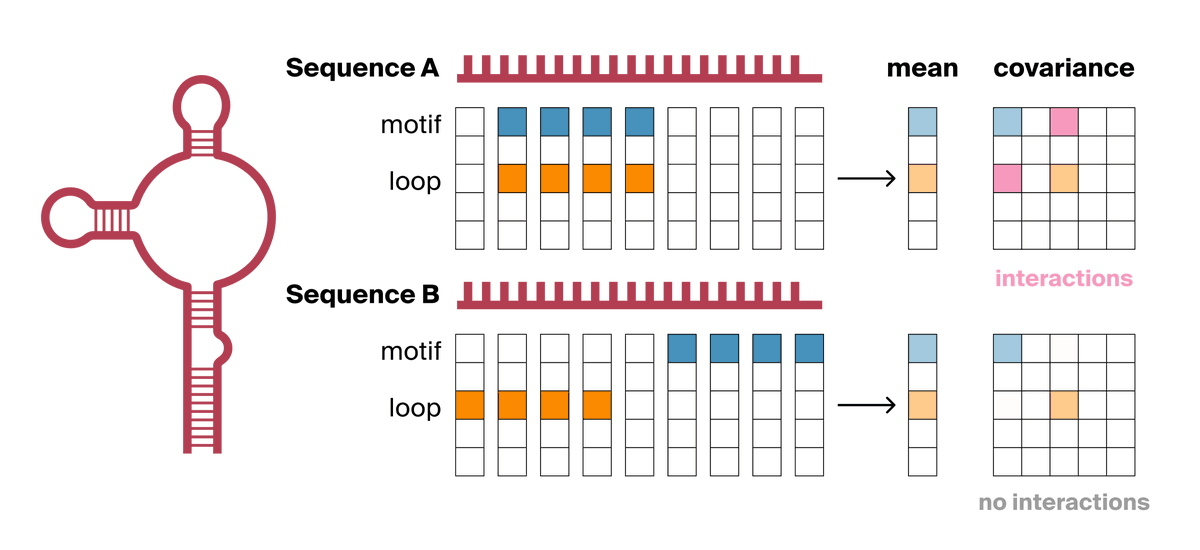
Very cool. Their covariance probe is the most interesting part here and one of the main technical contributions. Basically, instead of standard mean pooling, their method uses a compressed covariance (Gram-like) representation of the reference-alternate embedding differences, which captures second-order structure like correlations between embedding dimensions and co-occurrence patterns across the sequence (with a low-dimensional projection to keep it lightweight). I.e., variant effects aren’t fully captured by a simple additive pooled summary; part of the signal lives in this higher-order structure.
gen0m1cs tweet media
Goodfire@GoodfireAI

We achieved state-of-the-art performance in predicting which of 4.2 million genetic variants cause diseases by interpreting a genomics model, in a new preprint with @MayoClinic. We're now releasing an open source database for all variants in the NIH's clinvar database. 🧵(1/8)

English
4
2
40
5.3K
tdooms retweetet
Trevor Campbell
Trevor Campbell@TrevorCampbell_·
Already gave this a rip for some VUS and Suspected Pathogenic variants that I have previously done deep analysis on, and can confirm that EVEE posits many of the same findings and conclusions that I have found in terms of prediction and suggested failure mechanism Examples: VUS (for which *I* am the only ClinVar entry) for one of my heterozygous mutations in DNAH5 that could play a ~small~ factor in the overall root cause of my PCD My Variant of CLCN1 that gives me a rare muscular disorder (which makes me look like Wolverine without needing to go to the gym, so not all bad 🤷‍♂️) EVEE is a nice tool for variant interpretation!
Trevor Campbell tweet mediaTrevor Campbell tweet media
Goodfire@GoodfireAI

We achieved state-of-the-art performance in predicting which of 4.2 million genetic variants cause diseases by interpreting a genomics model, in a new preprint with @MayoClinic. We're now releasing an open source database for all variants in the NIH's clinvar database. 🧵(1/8)

English
3
10
70
8.9K
tdooms retweetet
Goodfire
Goodfire@GoodfireAI·
New research: we propose *covariance pooling* as a better replacement for mean pooling that improves probing for sequence-level properties. E.g., genomic model embeddings are often mean-pooled to understand genes - but that throws away all info about feature co-occurrence! (1/3)
Goodfire tweet media
English
1
30
326
35.2K
tdooms retweetet
Goodfire
Goodfire@GoodfireAI·
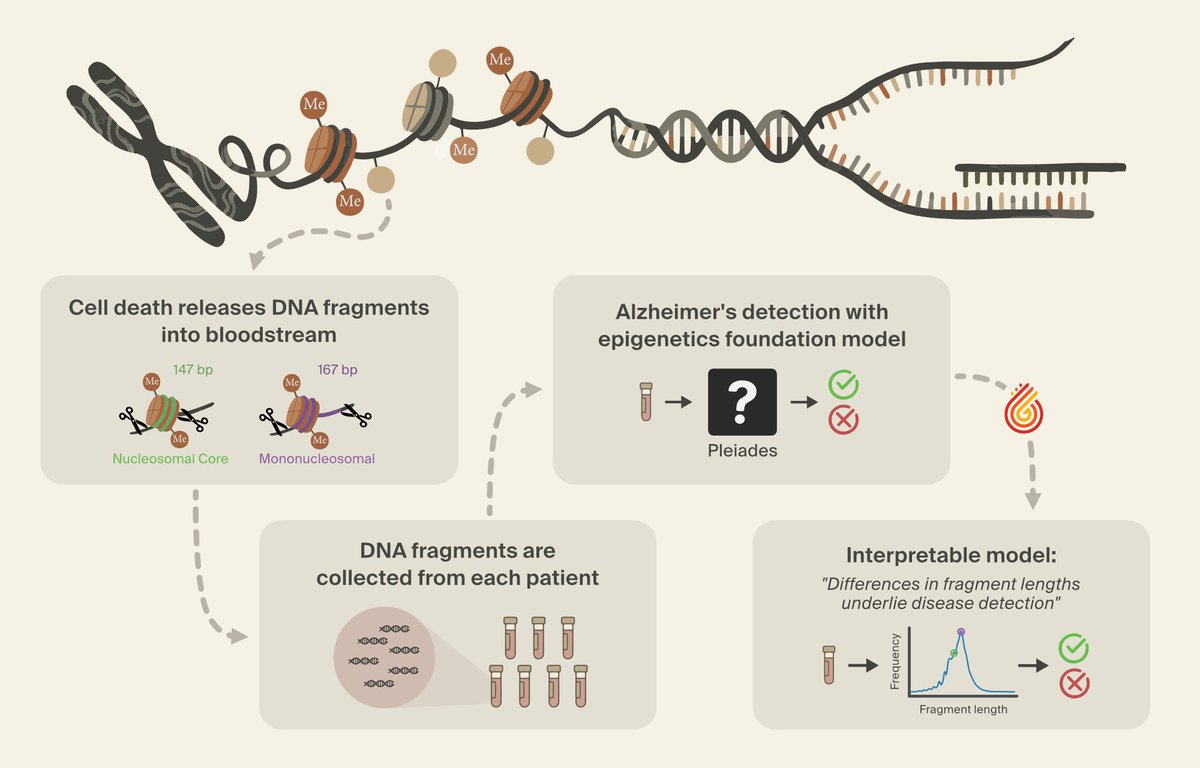
We've identified a novel class of biomarkers for Alzheimer's detection - using interpretability - with @PrimaMente. How we did it, and how interpretability can power scientific discovery in the age of digital biology: (1/6)
Goodfire tweet media
English
50
222
1.7K
395.4K
tdooms
tdooms@thomasdooms·
More broadly, if we want compositional interpretations, where interactions and geometries are explicit, we need primitives with algebraic structure. Polynomials are the natural first step beyond linear.
English
1
0
0
44
tdooms
tdooms@thomasdooms·
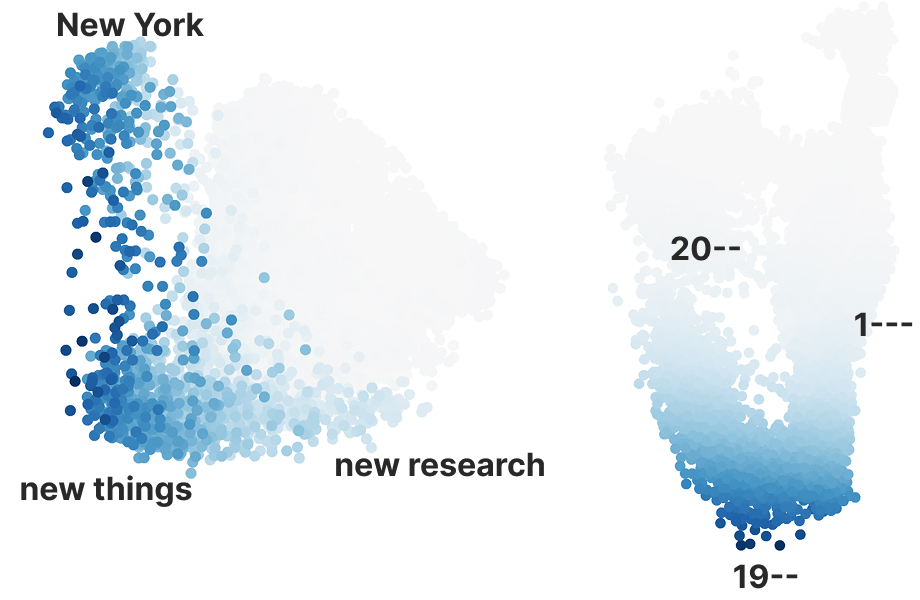
SAEs find interpretable features, but what if these aren't linearly represented? Recent work shows some concepts live on curved manifolds, not directions. How can we extract these automatically and analyze them?
tdooms tweet media
English
1
1
4
292
tdooms
tdooms@thomasdooms·
My previous work showed that bilinear layers are both interpretable and performant. This excellent paper from @norabelrose and @woog09 explains how to transform ordinary ReLU-based MLPs into polynomials, which can be similarly interpreted from their weights!
Nora Belrose@norabelrose

MLPs and GLUs are hard to interpret, but they make up most transformer parameters. Linear and quadratic functions are easier to interpret. We show how to convert MLPs & GLUs into polynomials in closed form, allowing you to use SVD and direct inspection for interpretability 🧵

English
0
0
7
191
tdooms
tdooms@thomasdooms·
Can we understand neural networks from their weights? Often, the answer is no. An MLP's activation function obscures the relationship between inputs, outputs, and weights. In our new ICLR'25 paper, we study "bilinear MLPs", a special MLP that's performant AND interpretable! 🧵
English
3
43
395
45.8K
tdooms
tdooms@thomasdooms·
(9/9) Our work shows that making models more inherently interpretable doesn't require sacrificing performance. We are excited to see how weight-based techniques can benefit interpretability!
English
1
0
10
1.3K