Crypto Nomad ➡️ Cannes 🇫🇷

1.1K posts

Crypto Nomad ➡️ Cannes 🇫🇷 banner
Crypto Nomad ➡️ Cannes 🇫🇷

Crypto Nomad ➡️ Cannes 🇫🇷

@xcryptonomad

Web3+AI x Good @ https://t.co/qYQtwX4z54 + @v_era3 + @anmlsc | Partnerships @ https://t.co/6nyxx1FtvV 👨🏼‍🎓 Global Studies 🗺 Serial Traveller

Nomad Beigetreten Haziran 2021
227 Folgt295 Follower
Angehefteter Tweet
Crypto Nomad ➡️ Cannes 🇫🇷
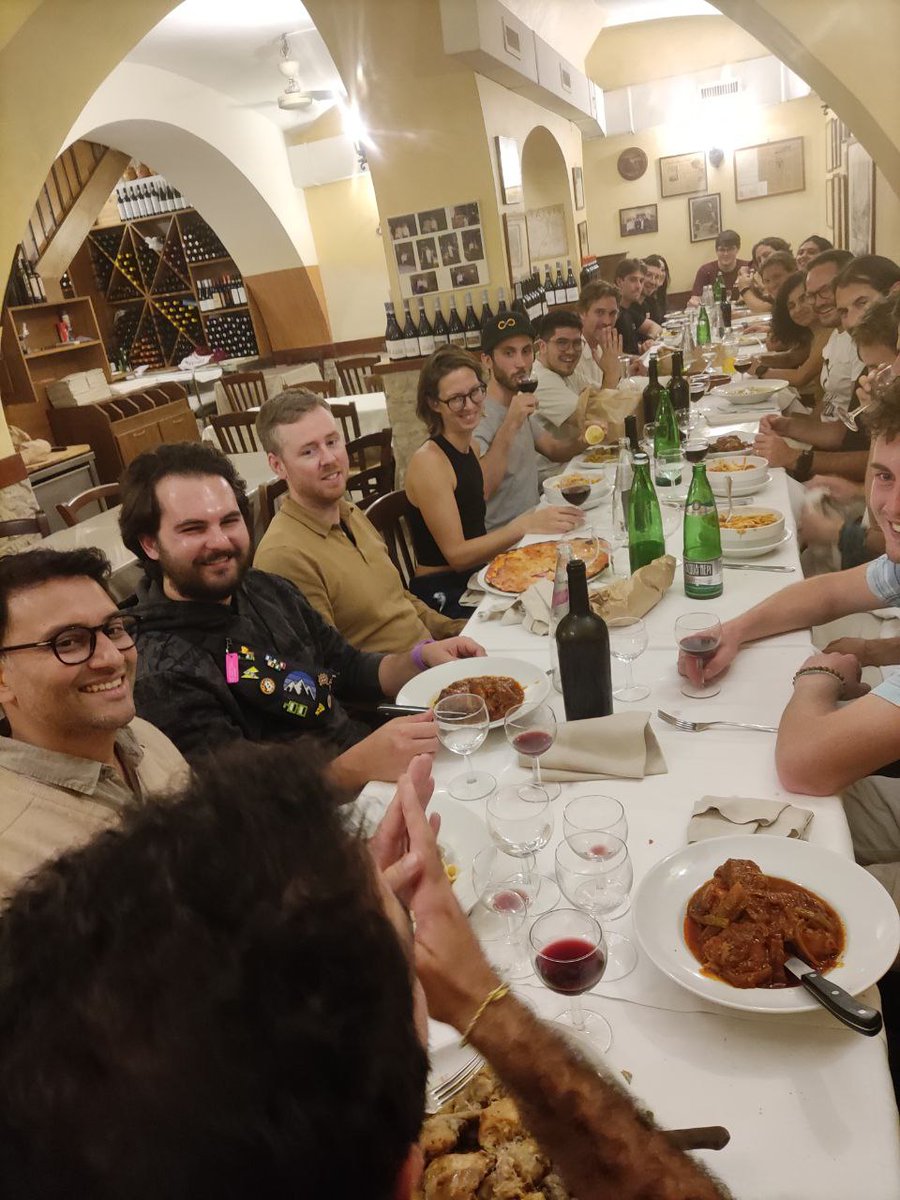
1\ 🧵 36h are so short to digest the magic last weekend in Rome... But let's try. A little dream came true after years of crazy efforts. Being surrounded by so many beautiful minds & hearts, all driving change for good - pure energy! The convergence has just started. ⚡️
Crypto Nomad ➡️ Cannes 🇫🇷 tweet mediaCrypto Nomad ➡️ Cannes 🇫🇷 tweet mediaCrypto Nomad ➡️ Cannes 🇫🇷 tweet media
English
5
4
31
928
Papaya
Papaya@papaya_fi·
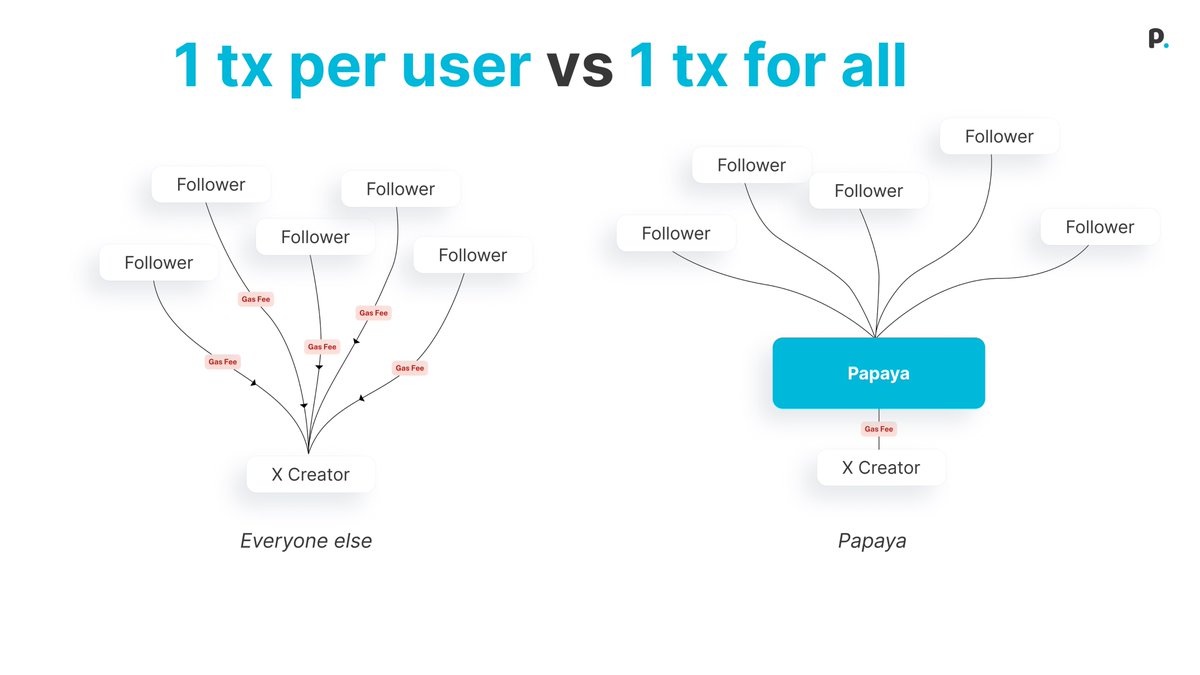
X Money wants recurring payments. We built the rails. Papaya is recurring payment infrastructure for the stablecoin economy: → Unlimited subscriptions settled in 1 tx → < $0.01 gas regardless of user count → Non-custodial, audited, live since 2024 Any platform can plug in. The infra is ready.
Papaya tweet media
Mario Nawfal@MarioNawfal

🇺🇸 Elon is working on automated recurring payments for X Money, letting users set subscriptions or bills directly inside the app. Another step toward turning X into the “everything app.”

English
1
1
9
336
Crypto Nomad ➡️ Cannes 🇫🇷 retweetet
Vera3
Vera3@v_era3·
Bringing Regenerative Finance to Rome 🌱 Proud to have hosted our friends from @ReFi_Italia bringing the 1st workshop at the new Veracura space in Rome (Viale di Scalo San Lorenzo, 67). Goal: Turn urban regeneration work of #Ridaje into verifiable impact through blockchain tech scaling trust, ops and funding. This 4-days design sprint led to: - a seed grant - an open source protocol - a defined pilot plan for 2026 Thank you @SpaghettEth, @RifaiSicilia and @LiminalVillage for your live contributions.
ReFi Italia 🇮🇹 🌳@ReFi_Italia

Come si trasforma la rigenerazione urbana e sociale in un valore per tutta la comunità? 🌿🏛️ A fine febbraio abbiamo portato il primo #ReFi Design Sprint a #Roma con #Ridaje, ospiti di @v_era3 Dall'impatto sul campo a un protocollo aperto. Vi raccontiamo com'è andata. 🧵👇

English
1
3
9
86
Papaya
Papaya@papaya_fi·
We've been quiet for a reason. Building something new on Papaya rails. Onchain. Non-custodial. Recurring. More this week.
English
3
2
10
117
urbe.eth 🐺
urbe.eth 🐺@urbeEth·
The Urbe Hub is now an official Ethereum Community Hub 🇮🇹 The Urbe Hub is officially recognized by the @ethereumfndn in collaboration with the @EFetheverywhere team, as a permanent reference point for the Ethereum ecosystem in Rome. On Feb 15, we’ll celebrate this milestone together with 1 year of Urbe Hub, which opened thanks to the support of the @AKASHAorg and has grown into a shared home for builders, developers, and communities. To mark both moments, we’re hosting an informal aperitif at the hub 🥂 No talks, no panels, just a chance to meet, connect, and celebrate together. Register via the link in the first comment 👇
urbe.eth 🐺 tweet media
English
51
31
147
19.9K
urbe.eth 🐺
urbe.eth 🐺@urbeEth·
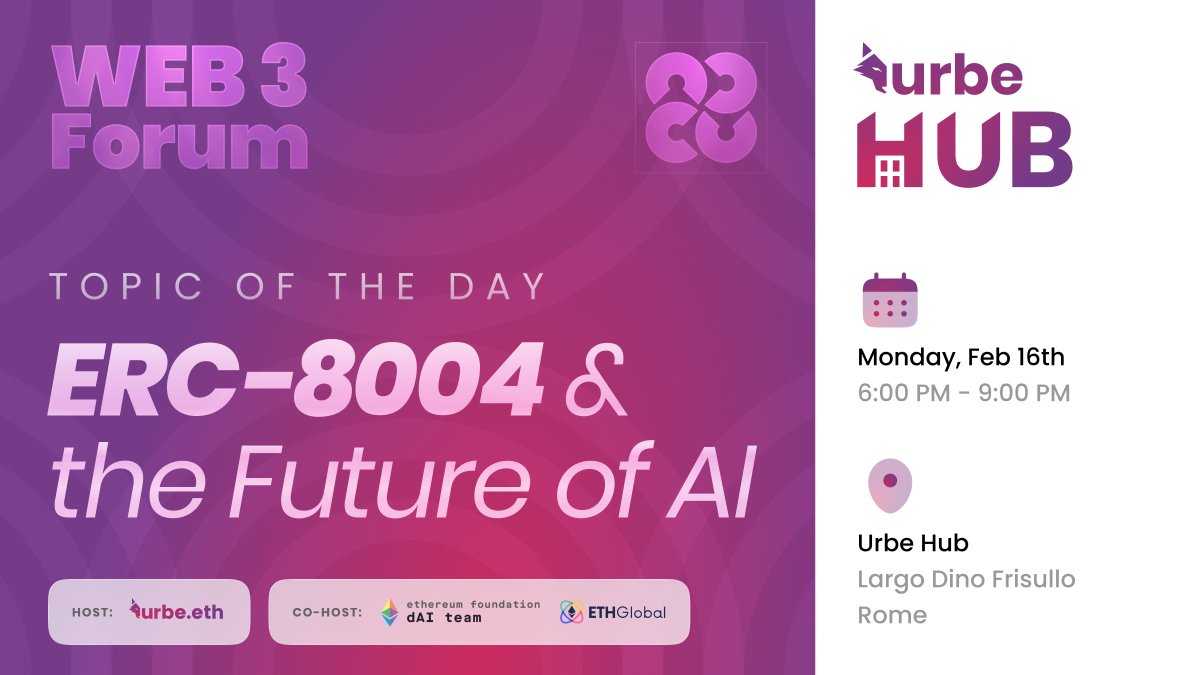
What if AI agents could be open, composable, and verifiable onchain? On Feb 16, together with @ETHGlobal, we’re hosting a Web3 Forum at Urbe Hub focused on ERC-8004, the proposed Ethereum standard for decentralized AI agents. We’ll welcome the Ethereum Foundation AI team onsite in Rome, with introductions by @DavideCrapis, @VittoStack, and @Marcello_AI, followed by a roundtable moderated by @matteoikari. 🕕 6:00 PM – 9:00 PM 🍷 Aperitif to close Register in the first comment👇
urbe.eth 🐺 tweet media
English
10
22
92
12.2K
Giveth
Giveth@Giveth·
Giveth successfully recovered over 50 ETH from TheDAO last night by migrating funds that had been sitting in an insecure contract for a decade. @404ouch, @jbaylina & @griffgreen executed the complex rescue. The ETH collected (minus gas costs) will be donated to the TheDAO Security Fund. They have agreed to return it to the people who put it there, or if unclaimed, to use it for funding Ethereum Security. We are also working on recovering the $SAI & $DGD that TheDAO holds. If you believe you may be the rightful owner of any of these funds, please reach out to Griff to coordinate a claim.
English
28
36
159
17.4K
thedao.fund
thedao.fund@thedaofund·
TheDAO is back. BULLISH A decade later, we’re opening a new chapter. TheDAO Security Fund: activating 75,000+ ETH to strengthen Ethereum security. thedao.fund
GIF
English
261
257
1.3K
484.4K
James | Snapcrackle
James | Snapcrackle@Snapcrackle·
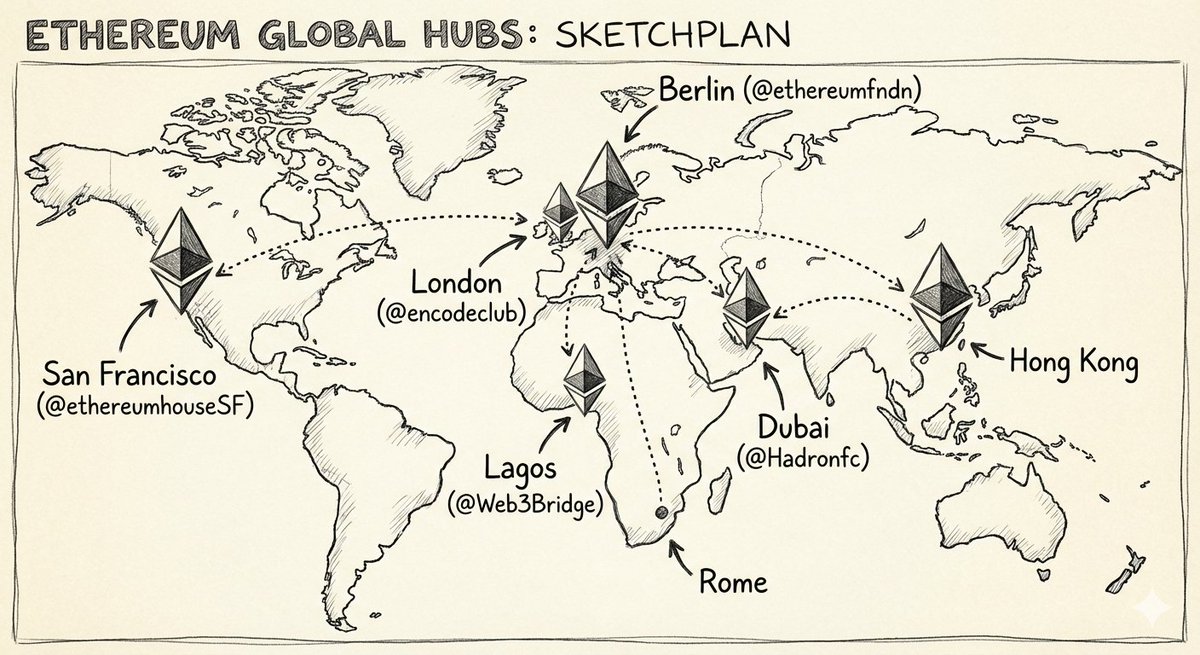
A new Ethereum Community hub has been launched every 30 days since the @EFetheverywhere team was launched. Ethereum Community hubs are special. Welcoming, events, learning places, startups, investors all meet - the aim is not to be a normal co-working. Where should we go next? We are in active conversations with many cities.
James | Snapcrackle tweet media
English
116
71
407
55.8K
Crypto Nomad ➡️ Cannes 🇫🇷 retweetet
vitalik.eth
vitalik.eth@VitalikButerin·
An important, and perenially underrated, aspect of "trustlessness", "passing the walkaway test" and "self-sovereignty" is protocol simplicity. Even if a protocol is super decentralized with hundreds of thousands of nodes, and it has 49% byzantine fault tolerance, and nodes fully verify everything with quantum-safe peerdas and starks, if the protocol is an unwieldy mess of hundreds of thousands of lines of code and five forms of PhD-level cryptography, ultimately that protocol fails all three tests: * It's not trustless because you have to trust a small class of high priests who tell you what properties the protocol has * It doesn't pass the walkaway test because if existing client teams go away, it's extremely hard for new teams to get up to the same level of quality * It's not self-sovereign because if even the most technical people can't inspect and understand the thing, it's not fully yours It's also less secure, because each part of the protocol, especially if it can interact with other parts in complicated ways, carries a risk of the protocol breaking. One of my fears with Ethereum protocol development is that we can be too eager to add new features to meet highly specific needs, even if those features bloat the protocol or add entire new types of interacting components or complicated cryptography as critical dependencies. This can be nice for short-term functionality gains, but it is highly destructive to preserving long-term self-sovereignty, and creating a hundred-year decentralized hyperstructure that transcends the rise and fall of empires and ideologies. The core problem is that if protocol changes are judged from the perspective of "how big are they as changes to the existing protocol", then the desire to preserve backwards compatibility means that additions happen much more often than subtractions, and the protocol inevitably bloats over time. To counteract this, the Ethereum development process needs an explicit "simplification" / "garbage collection" function. "Simplification" has three metrics: * Minimizing total lines of code in the protocol. An ideal protocol fits onto a single page - or at least a few pages * Avoiding unnecessary dependencies on fundamentally complex technical components. For example, a protocol whose security solely depends on hashes (even better: on exactly one hash function) is better than one that depends on hashes and lattices. Throwing in isogenies is worst of all, because (sorry to the truly brilliant hardworking nerds who figured that stuff out) nobody understands isogenies. * Adding more _invariants_: core properties that the protocol can rely on, for example EIP-6780 (selfdestruct removal) added the property that at most N storage slots can be changedakem per slot, significantly simplifying client development, and EIP-7825 (per-tx gas cap) added a maximum on the cost of processing one transaction, which greatly helps ZK-EVMs and parallel execution. Garbage collection can be piecemeal, or it can be large-scale. The piecemeal approach tries to take existing features, and streamline them so that they are simpler and make more sense. One example is the gas cost reforms in Glamsterdam, which make many gas costs that were previously arbitrary, instead depend on a small number of parameters that are clearly tied to resource consumption. One large-scale garbage collection was replacing PoW with PoS. Another is likely to happen as part of Lean consensus, opening the room to fix a large number of mistakes at the same time ( youtube.com/watch?v=10Ym34… ). Another approach is "Rosetta-style backwards compatibility", where features that are complex but little-used remain usable but are "demoted" from being part of the mandatory protocol and instead become smart contract code, so new client developers do not need to bother with them. Examples: * After we upgrade to full native account abstraction, all old tx types can be retired, and EOAs can be converted into smart contract wallets whose code can process all of those transaction types * We can replace existing precompiles (except those that are _really_ needed) with EVM or later RISC-V code * We can eventually change the VM from EVM to RISC-V (or other simpler VM); EVM could be turned into a smart contract in the new VM. Finally, we want to move away from client developers feeling the need to handle all older versions of the Ethereum protocol. That can be left to older client versions running in docker containers. In the long term, I hope that the rate of change to Ethereum can be slower. I think for various reasons that ultimately that _must_ happen. These first fifteen years should in part be viewed as an adolescence stage where we explored a lot of ideas and saw what works and what is useful and what is not. We should strive to avoid the parts that are not useful being a permanent drag on the Ethereum protocol. Basically, we want to improve Ethereum in a way that looks like this:
YouTube video
YouTube
vitalik.eth tweet media
English
664
527
3.7K
379.1K
Crypto Nomad ➡️ Cannes 🇫🇷 retweetet
vitalik.eth
vitalik.eth@VitalikButerin·
Welcome to 2026! Milady is back. Ethereum did a lot in 2025: gas limits increased, blob count increased, node software quality improved, zkEVMs blasted through their performance milestones, and with zkEVMs and PeerDAS ethereum made its largest step toward being a fundamentally new and more powerful kind of blockchain (more on this later) But we have a challenge: Ethereum needs to do more to meet its own stated goals. Not the quest of "winning the next meta" regardless of whether it's tokenized dollars or political memecoins, not arbitrarily convincing people to help us fill up blockspace to make ETH ultrasound again, but the mission: To build the world computer that serves as a central infrastructure piece of a more free and open internet. We're building decentralized applications. Applications that run without fraud, censorship or third-party interference. Applications that pass the walkaway test: they keep running even if the original developers disappear. Applications where if you're a user, you don't even notice if Cloudflare goes down - or even if all of Cloudflare gets hacked by North Korea. Applications whose stability transcends the rise and fall of companies, ideologies and political parties. And applications that protect your privacy. All this - for finance, and also for identity, governance and whatever other civilizational infrastructure people want to build. These properties sound radical, but we must remember that a generation ago any wallet, kitchen appliance, book or car would fulfill every single one of them. Today, all of the above are by default becoming subscription services, consigning you to permanent dependence on some centralized overlord. Ethereum is the rebellion against this. To achieve this, it needs to be (i) usable, and usable at scale, and (ii) actually decentralized. This needs to happen at both (a) the blockchain layer, including the software we use to run and talk to the blockchain, and (b) the application layer. All of these pieces must be improved - they are already being improved, but they must be improved more. Fortunately, we have powerful tools on our side - but we need to apply them, and we will. Wishing everyone an exciting 2026. Milady.
English
2.9K
2.1K
13.4K
1.4M
vitalik.eth
vitalik.eth@VitalikButerin·
This is what I worry Europe will get negatively polarized into: an ideology taking pride in a neat, sanitized online environment free of evil corporate and fascist pathogens. I hope European govs do not go this way, and instead take a Pirate Party approach of user empowerment. First, what's wrong with the tweet I'm quoting: The idea that there should be "no space" for something you dislike is fundamentally a totalitarian and anti-pluralistic impulse. It's incompatible with being in an environment that you do not fully control. This is especially true for categories that are subjective and controversial, because you end up trying to fully remove things you think are pathogens, when other people have good faith disagreements, and because you give yourself the maximalist goal of not even giving them breathing room, you create conflict and end up building the machinery of technocratic authoritarianism to impose your victory in the conflict. So sorry, if you want to be a free society, you have to bite the bullet that some people, somewhere, will be selling things that you consider dangerous and saying things you consider disinformation and vicious lies. What is the goal to shoot for? You want to create an environment where those things don't dominate. This is the problem with twitter today: not that it's a safe space where 1000 people talk to each other in a corner about how heritage americans are the master race and putin is good or whatever, but that that crap gets shoved in our face on a mass scale, and the algorithms actively favor it. The right metaphor is not castles and walls, but biological - think, why European forests don't have tropical lizards. Having incentives for social media platforms to have less of those things instead of more is fundamentally reasonable, @audreyt has talked about how Taiwan has done something similar. You also want to do this in a way where it's clear what the underlying principle is, so it's not a vehicle for imposing arbitrary and frequently changing expert-consensus agendas. You also want to empower users, rather than working against them. People want to see and buy good things instead of bad things. Often the problem is that competition is too difficult in the current market. I actually supported the USB-C standardization mandate; it created more interoperability and thus improved competition and convenience. I would support incentivizing social platforms to be more open, and to be more transparent (eg. my proposal to require algorithms to be continuously published with a 1-2 year delay, with zk-proofs to ensure that the algorithm being used in real time exactly equals the one that gets published later) Being able to better identify what messages are coming from what communities is also good, though I don't support the direction of banning anonymity of individual posters, rather I would want to see more macro-scale analytics, eg. seeing what communities are most strongly saying and amplifying content that semantically matches a particular idea; this can be done in privacy-preserving ways. There is a real opportunity to reaffirm freedom of speech in a unique and different way, that emphasizes pluralism and pushes against unbalanced attempts to manipulate the discourse by individual powerful actors. We want to do this, not go down the dark path of having something that claims to support fundamental rights but actually is not trusted by anyone to be anything other than the fundamental right to follow the footsteps of a few technocratic experts.
Digital EU 🇪🇺@DigitalEU

𝗡𝗢 space for cyberbullying. 𝗡𝗢 space for dangerous products. 𝗡𝗢 space for hate speech. 𝗡𝗢 space for scams. 𝗬𝗘𝗦. With the Digital Services Act, what is illegal offline remains illegal online. 🔗 link.europa.eu/gbRf9h

English
642
842
5.2K
627.1K
urbe.eth 🐺
urbe.eth 🐺@urbeEth·
We’re wrapping up our Arbitrum DAO Grant for Urbe Campus @ Devconnect. This marked the first-ever Urbe Campus in Latin America, focused on onboarding new builders in Buenos Aires. Thanks to @Arbitrum for enabling us to bring Arbitrum everywhere, onboarding new builders through accessible, hands-on education.
urbe.eth 🐺 tweet media
English
2
2
15
502
Crypto Nomad ➡️ Cannes 🇫🇷 retweetet
Web3Privacy Now
Web3Privacy Now@web3privacy·
UNITED IN PRIVACY The importance of collaboration 🧩🧩 @vpavlin x @Logos_network, @brewster_kahle x @internetarchive, T. Brown x @germnetwork, A. Ozdemir x @Stanford, @NanakNihal x @humntech, R. Fraser x @BKCHarvard, @AndyGuzmanEth x @PrivacyEthereum, @jaromil x @DyneOrg, @mishmosh x @IPFS, @alexis_roussel x @nym, @alisher x @Keycard_ Only together are we strong. Shot by @BabyBitProd at Cypherpunk Retreat—our exclusive C-level gathering organized with @protocollabs
English
7
15
76
5.5K