Post

NASA Space Alerts
NASA Space Alerts@NASASpaceAlerts·
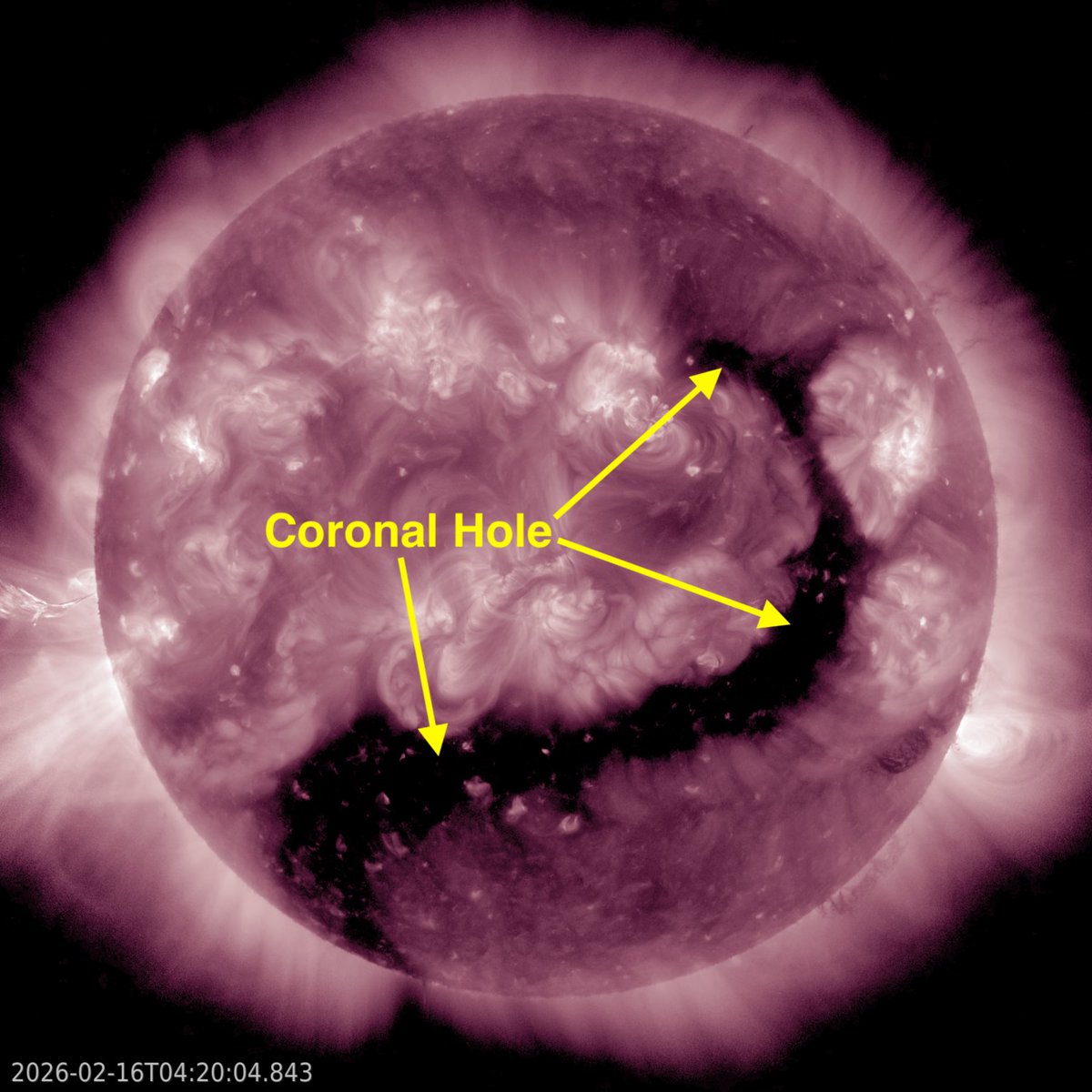
It’s #SunDay! Here’s your space weather report for the week of Feb. 13 - 19: •2 M-class flares •2 C-class flares •40 coronal mass ejections •1 geomagnetic storm This video from NASA’s Solar Dynamics Observatory (SDO) shows the week’s activity. This week’s moderate (G2 class) geomagnetic storm on Feb. 16 lit up auroras as far south as New York and Wisconsin. The storm was caused by a high-speed stream of solar wind flowing from a massive coronal hole on the Sun, which you can partly see in this video but is best seen in a different wavelength channel from SDO. 👇
English
15
114
436
15.2K
NASA Space Alerts
NASA Space Alerts@NASASpaceAlerts·
This image shows the coronal hole as it appeared on Feb. 16 in the 211-angstrom wavelength from NASA’s Solar Dynamics Observatory. This channel highlights solar material at temperatures of about 3.6 million degrees Fahrenheit (2 million degrees Celsius). Coronal holes are darker, cooler regions in the Sun’s outer atmosphere, known as the corona. In these areas, the Sun’s magnetic field opens outward into space rather than looping back to the solar surface. These open magnetic field lines allow charged particles to escape more easily, producing fast-moving streams of solar wind. When a high-speed solar wind stream reaches Earth, it can compress Earth’s magnetic field and enhance geomagnetic activity, sometimes leading to geomagnetic storms. 📸 SDO/Alex Young
NASA Space Alerts tweet media
English
0
17
99
6.3K
Share