Ammanichanda

54.5K posts

Ammanichanda banner
Ammanichanda

Ammanichanda

@Arkasiraee

Master the Know How | Industrial systems | Energy | Technology | Geopolitics | Financial Markets 7 minute deep dives into how the world actually works

Paris, France Joined Temmuz 2015
713 Following1.6K Followers
Pinned Tweet
Ammanichanda
Ammanichanda@Arkasiraee·
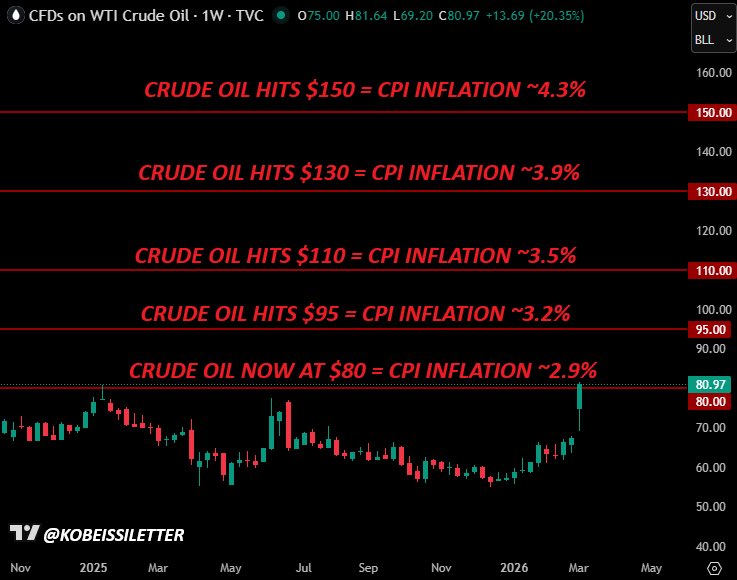
My clear prediction as to when USA will call off the war on IRAN and announce a ceasefire ? By reading is between March 20th - March 24th, 2026 As to why I can come up with this ? According to a recent Fed study, every $10 rally in oil prices can increase inflation by 20 bps. Oil has already surged from $55 to $80 per barrel, implying +50 bps of inflation pressure. This could push CPI from 2.4% to 2.9%. When oil prices rise above $90/barrel inflation becomes hotter, with 3.2% inflation expected at $95/barrel. The chart below Article summarize why oil prices are now the key leading indicator to watch. Inflation is heating up. The one thing Trump desperately wants in the USA is low Inflation so that he can ask the FED to drop rates by 100bps and create a massive rally by October 2026 to be able to win the Mid term elections. This will not happen if he continues this offensive on Iran at the current rate where USA is burning $4-4.25 Billion dollars of tax payers money a day. Trump will come on TV and announce a ceasefire within the next 10 - 15 days. Bookmark this and you will not regret following me.
Ammanichanda tweet media
English
10
13
60
10.3K
Ammanichanda
Ammanichanda@Arkasiraee·
2.3 million barrels per day saved” sounds big until you zoom out. Global oil demand in 2025 still increased to roughly 103–104 million barrels per day, up about 1–1.5 million bpd year over year. Supply rose right alongside it, led by the OPEC+ group and record output from the United States. So EVs are offsetting some growth, not reversing it. The reality is we are adding electric cars and consuming more oil at the same time. The fact is 1.5 million barrels of extra oil was produced per day and used in 2025 more than ever before and is still growing at pace. EV production has offset a very minute amount of carbon emissions.
English
0
0
0
187
Pubity
Pubity@pubity·
In 2025, electric vehicles saved an estimated 2.3 million barrels of oil per day from being used compared to if those were gas vehicles. Electric cars are starting to have a huge impact on saving the planet.
Pubity tweet mediaPubity tweet media
English
13
8
157
4.5K
Ammanichanda
Ammanichanda@Arkasiraee·
The human brain runs on just 12 watts. An AI system attempting comparable cognitive tasks today can require up to 2.7 billion watts across data centers, chips, and cooling infrastructure. That gap isn’t just technological. It’s evolutionary. Over hundreds of thousands of years, across more than 500 generations and millions of biological iterations, the human brain has been relentlessly optimized for efficiencys Every neuron, every synapse, every pathway has been shaped by survival pressure. Energy was scarce. Efficiency was not optional, Over Millions of iterations the efficiency was built to improve survival against the odds. The result is the most power-efficient general intelligence system ever known. It can process vision, language, motion, emotion, and abstract reasoning in real time, all while running on the energy equivalent of a dim light bulb. AI, by contrast, is still in its early industrial phase. There’s a fundamental reason why building artificial intelligence is progressing faster than creating robots that truly match the human body. The human brain, while extraordinarily complex, has evolved primarily for information processing over hundreds of thousands of years. But the human body is the result of a far longer evolutionary journey, refined over millions of years to achieve balance, dexterity, energy efficiency, and adaptability in the physical world. Movement, touch, coordination, and real time response to an unpredictable environment require an intricate integration of muscles, sensors, and control systems that we still struggle to replicate. In contrast, AI can scale through data and compute, but robotics must solve the far harder challenge of recreating a system that evolution has been optimizing for far longer. Modern systems achieve intelligence through brute force. Massive data. Massive compute. Massive energy. Where biology optimized through evolution, AI is scaling through electricity. But this gap will not remain forever. Advances in neuromorphic computing, chip design, and model efficiency are already pushing toward lower power consumption per unit of intelligence. What evolution took hundreds of thousands of years to refine, engineering is now attempting to compress into decades. The trajectory is clear, AI may take 50 to 100 years to approach the energy efficiency of the human brain. And when it does, the implications will be profound. Because intelligence will no longer be constrained by power, cost, or scale. At that point, the question shifts from can we build intelligence to how much intelligence can we afford to deploy everywhere.
English
0
0
0
43
Kekius Maximus
Kekius Maximus@Kekius_Sage·
🚨 The human brain runs on just 12 watts, while an AI system doing the same job could require 2.7 billion watts. Researchers are trying to close this gap.
Kekius Maximus tweet mediaKekius Maximus tweet media
English
97
41
375
9.9K
Ammanichanda
Ammanichanda@Arkasiraee·
Let me explain what’s really happening here. This isn’t just about automation anymore. It’s about ownership. Over the past decade, Jeff Bezos helped scale a system where warehouses are increasingly run by 750,000+ robots, checkout lines are replaced by cameras, and delivery is being pushed toward drones and autonomous systems. Now the play is evolving. Raising tens of billions isn’t about building new factories from scratch. It’s about acquiring existing ones and redesigning them from the inside out. Not to run them the old way. To rebuild them with minimal human labor. This is vertical integration at a different level. First, physical retail was disrupted. Then logistics was optimized and automated. Now manufacturing itself is becoming the next frontier. And this is where it gets uncomfortable. For years, the assumption was:- “Automation can take retail, maybe warehouses… but factories still need human hands.” That assumption is breaking. Robotics, computer vision, and AI-driven systems are now reaching a point where repetitive, precision-based factory work can be scaled with far fewer workers. So the question is no longer if factories automate. It’s who controls that transition. Because when capital acquires production capacity at scale, it doesn’t just improve efficiency. It resets the labor equation entirely. This isn’t about replacing jobs overnight. It’s about gradually redesigning entire industries so fewer people are needed at every step. Your factory job may have survived globalisation. It may have survived recessions. It may have survived pandemics. But this shift is different. Because it’s not about moving jobs somewhere else. It’s about redesigning the system so the jobs don’t exist in the same way anymore.
Ammanichanda tweet media
English
0
0
0
48
Bloomberg
Bloomberg@business·
Amazon founder Jeff Bezos is in talks to raise $100 billion for a fund to acquire manufacturing companies and infuse them with artificial intelligence, the Wall Street Journal reported bloomberg.com/news/articles/…
English
9
17
89
15.2K
Ammanichanda
Ammanichanda@Arkasiraee·
Let me explain what’s really happening here. This isn’t just about automation anymore. It’s about ownership. Over the past decade, Jeff Bezos helped scale a system where warehouses are increasingly run by 750,000+ robots, checkout lines are replaced by cameras, and delivery is being pushed toward drones and autonomous systems. Now the play is evolving. Raising tens of billions isn’t about building new factories from scratch. It’s about acquiring existing ones and redesigning them from the inside out. Not to run them the old way. To rebuild them with minimal human labor. This is vertical integration at a different level. First, physical retail was disrupted. Then logistics was optimized and automated. Now manufacturing itself is becoming the next frontier. And this is where it gets uncomfortable. For years, the assumption was:- “Automation can take retail, maybe warehouses… but factories still need human hands.” That assumption is breaking. Robotics, computer vision, and AI-driven systems are now reaching a point where repetitive, precision-based factory work can be scaled with far fewer workers. So the question is no longer if factories automate. It’s who controls that transition. Because when capital acquires production capacity at scale, it doesn’t just improve efficiency. It resets the labor equation entirely. This isn’t about replacing jobs overnight. It’s about gradually redesigning entire industries so fewer people are needed at every step. Your factory job may have survived globalisation. It may have survived recessions. It may have survived pandemics. But this shift is different. Because it’s not about moving jobs somewhere else. It’s about redesigning the system so the jobs don’t exist in the same way anymore.
English
0
1
1
492
unusual_whales
unusual_whales@unusual_whales·
BREAKING: Jeff Bezos is reportedly in talks to raise $100B for a new fund aimed at acquiring manufacturing firms and automating them with AI, per WSJ.
English
195
235
1.7K
1M
Spencer Hakimian
Spencer Hakimian@SpencerHakimian·
🚨BREAKING: AN F35 WAS HIT FOR THE FIRST TIME EVER
Spencer Hakimian tweet media
English
61
173
1.6K
23K
Ammanichanda
Ammanichanda@Arkasiraee·
@clashreport Every single day that this war goes on, the more the economic damage just compounds.
Ammanichanda tweet media
English
1
0
2
2.5K
Clash Report
Clash Report@clashreport·
Reporter: Could you continue this war without the United States? Netanyahu: You’ve exhausted your questions.
English
64
188
1.1K
143.9K
Ammanichanda
Ammanichanda@Arkasiraee·
@TheStalwart Netanyahu has the cards, He will decide when the war will end. Understand the game and the one who has leverage decides.
English
0
0
0
264
Joe Weisenthal
Joe Weisenthal@TheStalwart·
*NETANYAHU: WAR WILL END LOT FASTER THAN PEOPLE THINK
English
60
52
487
77.2K
Ammanichanda
Ammanichanda@Arkasiraee·
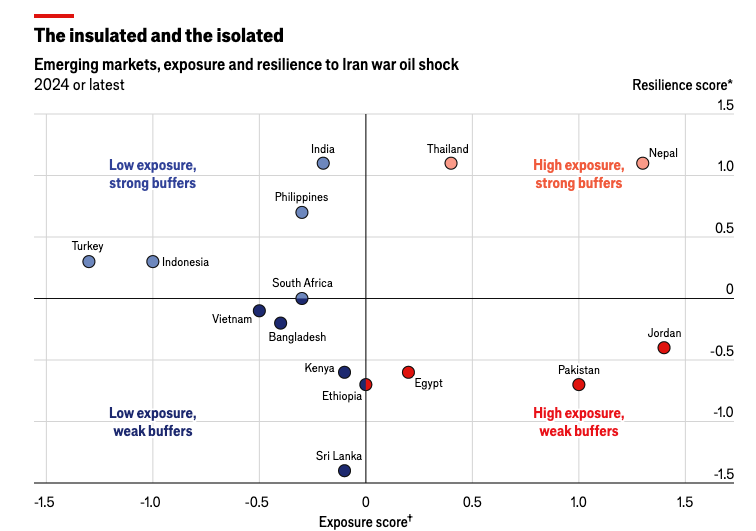
Ripple effects of War, The Insulated and the Isolated:- Emerging Markets on the Edge of an Oil Shock. - Emerging markets are not all created equal when it comes to absorbing a sustained oil shock from escalating Middle East tensions. As crude oil surges, the first and second-order effects are already visible in industrial production, supply chains, and household incomes. - The most well-insulated economies, such as India, the Philippines, Turkey, and Indonesia, benefit from diversified energy imports, domestic production, and robust fiscal and monetary buffers. These nations can absorb price shocks with minimal disruption, maintaining industrial activity while others struggle. Temporary price surges may even enhance their regional competitiveness. - At the other extreme, highly vulnerable countries like Jordan, Pakistan, and Egypt face severe exposure with limited resilience. Factories have begun partial shutdowns, initially one day per week, and some are now approaching two-day shutdowns, cascading into lost industrial output, stalled exports, and disrupted supply chains. Millions of workers in energy-intensive sectors face reduced incomes, layoffs, or even permanent job loss. - Countries on the edge, such as Vietnam and Bangladesh, tell a nuanced story. Despite previous gains in manufacturing competitiveness, sustained high oil prices threaten to reverse years of economic progress. Factory shutdowns, rising input costs, and unreliable electricity supply heavily dependent on diesel generators amplify the economic pain. Even low-exposure nations with weak buffers risk significant regression if high oil prices persist. - First-order effects include immediate industrial shutdowns, rising production costs, and supply chain delays. Second-order effects unfold over weeks to months, eroding competitiveness, slowing technological adoption, weakening foreign investor confidence, and potentially triggering social unrest in structurally fragile economies. My reading is that such an incredibly sudden spike in oil prices from around $60–$65 per barrel to $110–$115 in just 20 days combined with continued high prices, could effectively devastate small and vulnerable economies. Countries that were already fragile or heavily dependent on energy imports, such as Bangladesh, Vietnam, and Pakistan, face tens of billions in cumulative economic losses within weeks. Meanwhile, large economies like India and China have the financial might to secure enormous quantities of crude at lower effective prices, as seen during the Russian oil sanctions when India purchased nearly 100 million barrels of sanctioned Russian oil and continues to receive millions of barrels at $95 per barrel while market prices hover above $105. This asymmetry amplifies the shock:- Smaller nations have negligible buying power, forcing industrial shutdowns to extend and potentially evolve into full halts. Diesel-reliant manufacturing faces skyrocketing input costs, with fuel prices rising 25–35% across vulnerable economies, while India maintains stable prices. As a result, industrial production may collapse, competitiveness erodes, and manufacturing may relocate to stronger economies like China and India. If this scenario persists over one to two months, the most exposed countries could lose a full year of economic progress, creating a cascade of economic collapses across multiple emerging markets within the next six months to a year.
Ammanichanda tweet media
English
0
1
2
429
Ammanichanda
Ammanichanda@Arkasiraee·
Meanwhile, Iran’s Islamic Revolutionary Guard Corps (IRGC) has released a video claiming to show the targeting of an American F-35A/B Lightning ll with a surface-to-air missile in the skies over Iran. This claim by the IRGC follows reports that a F-35 was damaged and forced to make an “emergency landing” at an air base in the Middle East due to hostile fire over Iran.
English
0
3
53
2.3K
Clash Report
Clash Report@clashreport·
Trump lies: Their Navy is gone. Their Air Force is gone. Their anti-aircraft equipment is gone. We’re flying wherever we want. Nobody is even shooting at us.
English
183
216
1.3K
184.7K
Ammanichanda
Ammanichanda@Arkasiraee·
🚨🚨This is unprecedented, If confirmed true, first Surface to Air kill of an American Stealth Fighter Aircraft F - 35 Iran’s Islamic Revolutionary Guard Corps (IRGC) has released a video claiming to show the targeting of an American F-35A/B Lightning ll with a surface-to-air missile in the skies over Iran. This claim by the IRGC follows reports that a F-35 was damaged and forced to make an “emergency landing” at an air base in the Middle East due to hostile fire over Iran.
English
0
0
0
136
Ammanichanda
Ammanichanda@Arkasiraee·
@BRICSinfo Iran's state news agency releases footage it says is of a U.S. F-35 being hit by a surface-to-air missile.
English
1
0
20
2.5K
BRICS News
BRICS News@BRICSinfo·
JUST IN: 🇺🇸🇮🇱 President Trump says he told Prime Minister Netanyahu not to strike Iranian gas fields. "We're independent, we get along great… On occasion he'll do something…I don't like."
English
252
468
3.9K
329.8K
Ammanichanda
Ammanichanda@Arkasiraee·
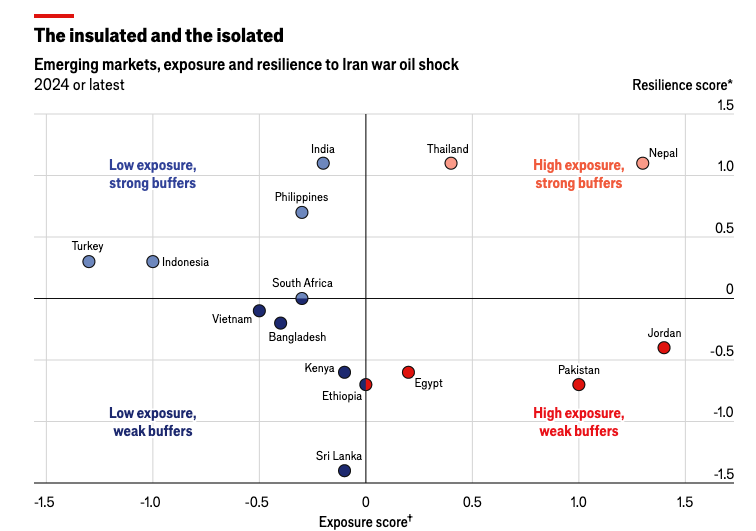
Ripple effects of War, The Insulated and the Isolated:- Emerging Markets on the Edge of an Oil Shock. - Emerging markets are not all created equal when it comes to absorbing a sustained oil shock from escalating Middle East tensions. As crude oil surges, the first and second-order effects are already visible in industrial production, supply chains, and household incomes. - The most well-insulated economies, such as India, the Philippines, Turkey, and Indonesia, benefit from diversified energy imports, domestic production, and robust fiscal and monetary buffers. These nations can absorb price shocks with minimal disruption, maintaining industrial activity while others struggle. Temporary price surges may even enhance their regional competitiveness. - At the other extreme, highly vulnerable countries like Jordan, Pakistan, and Egypt face severe exposure with limited resilience. Factories have begun partial shutdowns, initially one day per week, and some are now approaching two-day shutdowns, cascading into lost industrial output, stalled exports, and disrupted supply chains. Millions of workers in energy-intensive sectors face reduced incomes, layoffs, or even permanent job loss. - Countries on the edge, such as Vietnam and Bangladesh, tell a nuanced story. Despite previous gains in manufacturing competitiveness, sustained high oil prices threaten to reverse years of economic progress. Factory shutdowns, rising input costs, and unreliable electricity supply heavily dependent on diesel generators amplify the economic pain. Even low-exposure nations with weak buffers risk significant regression if high oil prices persist. - First-order effects include immediate industrial shutdowns, rising production costs, and supply chain delays. Second-order effects unfold over weeks to months, eroding competitiveness, slowing technological adoption, weakening foreign investor confidence, and potentially triggering social unrest in structurally fragile economies. My reading is that such an incredibly sudden spike in oil prices from around $60–$65 per barrel to $110–$115 in just 20 days combined with continued high prices, could effectively devastate small and vulnerable economies. Countries that were already fragile or heavily dependent on energy imports, such as Bangladesh, Vietnam, and Pakistan, face tens of billions in cumulative economic losses within weeks. Meanwhile, large economies like India and China have the financial might to secure enormous quantities of crude at lower effective prices, as seen during the Russian oil sanctions when India purchased nearly 100 million barrels of sanctioned Russian oil and continues to receive millions of barrels at $95 per barrel while market prices hover above $105. This asymmetry amplifies the shock:- Smaller nations have negligible buying power, forcing industrial shutdowns to extend and potentially evolve into full halts. Diesel-reliant manufacturing faces skyrocketing input costs, with fuel prices rising 25–35% across vulnerable economies, while India maintains stable prices. As a result, industrial production may collapse, competitiveness erodes, and manufacturing may relocate to stronger economies like China and India. If this scenario persists over one to two months, the most exposed countries could lose a full year of economic progress, creating a cascade of economic collapses across multiple emerging markets within the next six months to a year.
Ammanichanda tweet media
English
0
0
0
124
Javier Blas
Javier Blas@JavierBlas·
Well, I did not anticipate this: *BESSENT: US MAY UNSANCTION IRANIAN OIL THAT’S ON WATER
English
234
818
4.2K
1.1M
Ammanichanda
Ammanichanda@Arkasiraee·
Nobody is asking why Bitcoin rallied during a war. The answer is Iran. - Iran mines Bitcoin for $1,300 per coin. The cheapest on earth. - The IRGC runs the operation. Every coin gets sold to fund imports and bypass US sanctions. - They’ve been dumping tens of thousands of BTC on the open market for years. Constant invisible sell pressure. - Then the US bombed their power grid. Mining went offline overnight. The hashrate dropped within hours. - The sell pressure that nobody knew existed just vanished. The US accidentally made Bitcoin more scarce by bombing the world’s cheapest mining operation. And nobody is connecting the dots.
English
0
0
0
65
unusual_whales
unusual_whales@unusual_whales·
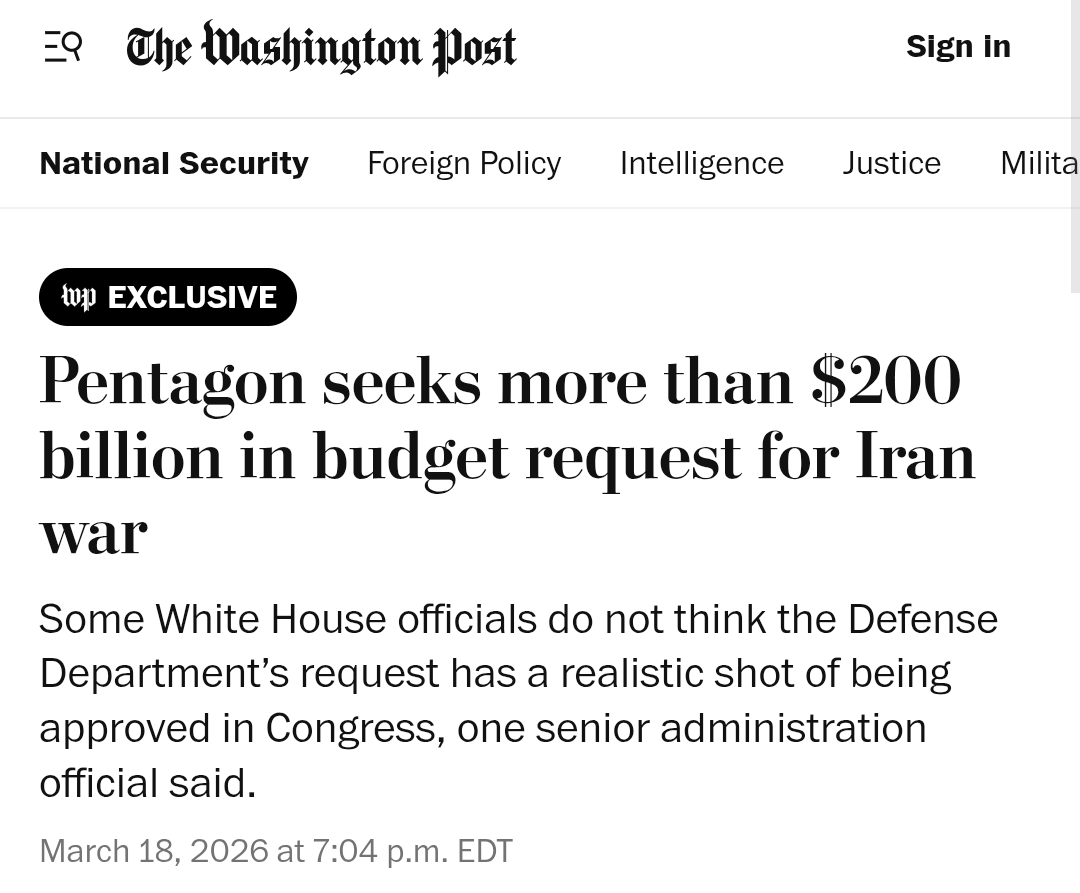
Secretary Hegseth on Pentagon request for Iran war supplemental of $200 billion: "As far as $200 billion. I think that number could move. Obviously, it takes it takes money to kill bad guys."
English
108
22
284
79.4K
Ammanichanda
Ammanichanda@Arkasiraee·
The idea that the U.S. is insulated from this shock is fundamentally flawed. The price gap between Brent and WTI may suggest a temporary domestic cushion, but the U.S. is the largest consumer economy in the world, deeply dependent on global supply chains. It doesn’t matter where the oil shock originates, the cost transmission is global and unavoidable. What we are seeing is not insulation, it is a delayed pass-through effect that is already in motion. - The surge of $50–60 per barrel in less than a month is too large for global manufacturers to absorb through margins. - Export-driven economies will pass these costs directly into goods and services shipped to the U.S. - American import prices will rise across the board, from industrial inputs to consumer goods. - This leads to imported inflation, reducing real purchasing power for U.S. consumers. - Lower disposable income feeds directly into weaker demand and economic slowdown. - At the same time, rising inflation makes it harder for the Federal Reserve to cut rates. Even if the conflict ends today, the damage is already embedded in the system. Supply chains have repriced, contracts have adjusted, and higher energy costs are working their way through the pipeline. This means inflation in the U.S. will continue to rise in the coming months, not fall. The assumption that America can stay shielded while the rest of the world absorbs the shock ignores how global trade actually functions. In reality, the U.S. consumer becomes the final shock absorber. And if inflation remains elevated, the broader objective of rate cuts, a strong equity rally, and a politically favorable economic backdrop becomes significantly harder to achieve.
English
2
0
10
638
Adam Kobeissi
Adam Kobeissi@TKL_Adam·
The US is ironically relatively "shielded" from rising oil prices abroad. Crude oil prices in Oman are trading at a +$70 premium to WTI crude, hitting record highs. Meanwhile, the US gets less than 8% of its oil from the Persian Gulf, at just 500,000 barrels per day. As a result, the US is actually seeing relatively *low* oil prices at home while foreign buyers are paying $150+/barrel in some cases. According to @KobeissiLetter, US oil companies are now set to make an additional $60+ billion this year if oil prices sustain current levels. US oil giants will realize record profits.
The Kobeissi Letter@KobeissiLetter

Global oil markets are out of control: As the Iran War closes week 3, US oil prices are trading at $97/barrel, up +76% since December. Meanwhile, physical oil prices in Oman are up to a RECORD $167/barrel, a +72% PREMIUM. What is happening? Let us explain. (a thread)

English
130
133
915
209.9K
Ammanichanda
Ammanichanda@Arkasiraee·
As of March 19, 2026, there are roughly 180 to 200 million barrels of Iranian crude and condensate sitting on tankers offshore, effectively “oil on water” that has been constrained by sanctions and logistics bottlenecks. This is an unusually large floating stockpile, built up over months as Iran continued producing but faced limits in selling and transporting oil. To put that into perspective, this volume alone represents nearly 2 days of total global oil consumption, or several months of Iran’s typical export capacity. In theory, if sanctions were suddenly lifted, this oil is already loaded, already at sea, and could begin flowing into the global market much faster than new production. If fully released, this could translate into an additional 0.5 to 1.5 million barrels per day entering global supply over weeks, not instantly. It would act as a short-term supply buffer, especially in a market currently facing disruption in key flows like the Strait of Hormuz. The immediate effect would likely be psychological and pricing relief, potentially easing crude prices in the near term. However, this is finite inventory, not ongoing production, meaning once absorbed, the effect fades. More importantly, the current crisis is driven by flow disruption (shipping, insurance, geopolitics), not just lack of stored oil. Even if the U.S. were to unsanction this oil, it would not fundamentally solve the current energy shock. It could temporarily cool prices and reduce panic, but it cannot replace sustained supply or fix disrupted trade routes.
Ammanichanda tweet media
English
0
0
6
1.2K
BRICS News
BRICS News@BRICSinfo·
JUST IN: 🇺🇸🇮🇷 Treasury Secretary Bessent says US may unsanction Iranian oil on tankers to lower prices.
English
227
313
2.1K
181.2K
Ammanichanda
Ammanichanda@Arkasiraee·
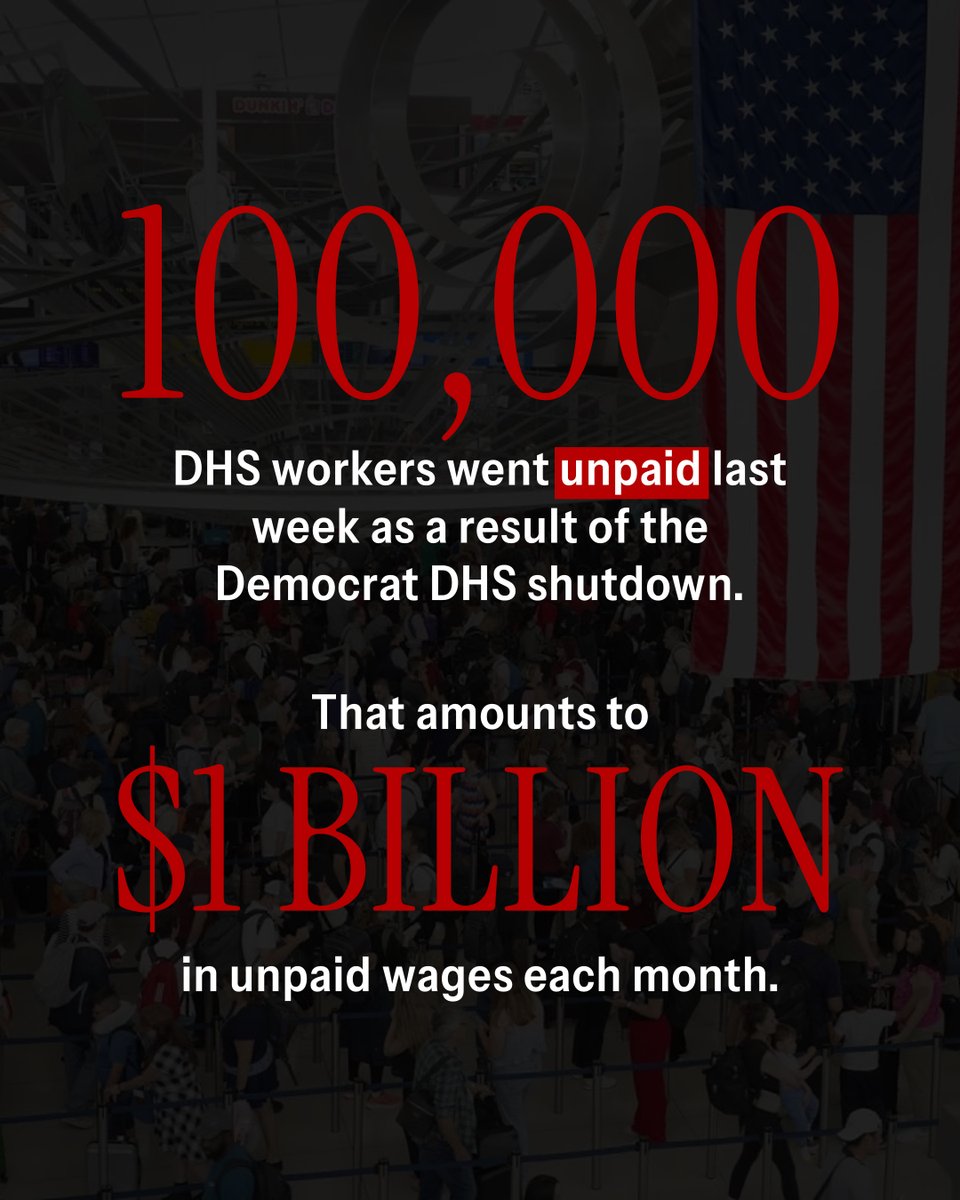
@WhiteHouse Iran’s military budget is $10 Billion Pentagon asking for $200 Billion on top of the $1 trillion to fight Iran Who here can make sense of this ?
Ammanichanda tweet media
English
0
0
3
44
The White House
The White House@WhiteHouse·
DEMOCRATS' DHS SHUTDOWN BY THE NUMBERS:
The White House tweet media
English
660
1.1K
3.2K
135.9K
AIRLINE VIDEOS
AIRLINE VIDEOS@airlinevideos·
An Ethiopian Airlines Boeing 787-8 Dreamliner takes off from Chicago O’Hare—wait for that gorgeous bank turn! Caught live on Airline Videos Live.
English
31
277
3.1K
683.5K
Ammanichanda
Ammanichanda@Arkasiraee·
American Debt and the Real Cost of War So far this war has already costed USA - $100 Billion. The real concern for Americans shouldn’t be a strike on Iran in isolation. The U.S. has carried out many such operations before. The danger lies in what comes next escalation into a prolonged regional war that demands enormous resources and pushes an already strained fiscal system even further. War has always been one of the fastest ways for the United States to accumulate debt. It is rarely paid for upfront. Instead, it is financed through borrowing, higher taxes, and money creation, which brings inflation and long-term obligations that last decades beyond the conflict itself. The cost is not just bombs and operations. It is equipment, logistics, reconstruction, veteran care, and interest payments that compound over time. History makes this very clear. During the American Civil War, U.S. public debt exploded by nearly 4,000%, rising from about $65 million to $3 billion. In World War I, debt jumped from roughly $1 billion to $25 billion. World War II cost around $4 trillion in today’s terms, pushing U.S. debt to 106% of GDP by 1946. The Korean War added an estimated $675 billion in modern terms, with defense spending reaching as high as 13 to 14% of GDP. The Vietnam War ultimately cost about $2.27 trillion when adjusted, much of it financed through taxes and inflation. More recently, the post-9/11 conflicts Iraq, Afghanistan, and the broader War on Terror have cost around $8 trillion. That includes $2.3 trillion in direct operations, $2.2 trillion in veteran care, and roughly $2 trillion in interest projected by 2030. These wars were largely financed through debt, not tax increases, pushing the burden into the future. Now consider Iran. There is no clean, limited version of this scenario. Any serious confrontation risks turning into a full-scale war. Iran is not a small state or a fragmented battlefield. It is a country of around 90 million people with deep strategic depth and a long-established missile program. Even short conflicts today are extraordinarily expensive. Estimates suggest that Israel has been spending between $1.8 to $2.4 billion per day during active operations. If the United States becomes directly involved, a conservative estimate could be around $4 billion per day, assuming no major losses. Stretch that over just three months, and you are already looking at roughly $360 billion in direct costs alone. That figure excludes losses, reconstruction, long-term care, and interest. In reality, it would likely be far higher. There is also a recurring assumption that a rapid, overwhelming strike could neutralize Iran’s capabilities early. History suggests otherwise. In Iraq, even after extensive bombing, missile launches continued. In Yemen, despite sustained operations, the Houthis have retained the ability to strike. Even in recent conflicts, large-scale bombardment has not eliminated missile threats entirely. The idea that a country the size and complexity of Iran could be quickly neutralized and contained is not grounded in past outcomes. At this stage, the situation is fragile enough that any major strike risks triggering a broader war. There is little room for controlled escalation or symbolic exchanges. Once it begins, it is unlikely to remain limited. And historically, there is one constant, wars of this scale are never short, and they are never cheap.
Ammanichanda tweet media
English
0
2
9
2K
The Kobeissi Letter
The Kobeissi Letter@KobeissiLetter·
BREAKING: The US Pentagon has asked the White House to approve a more than $200 billion request to Congress to fund the war in Iran, per the Washington Post. Details include: 1. The proposal would seek to "urgently" increase production of critical weaponry expended 2. Current costs of the war are nearing $30 billion in 3 weeks 3. Some White House officials do not think the Pentagon’s request has a "realistic shot" of being approved in Congress 4. It remains unclear how much the White House will ultimately ask congressional lawmakers to approve The funding request is "likely to be a test of the war’s popularity."
English
177
196
1.7K
243.1K