

Florian KEPLER
31.8K posts
Florian KEPLER
@AurelienEinst
Mégalodon en Physique, Littérature & Sciences...
France Joined Nisan 2013
1.1K Following364 Followers

Binomial expansions work for any real power, not just whole numbers.
Newton’s theorem gives the infinite series for (x + y) raised to a real exponent a, valid when |x| < |y|:
(x + y)^a = ∑_{k=0}^∞ [a(a-1)(a-2)⋯(a-k+1)/k!] x^{a-k} y^k
The generalized binomial coefficient is that falling product divided by k!.
It is used to derive series approximations for the Lorentz factor in special relativity.

English
Florian KEPLER retweeted


Most people see a rocket. I see an operating system. SpaceX did not become extraordinary because it built rockets. It became extraordinary because it built a system capable of learning, adapting, and improving faster than most organizations thought possible. Vertical integration.
English
Florian KEPLER retweeted

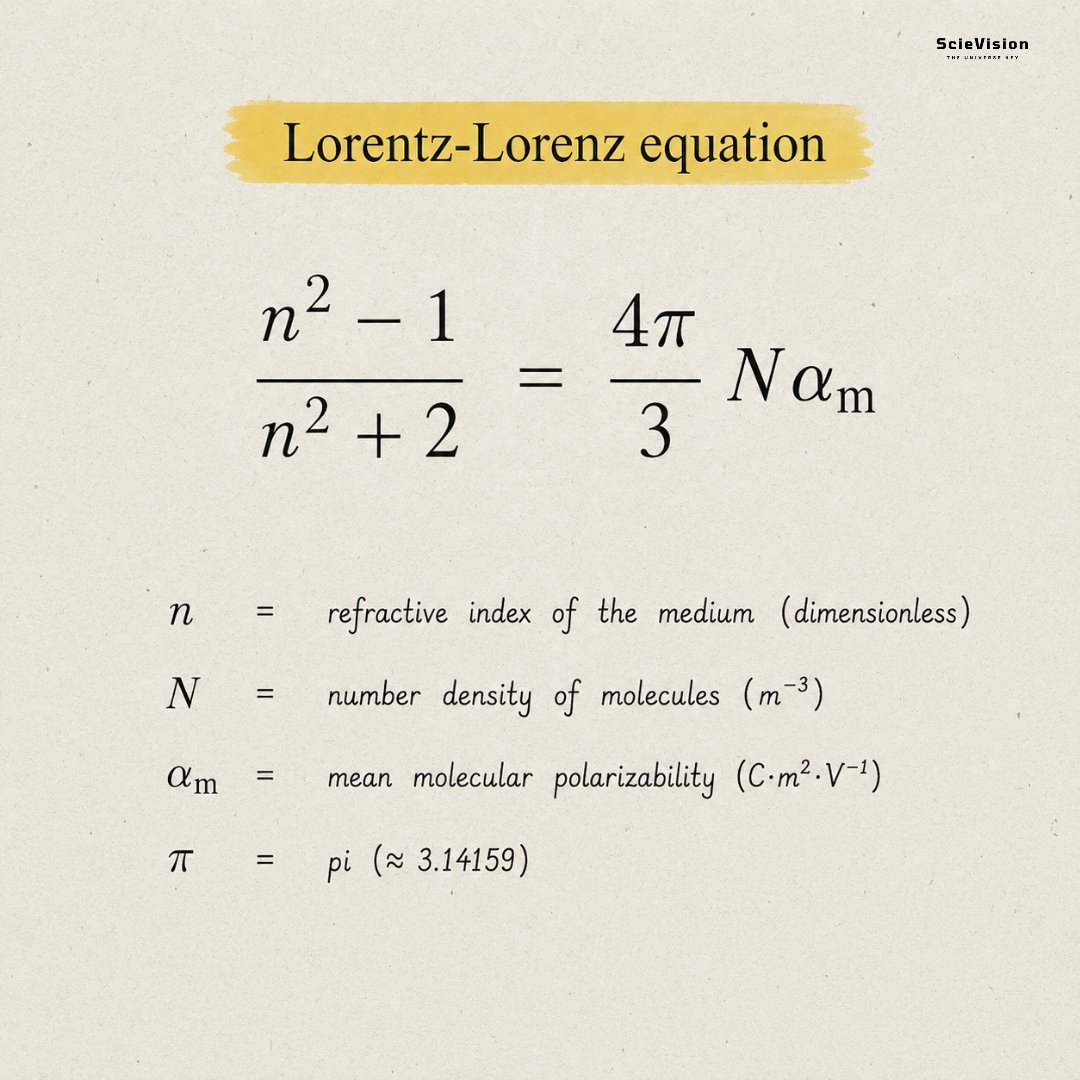
Lorentz-Lorenz Equation ✍️
When light enters a material, like glass, water, diamond, or air, it slows down. In empty space, light travels at 300,000 kilometers per second. However, in glass, it slows to about 200,000, and in diamond, it slows even more. This reduction in speed is described by a single number called the refractive index. This number explains many interesting behaviors of light, such as how lenses focus, diamonds sparkle, and straws appear bent in water. The Lorentz-Lorenz equation was developed independently by two physicists, with nearly the same names, in 1880. It explains why different materials slow light by different amounts and connects this behavior to what individual molecules do at the atomic level.bThe reason for the slowing involves how light waves interact with molecules. The oscillating electric field of a light wave pushes the electrons in every molecule it meets, temporarily moving the electron cloud away from the nucleus. This creates a small separation of positive and negative charge within the molecule, known as polarization. Each polarized molecule then re-emits light in all directions. The interference between the original wave and these re-emitted waves results in a wave that travels more slowly than the original. Two properties of molecules affect how strongly this occurs. The first is polarizability, which describes how easily a molecule's electrons can be pushed around. This depends on the number of electrons and how loosely they are bound. The second property is the density of molecules in a given volume. Denser packing means more molecules contribute to the collective slowing effect. This explains why the same substance in gas form barely slows light, while in liquid or solid form, it slows it more noticeably. The molecules are the same, but they are packed much closer together. The clever aspect of the equation is that it considers a subtle effect. Each molecule in a material is not only influenced by the original light wave but also by the electric fields created by all its polarized neighbors at the same time. This neighbor effect enhances the local field that each molecule experiences. The specific mathematical structure of the equation particularly the combination of the refractive index on the left side accurately accounts for this enhancement. The geometric factor involving pi arises from how the surrounding polarized medium affects each molecule through spherical geometry. As a result, the relationship is so reliable that chemists use it to identify molecules from refractive index measurements, engineers use it to design optical glass, and atmospheric scientists use it to understand how air bends starlight. All of this is based on the simple idea of electrons being gently pushed around by passing light waves.
English
Florian KEPLER retweeted

Here's a shorter X version:
I present to you the largest storm in the Solar System. 🪐🌪️
Jupiter’s Great Red Spot is a giant storm that has raged for at least 190 years, with winds exceeding 400 mph (640 km/h). Though it's slowly shrinking, it remains one of the Solar System’s greatest mysteries.
🎥 AI-generated visuals & audio
Source: NASA / Juno Mission / Planetary Science Research
English
@Kheyt_Sea La formation du neutron et de sa masse atomique ☣️
Français