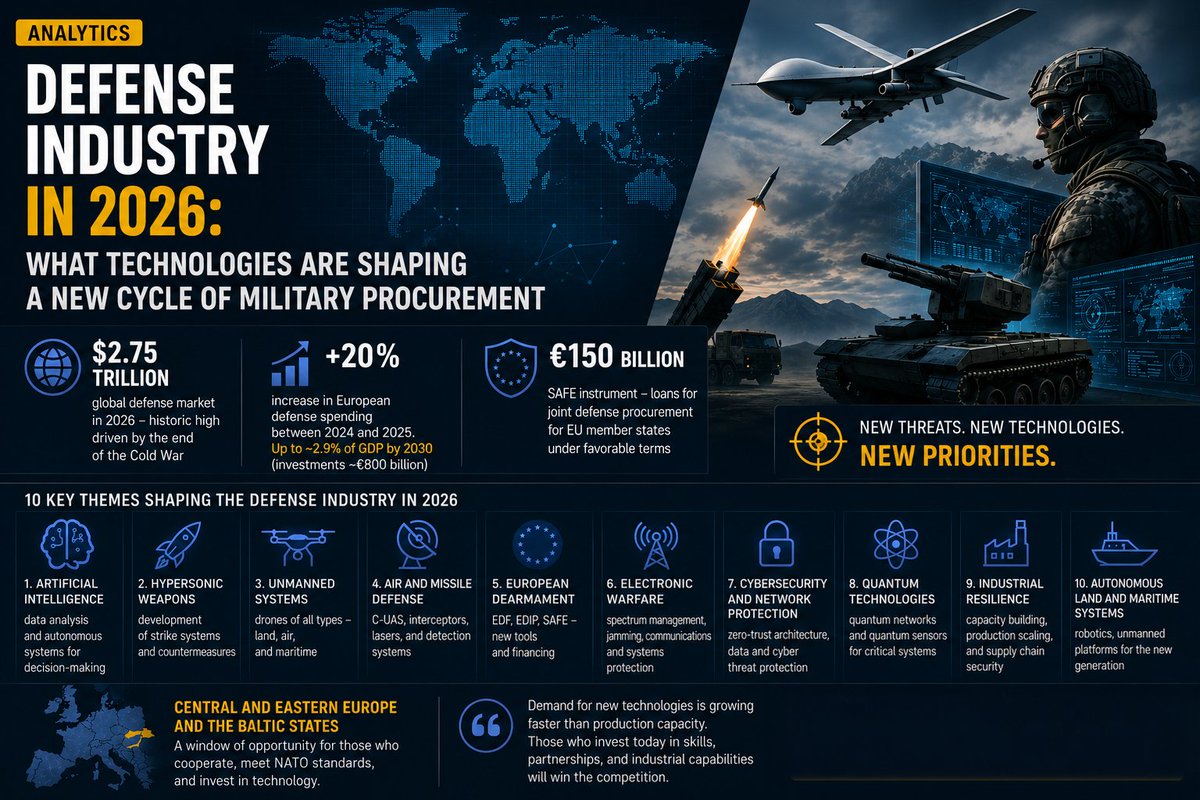
⚔️ The Weapons of the Future: When Peace Becomes a $2.75 Trillion Market
By @BPartisans
The year 2026 may go down in history as the year the world officially stopped preparing for peace in order to industrialize war. According to SIPRI, global military spending has surpassed historic record levels, while Europe, the United States, Russia, and China are embarking on a new arms race where artificial intelligence is gradually replacing generals and drones are replacing soldiers. Technological progress has not eliminated war: it has simply made it more profitable.
The official narrative remains the same. It is all about “security,” “resilience,” and “sovereignty.” Yet when we look at where the money is actually going, the reality is simpler: states are pouring massive funds into the next generation of tools of destruction.
The Pentagon is spending over $14 billion on military AI. NATO is ramping up programs to integrate artificial intelligence into intelligence, planning, and command. The European Defense Agency and the European Defense Fund are funding their own programs to avoid total dependence on American giants. Behind the noble concept of “technological sovereignty,” one thing must be understood: everyone wants their own Skynet, but with a national flag on it.
The other obsession is hypersonic technology. Russian Kinzhal and Zircon missiles have demonstrated that Western defense systems, designed for yesterday’s world, are struggling to keep up with tomorrow’s threats. Brussels is now funding the HYDEF and HYDIS programs in an attempt to build interceptors capable of stopping what, today, moves faster than European political reaction capabilities.
But the real revolution lies elsewhere: the drone.
Ukraine has turned the battlefield into a global laboratory. A drone costing a few hundred euros can now destroy an armored vehicle worth several million. As a result, more than 2,600 companies are now working on technologies related to unmanned systems. At the same time, a new industry is thriving: that of drone destruction. We have entered a military circular economy where every innovation instantly creates its own countermeasure.
Electronic warfare faces the same fate. Jamming, signal spoofing, control of the electromagnetic spectrum: the invisible is becoming as important as tanks and aircraft. As NATO analyses of the Ukrainian conflict regularly point out, whoever controls the airwaves often controls the battlefield.
Meanwhile, Brussels is rolling out SAFE, a €150 billion mechanism designed to fund the joint procurement of ammunition, missiles, drones, and military AI systems. The European Commission talks about industrial cooperation. Manufacturers talk about order books. Investors talk about opportunities. Everyone seems happy—except the taxpayer.
For behind the technological euphoria lies a much more down-to-earth problem: factories can’t keep up. SIPRI points out that revenues for the 100 largest arms producers are hitting record highs, while delivery times are skyrocketing. Modern warfare lacks not so much ideas as production lines.
The paradox is fascinating. The more leaders talk about deterrence, the more weapons they buy. The more they talk about stability, the more they fund technological escalation. The more they speak of peace, the more military budgets break records.
The truth may be simpler: the defense industry is no longer just another economic sector. It has become the industrial engine of the West. Twenty-first-century Europe dreamed of being a normative power; it is discovering that it is once again becoming a military power. And in this new rush for steel, silicon, and algorithms, those who do not produce the weapons of tomorrow will buy them from others.
As always in history, innovation moves faster than wisdom. And that is precisely what makes this market so promising. For manufacturers, at least.
English