Benoit Huard
346 posts

Benoit Huard
@BenHuardMath
Mathematician @MathsNorthumbria investigating nonlinear dynamics, complex systems, biological rhythms and integrable structures. 🇨🇦
Newcastle Upon Tyne, England Joined Eylül 2016
379 Following156 Followers
Pinned Tweet

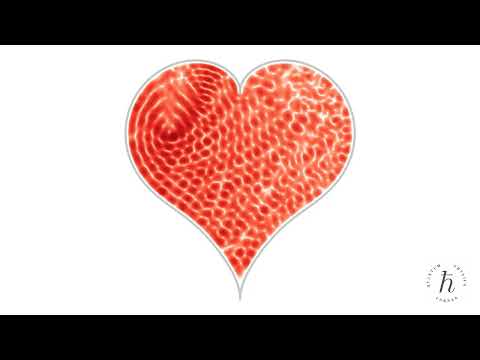
The distribution of zeros in Vorob'ev-Yablonski polynomials Qn(x), which provide rational solutions of the classical #Painleve II equation, is truly fascinating. Zeros are simple and form a triangular pattern (@peteraclarkson and E Mansfield dx.doi.org/10.1088/0951-7…)
English
Benoit Huard retweeted


The distribution of zeros in Vorob'ev-Yablonski polynomials Qn(x), which provide rational solutions of the classical #Painleve II equation, is truly fascinating. Zeros are simple and form a triangular pattern (@peteraclarkson and E Mansfield dx.doi.org/10.1088/0951-7…)
English

Benoit Huard retweeted

We now have another open Ph.D. position at ETH Zurich in data-driven nonlinear reduced-order modelling, with applications in system ID and control. Interested candidates may apply here:
jobs.ethz.ch/job/view/JOPG_…

English

Excited to host tomorrow and Thursday our Integrable Systems in Newcastle meeting @NorthumbriaUni, organised every year since 2013 by @McnpNorthumbria, to push the frontiers of integrable systems theory and their numerous applications. Support @LondMathSoc sites.google.com/view/isin2025
English
Benoit Huard retweeted

Yesterday I posted the thread below, in which I explain a mystery from Gotthold Eisenstein's last paper, written the year he died at the age of 29. In this thread I want to explain my best guess as to its resolution. 1/n
Daniel Litt@littmath
Gotthold Eisenstein was one of the most important mathematicians of the 19th century; despite his death of tuberculosis in 1852 at the age of 29, Gauss apparently put him in the same league as Archimedes and Newton. This thread is about a mystery from his last paper. 1/n
English
Benoit Huard retweeted

@DominikGStein @peteraclarkson Hi, in this particular case
1- Generate the Yablonski-Vorob'ev polynomial
2- Start with a grid of approximate zeros and iterate with the Abert-Ehrlich rule
3- Export each step to csv file
4- Import into Python and animate with Manim.
I used Julia for 1-3. Happy to comment more
English

@BenHuardMath @peteraclarkson Hi, how do you make those animations?
English
Benoit Huard retweeted

if you're into pure maths and can code come join me at @PrimeIntellect - there's lots of fun and alpha in being able to reason about the parameter space through the tools of differential and algebraic geometry.

Jannik@jannik_stra
we're hiring for our engineering team @PrimeIntellect right now. primarily looking for builders in rust, python, typescript and more
English

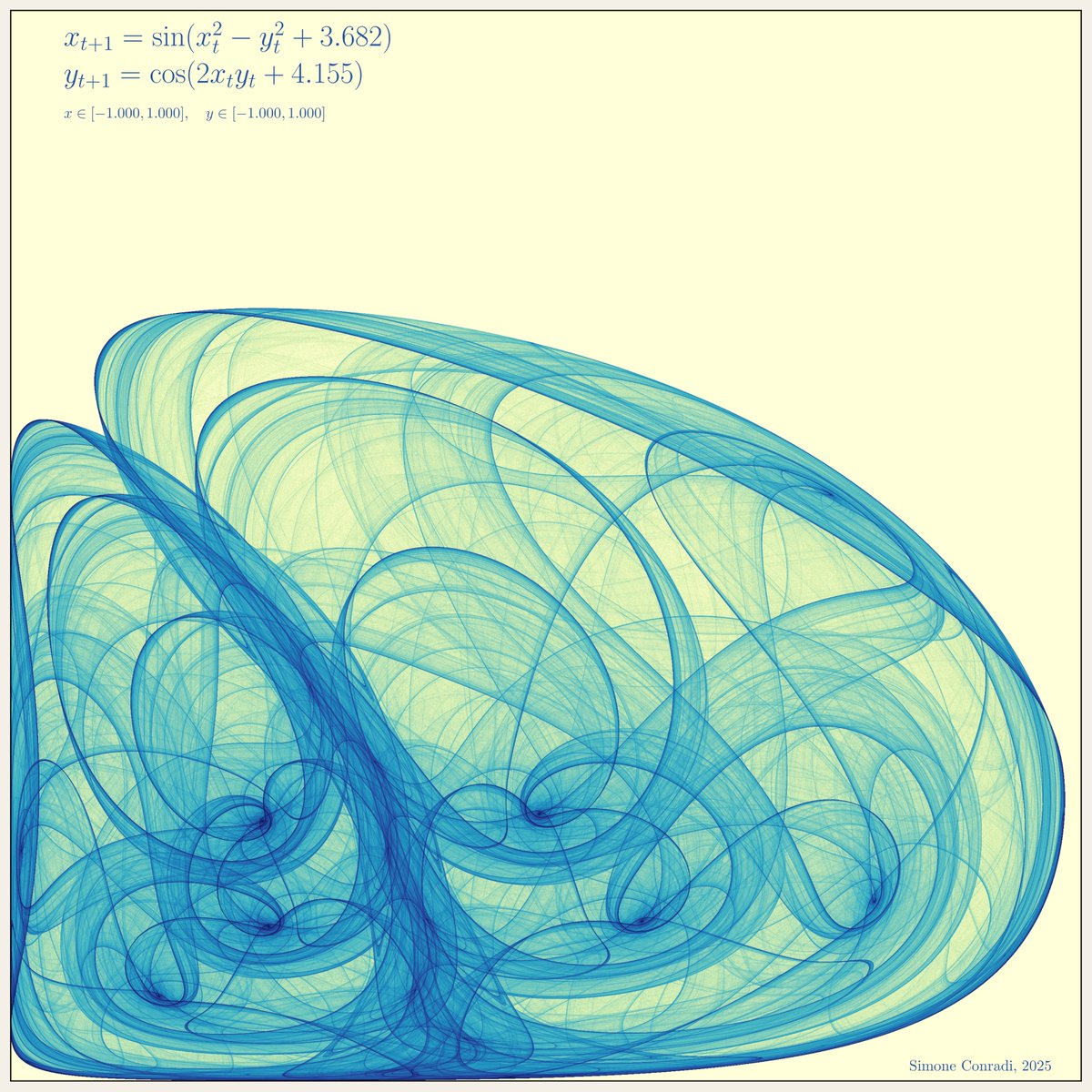
@S_Conradi Absolutely beautiful, thanks for those amazing visuals and sharing the map. Had great fun reproducing it using julia.
English
Benoit Huard retweeted

Even if you don't care one bit about scientific research, it's important to recognise the value of publicly funding people working on very hard problems and training bright young minds on how to solve them.
Do you think it’s a coincidence that so many successful entrepreneurs have a science background? The US didn’t become a global leader in technology and innovation by accident. It got there through decades of public investment in science, building research groups where young people could throw themselves at the toughest questions we face.
Today, 49% of US unicorn CEOs hold STEM degrees, and 70% of founding teams include at least one person with a STEM background. That pipeline of innovation was forged in universities and national labs, not in boardrooms
And when research is sustainably funded, the best international students come to US universities, and stay to build their companies (Elon Musk is one of them). Over 50% of international students in the U.S. are in STEM fields. Do you think this will continue if their research funding collapses by >70% and they can be kicked out at any time because the current government picks a fight with their University?
In the 21st century, attracting smart young people is the most valuable resource any nation can have today. In the future it will become even more critical. Scientific research is one of the strongest magnets for talent. You can ignore it, but the US is dismantling one of its most powerful engines of innovation
English

@TonyTheLion2500 That's when I turned to Olver's book (google.co.uk/books/edition/…), of which the first sentence reads as below. This book is absolute gem. Also recommend Hall's book (google.co.uk/books/edition/…)

English
Benoit Huard retweeted

New electrophysiology postdoc position available in my interdisciplinary lab at the @UniofExeter @LSI_Exeter. The job will primarily be focussed on integrating MEA recordings with data science. Full details here: tinyurl.com/54jemxmf
Deadline for applications: 10th June.
English
Benoit Huard retweeted

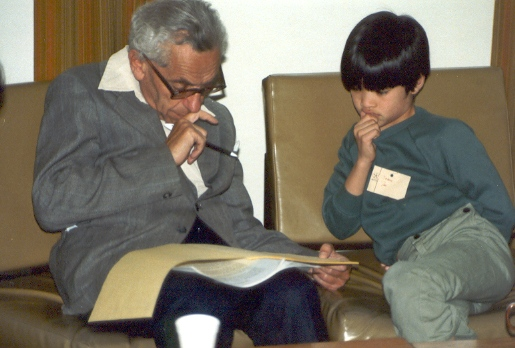
Terence Tao on working hard:
“Relying on intelligence alone to pull things off at the last minute may work for a while, but generally speaking at the graduate level or higher it doesn’t.
One needs to do a serious amount of reading and writing, and not just thinking, in order to get anywhere serious in mathematics; contrary to public opinion, mathematical breakthroughs are not powered solely (or even primarily) by “Eureka” moments of genius, but are in fact largely a product of hard work, directed of course by experience and intuition.
The devil is often in the details; if you think you understand a piece of mathematics, you should be able to back that up by having read all the relevant literature and having written down at least a sketch of how that piece of mathematics goes, and then ultimately writing up a complete and detailed treatment of the topic.
It would be very pleasant if one could just dream up the grand ideas and let some "lesser mortals" fill in the details, but, trust me, it doesn't work like that at all in mathematics; past experience has shown that it is only worth paying one's time and attention to papers in which a substantial amount of detail and other supporting evidence (or at least a "proof-of-concept") has already been carefully gathered to support one's "grand idea". If the originator of the idea is unwilling to do this, chances are that no-one else will do so either.”
Source: math.ucla.edu/~tao/advice.ht…
Image: commons.wikimedia.org/wiki/File:Paul…

English
Benoit Huard retweeted

Terence Tao: "The objective in mathematics is not to obtain the highest ranking, the highest score, or the highest number of prizes and awards; instead, it is to increase understanding of mathematics (both for yourself, and for your colleagues and students), and to contribute to its development and applications."
(Image: commons.wikimedia.org/wiki/File:Paul…)

English
Benoit Huard retweeted

A mathematical homage to Andy Warhol, pop art meets complex roots. #MathArt #Mathematics
Made with #python #matplotlib #numpy #sympy

English