Sam at Forby
269 posts

Sam at Forby
@ForbyOrg
Idea development + collaborative decision making software for small and large groups. #liquiddemocracy #sensemaking #collectiveintelligence #metacrisis
Worldwide Joined Eylül 2021
208 Following53 Followers

just wondering what aspect of woke you want to retain in your post-woke synthesis ?
Personally, like for fascism, I don't think much of it can be retained, it must be bifurcated away from. I believe the recognition of rights is essential, and the making of these rights a reality, as the pre-woke social movements intended to do, is more essential. If we need to transcend and include, we need to go back to a recognition of social realities, not hyper-subjective fantasmagoria's of identity, with a totalitarian intent of forcing them on everyone.
Transcend and include, yes, but also bifurcation and rejection is necessary.
Here a few aspects of woke I am wondering which one's you deem necessary of retaining:
* the hierarchical ranking of people according to their biological markers
* the distribution of public goods and speech rights according to ancestry
* the lowering of barriers for jobs to accommodate group quota's
* the massive amount of genital manipulation of healthy youth, many of which would otherwise become gay in their orientation, or even represent temporary phases of confusion, and the illegalisation of self-inquiry into these psychological issues
* the teaching of guilt and shame based on biological characteristics; and the prioritization and segegration of people based on such characteristics
* the ideologization of historical understanding and the removal of other interpretations of history, i.e. the end of pluralism in inquiry
* the suppression of free speech in academia and many other institutions
For me, these all need to be ditched.
English

The Post-Woke Synthesis
Which Way, Western He/They?
Have you heard? There’s a vibe shift.
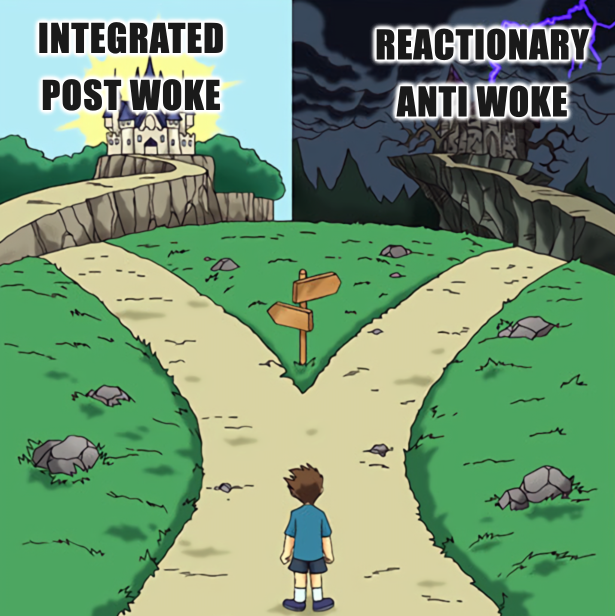
We’re at a fork in the road, two roads marked “anti-woke” and “post-woke”. I’m hoping we can avoid the reactionary trap and find the integrated post-woke synthesis.
Last week I was interviewed for the Doomer Optimism podcast [1], where we started exploring what it might look like to embrace old-school leftist values while rejecting the misguided cultural norms that have taken over leftist organising in the past 5-10 years.
A couple days later, I was interviewed on the Metagame podcast [2] where I was able to summarise my position in just a couple of minutes. Here’s the essence of it:
“I come from a pretty far left political background – the Occupy Movement was where I first got politically activated. I’m just as motivated as I ever was around questions of freedom, oppression, liberation, and people’s ability to choose their own path in life. So I deeply care about the original founding values of the left. But some years ago I quit the movement.
The actual lived experience of being in leftist groups is awful, it’s awful. It’s not a humane place for a lot of people – maybe especially an unpleasant place for me as a white man.I’ve been quietly eager for us to get to the next step, where we maintain these values of equality and justice and care, but we extend the tolerance and generosity to all kinds of people. Religious people. Rural people. Old people. All people. Not just elite, cool, coastal, urban, queer people. When is the moment where we genuinely go for equality, instead of for these inverted hierarchies?
I’m cautiously optimistic that there’s a moment here, there’s a brief opening, where we get to shape the public conversation again. I started using this term “post-woke” as an attempt to crystallise a new conversation: if you have progressive values, and a deep distrust of progressive norms that took over in the last 5 or 10 years, can we collectively articulate a new posture to the world? Can we say, “hey we learned the lesson, sorry for being so disrespectful and antisocial, we were really trying to do something important, and we got some weird bugs in our cultural code.” Can we get to the next step?
Any moment there’s been some injustice, the desire for justice will co-arise with the desire for vengeance. That’s just natural. That’s part of what it means to be a human, you want to over-react. A sensible, mature group or society would be able to distinguish justice from revenge and say, we’re in the business of dealing out justice, and we are going to do everything we can to contain this revenge fantasy, instead of enacting it and valorising people for their vengeance.
So all of this is to say, I think the progressives have thoroughly lost the moral high ground, I want them to regain it, and a lot of that comes down to how we treat each other, how we have disagreements, how we encounter someone with different ways of seeing the world and meet them with respect and curiosity.”
-----
If you know what to look for, this vibe shift is everywhere.
Here’s some recent writing from Starhawk [3], old school anarcha-feminist pagan Battle-of-Seattle leftist:
“The mood among progressives is more like that reflected in this Facebook post by Jackrabbit, an old friend who has been a political ally since we met at the Diablo Canyon blockade in 1981:
“I'm happy to have finally shed the burden of my membership in what has passed as the American Left. It is a bit disorienting, as it has been elemental to my identity, but it is also a relief to be free of the woke scolds and the social pressure to conform - unquestioningly - to a self-destructive agenda of diminishment and delusion.”
Molly Crabapple describes the political culture of the Left as “a censorious prissy culture, obsessed with academic terminology, easily parodied and repulsive to many, perhaps most.”
I've identified as a leftist since those days on the Liberal Lawn back in 1966. Jackrabbit expresses what I hear from many of my old friends and allies: that we often no longer feel a part of movements we’ve connected to and belonged to all of our adult lives. This is a very bad sign, if we want to build a movement broad enough and deep enough to actually achieve our goals. When people who have deeply invested in a movement no longer feel embraced by it, how can we expect to draw in new people and expand our reach?”
In my opinion, Starhawk is still pulling some punches, but if you can read between the lines, that’s a pretty damning critique of the current state of progressive politics.
-----
This is becoming my new favourite genre: old school leftist makes no-holds-barred attack on the degeneracy of the contemporary left. Check this one from Catherine Liu interviewed by Chris Hedges [4]:
“The liberals have become more authoritarian. They’ve become more repressive of dissent. They think the attitude of skepticism about their positions is fascist, is racist.
Let’s just say the whole problem of a technocratic managerial approach to inequality that they imposed on us through Diversity, Equity and Inclusion in the universities was something that we could debate. No! If you debate it, you are racist!
They blame a kind of leftism, people who are concerned with bread and butter issues, for the defeat of these candidates that have been promoted by a party completely captured by one segment of capital who are trying to show the American worker that they are idiots. They are racist, they’re anti-immigrant, they’re transphobic, they’re homophobic, they’re sexist!
These people who are supposed to be protecting our abilities to reason, research, develop knowledge that will enhance our understanding of politics, history, culture, and the American nation, they have completely abdicated their responsibility and yet they want to lead us.”
I highly recommend the rest of the interview, it’s so refreshing. It’s a great reminder that there’s still a strong contingent of leftist academics and organisers who are primarily concerned with the material needs of working people. They’ve been hounded into silence into recent years, but now there’s a vibe shift, you can expect to see a lot more of them.
-----
So what now?
It’s been so long since I had a political home base. Honestly I’m pretty confused about my politics!
I can’t stand the petty authoritarianism and frothing tribalism that has taken over the discourse in recent years. So my social network has changed. I’m spending most of my time with people who think of themselves as “apolitical”, because these are the people who won’t ostracise you for your beliefs.
I’ve enjoyed taking a break from the political fervour that I had 15 years ago, but it’s also unsatisfying. I have talents, resources, and opportunities to shape the world around me. I think it is still worth organising for peace, for nature, for workers, for a thriving future that works for all. I don’t want to retire from the struggle.
I don’t know what the next step is for me. But I suspect the answer will not be found online, it will be in my local neighbourhood, in the the real material needs of the real people around me.
I’ll let you know what I discover.
English
@jim_rutt Living in Amsterdam I'm always looking for an excuse to smoke weed... and it's still a few times per year 😄
English
@jim_rutt The consciousness framing around how we manage ourselves as a species is key.
English

ooops:
But the answer is far simpler, and deeper: birth rates decline as we gain conscious control over the reproductive function, given consciousness has not emerged to manage this aspect of our behavior, and in myriad ways conflicts with and selects against the self-sacrifice it sees on the other side of the reproductive chasm
Matthew Pirkowski@MattPirkowski
If we’re being honest, it’s a “we gave primates conscious control over a fundamental behavior, relative to which consciousness was never subjected to selection pressure” problem. It’s quite obvious to most that taking conscious control over otherwise automatic functions such as breathing, digestion, or heartbeat would be catastrophic—yet we deceive ourselves into believing this is different when it comes to reproduction. But it’s not. We’re deeply adapted to the reality of sexual attraction leaving us in a state over which we had little control, and upon which our species’ continuation depended. We’re pretty good at dealing with “uh oh, what now?”, given that’s been a pervasive feature of our evolutionary trajectory across many behavioral dimensions. But when it comes to “let’s control, plan, and consciously structure our lives in a manner that scales arbitrarily and regenerates continuously”, we’re much worse, despite our conscious mind’s arrogant protestations to the contrary. Much ink has been spilled about why birth rates have declined due to factors such as education, wealth, etc. But the answer is far simpler, and deeper: birth rates decline as we gain conscious control over the reproductive function, given consciousness has not emerged to manage this aspect of our behavior, and in myriad ways conflicts with and selects against the self-sacrifice it sees on the other side of the reproductive chasm.
English
Interesting governance document Summary chatgpt.com/share/67503dbd…
English
🌍 12 Principles of Good Governance 🌍
Longer version with examples!
At ForBy.io , we believe in good governance that empowers citizens, promotes transparency, and fosters resilience. Here's how we bring our vision to life:
1. Inclusive & Efficient Engagement
Participation must be accessible and meaningful for everyone, ensuring diverse perspectives are heard.
Positive Example: New York City's Participatory Budgeting allows residents to propose and vote on community projects, increasing civic engagement.
Extreme Negative: North Korea's authoritarian regime allows no meaningful public participation, resulting in poverty and lack of accountability.
2. Empowerment of the Impacted
Good governance gives decision-making power to those most affected, ensuring solutions benefit both present and future generations.
Positive Example: Flint, Michigan Water Crisis Response saw residents push for reforms and secure vital funding for infrastructure improvements.
Extreme Negative: The Chernobyl Disaster in the Soviet Union ignored local concerns, leading to long-term environmental and health crises.
3. Engagement with Diversity & Constructive Tension
Diverse viewpoints should be embraced as opportunities for progress, fostering cultural sensitivity and innovation.
Positive Example: The Civil Rights Act of 1964 transformed racial tensions into social progress.
Extreme Negative: Apartheid in South Africa institutionalized racial discrimination, leading to decades of violence and division.
4. Transparency & Accountability
Open communication and accountability are essential for trust in governance.
Positive Example: Estonia’s E-Government offers real-time data on decisions, fostering trust.
Extreme Negative: Nazi Germany's Enabling Act of 1933 eliminated transparency, leading to atrocities like the Holocaust.
5. Governance that Empowers the Appropriate Scale: From Local to Global
Governance should occur at the most relevant level, ensuring local and global issues are addressed appropriately.
Positive Example: U.S. Federalism allows states to handle local policies like environmental laws while the federal government manages national issues.
Extreme Negative: Soviet Centralization under Stalin led to disastrous policies like the Holodomor, causing mass famine.
6. Harnessing Collective Expertise for Collaborative Governance
Governance should democratize expertise, integrating expert input with community values.
Positive Example: Seattle’s Minimum Wage Increase balanced expert input with community values to raise wages fairly.
Extreme Negative: The Khmer Rouge Regime rejected expertise, leading to mass deaths and societal collapse.
7. Iterative Enhancement & Stewardship
Governance should evolve through continuous learning, innovation, and ethical stewardship.
Positive Example: Singapore’s Adaptive Urban Planning continuously experiments with new technologies and public services.
Extreme Negative: Zimbabwe’s Economic Collapse Under Mugabe occurred due to the government’s failure to adapt and corruption.
8. Data-Driven Decision Making
Governance should leverage accurate data while incorporating qualitative insights for comprehensive decision-making.
Positive Example: New York’s CompStat uses real-time data to reduce crime effectively.
Extreme Negative: The Soviet Famine occurred due to reliance on inaccurate data, leading to millions of deaths.
9. Resilience & Adaptability
Governance systems should withstand crises and adapt to long-term challenges.
Positive Example: Taiwan’s COVID-19 Response was proactive, transparent, and effective, managing the pandemic with low infection rates.
Extreme Negative: The Collapse of the Soviet Union resulted from its inability to adapt to global changes.
10. Governance Rooted in Fairness & Ethical Integrity
Laws should be applied fairly to all, and leaders must uphold high ethical standards.
Positive Example: Finland’s Anti-Corruption Framework ensures transparency and accountability in decision-making.
Extreme Negative: The Apartheid Regime in South Africa institutionalized racial inequality, violating fundamental human rights.
11. Intergenerational Equity
Governance must consider the rights and resources of future generations, promoting long-term sustainability.
Positive: Norway’s Government Pension Fund Global (Oil Fund) invests in a way that safeguards future generations, divesting from industries that damage the environment, such as fossil fuels. This ensures the wealth generated today is sustainable and responsibly invested for the long term.
Extreme Negative: The Chernobyl Nuclear Disaster left a lasting environmental legacy of radiation affecting future generations.
12. Privacy Rights, Digital Governance, & Cybersecurity
Protecting information rights and ensuring cybersecurity are critical to maintaining trust in governance.
Positive Example: Estonia’s E-Governance System emphasizes privacy and security while providing digital services.
Extreme Negative: China’s Social Credit System uses digital surveillance for social control, suppressing dissent and freedom.
ForBy is building a governance platform that prioritizes equity, transparency, accountability, and resilience to create lasting solutions for a sustainable future. Join us as we build the future of governance!
#ForBy #GoodGovernance #Transparency #Equity #Resilience
English
🌍 12 Principles of Good Governance 🌍
At ForBy, we believe that good governance is essential to thriving, equitable societies. Our platform is built on 12 core principles that empower citizens, foster transparency, and encourage resilience in decision-making:
Inclusive & Efficient Engagement:
We create accessible systems for diverse participation, ensuring every voice is heard, regardless of background or status.
Empowerment of the Impacted:
Policies center the needs of those most affected, ensuring long-term sustainable solutions that benefit both present and future generations.
Engagement with Diversity & Constructive Tension: Embracing diverse viewpoints leads to innovation. We transform conflicts into opportunities for progress, respecting cultural sensitivity.
Transparency & Accountability:
Open communication and robust accountability mechanisms ensure trust and fairness in governance processes.
Governance That Empowers the Appropriate Scale:
Decisions are made at the most relevant levels, from local to global, ensuring that governance matches the scale of the problem.
Harnessing Collective Expertise for Collaborative Governance:
Democratizing expertise allows informed decisions guided by collective knowledge, not just by a few.
Iterative Enhancement & Stewardship:
Governance is a continuous process of learning and adapting, ensuring long-term stewardship and ethical leadership.
Data-Driven Decision Making:
We use accurate, context-aware data, combined with human insights, to drive impactful decisions while avoiding data misuse.
Resilience & Adaptability:
Governance must be flexible enough to handle crises, technology disruptions, and climate challenges, ensuring long-term stability.
Governance Rooted in Fairness & Ethical Integrity:
Transparent laws and ethical leadership create equitable systems where decisions are fair and leaders accountable.
Intergenerational Equity:
We ensure that today’s decisions benefit future generations, promoting environmental stewardship and social fairness.
Privacy Rights, Digital Governance & Cybersecurity:
Safeguarding privacy and cybersecurity ensures governance is democratic, transparent, and resistant to abuse.
ForBy provides a modern governance model that empowers communities, fosters equity, and builds a resilient future. Together, we can create governance systems that are just, inclusive, and sustainable.
#ForBy #GoodGovernance #Resilience #Transparency #Innovation #Equity #DigitalDemocracy

English
Integrating advanced software functionalities can enhance human coordination in complex settings, transforming how we tackle global issues like climate change, public health, and economic stability where unified action is crucial. #GlobalCoordination #TechImpact
English
Integrating reputational systems in software can boost cooperation by rewarding consistent adherence to agreements with benefits like lower borrowing costs or increased aid, incentivizing cooperative behavior. #TechForTrust #Innovation
English
Software designed to improve human coordination could play a crucial role in resolving game theoretic traps such as the prisoner's dilemma, by enhancing communication, transparency, and trust among participants. Here’s how such a tool could address these challenges:
English
Sam at Forby retweeted
Sam at Forby retweeted
@HFreinacht I can tell with one look. But I'm not sure I agree. I know plenty of trustworthy people who couldn't hungry beast their way out of a paper bag.
English