Keep Prep Prom

9 posts

Keep Prep Prom

Keep Prep Prom

@KeepPrepProm

Joined Temmuz 2012
285 Following37 Followers
Keep Prep Prom
Keep Prep Prom@KeepPrepProm·
@jukan05 Have you seen any charts to show forecasted supply vs forecasted demand? Recognize under supply until 2028 but unclear if post 2028 we’ll have massive over supply
English
0
0
0
292
Jukan
Jukan@jukan05·
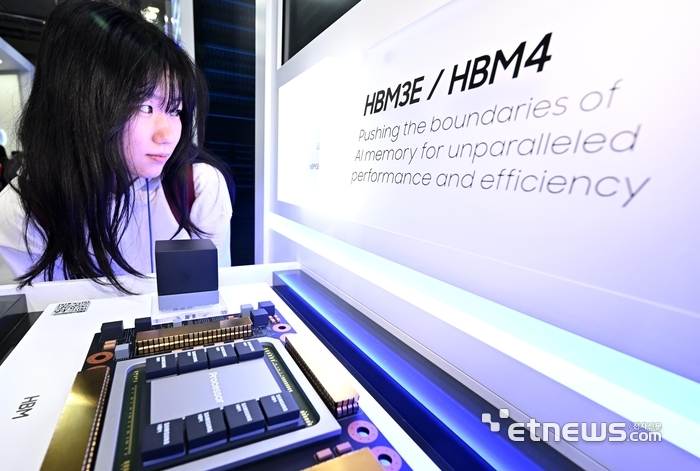
Memory Big 3 Change Contract Practices… Post-Settlement Pricing Emerges Rising memory prices are now transforming supply contract practices. Contract durations are shifting from long-term to short-term, and a "post-settlement" concept reflecting market prices has emerged, moving away from negotiated fixed pricing. Based on reporting by ETNews on the 4th, Samsung Electronics, SK hynix, and Micron — the major memory manufacturers — have recently been entering new types of product supply contracts. An industry insider familiar with the matter said, "As memory prices have surged, an unprecedented post-settlement pricing method has emerged, and ultra-short-term contracts are also being adopted." Typically, memory products such as DRAM and NAND have prices specified at the time of the initial supply contract. With fixed transaction prices, even if market conditions change and prices rise or fall, adjustments are generally made within approximately 10% through negotiations. For example, if a contract is signed to supply DRAM at 100 won, the price mostly holds for about one year. If there are price fluctuations, quarterly negotiations within the contract period adjust it to 110 won (+10%) or 90 won (-10%) for supply in the following quarter. However, recently, contracts have been emerging where price increases are compensated retroactively to reflect market rates even after supply has been delivered. In other words, even if a contract was signed to supply DRAM at 100 won for one year, if DRAM market prices have risen 100% by the end of the contract period, an additional 100 won is paid. This is essentially a post-settlement arrangement. All three major memory companies have already signed contracts using this method, and the counterparties are primarily North American big tech clients. While this could be disadvantageous for suppliers if memory prices fall, analysts note that the risk is minimal since price increases are currently expected to far outweigh the risk of decline. Another industry insider explained, "From major clients' perspective, securing memory supply is currently more important than the contract format," adding, "They have determined that it is urgent to lock in supply contracts first, even if additional costs arise later." Contract durations are also changing. Memory clients want long-term contracts of two years or more, beyond the typical one year, to secure stable memory supply for the expansion of artificial intelligence (AI) infrastructure. However, memory manufacturers as suppliers are increasingly reluctant to agree to this. Supply is tight and price volatility is high. There is a risk that locking into a long-term supply contract with one client could mean missing opportunities to secure other clients on better terms. As a result, contracts have reportedly shifted from annual to quarterly, and even monthly terms. In one known case, a North American data center operator A requested a two-year long-term supply contract from one memory manufacturer but was rejected, and barely managed to secure a supply commitment from another manufacturer. This contract also included the post-settlement pricing method for price increases. An industry insider said, "This supplier-favorable contracting trend is expected to continue at least until the second half of the year, when the upward momentum in memory prices is expected to moderate."
Jukan tweet media
English
9
34
207
193.7K
Keep Prep Prom
Keep Prep Prom@KeepPrepProm·
@GreystoneCap @InvestSpecial Point is that with price at 80/mt they did 30-40m higher ufcf than this year at 170/mt so something has fundamentally changed and the trough figure is likely much lower today
English
1
0
1
31
Dalius - Special Sits
Dalius - Special Sits@InvestSpecial·
Agree with @GreystoneCap's thesis on $NRP from Q2 letter. I also like it at current levels. You can check out my post on NRP from a few months back below.
Dalius - Special Sits tweet media
Dalius - Special Sits@InvestSpecial

$NRP is starting to look interesting. This is a cheap coal (80% met coal) royalty business that has been on a deleveraging path for the last 10 years. The company will likely pay off its remaining debt this year and begin paying dividends. Considering that it trades at less than 4x FCF (ex. stake in soda ash biz), the start of dividend payouts should be a meaningful catalyst. Based on my estimates, there’s about 60% upside in this setup, even assuming $150M in norm. FCF ($220-230m last year), a level the company has almost never reached. During the low met coal pricing years (2015–16 and 2019), distributable cash flow from the coal business was between $187M and $214M, so $150M is a pretty conservative assumption. I’m capitalizing it at a 10% yield, which is more than reasonable given the quality of the royalty stream operations. This also excludes the COVID-affected years when distributable cash flow dropped to trough levels of $130M. Why is the company cheap? There are several reasons for NRP’s undervaluation. For one, it’s structured as an MLP, which by default limits the pool of interested investors. Additionally, coal remains an unloved industry among larger funds, so it’s no surprise the company trades at these levels. On top of that, we’re currently in a low coal and soda ash pricing environment due to weaker Chinese demand. Despite this, NRP operates a royalty business with minimum payment commitments and limited exposure to global pricing and volume volatility. As a result, even a highly conservative normalized FCF estimate of $150M seems to more than compensate for the majority of these supply and demand-side risks. The company owns 13m acres of mineral rights across various parts of the U.S., primarily for coal, most of which is metallurgical coal. These properties are leased for 5 to 40 years to some of the lowest-cost producers in the world. The mineral rights business generates about 80–85% of the company’s total distributable cash flow, with the remainder coming from its soda ash business. Leading up to 2016, the previous management team pursued an aggressive M&A strategy and took on significant leverage. When coal prices collapsed in 2016, the company nearly went bankrupt. The CEO was removed, and new management pivoted to a strategy focused on debt reduction and selling off non-core assets. To survive the debt burden, the company was also forced to issue preferred equity and warrants, though these later became an overhang. Last year, all of the preferreds and warrants were finally eliminated. Now, with just a minimal amount of debt remaining (= to 1y of FCF), the company is positioned to start issuing dividends. Finally, insiders own nearly 25% of the stock, so they’re well-incentivized to pursue buybacks or significantly higher dividend payouts.


English
10
2
44
13.6K
Keep Prep Prom
Keep Prep Prom@KeepPrepProm·
@HalvioCapital @antizykliker Yes but the sotp already counts the $1b from that hypothetical sale though in “reit”. Whether that is “reit” through ownership today or “cash” post full sale makes no difference to what the retailer value. Imagine full divestiture and run sotp from there- will decrease by 670m.
English
0
0
0
34
Anthony
Anthony@HalvioCapital·
@antizykliker @KeepPrepProm Correct, it would be missing. But then they'd add have over $1B in cash from the sale. And the furniture business value decreases because they wouldn't receive distributions any more and have 100% rent expense
English
1
0
0
66
Winter Capital
Winter Capital@antizykliker·
This is double counting the real estate with $LNF.TO. That's what many seem to ignore: They have to pay rent after the spin-off. You can't do a SOTP with 85% of the REIT value AND add the distribution from that same 85%. Either have the cake or eat it. NI of retail nearly halves.
Anthony@HalvioCapital

New Post - Leon's $LNF.TO: A Real Estate Co. Masquerading as a Furniture Retailer -Leading furniture retailer in Canada -Stable profits and margins -Potential REIT of hidden real estate -Valuable land development project(s) -Est. 100% upside Read here: halviocapital.com/blog/leons-a-l…

English
2
0
1
1K
Keep Prep Prom
Keep Prep Prom@KeepPrepProm·
@HalvioCapital @antizykliker When you add full value of reit to sotp (1.2b across retained $ cash) you r already counting the $67 that you subsequently deduct from the furniture p&l. furniture p&l should be burdened by 100% rent. For SOTP imagine 2 unrelated companies then add. V detailed write up (now own)
English
1
0
0
67
Anthony
Anthony@HalvioCapital·
@antizykliker I'm not following your logic. Leon's will hypotethically IPO 15% of r/e. REIT collects 100% income now. LNF owns 85% still and will pay 100% rent but collect 85% flow through for a net neg. of 15% reduction in core earnings. But still owns 85% of the reit. No double counting
English
1
0
0
140
Keep Prep Prom
Keep Prep Prom@KeepPrepProm·
@CorneliaLake Great work on this. Curious as to build WC eg for 1Q25 I get $(110)-$(115) using BAMSEC CFS (depending if you inc. LT as NWC or not). High level - LTM EBITDA is $65m (cash EBITDA $50m), interest and taxes shouldn't be more than $30m yet LTM CFO= $(50m). When does that stabilize?
English
0
0
0
47
Lake Cornelia Research Management
You are in the camp of needing more Q's. Most people need more Q's. I think your comment on Q3 cash burn and implication of ATMs + accounting change meaning something more will only be disproved with time...for those that need it disproved. The cash burn / needing cash is a puzzling call though. They have a $325 million credit facility and are though the worst of the cash burn for the year (July). With only 177.6 mm outstanding + PF cash for ATM1 of $41.3 mm...to say nothing of the cash generation in Jan + April Q's (especially April when all the WoC unwinds), I think the argument is that they are being exceedingly conservative - or there is another explanation such as the index add. Again, totally get that you are in the "show me" camp...more for other people that can buy this without seeing 8-12 quarters.
Lake Cornelia Research Management tweet media
English
1
0
4
503
Lake Cornelia Research Management
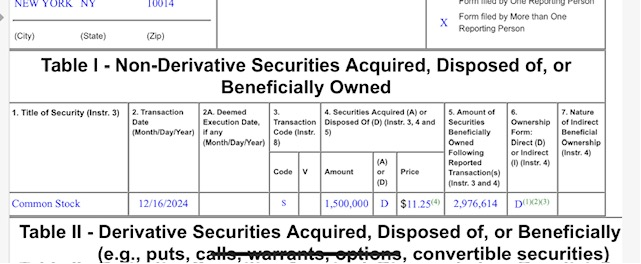
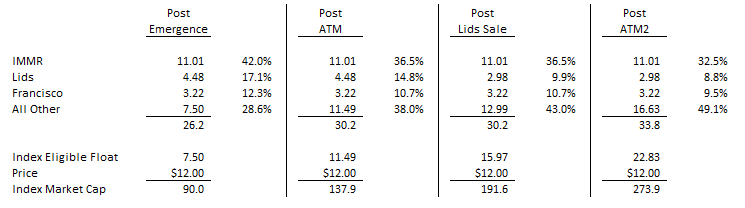
$BNED Summary of our call with $BNED earlier this week is below in the thread. Post close today, #2 $BNED holder Lids (the apparel company) sold down 1.5 mm of their 4.48 mm shares of $BNED. Lids took an equity stake as part of the rights offering as they had previously been a 2nd lien lender - they equitized at $5 and have more than doubled their money. Lids is also a huge partner for $BNED stores on the merchandize front - their investment was strategic, not purely financial. Form 4 filed post close today showing they sold exactly 1,500,000 shares on 12/16 (Monday)...which is somewhat odd for several reasons. First, reported exchange volume was only 1,243,550 shares. Second, they previously owned 4,476,614 shares so its not exactly the case that they are married to round numbers. Third, the sales conveniently get them under 10.0% of the outstanding. Many index guys have pointed out to us that both $IMMR, Lids and Francisco Partner's stakes are not index eligible unless they get under 30% or 10% (see below for the rules per the index). We, and most people, have a lot of heartburn on ATM1 and ATM2...with the later a real head scratcher. We have presumed, and hoped, that $IMMR had a logical plan behind what they were doing and this sale might further suggest it. At $190+ million of index eligible market cap, we hope that ATM2 is either put on the shelf or slow walked. Certainly, the entire $40 mm isn't need anymore...perhaps just another 2 mm shares to get Francisco under the 10.0% ownership threshold - if Francisco gets under 10.0%, this will have over $250+ million of index eligible market cap...and that just assumes $12 per share, if we all knew they were done with issuance, the stock would be much higher. Admittedly, this is all somewhat of a conspiracy theory. The answer could also be that Lids had ~$25 million invested in 2nd lien debt and with their stake now worth over $50 million, they are taking some chips off the table...we don't expect a full sale given the investment is strategic vs. financial. That said, we left our management call (see below thread) even more confident in the business momentum and $BNED is already on path to be organically net debt free in 18-24 months while having an under utilized credit facility at ~8% all in cost. The stated rationale for ATM2 makes little sense to us as the company has ample fire power and access to capital. Hopefully, this was at least partially index driven. We would love if the company ended up at 32.3 mm shares vs. the 37.5 mm we presumed in our math in the prior thread. Time will tell.
Lake Cornelia Research Management tweet mediaLake Cornelia Research Management tweet mediaLake Cornelia Research Management tweet mediaLake Cornelia Research Management tweet media
Lake Cornelia Research Management@CorneliaLake

$BNED We had a call with $BNED CEO Jonathan Shar to follow up on the Q. Jonathan has a ton of energy and his excitement for the business opportunity was palpable throughout our conversation. He was extremely articulate about the value proposition of their offerings to students and how they drive educational outcomes. Penetration and market acceptance is increasing and there are robust tailwinds to the industry in a win / win / win for students, schools and professors. The user experience for students is also increasingly a selling point…no longer do students have to deal with standing inline at the book store before school…its often just a QR code scan now. Management also led with comments about First Day “Course” which is the smaller of the two First Day programs and more ala cart tied to individual course materials. The “Course” offering has substantial tailwinds on its own (it is growing slower than FDC) and can be an easier sale to make as a “first step” for schools skittish about fully adopting FDC out of the gate – but we note that FDC is growing fine on its own and many / most schools adopt the fully program without the intermediate step. $BNED sees the total TAM of ~16 mm post-secondary students as having the potential to be fully captured in the end by “First Day” programs; $BNED currently has 925k students enrolled in schools that have adopted FDC. The market is split roughly 30 / 30 / 30 / 10 between $BNED / Follet, self-operated (ie schools that run their own bookstores) and then 10% split between various smaller vendors. The recent new business wins touched on two themes: (1) Syracuse was previously a self-operated bookstore school that because of increasing complexity to operate their own store is now using $BNED…they expect additional self-operated schools may come to a similar conclusion over time and (2) North Carolina A&T was won back, after they left last year…the school found that $BNED had a superior offering and value proposition…management hopes that as the dust continues to settle from the restructuring that any lingering doubts about financial viability fade away. Store count has fallen from (split between physical and virtual) 774 / 592 = 1,366 stores in April 2023 (against FDC enrollment of 580k) to 653 / 509 = 1,162 (against FDC enrollment of 925k) as of the most recent quarter. It sounded to us that most of the heavy lifting with closing unprofitable stores is in the rear view mirror and we note that comp store sales were +3.8% in the most recent quarter. We didn’t appreciate that the virtual stores, while working everywhere, are especially positive for smaller schools. The store discussion ultimately reverted back to the TAM discussion, which we found interesting…under the old physical textbooks bought in actual stores model, many smaller schools were not economical to service. In the current world of digital course materials and virtual stores, these smaller schools are profitable and indeed can have strong economics for $BNED…all else equal, the market evolution means more / all of the TAM is addressable now. The $20 million of cost cuts achieved to date is mostly related to corporate overhead, which was bloated. Some of this $20 million is already in the numbers but a lot will flow through overtime. Coupled with the store rationalization, it sounds like there is more “meat on the bone” when it comes to optimization and this will continue to be a tailwind for numbers. Management was limited in terms of what they could say about the $40 million shelf offering. They did note the cash flow savings from lower interest expense and increasing financial strength. They seemed to suggest a greater ability to win new business was a partial dirver as well. While management didn’t comment on this, we would note that the share count getting over ~37.5 million shares (it will be ~34 if they issue the next $40 mm in equity and is currently ~30.5 million) would bring $IMMR under 30% and allow all of their shares to count towards the market cap used by the R2K $IWM - even excluding the $IMMR shares, $BNED is a near certainty to be added to the index this summer. In short, we left the call convinced of the business momentum and think the additional capital raises are extremely unlikely to be tied to a perception of future deterioration in the business; quiet the opposite, we left the call firmly convinced that our bear / base / bull case EBITDA projections are likely to prove conservative. Our math below assumes that they eventually issue enough shares to get to 37.5 mm outstanding. We note that overtime, net debt will trend to zero (~$20 million of capex) and buybacks will likely reduce the share count. As of April, the company had a $457 million NOL (likely lower now given CODI and actual positive net income). With pre-tax FCF per share of ~$2.00+ per share, likely to grow to $4+ in the intermediate term, we think the name warrants investor attention.


English
3
1
21
14.2K