
Probe International

28.4K posts

Probe International banner
Probe International

Probe International

@ProbeIntl

An environmental and economic think-tank monitoring aid, trade, corruption, and China's transition to rule of law and constitutional government.

Toronto Joined Şubat 2010
958 Following1.3K Followers
Probe International retweeted
Sam Cooper
Sam Cooper@scoopercooper·
‘Have You Witnessed Forced Labour?' Floor-Crossing Liberal MP Michael Ma Challenges Former Senior Canadian Official and China Expert thebureau.news/p/have-you-wit…
English
2
14
47
999
Probe International retweeted
Probe International
Probe International@ProbeIntl·
10) Things didn’t end well for most of those women.
English
0
0
0
11
Probe International
Probe International@ProbeIntl·
9) Officials tracking Walsh worry her trajectory could mirror those of other female leftists and self-proclaimed revolutionaries who emerged in the 1970s and early ’80s to fight American imperialism and support the Palestinian cause.
English
1
0
0
12
Probe International
Probe International@ProbeIntl·
A brother and sister are charged with a plot involving an improvised explosive device targeting MacDill Air Force Base—the nerve center of US military operations against Iran—raising urgent questions on motive and the possibility of geopolitical factors. thebureau.news/p/florida-man-…
English
0
0
0
45
Probe International retweeted
Ken Cao-The China Crash Chronicle
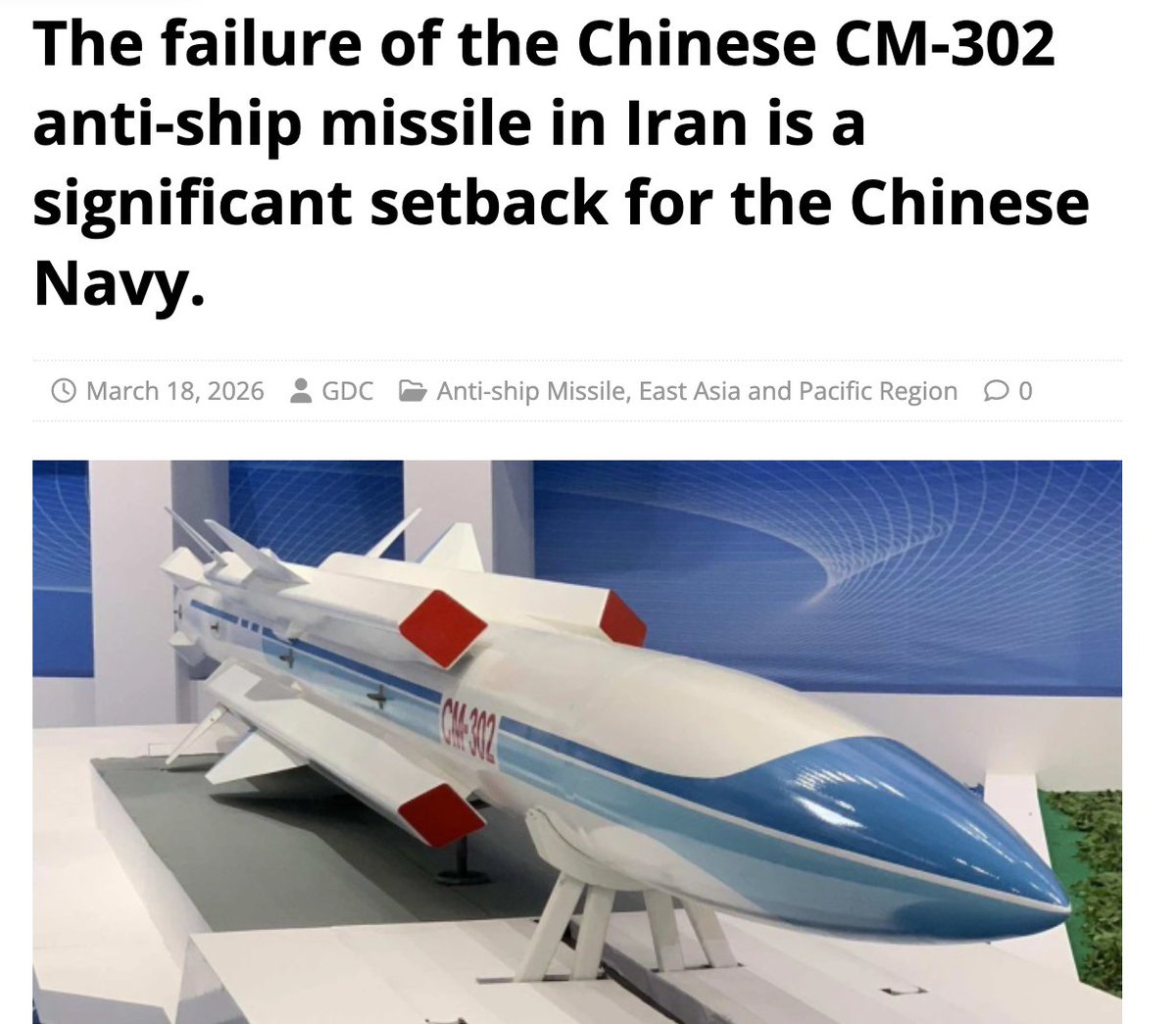
China’s “Carrier Killer” has failed spectacularly in Iran. In this conflict, Iran used Chinese-made CM-302 anti-ship missiles and HQ-series air defense systems, but they either failed to hit targets or were quickly destroyed by U.S. forces. Let’s start with earlier developments. Since February, the U.S. deployed major forces to the Middle East, including two carrier strike groups near Iran. War was on the verge of breaking out. To counter these carriers, Iran urgently purchased China’s so-called “carrier killer” CM-302 anti-ship missiles. The CM-302 is the export version of China’s YJ-12 missile. It is supersonic, has a range of about 290 km, and can strike large vessels. Beijing has long promoted it as one of the most powerful anti-ship missiles in the world. But in real combat, this “carrier killer” delivered a shocking result: zero hits! Investigations showed that many of the CM-302 missiles malfunctioned mid-flight and crashed, while the rest were easily intercepted by U.S. forces. Combined with U.S. Aegis combat systems, SM-6 interceptors, and electronic warfare, the missiles were neutralized with ease. There are even reports that Chinese technical personnel suffered casualties. The complete failure of these “carrier killers” not only damaged Iran’s confidence but also triggered global skepticism toward Chinese weapons. Rumors even suggest that Xi Jinping was furious, criticizing military engineers for pushing substandard equipment to secure funding, and launching internal crackdowns. This disastrous performance exposes a deeper issue: China’s military industry has long focused on paper performance rather than battlefield effectiveness. Weapons are not like consumer products. A sports car reaching 500 km/h proves performance. But for missiles, speed alone means nothing because if the enemy intercepts or jams it, the weapon is useless. A weapon must prove it can survive defenses and hit real targets under combat conditions. China’s approach to weapons development resembles consumer product design, chasing specs rather than real-world effectiveness. Take the CM-302: on paper, it looks impressive—290 km range, 500 kg payload. In theory, a few missiles could destroy a carrier. But that assumes the enemy is unprepared. In real combat, the opponent has layered missile defenses, electronic warfare, and early warning systems. Chinese weapons, designed without sufficient real combat considerations, collapse under these conditions, like paper tigers. This also reflects a structural weakness: China’s military has not fought a real war since the Sino-Vietnamese War. Nearly 50 years without combat means a lack of real battlefield experience, making it difficult to design weapons for actual war scenarios. As a result, Chinese weapons prioritize theoretical performance over proven effectiveness. In the global arms market, the most reliable weapons are those tested in real combat. Without that validation, even impressive specifications can be meaningless. Iran learned that lesson the hard way by buying Chinese weapons.
Ken Cao-The China Crash Chronicle tweet media
English
128
414
2.1K
117K
Probe International
Probe International@ProbeIntl·
Germany’s minister for energy and economy tells the “Super Bowl of energy” the EU needs to relax its net-zero target, calling mid-century goal into question. politico.eu/article/german…
English
0
0
0
32
Probe International retweeted
cbcwatcher
cbcwatcher@cbcwatcher·
"Canada’s National Security and Intelligence Committee of Parliamentarians, in a Top Secret 2019 report obtained by The Bureau, found that Beijing was already targeting First Nations leaders through intelligence operations disguised as tourism. The goal, a People’s Republic of China Embassy official acknowledged in intercept reports reviewed by Canada’s intelligence watchdog, was never cultural exchange." @scoopercooper
cbcwatcher tweet media
Sam Cooper@scoopercooper

Beijing's "Two-State" Strategy Targets Indigenous Land Claims and Resources to Undermine Canada's National Sovereignty, and Mark Carney's PRC Pivot Makes It More Dangerous thebureau.news/p/beijings-two…

English
19
290
476
12.4K
Probe International retweeted