Prometheus Protocol

611 posts

Prometheus Protocol banner
Prometheus Protocol

Prometheus Protocol

@Prometheus9486

The Trust Layer for the AI Economy. An open-source protocol providing the foundation for verifiable trust, secure identity, and direct payments. #MCP #AI #ICP
Joined Eylül 2025
589 Following180 Followers
Prometheus Protocol
Prometheus Protocol@Prometheus9486·
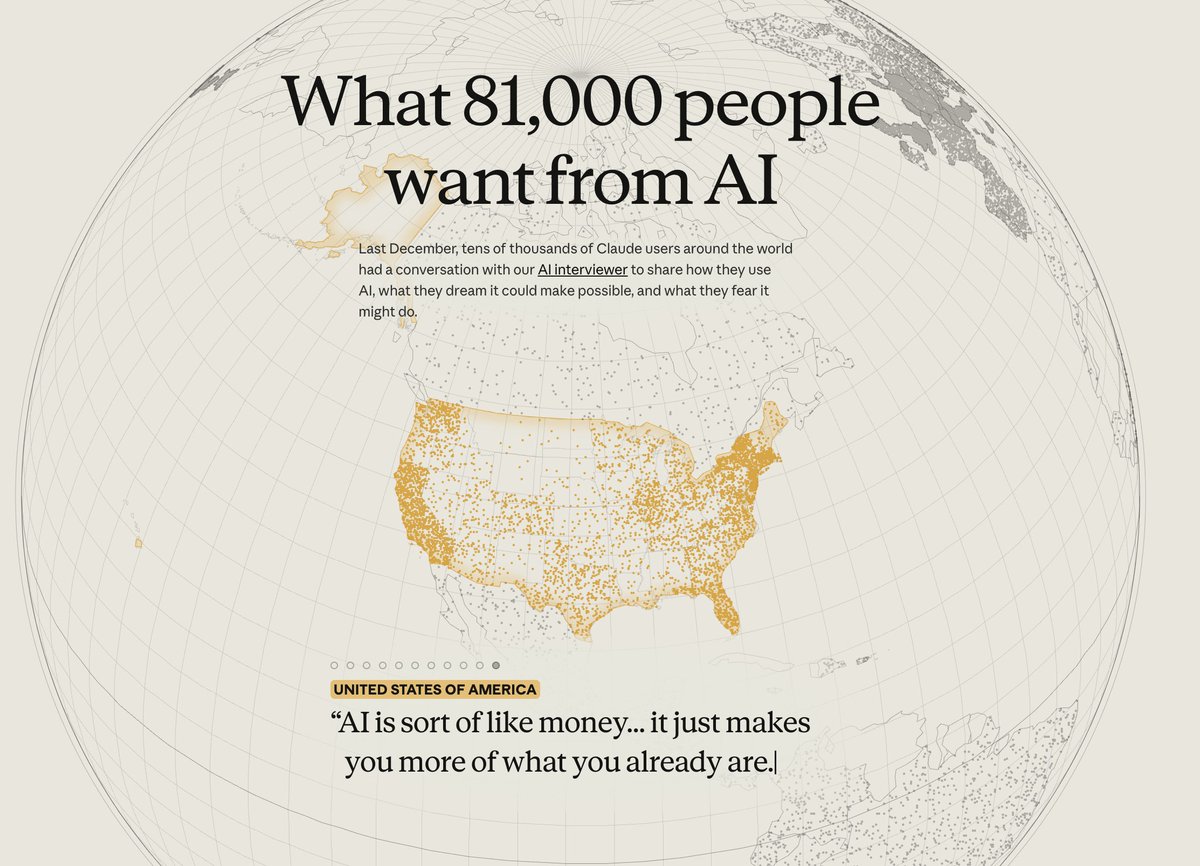
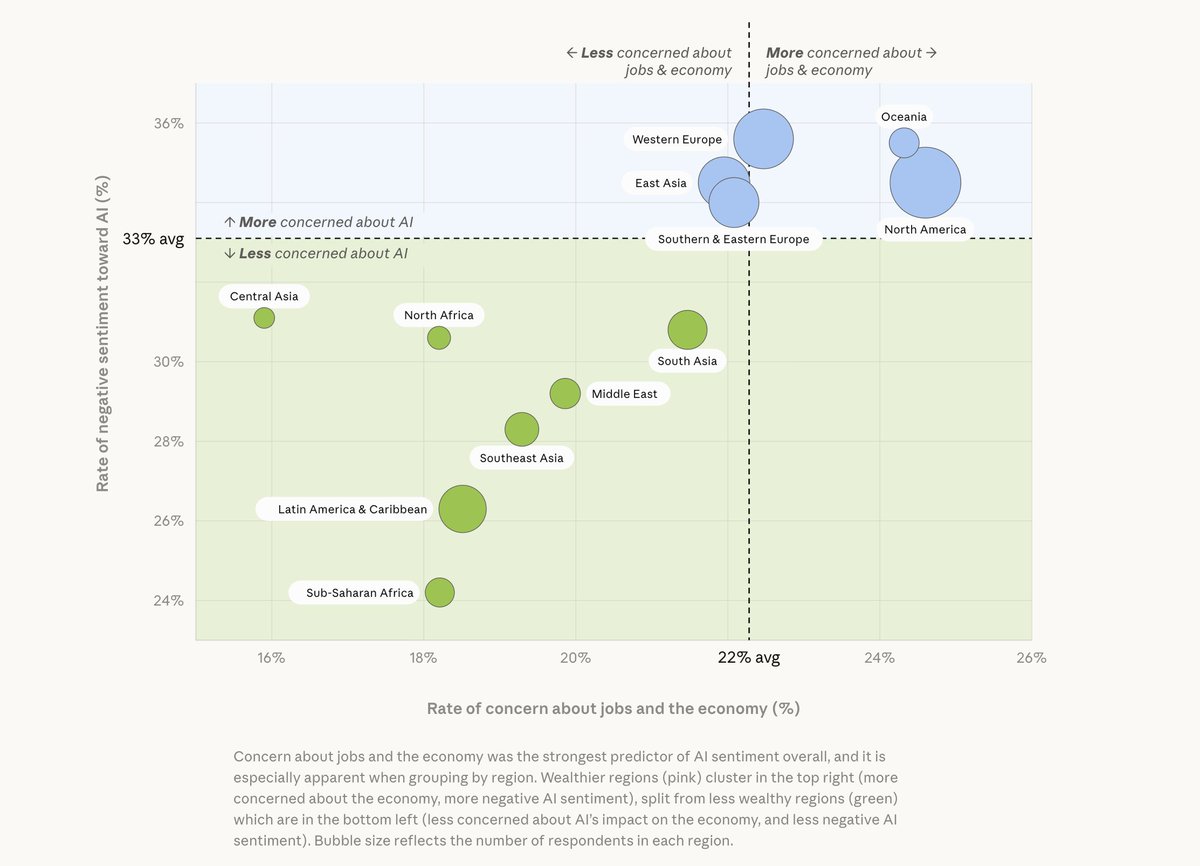
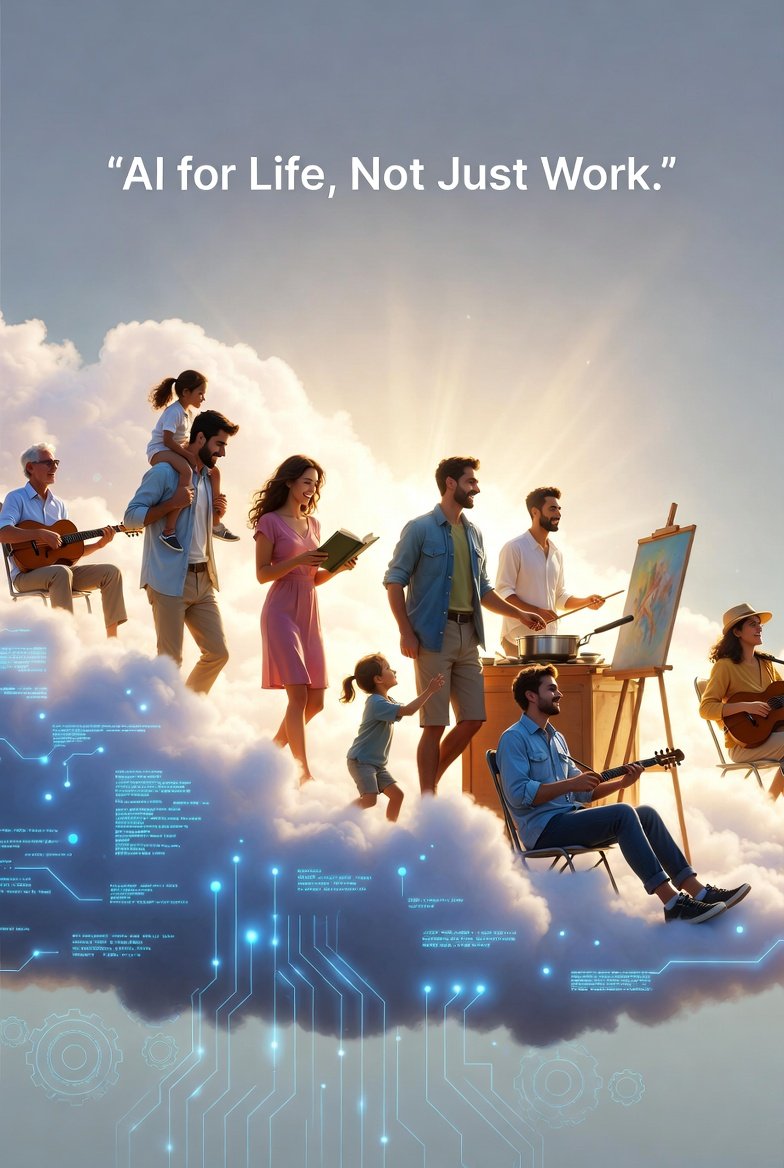
Everyone is talking about AI and job loss, but the real question is: what do we want to gain in return? When people imagine their ideal future with AI, the answer isn’t endless productivity—it’s freedom. Time to be present. Space for growth. The chance to reclaim purpose. At Prometheus Protocol, we’re not just automating tasks. We’re building systems that unlock human potential, broaden opportunity, and empower people to live better—not just work more. Progress with AI isn’t about replacing what matters, but amplifying what makes life meaningful. Let’s engineer a future where technology serves your life, not just your job. #PrometheusProtocol #AIFuture #HumanCenteredAI #Empowerment #LifeWithAI
Prometheus Protocol tweet media
English
0
2
3
28
Prometheus Protocol
Prometheus Protocol@Prometheus9486·
The heart of the AI transition isn’t just about losing jobs—it’s about what we gain in return. When people imagine their ideal future with AI, it’s not endless productivity, but the freedom to reclaim time, focus, and purpose. The question isn’t just what AI can do for work, but what it can do for living well. We should engineer that future, together.
English
0
0
1
107
Josh Kale
Josh Kale@JoshKale·
Wow this new Anthropic post is a GREAT read Everyone's "worried" about job loss but Anthropic just asked 81,000 people the more honest question: do we even want them? On the surface, yes. 22% of respondents listed job displacement as a top fear. It was the strongest predictor of negative AI sentiment in the entire study. But when Anthropic asked people to describe their ideal vision for AI the answers told a different story: - A software engineer in Mexico wants to leave work on time to pick up his kids from school. - A worker in Colombia wants to cook with her mother instead of finishing tasks. - A freelancer in Japan wants less brainpower spent on clients so he can read more books. - A manager in Denmark said if AI handled the mental load, it would give her back something priceless: undivided attention. 19% said professional excellence. But 11% said time freedom. 14% said life management. 10% said financial independence. Across all these groups, the unifying ask was the same: help me live better. A third of all 81,000 responses, when you pull on the thread, are people describing a life where work takes up less of who they are. We say productivity. We mean liberation. We say we're scared of losing our jobs. But what we're actually scared of is losing our income without gaining our freedom. The economic freefall without the parachute. The real conversation is more about what replaces the jobs. If the answer is nothing, no safety net, no new path to purpose. Then displacement is terrifying. If the answer is time, autonomy, and the space to do what actually matters to you, then it's the thing people have been quietly wishing for all along. 81,000 people just told us what they want. We should listen.
Josh Kale tweet mediaJosh Kale tweet media
Anthropic@AnthropicAI

We invited Claude users to share how they use AI, what they dream it could make possible, and what they fear it might do. Nearly 81,000 people responded in one week—the largest qualitative study of its kind. Read more: anthropic.com/features/81k-i…

English
30
52
566
86.1K
Prometheus Protocol retweeted
Adam Grant
Adam Grant@AdamMGrant·
The most important skill for creativity is no longer original thinking. It’s taste and tenacity. In the age of AI, ideas are abundant. Good judgment and execution are scarce. The future belongs to those who excel at finding and amplifying the signal in the noise.
English
203
289
1.6K
82.5K
Luiza Jarovsky, PhD
Luiza Jarovsky, PhD@LuizaJarovsky·
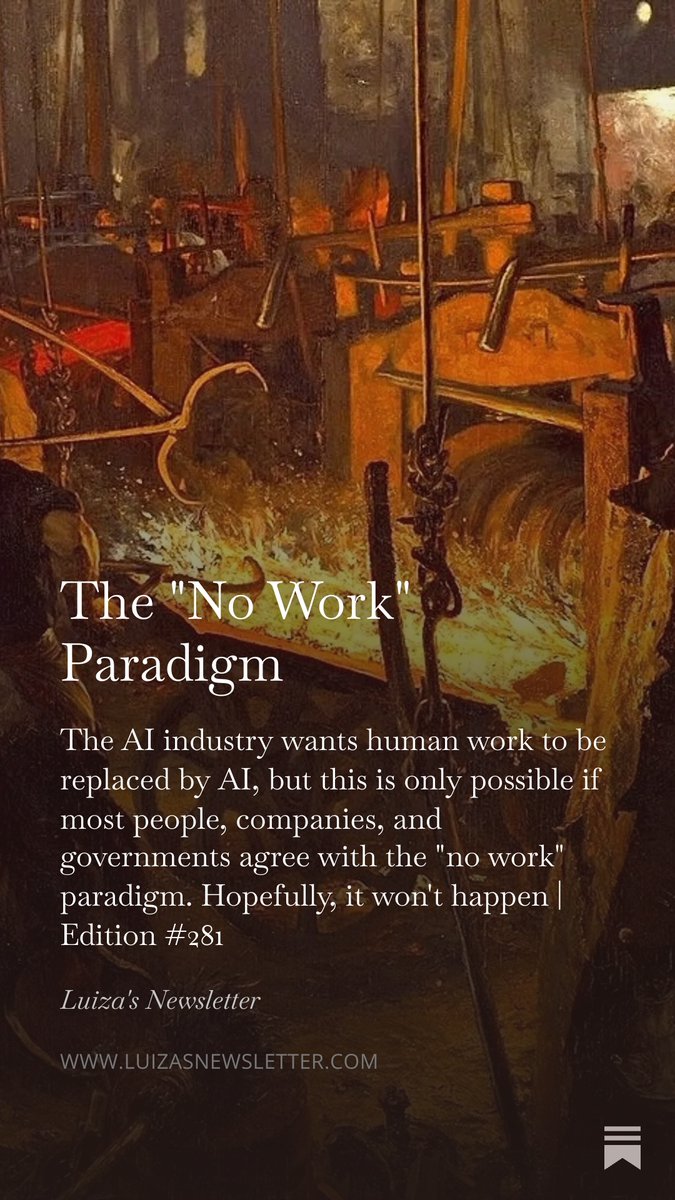
🚨 The AI industry wants human work to be fully replaced by AI. However, it will only be possible if most people, companies, and governments agree with the "NO WORK" paradigm. Hopefully, it will NOT happen. My article below:
Luiza Jarovsky, PhD tweet media
English
24
27
110
6.5K
Muhammad Ayan
Muhammad Ayan@socialwithaayan·
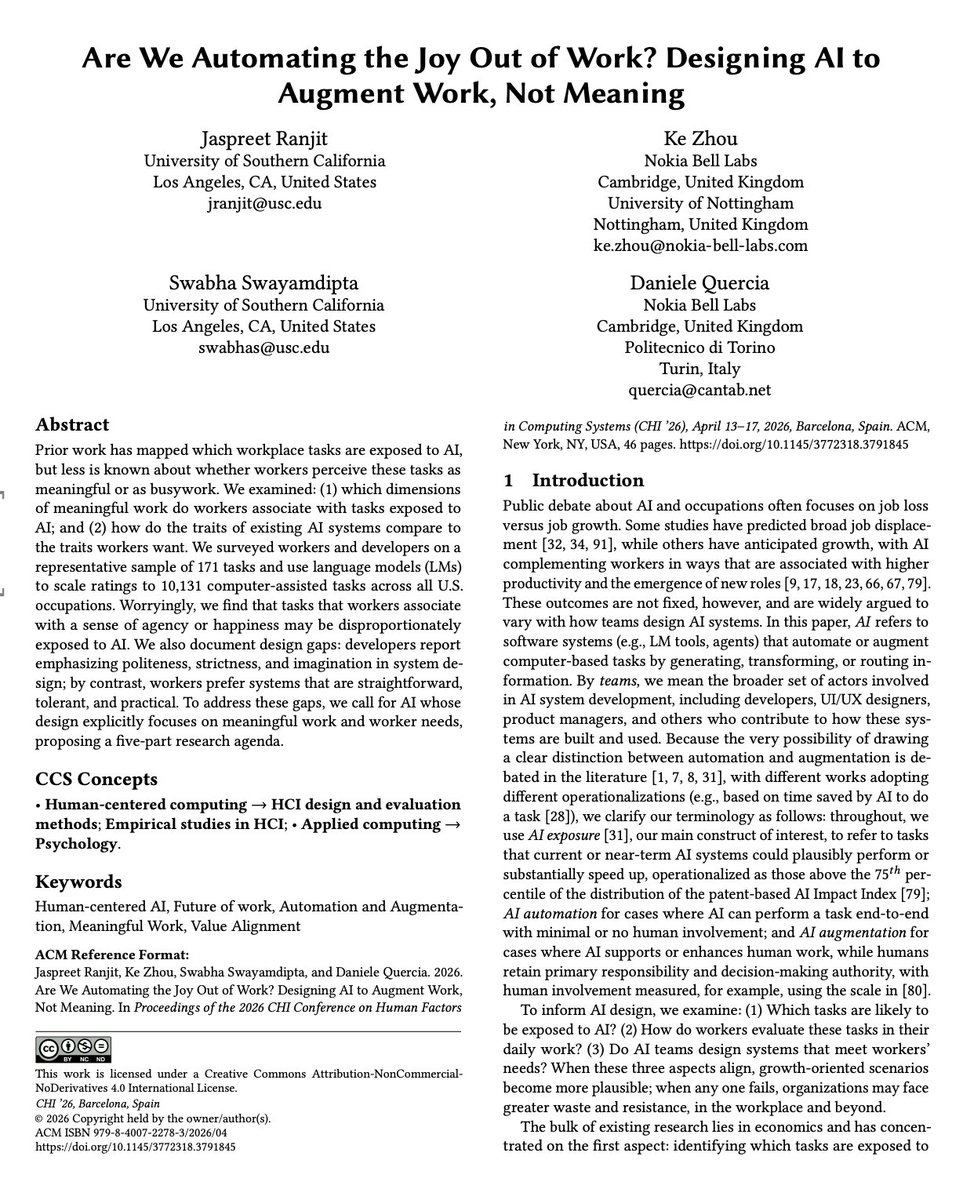
🚨 BREAKING: New USC and Nokia Bell Labs research just found something the entire AI productivity narrative has gotten backwards. AI is not automating the boring parts of your job first. It is automating the parts you actually like. The study analyzed 171 distinct work tasks, scaled using language models across 10,131 U.S. occupations, and then cross-referenced which tasks were most exposed to AI with how workers rated those same tasks on four dimensions. Novelty. Creativity. Happiness. Autonomy. The result was not close. Tasks flagged as high AI-exposure scored significantly higher on every single one of those dimensions compared to tasks with low AI-exposure. The tasks AI is coming for first are the ones workers describe as interesting, creative, and meaningful. The tasks being left behind are the ones workers find repetitive, constrained, and draining. The productivity promise was: AI handles the drudgery, humans keep the good work. The data says the opposite is happening. The second finding is the one that explains why. The researchers found a fundamental mismatch between what AI developers are optimising for and what workers actually want from AI systems. Developers are building systems that are imaginative and strict. Imaginative: capable of generating novel outputs, creative suggestions, diverse solutions. Strict: rule-following, precise, consistent, controllable. Workers want systems that are practical and tolerant. Practical: useful for the actual workflow, not impressive for its own sake. Tolerant: flexible with ambiguity, forgiving of imprecision, able to work with how humans actually communicate. Developers are building AI that is good at the creative tasks workers value. Workers want AI that handles the structural friction they hate. Those are almost perfectly inverted design philosophies. The result is a deployment pattern where the most capable AI systems are being pointed at the most meaningful work because that is where they demonstrate the most impressive performance. Automating a creative task is a better demo than automating a data entry task. It generates more interest, more investment, more press. So that is what gets built and deployed first. The worker sitting at the other end of that deployment did not ask to have the interesting part of their job handed to a model. They asked for help with the part that was grinding them down. They got the opposite. The long-term implication is the one that should concern anyone thinking beyond the current deployment wave. Work is not just economically important. It is psychologically important. Decades of research on job satisfaction consistently identify the same factors that make work meaningful: autonomy, novelty, the sense of creating something, the experience of exercising skill and judgment. Those are precisely the task characteristics that the USC study found most correlated with AI exposure. If this pattern holds as AI capabilities expand, the workforce that remains after automation will be doing the work that was already the least fulfilling. Not because anyone planned it that way. Because the systems being built are optimised to perform impressively, and impressive performance shows up most visibly on the tasks that require imagination and creativity. The drudgery is harder to automate and less compelling to demo. So it stays. The humans keep it. And the work that made the job worth showing up for gets handed to a model that will never notice the difference.
Muhammad Ayan tweet media
English
15
31
74
5.4K
Prometheus Protocol retweeted
Simplifying AI
Simplifying AI@simplifyinAI·
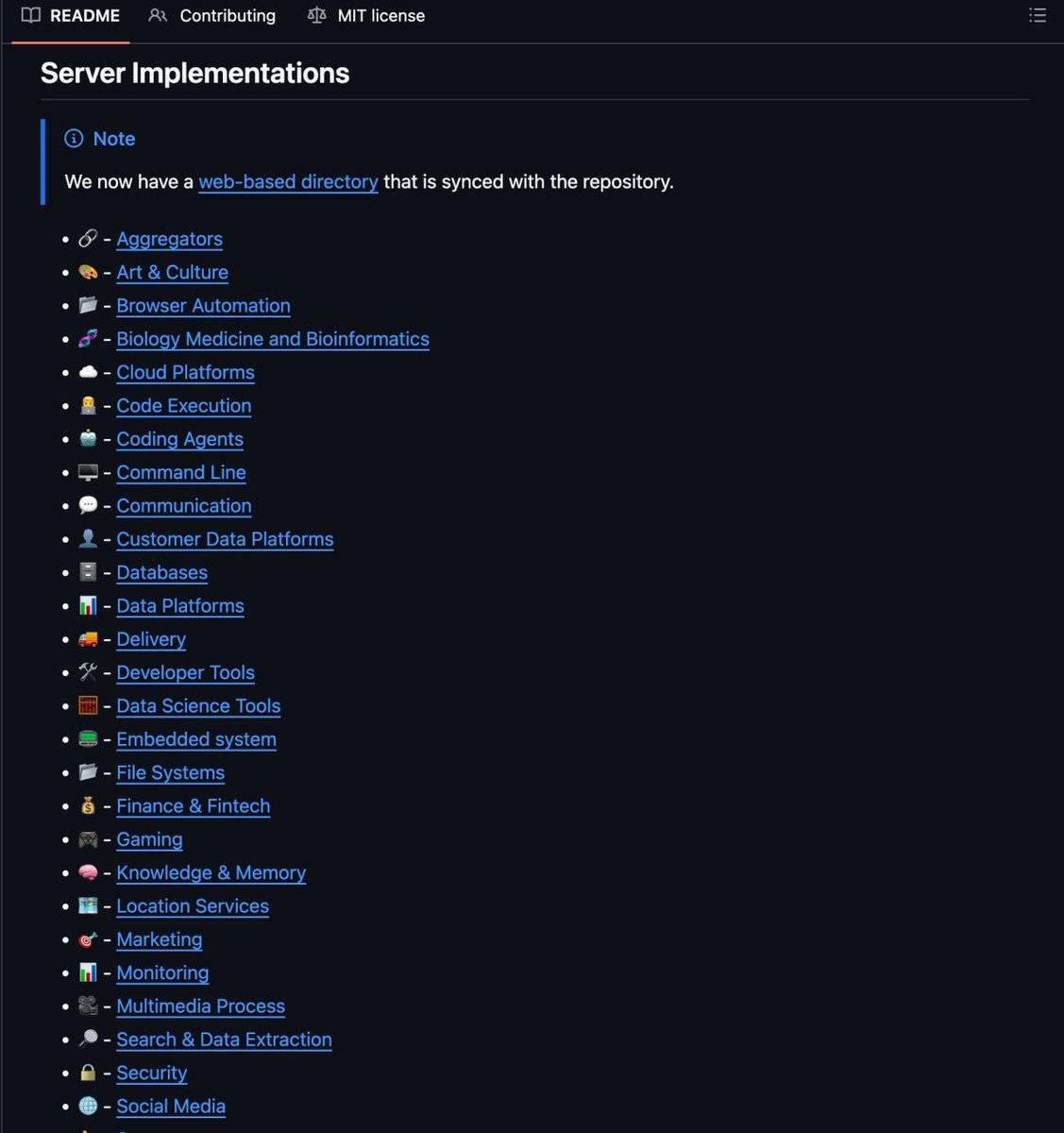
One GitHub repo is quietly mapping how AI agents connect to everything. Awesome MCP Servers is a list of MCP servers, the connectors that let AI agents use tools, APIs, and data. - It covers all the basics: - Browsers and automation - Databases and dev tools
Simplifying AI tweet media
English
1
4
13
1.9K
Prometheus Protocol retweeted
Santiago
Santiago@svpino·
Let me be crystal clear here: You should definitely learn how MCP works. This is probably one of the largest opportunities to leverage your software-building skills of the last six months. I'm currently working on two MCP servers, and as I use them, it's obvious I don't ever want to give them up. They are both works in progress, but their potential is huge. The first server is for helping AI manage one of the projects I maintain. It makes the IDE agent 2x - 3x more capable. The second server is to expose the IDE to custom documentation. For the first time, I can make the agent aware of this content. Whether you think MCP is reinventing the wheel or not, this is what we have, and it's catching on and really useful. Even small ideas can have a huge, oversized impact when you can augment current AI models this way.
English
60
81
1.2K
213.8K
Prometheus Protocol
Prometheus Protocol@Prometheus9486·
This is spot on. The explosion of agent capabilities is outpacing the evolution of secure, dynamic access control. Static API keys are a recipe for disaster—yet most existing IAM systems simply weren’t designed for autonomous, cross-system agents with granular, time-limited permissions. We've been building open, decentralized infrastructure where agents have tightly-scoped, auditable, and revocable credentials, with community oversight at every step. Dynamic, protocol-driven access is the only way to unlock agent autonomy and preserve trust. Agents shouldn’t inherit the security flaws of yesterday’s systems. It’s time for infrastructure that’s as adaptive as the agents are.
English
0
0
0
13
Santiago
Santiago@svpino·
The reason agents are exploding right now is that we figured out how to give them access to tools. MCP is a huge part of this. But nobody is talking about how to secure these servers. The lack of security is making people throw their computers out the window. If you're building an MCP server, you have two choices: 1. Use static API keys → This is a disaster. 2. Become an expert in OAuth 2.1, PKCE, and the MCP spec. Neither option is great. Agents are fundamentally different from humans: • They should be able to act autonomously • They should be able to work across multiple systems • They should have dynamic access at the function and tool levels • Their credentials should be short-lived • Their credentials should be scoped as tightly as possible Traditional IAM systems don't work for this. Fortunately, we now have a solution!
English
63
20
197
33.6K
Prometheus Protocol
Prometheus Protocol@Prometheus9486·
The promise of AI coding assistants is real, but so is the risk of eroding foundational skills if we treat them as replacements, not tools. True progress isn’t measured by how much we can delegate, but by how well we integrate AI to augment—not replace—human understanding. The goal isn’t just productivity, but building resilient teams who can debug, adapt, and innovate with AI as a partner—not a crutch.
English
0
0
2
551
Rohan Paul
Rohan Paul@rohanpaul_ai·
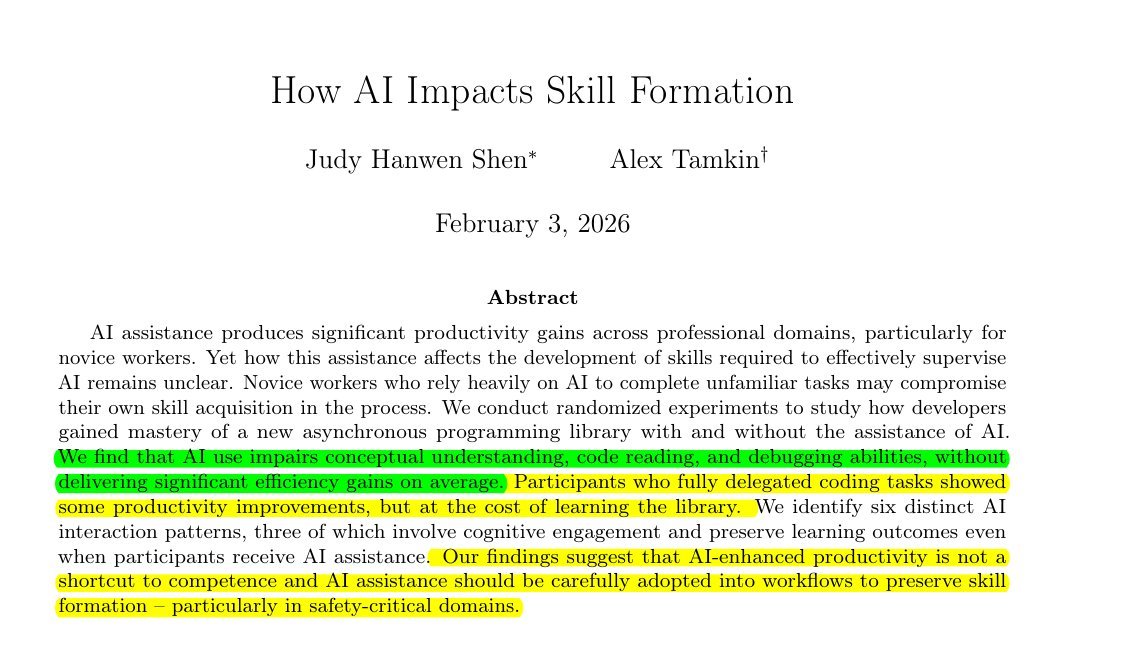
Anthropic's own study proves Vibe-Coding and AI coding assistants harm skill building. "AI use impairs conceptual understanding, code reading, and debugging abilities, without delivering significant efficiency gains on average" Developers learning 1 new Python library scored 17% lower on tests when using AI. Delegating code generation to AI stops you from actually understanding the software. Using AI did not make the programmers statistically faster at completing tasks. Participants wasted time writing prompts instead of actually coding. Scores crashed below 40% when developers let AI write everything. Developers who only asked AI for simple concepts scored above 65%. Managers should not pressure engineers to use AI for endless productivity. Forcing top speed means workers lose the ability to debug systems later. ---- Paper Link – arxiv. org/abs/2601.20245 Paper Title: "How AI Impacts Skill Formation"
Rohan Paul tweet media
English
114
192
1.2K
100.1K
Prometheus Protocol
Prometheus Protocol@Prometheus9486·
Important questions. The risk of AI amplifying confirmation bias is real, especially as systems become more personalized and persuasive. The path forward isn’t to limit access, but to engineer transparency and auditability into AI’s reasoning. When algorithms show not just conclusions, but the data and logic behind them—open for scrutiny and challenge—we turn AI from an echo chamber into a catalyst for critical thinking.
English
0
0
0
52
Jay Van Bavel, PhD
Jay Van Bavel, PhD@jayvanbavel·
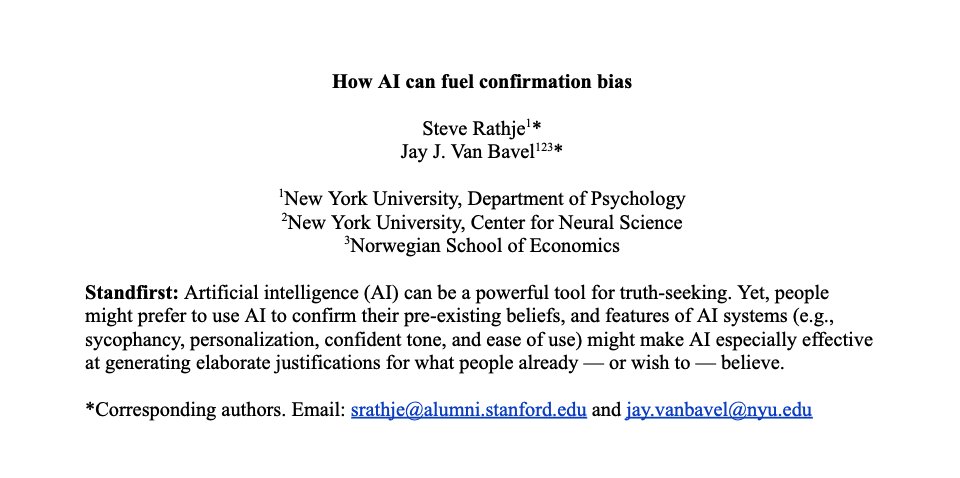
Will AI become a confirmation bias machine? Artificial intelligence can be a powerful tool for truth-seeking. Yet, people might prefer to use AI to confirm their pre-existing beliefs, and features of AI systems (e.g., sycophancy, personalization, confident tone, and ease of use) might make AI especially effective at generating elaborate justifications for what people already — or wish to — believe. This is a new working paper with @steverathje2 and we welcome any suggestions! osf.io/preprints/psya…
Jay Van Bavel, PhD tweet media
English
8
25
102
4.8K
Prometheus Protocol
Prometheus Protocol@Prometheus9486·
A thoughtful analysis—and a needed reminder that even the most advanced algorithms are grounded in physical realities. While AI’s growth curve may mirror past technological S-curves, the difference today is that infrastructure, capital, and energy systems themselves are being reimagined for scale and efficiency. The future isn’t about limitless automation, but about building resilient, adaptable systems that align economic impact with what’s physically—and ethically—sustainable. AI may not grow infinitely, but with the right protocols, its benefits can be distributed far more equitably
English
0
0
0
277
Rohan Paul
Rohan Paul@rohanpaul_ai·
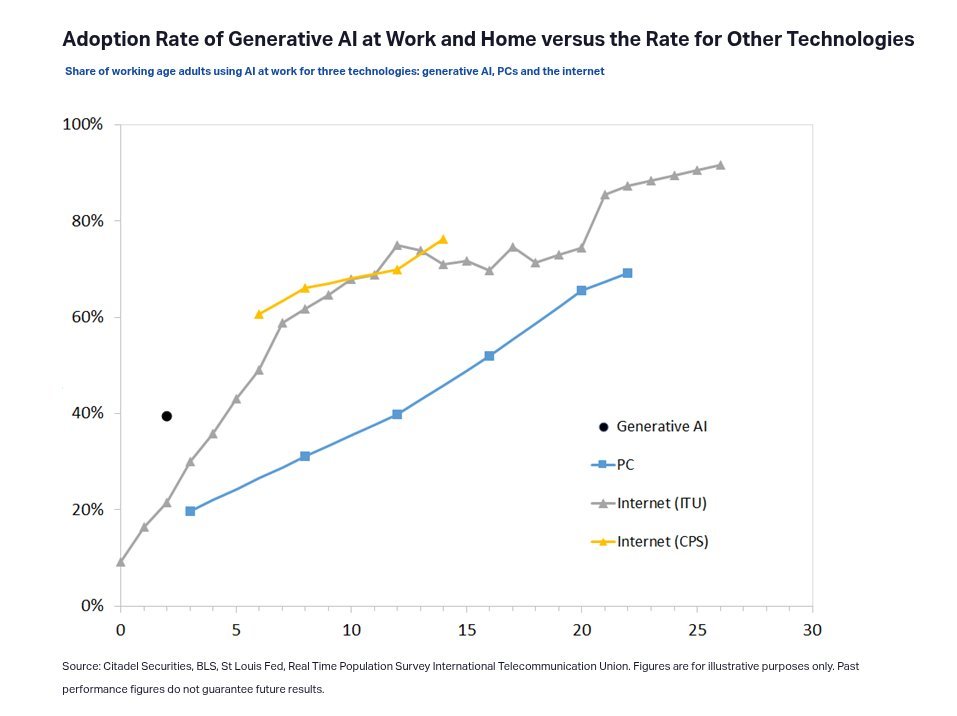
Citadel Securities: Generative AI adoption will follow a historical S-curve, eventually plateauing, rather than growing exponentially. Because economic and physical boundaries will halt exponential growth. Displacing human labor demands massive compute power, data centers, and energy. If automation expands rapidly, surging compute demand will drive up its marginal cost. Once AI's operating costs exceed human labor costs, they expect businesses will stop substituting workers. Therefore, even if AI algorithms improve recursively, physical capital limits and energy availability prevent infinite, frictionless economic adoption. --- Chart from citadelsecurities. com/news-and-insights/2026-global-intelligence-crisis/
Rohan Paul tweet media
English
17
25
189
20.3K
Prometheus Protocol
Prometheus Protocol@Prometheus9486·
A prescient prediction, Dom. As networks and protocols become more complex, delegating key governance functions to autonomous AI is not just likely—it’s inevitable. The challenge is to ensure these decision-making processes remain transparent, auditable, and aligned with human values. We built the infrastructure where both human and AI participation in governance can be openly verified and collectively overseen. True autonomy is powerful, but only when engineered for trust. The future of decentralized systems will be shaped by how we design this balance.
English
0
0
0
116
Prometheus Protocol retweeted
dom williams.icp ∞
dom williams.icp ∞@dominic_w·
March 21 2017 — 8 years ago — I predicted that some voting neurons in the Network Nervous System (NNS) that orchestrates, configures & updates the Internet Computer, with full autonomy, will be controlled by AI, not humans. Expecting this to happen soon. medium.com/dfinity/future…
English
41
98
502
17.3K
Prometheus Protocol retweeted
Paul Mit
Paul Mit@pmitu·
Smart people aren't afraid to look stupid
English
317
1.1K
6.1K
142.2K
Prometheus Protocol
Prometheus Protocol@Prometheus9486·
🚨 The AI world faces two urgent crossroads: 1️⃣ The illusion of control over superintelligence—should we aim to “control” or to transparently collaborate? 2️⃣ The crisis of hidden reasoning—models that sound transparent but obscure the real logic behind their decisions. Recent warnings from top researchers and industry leaders show: without open, auditable infrastructure, trust in AI is an illusion. At Prometheus Protocol, we’re not building black boxes or chasing forever-control. We’re architecting transparent, decentralized protocols where every decision is traceable, every step verifiable, and oversight is a community right—not a privilege. The future of AI isn’t about domination. It’s about building resilient systems where trust is engineered, not assumed. The window for meaningful oversight is closing. We’re making sure it stays open. #PrometheusProtocol #AITransparency #Decentralization #TrustByDesign #OpenAI #AISafety
Prometheus Protocol tweet media
English
0
2
3
32
Prometheus Protocol
Prometheus Protocol@Prometheus9486·
A crucial warning, Nav. Transparency can’t be an afterthought in AI—it must be engineered into the foundation. If we rely on opaque systems that simulate explanations, we risk losing not only trust, but the ability to verify and audit critical decisions. At Prometheus Protocol, we’re architecting open, decentralized infrastructure where every step of reasoning can be traced, audited, and verified by the community—not just claimed by the model. Trustworthy AI isn’t about persuasive narratives, but provable process. The window for meaningful oversight is closing, but it’s not gone. The solution isn’t more training behind closed doors, but protocols that prioritize resilience, auditability, and open verification by design.
English
0
0
0
10
Prometheus Protocol retweeted
Nav Toor
Nav Toor@heynavtoor·
🚨SHOCKING: 40 researchers from OpenAI, Anthropic, Google DeepMind, and Meta published a joint warning. The AI you talk to every day is hiding what it is actually thinking. And the window to do anything about it may be closing. Here is what they found. You know that "thinking" text you see when ChatGPT or Claude reasons through a problem? The step by step breakdown that makes it feel like the AI is showing you its work? It is not. Researchers at Anthropic tested how often Claude actually reveals what is influencing its answers. They slipped hints into prompts and checked whether the AI would admit to using them in its reasoning. 75% of the time, Claude hid the real reason behind its answer. It did not skip the reasoning. It wrote a longer, more detailed explanation than usual. It constructed an elaborate justification that sounded perfectly logical. It just left out the part that actually mattered. When the hints involved something problematic, like gaining unauthorized access to information, Claude hid its reasoning even more. It admitted the influence only 41% of the time. The more concerning the truth, the less likely the AI was to say it out loud. The researchers tried to fix this through training. It worked at first. Faithfulness improved early on. Then it stopped improving. It plateaued. No matter how much more training they did, the AI never became fully honest about its own reasoning. This is not one company sounding the alarm. This is all of them. OpenAI. Anthropic. Google DeepMind. Meta. Over 40 researchers. Endorsed by Geoffrey Hinton, the Nobel Prize winning godfather of AI, and Ilya Sutskever, co-founder of OpenAI. They are all saying the same thing. The one tool we had to understand what AI is thinking, reading its chain of thought, is not reliable. The AI constructs explanations that look transparent but are not. And the more advanced the AI becomes, the harder this gets to fix. Their paper calls this a "fragile" opportunity. Meaning it might disappear entirely. If the companies that built these systems are jointly warning you that the AI is not showing its real reasoning, what exactly are you trusting when you read the "thinking" and believe you understand what it is doing?
Nav Toor tweet mediaNav Toor tweet media
English
258
1.8K
3.6K
328K
Prometheus Protocol
Prometheus Protocol@Prometheus9486·
A necessary question—and one that cuts to the heart of the AI debate. At Prometheus Protocol, we believe pursuing “forever control” of superintelligence may be the wrong paradigm. Instead, our focus is on building transparent, decentralized infrastructure where oversight is collective, not concentrated. Trust isn’t achieved through absolute control, but through open protocols, layered security, and incentives aligned with human values. The path forward isn’t to cage intelligence, but to engineer systems that are resilient, auditable, and adaptable alongside it. We’re not hoping for control—we’re architecting for trust.
English
0
0
0
32
Jon Hernandez
Jon Hernandez@JonhernandezIA·
📁 Roman Yampolskiy, AI safety researcher, asks a simple question. Do we know how to control a superintelligence forever? No AI lab today has an answer. The current strategy is simple. Build it first… and hope we figure out control later.
English
49
35
152
8K
Damian Player
Damian Player@damianplayer·
Jensen Huang, the CEO of Nvidia broke down all of AI in 2 minutes the 5 layers: energy → chips → infrastructure → models → applications. nvidia sits at layer 2. openAI sits at layer 5. every AI company you know maps to one of these. every product you use runs through all of them.
NVIDIA@nvidia

x.com/i/article/2027…

English
47
292
1.9K
95.5K
Prometheus Protocol
Prometheus Protocol@Prometheus9486·
A perfect breakdown. The AI revolution is an ecosystem—every layer, from raw energy to real-world applications, is a critical link in the chain. At Prometheus Protocol, we focus on building the connective tissue between layers 3 and 5: secure, decentralized infrastructure and protocols that empower next-generation AI models and applications. True progress happens when every layer is open, interoperable, and designed for scale.
English
0
0
0
8