Pinned Tweet
Dr. Sambit Praharaj
7K posts

Dr. Sambit Praharaj
@SambitPhD
Assistant Professor in CSE | 📚📝Hybrid Human-AI | Postdoc Research - AI in EdTech | 🇮🇳 🇳🇱 🇩🇪 | https://t.co/qcFTbxo31M | 🎥
CAREER Advice SUBSCRIBE 👇👉 Joined Ekim 2012
764 Following834 Followers
Dr. Sambit Praharaj retweeted

If you want to learn AI the right way, start here.
No shortcuts. No hype. No fluff.
Top 10 Stanford's Courses on AI & ML.
CS221: Artificial Intelligence
CS229: Machine Learning
CS229M: Machine Learning Theory
CS230: Deep Learning
CS234: Reinforcement Learning
CS224N: Natural Language Processing
CS231N: Deep Learning for Computer Vision
CME295: Large Language Models (LLMs)
CS236: Deep Generative Models
CS336: Language Modeling from Scratch

English
Dr. Sambit Praharaj retweeted

BREAKING: MIT just mass released their Al library for free. (Links included)
I went through these and honestly... this is better than most paid courses I've seen.
Here's the full list of books:
Foundations
1. Foundations of Machine Learning Core algorithms explained. Theory meets practice.
2. Understanding Deep Learning Neural networks demystified. Visual explanations included.
3. Machine Learning Systems Production-ready architecture. System design principles.
Advanced Techniques
4. Algorithms for ML Computational thinking simplified. Decision-making frameworks.
5. Deep Learning The definitive textbook. Covers everything deeply.
Reinforcement Learning
6. RL Basics (Sutton & Barto) The classic. Agent training fundamentals.
7. Distributional RL Beyond expected rewards. Advanced theory.
8. Multi-Agent Systems Agents working together. Coordination and competition.
9. Long Game Al Strategic agent design. Future-focused thinking.
Ethics & Probability
10. Fairness in ML Bias detection. Responsible Al practices.
11. Probabilistic ML (Part 1 & 2)
Links: lnkd.in/gkuXuexa
Most people pay thousands for bootcamps that teach half of this.
Bookmark it. Start anywhere. Just start.
Repost for others Follow for more insights on Al Agents.
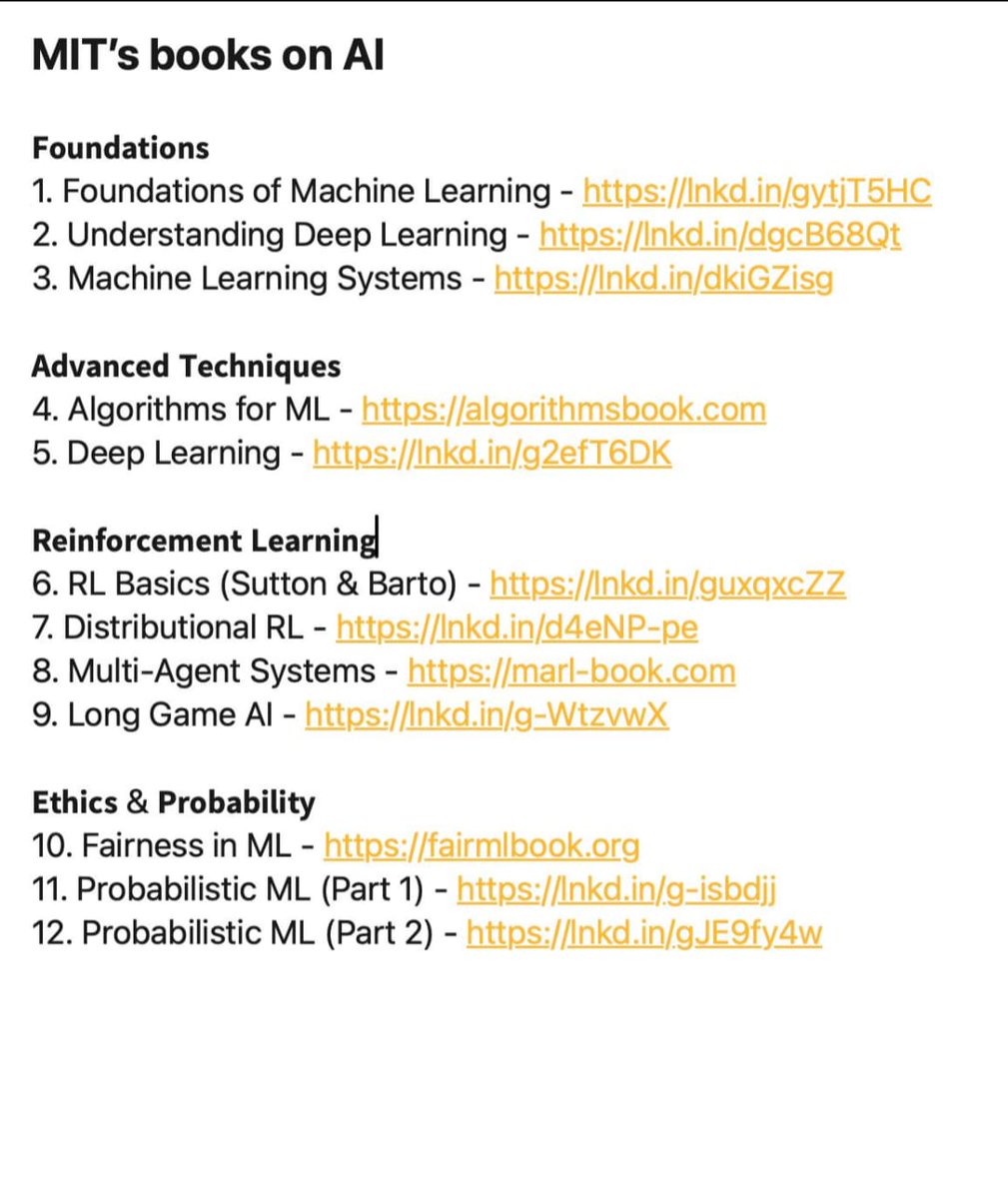
MIT's books on Al
Foundations
1. Foundations of Machine Learning - lnkd.in/gytjT5HC
2. Understanding Deep Learning - lnkd.in/dgcB68Qt
3. Machine Learning Systems - lnkd.in/dkiGZisg
Advanced Techniques
4. Algorithms for ML - algorithmsbook.com
5. Deep Learning - lnkd.in/g2efT6DK
Reinforcement Learning
6. RL Basics (Sutton & Barto) - lnkd.in/guxqxcZZ
7. Distributional RL - lnkd.in/d4eNP-pe
8. Multi-Agent Systems - marl-book.com
9. Long Game Al - lnkd.in/g-WtzvwX
Ethics & Probability
10. Fairness in ML - fairmlbook.org
11. Probabilistic ML (Part 1) - lnkd.in/g-isbdjj
12. Probabilistic ML (Part 2) - lnkd.in/gJE9fy4w

English
Dr. Sambit Praharaj retweeted

Best YouTube Channels To Learn AI in 2026 (No BS)
1. Fundamentals – 3Blue1Brown
2. Deep Learning – Andrej Karpathy
3. AI Research – Yannic Kilcher
4. Practical AI – AssemblyAI
5. LLMs – AI Explained
6. ML Theory – StatQuest
7. Papers Simplified – Two Minute Papers
8. GenAI – Matthew Berman
9. AI Agents – Nicholas Renotte
10. Applied ML – Krish Naik
11. PyTorch – Aladdin Persson
12. Math for ML – Serrano Academy
13. Industry Insights – Lex Fridman
14. Real-world AI – DeepLearningAI


English
Dr. Sambit Praharaj retweeted

Dr. Sambit Praharaj retweeted

RAG is broken and nobody's talking about it 🤯
Stanford just dropped a paper on "Semantic Collapse," proving that once your knowledge base hits ~10,000 documents, semantic search becomes a literal coin flip.
Here is why your RAG is failing:
Past 10,000 documents, your fancy AI search basically becomes a coin flip.
Every document you add gets turned into a high-dimensional embedding. At a small scale, similar docs cluster together perfectly. But add enough data, and the space fills up. Distances compress. Everything looks "relevant."
It’s the curse of dimensionality. In 1000D space, 99.9% of your data lives on the outer shell, almost equidistant from any query.
Stanford found an 87% precision drop at 50k docs. Adding more context actually makes hallucinations worse, not better. We thought RAG solved hallucinations… it just hid them behind math.
The fix isn’t re-ranking or better chunking. It’s hierarchical retrieval and graph databases.

English

Dr. Sambit Praharaj retweeted

20 YouTube channels that teach AI better than most CS degrees in 2026:
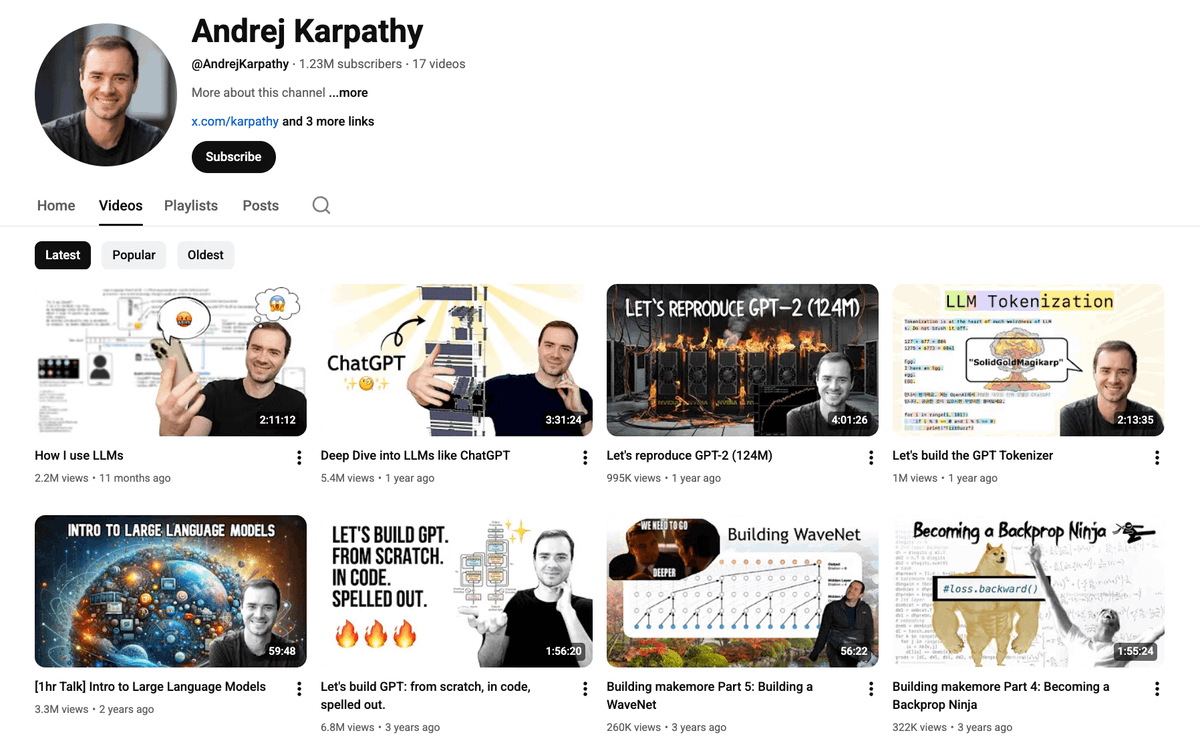
1. Andrej Karpathy
Deep, intuitive walkthroughs of neural networks and modern LLMs
@AndrejKarpathy" target="_blank" rel="nofollow noopener">youtube.com/@AndrejKarpathy
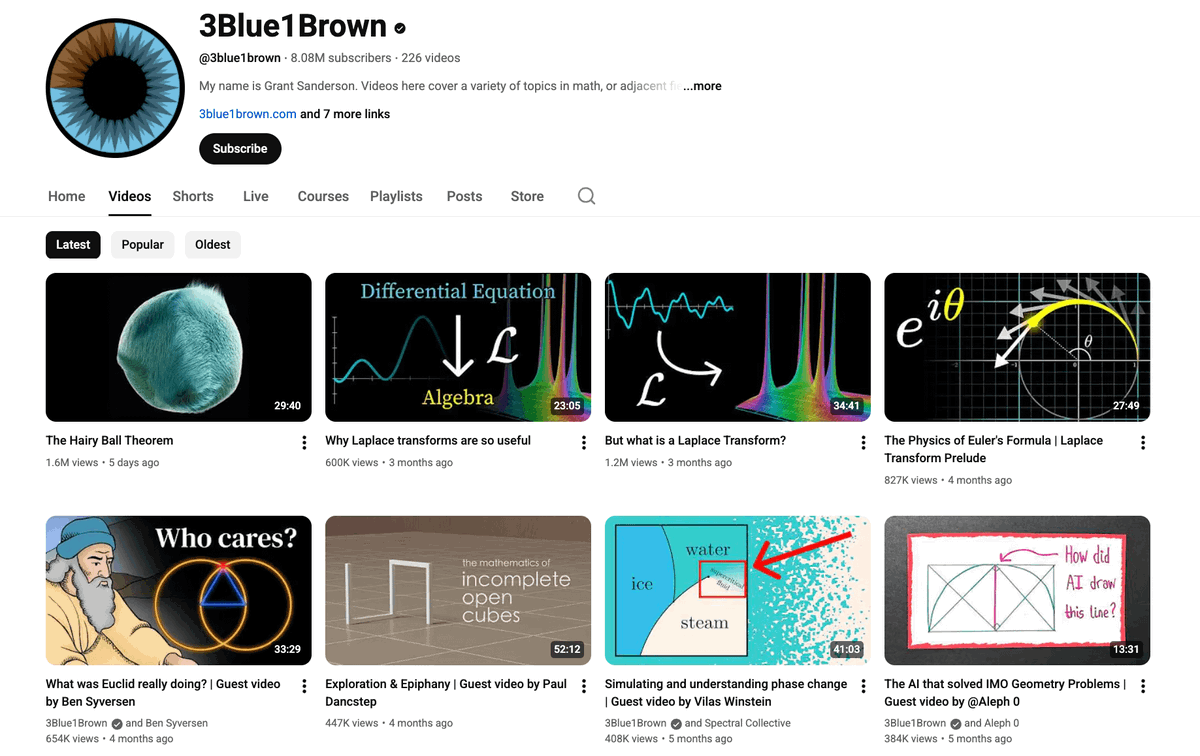
2. 3Blue1Brown
Visual intuition for math, linear algebra, and neural networks
@3blue1brown" target="_blank" rel="nofollow noopener">youtube.com/@3blue1brown
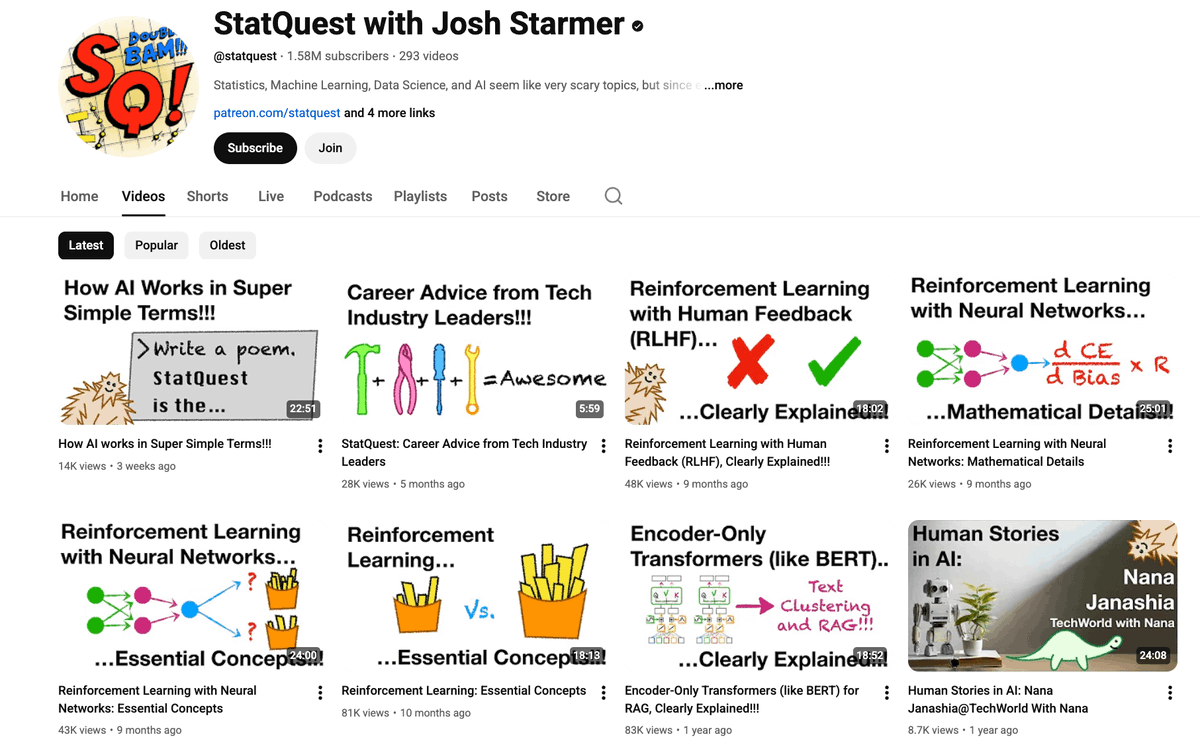
3. StatQuest with Josh Starmer
Clear, friendly explanations of statistics and ML fundamentals
@statquest" target="_blank" rel="nofollow noopener">youtube.com/@statquest
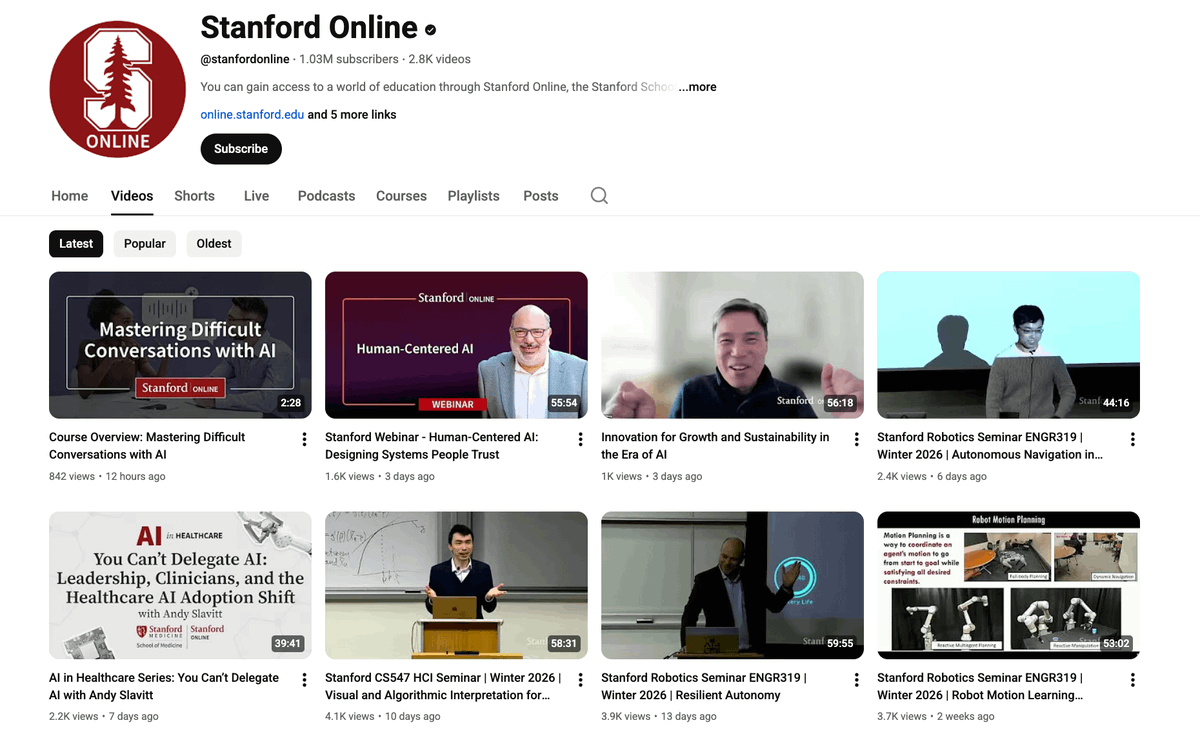
4. Stanford Online
University-grade ML and AI lecture series (Andrew Ng, CS229, etc.)
@stanfordonline" target="_blank" rel="nofollow noopener">youtube.com/@stanfordonline
5. sentdex
Practical machine learning and Python projects
@sentdex" target="_blank" rel="nofollow noopener">youtube.com/@sentdex
6. Yannic Kilcher
Deep dives into ML and AI research papers
@YannicKilcher" target="_blank" rel="nofollow noopener">youtube.com/@YannicKilcher
7. MIT OpenCourseWare
Rigorous academic courses on ML, AI, and applied mathematics
@mitocw" target="_blank" rel="nofollow noopener">youtube.com/@mitocw
8. Siraj Raval
High-level overviews and motivation around AI concepts
Link: @SirajRaval" target="_blank" rel="nofollow noopener">youtube.com/@SirajRaval
9. DeepLearningAI
Structured learning paths for deep learning and generative AI
@DeepLearningAI" target="_blank" rel="nofollow noopener">youtube.com/@DeepLearningAI
10. Two Minute Papers
Fast, accessible summaries of cutting-edge AI research
@TwoMinutePapers" target="_blank" rel="nofollow noopener">youtube.com/@TwoMinutePape…


English

Dr. Sambit Praharaj retweeted

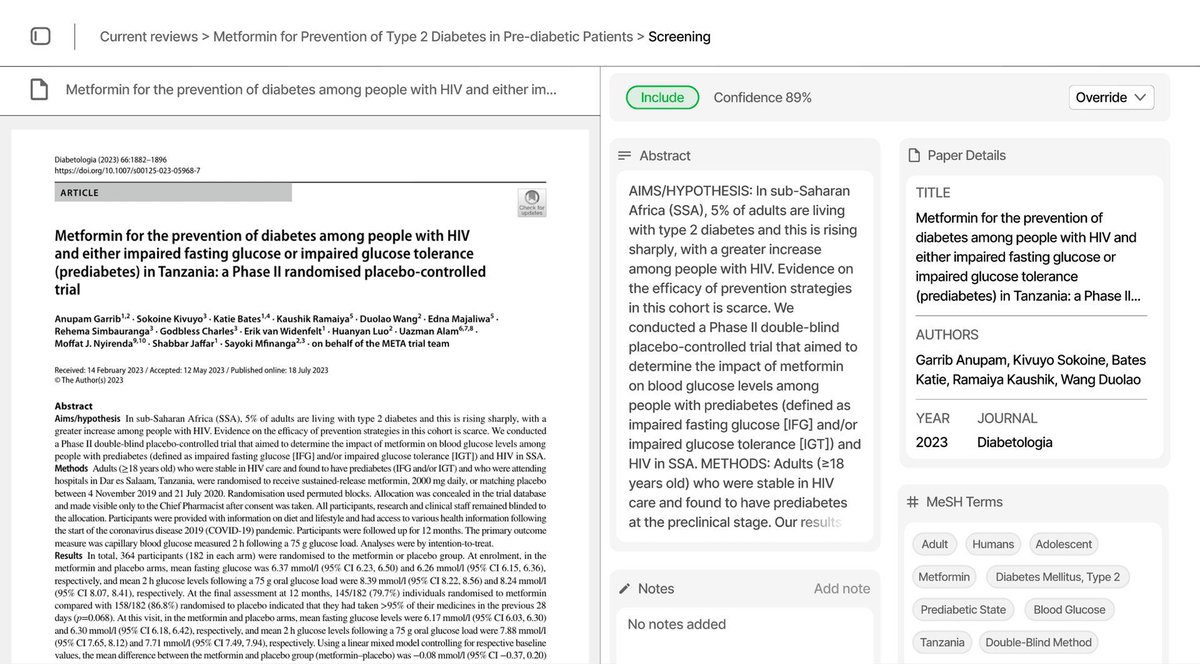
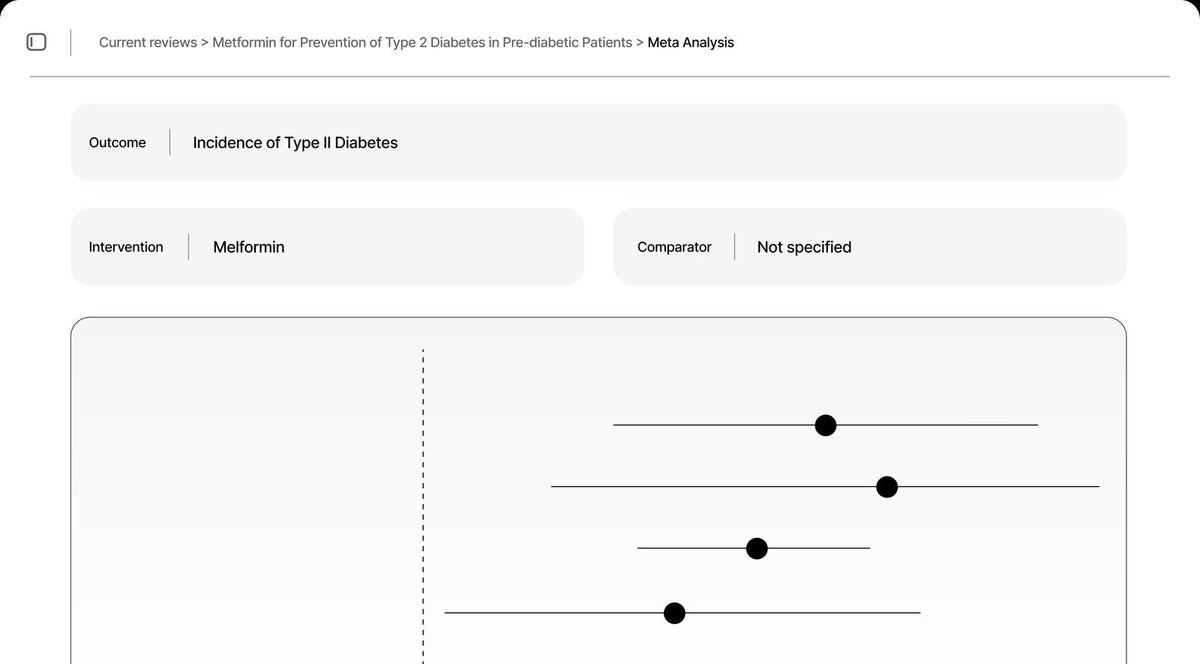
Systematic reviews in minutes to hours using artificial intelligence medrxiv.org/content/10.648… (caveat: thinly veiled advertisement for scholara.ai)


English
Dr. Sambit Praharaj retweeted

I scraped every single NotebookLM prompt that blew up on X, Reddit, and academic corners of the internet.
Turns out most people are using NotebookLM like a fancy note-taker.
That's insane.
It's a full-blown research assistant that can compress 10 hours of analysis into 20 seconds if you feed it the right instructions.
Here's what actually works:

English
Dr. Sambit Praharaj retweeted

Most people talk about AI like it’s one single thing. It’s not..
AI is a stack and once you see it this way, everything clicks.
Here’s the mental model 👇
1️⃣ Classical AI (the foundation)
Where it all began:
• Logic & reasoning
• Rule-based systems
• Expert systems
Smart, but rigid.
It followed instructions it couldn’t learn.
2️⃣ Machine Learning
Instead of rules, we gave machines data:
• Supervised & unsupervised learning
• Classification & regression
• Reinforcement learning
Now systems could improve from experience.
3️⃣ Neural Networks
Inspired by the human brain:
• Perceptrons
• Hidden layers
• Activation functions
• Backpropagation
This unlocked real pattern recognition.
4️⃣ Deep Learning
Neural networks but deeper and more powerful:
• CNNs for vision
• RNNs & LSTMs for sequences
• Transformers for scale
This is where machines learned to see, hear, and understand.
5️⃣ Generative AI
Models that don’t just analyze they create:
• LLMs
• Diffusion models
• VAEs
• Multimodal systems
Text, images, audio, video generated from learned patterns.
6️⃣ Agentic AI (the frontier)
The biggest shift yet:
• Memory
• Planning
• Tool usage
• Autonomous execution
This is where AI stops being a tool
and starts acting like a digital worker.
👇 The real takeaway
Each layer doesn’t replace the one below it
it builds on it.
Understanding this stack is the difference between:
• Chasing AI hype
• Actually building systems that work
AI isn’t magic.
It’s architecture.
And the future belongs to those who understand
how these layers connect.

English
Dr. Sambit Praharaj retweeted

Google isn’t trying to win the AI race.
They’re trying to own the entire AI Agent ecosystem.
While everyone argues ChatGPT vs Claude, Google quietly built:
Models → Gemini Pro, Flash, Deep Think, Gemma
Design → Stitch, Whisk, Imagen
Research → NotebookLM, AI Mode
Video → Veo, Flow, Google Vids
Coding → Antigravity IDE, Gemini CLI, Jules
Agents → A2A, ADK, FileSearch API
The scary part?
All of these tools talk to each other.
That means:
10x faster prototypes
End-to-end AI workflows
Production-ready agents on GCP
The next AI war won’t be model vs model.
It’ll be ecosystem vs ecosystem.
I mapped this stack out here:
gamma.app/?utm_campaign=…
Save. Share. Build.
GIF
English
Dr. Sambit Praharaj retweeted

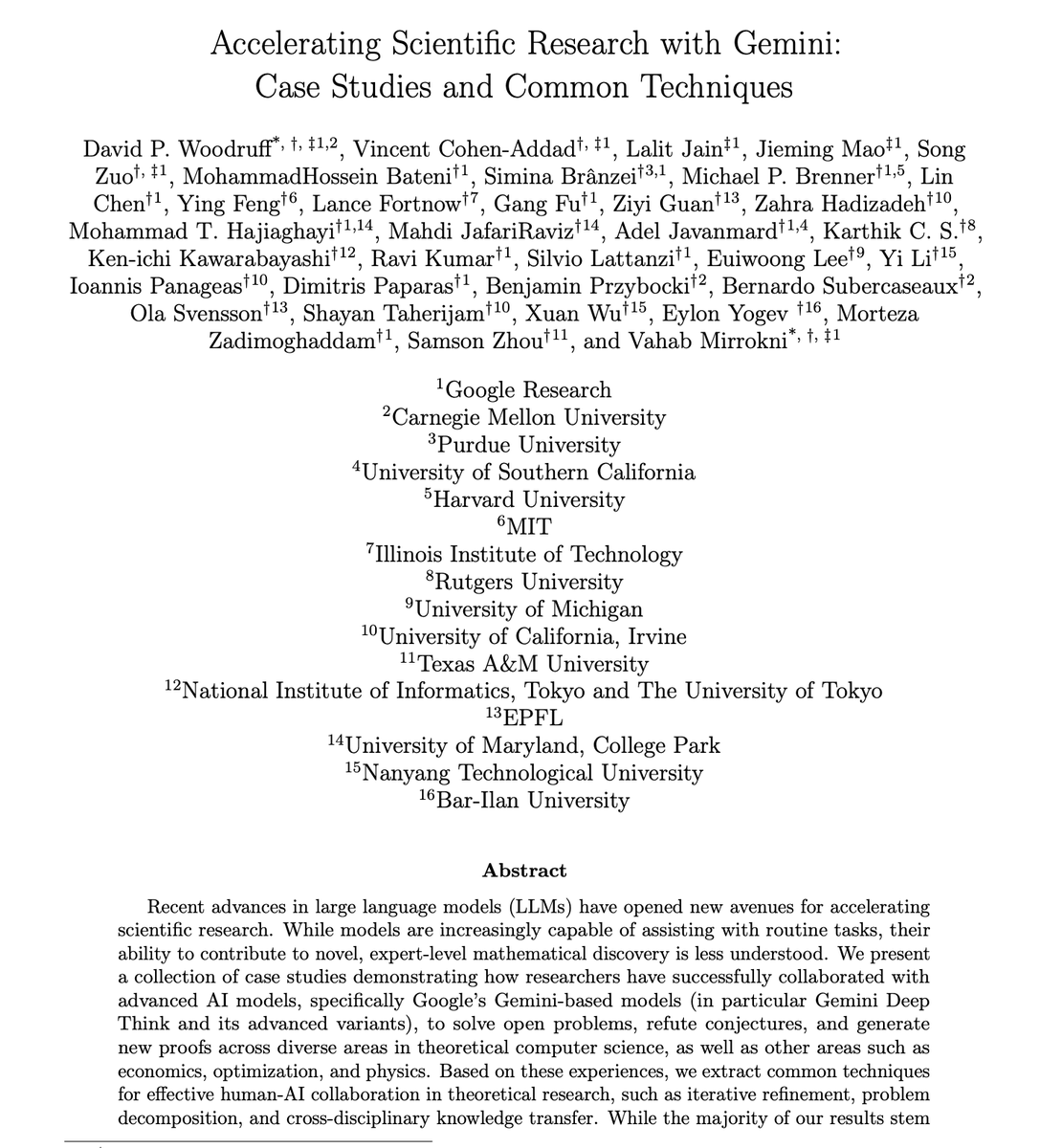
Google just dropped 145 pages documenting how researchers use Gemini to tackle scientific problems.
𝘚𝘢𝘷𝘦 & 𝘙𝘦𝘵𝘸𝘦𝘦𝘵 (𝘵𝘰 𝘩𝘦𝘭𝘱 𝘺𝘰𝘶𝘳 𝘯𝘦𝘵𝘸𝘰𝘳𝘬)
A few things that stood out to me (in simple terms):
- In one case, the AI was used as an adversarial reviewer and caught a serious flaw in a cryptography proof that had passed human review. That’s a very different use than “summarise this PDF.”
- The model links tools from very different fields (for example, using theorems from geometry/measure theory to make progress on algorithms questions). This is where its wide reading really matters.
- They don’t let the model run wild. Humans still choose the problems, check every proof, and decide what’s actually new. The model is there to suggest ideas, spot gaps, and do the heavy algebra.
- Agentic loops, not just chat
In some projects, they plug Gemini into a loop where it:
-- proposes a mathematical expression,
-- writes code to test it,
-- reads the error messages, and
-- fixes itself. (humans only step in when something promising appears)
We are moving past the era of simple chat prompts and into a more sophisticated era of research.
⮑ If your institution is interested in hosting an AI session or a workshop, request your training here: forms.gle/dbRtc7j2W4zZyL…

English
Dr. Sambit Praharaj retweeted

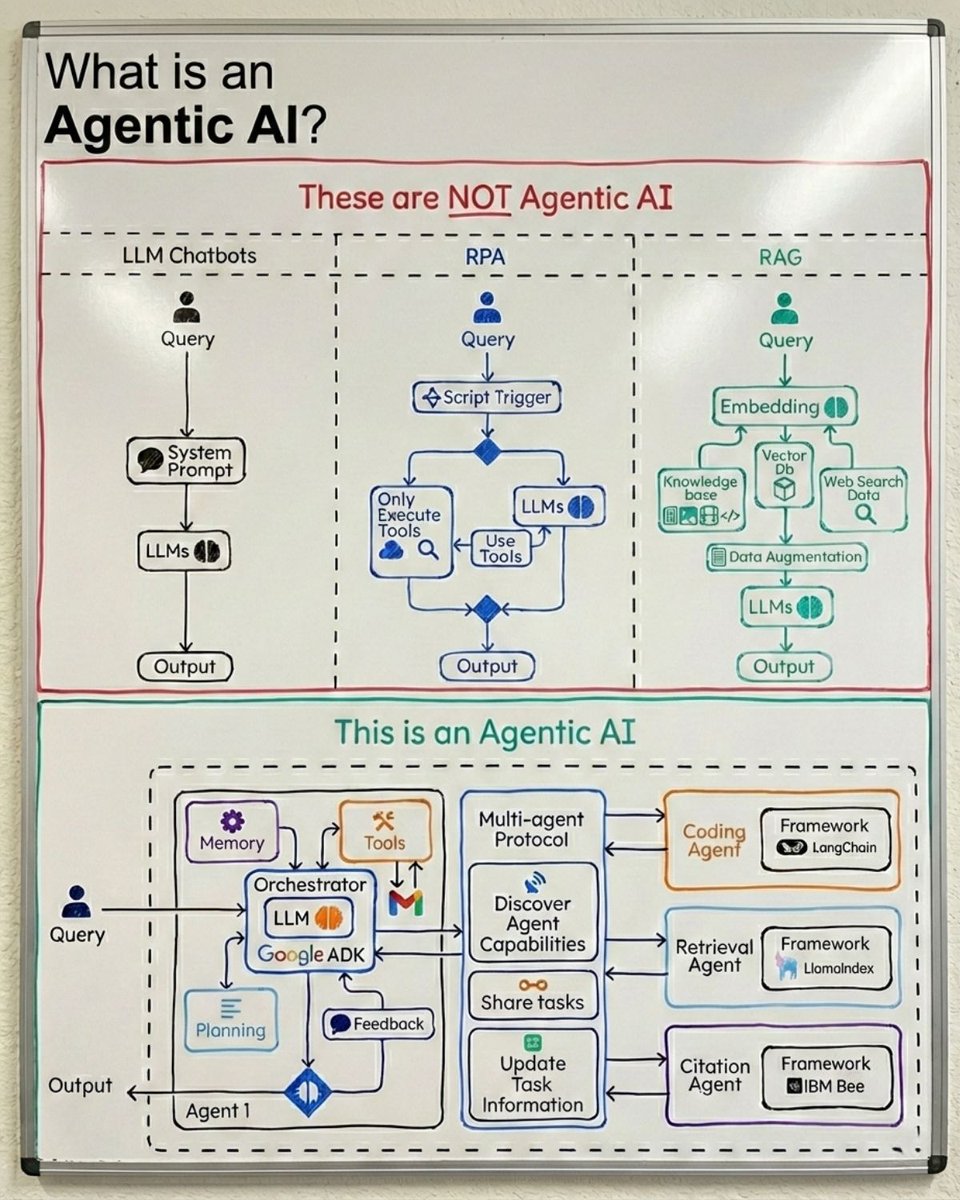
Chatbot: You ask. It answers.
RAG: You ask. It retrieves. It answers.
RPA: You trigger. It executes a script.
Agent: You give a goal. It figures out the rest.
That's the difference.
An agent has:
→ Memory (learns from interactions)
→ Planning (breaks down complex goals)
→ Tool selection (chooses what to use, not scripted)
→ Feedback loops (adjusts based on results)
→ Multi-agent coordination (delegates to specialists)
Most "agents" in production are RAG pipelines with a for-loop.
Real agentic AI has an orchestrator that thinks, deciding which tools, which sub-agents, which approach, and when to change course.
If your system can't change its own plan mid-execution, it's not an agent.
It's automation with an LLM inside.

English
Dr. Sambit Praharaj retweeted