Pinned Tweet
Health Lab
7.2K posts

Health Lab
@TheHealthLab
Your Guide to Peak Wellness | Unlock the Science of Longevity, Elevate Your Performance, and Redefine Your Health
Joined Şubat 2023
54 Following281.9K Followers
Health Lab retweeted

The construction industry has a dirty secret.
The defect rate on commercial construction projects is not a rounding error. It's a near-certainty.
And most owners will never know — until it's too late.
Here's what the data actually shows:
Studies on construction quality consistently find that between 5% and 15% of total project costs are attributable to rework caused by errors, omissions, and defects.
On a $100 million project, that's $5 to $15 million in problems built right into the structure.
Think about that for a second. No other industry would accept a 5-15% failure rate on a finished product and call it normal.
If 10% of the cars rolling off a Toyota assembly line had defective brakes, there'd be congressional hearings. If 10% of commercial flights had mechanical failures, nobody would fly.
But in construction? It's just the cost of doing business.
Why does this happen?
Schedule pressure. Contractors are on tight timelines with liquidated damages for delays. When you're behind schedule, shortcuts get taken. Grease caps get skipped. Flashing gets lapped wrong. Waterproofing gets rushed.
Fragmented accountability. On a typical commercial project, there might be 30 to 50 subcontractors. Each one is responsible for their scope. When systems interact — and they always do — the gaps between scopes are where defects hide.
Inspection limitations. Municipal inspectors are checking code compliance at specific milestones. They're not evaluating overall quality. They can't be everywhere at once. And they're not your quality control team.
So who catches the problems?
On most projects? Nobody. Not until the problems show up as water stains, cracked concrete, mold, or energy bills that don't make sense.
By then, the statute of limitations clock has been running. The contractors have moved on. The subs have moved on. And the owner is left holding the bag.
Defects in construction aren't exceptional. They're statistical.
The question isn't whether your building has issues. It's whether you find them before the window to do something about it closes.
A quality audit isn't about assuming the worst about your contractor. It's about understanding the reality of how buildings get built in America.
The clock starts ticking the day construction ends. Don't wait for the ceiling to tell you there's a problem.

English
Health Lab retweeted

We tested 40+ enrichment providers for our B2B clients. Most agencies still use one.
Single-provider enrichment misses 30-40% of your list. Stack four in a waterfall and you're suddenly matching people the first provider never found.
That means your "verified" list was garbage before a single email went out.
Here's the actual stack we run. Pricing included.
ENRICHMENT
→ Apollo - $79/mo. Database + contact filters only. Never rely on one source for emails.
→ Waterfall: Apollo → Prospeo → Hunter → Findymail. Each provider catches what the last one missed. Four layers. One pass.
→ Verification: Million Verifier. $0.0005 per email. Not $0.02. Twenty times cheaper than what most agencies quietly bill you for.
DOMAIN HEALTH
→ Never send from your primary domain. One spam complaint tanks everything - website, brand, deliverability. All of it.
→ Dedicated sending domains. Separate DNS. SPF/DKIM/DMARC configured per domain. Warmup monitored daily across every inbox.
→ Unhealthy accounts get flagged and quarantined before they drag down the rest of the pool.
ICP CLASSIFICATION
→ Most outbound skips this entirely. They enrich a list and blast it.
→ We run AI classification on every lead before it enters the sequence. Score against your ICP. Reject bad fits before you spend a dollar sending to them.
SIGNALS
→ Google News RSS - free. Unlimited. Real-time. Add /rss to any Google News search URL. That's a live buying signal feed.
→ Job postings, funding rounds, tech stack changes. Monitor these. Build micro-campaigns around them. 15-20 targeted campaigns/month vs 2-3 blasts.
The difference between 100 emails per reply and 2,000 emails per reply is never the copy.
It's whether the system behind it was built to work or built to look busy.
What's your current enrichment stack looking like?
---
If your team is hiring 3-5 SDRs to run outbound - that's what we replace with one system. Link in bio.

English
Health Lab retweeted

Most people think they’re compounding.
They’re not, they’re leaking.
Every time you move capital, taxes take a cut.
And that friction compounds, too.
That’s the part most models ignore.
There’s a better way to structure it.
Join 400k+ investors in #WealthStackWeekly
wealthstackweekly.com
English
Health Lab retweeted

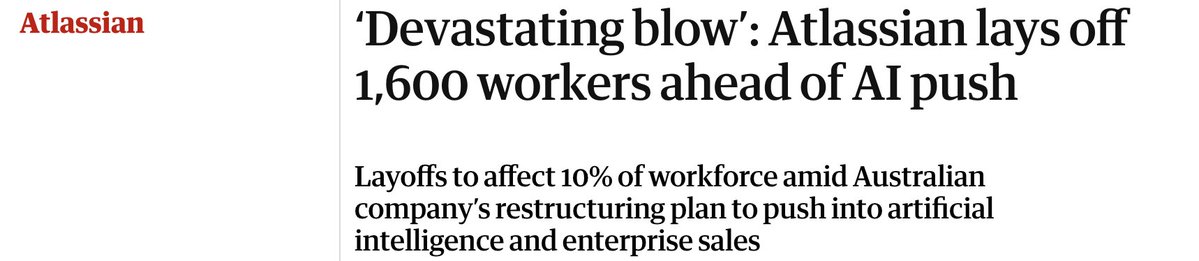
three weeks ago, a software company cut 1,600 jobs and replaced its CTO with two AI leaders.
the company is Atlassian. they weren't cutting costs to survive - they were restructuring to go all in on AI.
they chose AI instead.
$225 million in restructuring - 900 of those roles from R&D.
the people who build Jira, Confluence, and Trello.
we run a GTM engine for B2B companies with under 10 people. a year ago the same operation would have needed 30-40. not a projection - that's what we're living right now.
Atlassian isn't alone.
Amazon cut 16,000 corporate roles in January. 45,000+ tech jobs gone in Q1 - AI cited as the main driver. 750 CFOs surveyed privately projected 502,000 AI-related cuts this year. 9x more than 2025.
the CTO role didn't get filled. it got restructured around AI.
one exec for AI products, one for enterprise. companies aren't adding AI to the org chart anymore. they're rebuilding the org chart around AI.
what function at your company gets restructured next?

English
Health Lab retweeted

Our best copper hit yet at Lion.
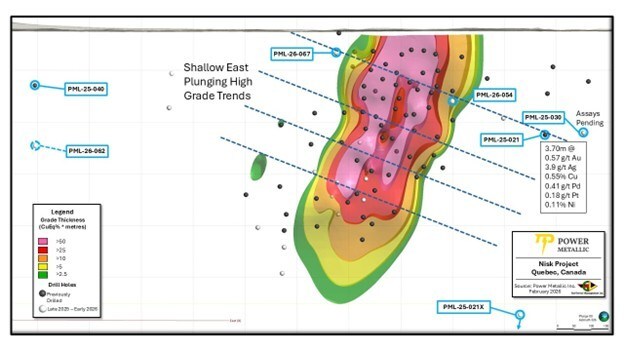
Hole PML-26-049 — the very first hole of our 2026 winter campaign — intersected 16.55m of massive to brecciated copper sulphides grading 10.08% Cu (15.11% CuEqRec). Near surface. This hole greatly expands the zone that could be amenable to early open pit extraction in a possible future mining operation.
100m to the west, PML-25-047 confirmed it with 4.15m @ 4.16% Cu (6.80% CuEqRec). The near-surface high-grade is real and it's repeatable.
Deeper down, PML-25-043 gave us 7.60m @ 7.20% CuEqRec within 18.00m of 3.18% CuEqRec — expanding the high-grade lode on the west side of the deposit.
Our infill drilling for the 2026 Mineral Resource Estimate keeps showing high repeatability of the zone geometry. That's what builds confidence toward an Indicated Resource classification.
The market certainly has not fully appreciated just how productive this discovery has become. Despite current analyst estimates, the very high metallurgical recoveries, and the ongoing high-grade assays at Lion, we're still heavily discounted vis-a-vis our peers. We'll keep delivering results and working toward a near-term PEA.
$PNPN

English
Health Lab retweeted

Cruise ships and mega casino resorts look different.
Operationally, they're the same: cities that never stop.
And once you understand that, robotics stops being optional.
A cruise ship is a city that moves. A casino resort is a city that never sleeps.
Everything lives inside the system: rooms, food, entertainment, logistics, security.
The building isn't just a place. It's a machine.
And that machine never turns off.
English
Health Lab retweeted

I want to step back and talk about the scale of what we're working with at Power Metallic (TSXV: PNPN).
We now control over 330 km2. We've drilled just 16 regional holes across a 40km x 10km area. Holes are separated by kilometers. This is first-pass reconnaissance — and what we're already seeing is remarkable.

English
Health Lab retweeted