

Andreas Longva
1.4K posts
Andreas Longva
@andreas_longva
Researcher and PhD candidate @ RWTH Aachen University. I work in the intersection between math, physics and software. Simulating the macroscopic world 🌍🦀
Joined Nisan 2021
157 Following220 Followers

@andreas_longva @NikhilYewale93 Could you point to any useful resources on this, please?
English
They went from "data-driven" to "data-free" in a couple of years,
says data-free, but needs the desired solution at a finite number of points...
uses FEM as a replacement for automatic differentiation 🤣🤣🤣
they are circling back 😂
#SciML is crazily bonkers!

English
@chenna1985 @NikhilYewale93 It can also be done at compile-time and embedded into the executable though, that's just an implementation detail.
English
@andreas_longva @NikhilYewale93 Yes, that's what FEniCSx does with JIT compilation. But, this is not practical when we use compiled executables and input files.
English
@chenna1985 @NikhilYewale93 Depends how you define AD, but symbolically differentiated compile-time generated code for derivatives can be very close to manually optimized derivatives in our experience. To the point where bottlenecks are elsewhere...
English
@NikhilYewale93 On why: it's a difficult question to answer. Some claim that they use it because it is difficult to derive/calculate the elasticity tensors for complex energy functions using closed form expressions. Some truth is there but AD is expensive. Difficult to justify.
English
@istvan_csanady Implicits many fundamental drawbacks though. For example, if you have to surfaces that are very close together, they will tend to merge with implicits unless you have some way of knowing that there's a gap. There are also fundamental issues with using implicits for simulation
English

My bet for the application layer innovation is (obviously) is what we do at Shapr3D, and for the new representation, I’d put my chips on implicits. Who’s building this? (besides the incredible folks ar nTop)
István Csanády@istvan_csanady
If there is anything that could replace and disrupt the b-rep ecosystem, it will be implicits/Signed Distance Fields. It would completely change the world of engineering software. Here is why 👇 I wrote a lot about b-reps before, and why it doesn’t make sense to write yet another b-rep kernel: 1. It’s basically about covering a zillion corner cases, which has been done by all the commercial kernels 2. Because of that, reaching industrial grade robustness takes a decade. 3. But you still miss the application layer and the ecosystem integration, so what’s the point then? 4. B-reps are intrinsically broken due to the double book keeping of the separate data structures of topology and geometry. However, there is a magical representation, that’s almost too good to be true… Meet implicit geometry - or Signed Distance Fields (SDF). While b-reps describe geometry with their boundaries defined as surfaces and curves, SDFs describe geometry with a function S(x,y,z): - Positive values: Outside the shape. - Negative values: Inside the shape. - Zero values: Exactly on the surface of the shape. - Encodes both distance and orientation information (sign indicates inside/outside). Implicits have some magical properties: 1. they can be directly rendered (ray traced!!!) on a GPU without tessellation 2. many operations that are insanely hard with b-reps are literally free for SDFs. For example an offset is simply just adding a number to the function. A boolean is simply a min/max function of two SDFs, for example a union is max(S1, S2). These operations literally cannot fail, unlike in b-rep kernels, that are famous of their lack of robustness. 3. because of this they are insanely fast. These operations are not only O(1) operations, but they are literally just appending an arithmetic operation. Imagine a feature tree with 10000 steps, where you can change or drag a parameter, and the entire thing updates real time. 4. they can describe infinitesimally detailed geometry, and insanely complex geometry structures, where b-rep just dies. 5. the memory consumption of the geometry representation is literally <1% of a similar b-rep especially for complex geometries. So why are implicits not taking over the world? - actually I think they will eventually - implicits don’t have topology like b-rep. The concept of faces/edges don’t exist, and because of that the implicit workflows are very different compared to legacy CAD workflows. - however there are already fantastic results in production, using the leading implicit modeler, @nTopology. @nTopology is an implicit CAD system specifically designed for ultra high end applications, like designing heat exchangers for space rockets and lightweighting drone parts in the defense industry. However, nTop is specifically focused on designing things that are impossible to design with b-reps, like lattice structures, where implicits truly excel. These applications are extremely high value applications, but not mainstream, partly because these parts need to be 3D printed, often from metal. What needs to happen for implicits to go mainstream? Someone needs to figure out how to create a workflow with impicits that is suitable for legacy workflows. This can be done either by redefining workflows with implicits or by figuring out how to make implicits behave like b-reps (but without bringing in all the crap that comes with b-reps). The former is an formidable go-to-market challenge, as it requires the entire industry to relearn CAD. The latter is a formidable technical challenge, as it is an insanely hard computational geometry problem, and it’s not even certain if it is doable. What will a world look like if someone cracks this problem? - assemblies with a million unique parts seamlessly running on an iPad - parametric parts with 10,000 features updating real time when parameters change - million part assemblies opening up in an instant on any computer - no geometry operations will fail ever again. No non-manifold body errors, no failed booleans or shells. Everything will just work. - real time simulations using monte carlo methods - real time ray traced visualization of large geometries - CAD data shrinks by 99% Almost too good to be true, isn’t it? Picture: heat exchanger designed using implicits in @nTopology cc @brad_rothenberg
English
Due to business and math constraints, it’s not feasible to build a new b-rep kernel that is better than Parasolid. Hence the next generation of CAD must innovate in the application layer and/or come up with a new representation that is 10x better than brep, yet compatible with it

English
@chenna1985 Aren't LLMs fundamentally unable to innovate? That's been my experience. It's useful for assisting with already solved problems but it's never ever been of any help at all for new problems that presumably hardly anyone else has ever looked at.
English
@chenna1985 ... will anyway be dominated by the areas where you have the highest resolution (in both space and time), whereas the coarser elements are likely to cost you much less. So it seems to me that you'd need a very special scenario for it to be worth the complexity...
English
@chenna1985 I agree. Are they actually ever worth it though? The primary use case, to my knowledge, is the ability to use local adaptivity in time as well as space. But, most often when you need temporal adaptivity you anyway need spatial adaptivity, and the overall computation cost ...
English
Space-time formulations are quite interesting!
Hiroaki Nishikawa@HiroNishikawa
"There's no difference between (x,y,z) and time in space-time discretizations", my collaborator says, and I agree with him. Here, z is actually time, but there's no special treatment for time. In discretizations, we use an upwind flux in z-direction just because the PDE is hyperbolic in z: du/dtau + dudz = 0, where tau is a pseudotime introduced to clarify the nature of du/dz (=du/dt).
English
@heskelbalas @zhou_xian_ @j_d_noone @jessfraz Looks like it's "visually accurate", i.e. it gives visually realistic simulations for the most part. But I wouldn't expect any decent force measurements (which you'd typically need for CAD-related stuff) since this requires entirely different simulation methods
English

@zhou_xian_ Cc @j_d_noone @jessfraz. It's open source. If it's accurate, it'd be amazing to be able to combine this with CAD
English

Everything you love about generative models — now powered by real physics!
Announcing the Genesis project — after a 24-month large-scale research collaboration involving over 20 research labs — a generative physics engine able to generate 4D dynamical worlds powered by a physics simulation platform designed for general-purpose robotics and physical AI applications.
Genesis's physics engine is developed in pure Python, while being 10-80x faster than existing GPU-accelerated stacks like Isaac Gym and MJX. It delivers a simulation speed ~430,000 faster than in real-time, and takes only 26 seconds to train a robotic locomotion policy transferrable to the real world on a single RTX4090 (see tutorial: genesis-world.readthedocs.io/en/latest/user…).
The Genesis physics engine and simulation platform is fully open source at github.com/Genesis-Embodi…. We'll gradually roll out access to our generative framework in the near future.
Genesis implements a unified simulation framework all from scratch, integrating a wide spectrum of state-of-the-art physics solvers, allowing simulation of the whole physical world in a virtual realm with the highest realism.
We aim to build a universal data engine that leverages an upper-level generative framework to autonomously create physical worlds, together with various modes of data, including environments, camera motions, robotic task proposals, reward functions, robot policies, character motions, fully interactive 3D scenes, open-world articulated assets, and more, aiming towards fully automated data generation for robotics, physical AI and other applications.
Open Source Code: github.com/Genesis-Embodi…
Project webpage: genesis-embodied-ai.github.io
Documentation: genesis-world.readthedocs.io
1/n
English
@chenna1985 I do mainly solids, but man do I dislike DG. Discontinuous displacement field is sometimes very impractical, and it just feels... Icky 😅
English
Ignoring fluid flows with shocks and adaptive refinement, for which other problems discontinuous Galerkin is advantageous over continuous Galerkin?
For incompressible and turbulent flows, CG is enough.
English
@chenna1985 I'm also working on something CutFEM-like and I'm also writing my own code because it's nice to have the flexibility, and not have to work against the limitations imposed by FEM libraries that were not designed for it
English
Starting the development of new CutFEM and FDM/LM based solvers for Multiphysics problems.
After trying the open source libraries again and again, I get back to my own code because there are some features lacking for sophisticated formulations.
English
Andreas Longva retweeted

MPM continues to be the GOAT multi-phase physics solver, and I always like to point out / brag that it was introduced into computer graphics by @DisneyAnimation.
Morteza Ahmadi@CgMort
I've been doing simulation and vfx studies for years and I must say, Bifrost MPM is just mind-blowing. The simulation quality and performance are on another level. and Yes, I think it's better than Houdini. Made in @AdskMaya and Bifrost, rendered with @arnoldrenderer
English
@chenna1985 Huh, so there's really nonvalidation in any of the papers? That's unfortunate if it's th case...
Not super familiar with LBM, would you be willing to elaborate what makes it unsuitable?
English
@andreas_longva The renderings are awful! There are no quantitative comparisons.
x.com/amit_aeroastro…
Also, LBM is not good for such aerodynamic problems.
Amit@amit_aeroastro
@chenna1985 I remember, myself and a few other guys asked for validation, drag/lift over a standard test case etc. Scales resolution in the clips appears great. But no clarity with the numbers/validation....
English
Popular for producing the most garbage of simulations!
Wevolver@WevolverApp
FluidX3D – Advancing Computational Fluid Dynamics Using traditional commercial CFD software, Dr. Moritz Lehmann's PhD studies would have taken decades due to long compute times. To address this, he developed his own CFD solver with GPU programming, reducing runtime to just days. Now, a 10-billion-cell simulation (like the one shown in the video) can run overnight on an 8-GPU server, processing hundreds of terabytes with an OpenCL graphics engine. FluidX3D CFD code on GitHub: github.com/ProjectPhysX/F… Video source: Dr. Moritz Lehmann -------------------------------- Stay ahead of the curve! Follow us now on our WhatsApp (wevlv.co/wevolver-whats…) and Telegram (wevlv.co/3sJlFn5) channels and stay updated about the cutting edge.
English
I'm up and running on Bluesky in an attempt to join the exodus. Fingers crossed it sticks.
English
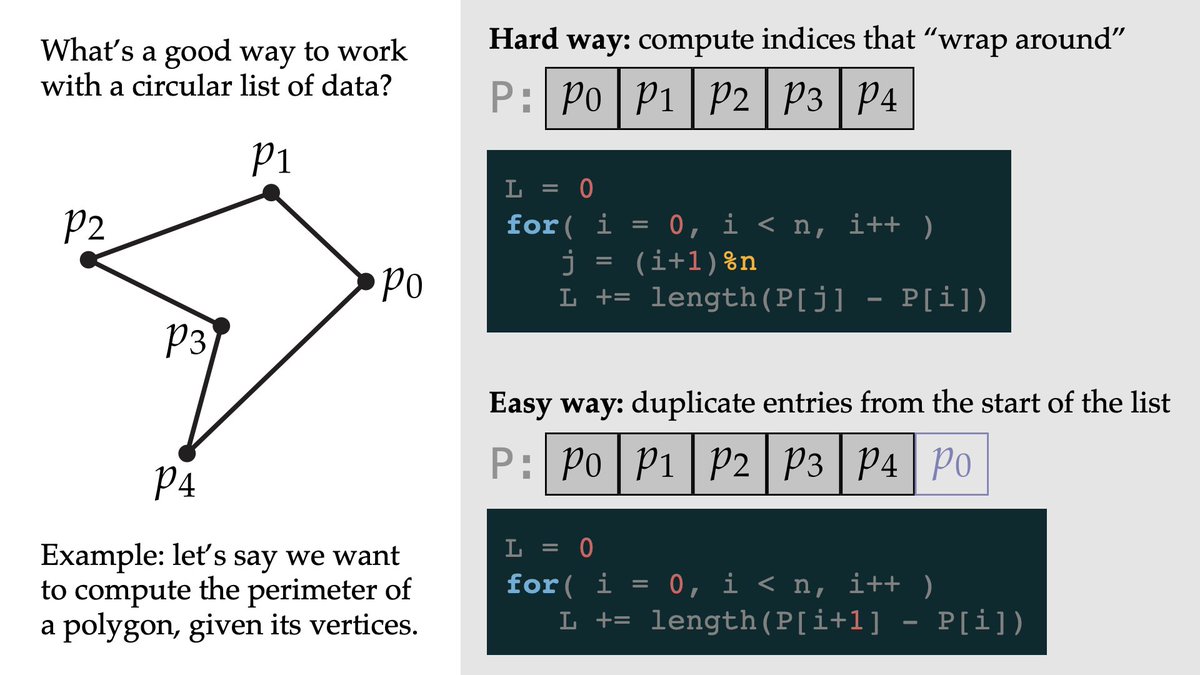
@ExodusPgame @keenanisalive Yeah, I think I actually prefer the "hard" way, ironically I find it easier for this reason
English

@keenanisalive I don't think it's a good solution, in addition to the extra memory it takes, you now need to make sure that if you update p[0] you also need to make sure p[n] is synced. This will add more
/potential bugs to your programs then getting rid of %
English
Not sure who needs to hear this, but I spent enough of my life doing things the hard way that it's hopefully helpful to someone.
It doesn't make a big difference in this simple example, but is helpful when you have more complicated calculations with more terms "off the end."
English
@chenna1985 Yeah, I've always thought it makes more sense to use NN to somehow speed up conventional simulation rather than replacing it outright. i don't think NN alone could ever give enough accuracy and reliability
English
I have always believed that all the efforts to improve the accuracy and performance of Machine Learning methods for PDEs will ultimately converge to adding conventional methods (FDM/FEM) to NN architectures in some form.
Now, I am seeing exactly this in the recent papers.
#SciML
English
If there's one thing AI is *actually* good at (but not perfect), it's translation. This comes at a good time for the EU — which traditionally has been limited by language barriers — as European countries need to cooperate more than ever to secure their own interests
English
@chrisoffner3d Imo graphics is at a totally different level compared to engineering / applied math / physics. I just can't take more of those painful red/blue MATLAB plots 😅
English
@chrisoffner3d One of the reasons I'm pursuing a PhD in physics simulation in computer graphics instead of engineering or physics is because graphics people really care about presentation, including content presentation in papers
English

STEM academia is full of people who absolutely suck at presentations, yet almost no one gives honest feedback, because they fear opening themselves to future critique of their own poor presentation skills. This makes it really hard for people to improve.
English